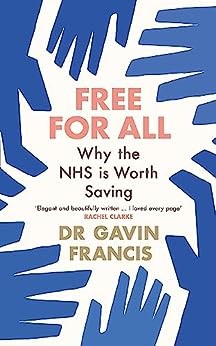
Dr Gavin Francis’s Intensive Care is the definitive Covid-19 read for me, and I admired his follow-up, Recovery, a personal and general history of convalescence. Free for All is most similar to the latter: a short book, impassioned and practical, that demands a social safety net.
The UK’s National Health Service was established 75 years ago this summer, with the aim of making healthcare free at the point of use for everyone, funded not by charity but by taxation. Today, the NHS is limping along from crisis to crisis (every winter, basically) because it has been chronically underfunded. Any UK-based reader could tell their own story of ridiculous wait times*, I suspect.
Francis makes it clear that the governing party of the last 13 years bears the responsibility for this. The UK’s healthcare spending is lower than that of key European benchmark nations that have better health outcomes. The Conservatives’ goal seems to be to privatize health and focus on market demand. Francis argues powerfully that allowing healthcare to be driven by profit, as it is in the USA, is immoral and uncivilized.
His valuable perspective is that of a GP who has to pick up the slack in his clinics and is begged not to send any but the most desperate cases to overcrowded hospitals. Services are strained to the breaking point; private medicine, far from lessening the burden, increases it when patients revert to the NHS for follow-up care or repair of botched procedures. Meanwhile, the introduction of performance standards can divert doctors’ attention to ticking boxes and ensuring value for money rather than providing the best possible care. Overtreatment (mostly of the elderly) is another potential pitfall.
Francis elaborates his case through his work with anonymized patients, conversations with fellow medical professionals, and a frank look at the statistics on spending and achievements. The book is slightly dry compared to some of his earlier work, simply because of the subject matter, and I noticed a bit of repetition. However, it is still a concise and cogent manifesto. The author believes that people can show they value the NHS by electing politicians who will properly fund it. The NHS is, after all, “an expression of what’s best in our society” and “worth saving,” he concludes. Hear hear!
With thanks to Profile Books/Wellcome Collection for the free copy for review.
Buy Free for All from Bookshop UK. [affiliate link]
*Mine? I waited 12 months for a PHONE consultation with an ear, nose and throat specialist regarding tinnitus. By that point, of course, my problem had largely subsided.
 Bookish Beck = Rebecca Foster. American transplant to England. Freelance proofreader and book reviewer.
 Bookish Beck
Of course it’s worth saving. I doubt if I’ll read this as it would only add to my unbounded ire at the incompetence of a government that couldn’t really care less about Mr. & Mrs. Average and their dependents, much less the Less -than-Average.
LikeLiked by 1 person
It’s a real disgrace how Tories have run the NHS into the ground.
LikeLiked by 1 person
Grrrrr.
LikeLike
I’m daring to hope for change in 2024 but it will take many years to undo the damage done to the NHS by both austerity and Brexit even before the needs of an ageing population are taken into consideration.
LikeLiked by 1 person
For sure. It’s a tall order, but worth throwing everything we can into (as is climate change mitigation).
LikeLiked by 1 person
This sounds like an important read. Somewhere in the stacks I spotted that an author’s earlier work was nominated for the Wellcome Prize and I thought of your ongoing project; when I get back to it, I’ll let you know which one.
LikeLiked by 1 person
How lovely to see your name in my comments! Forgive my ignorance: I have it in mind that Canada also has socialized healthcare of some type? Does it work well over there? Hoping you haven’t adopted U.S.-style profit models…
Ooh, I always look out for the Wellcome Prize stamp of approval. Over the 10 years that it ran, it recognized quite a number of books through the short- and longlists; novels as well as nonfiction.
LikeLike
Officially, yes, and much of what you’ve said here seems relevant here, too; the provincial government here has been steadily pressing towards a private model, however. From chatting with friends overseas over the years, it seemed as though the NHS used to work slightly better than our system, and now it seems as though both have deteriorated in similar ways. (Still haven’t spotted that Wellcome book, must be in another “part” of my stack!)
LikeLike
Have you been in touch with Tinnitus UK? They have a really good helpline and loads of info. I edit their magazine, which does make my own tinnitus flare up like nobody’s business, but they are a good force in the world.
Anyway, an important book. I have been very fortunate in my dealings with the NHS although had to give feedback on some distressing experiences at one hospital a decade ago caused mainly by the place being underfunded and under-refurbished.
LikeLiked by 1 person
I never thought of looking into a charitable organisation. My issues with tinnitus are pretty much gone but Chris’s has been much more persistent over the years.
I have had largely positive experiences with the NHS, including treating my broken foot when I was only a study abroad student here, and efficient six-monthly check-ups for my kidney disease.
LikeLike
Definitely worth a look, then. Mine only really maddens me if I think of it – oh – and yes, the NHS were absolutely brilliant recently when I had a worrying symptom, although my GP did have to know how to game the system slightly to get me an urgent referral.
LikeLiked by 1 person
Such a shame that that’s what it takes these days.
LikeLike
I don’t know much about the NHS but can definitely agree with the concept of accessible healthcare for all! Unfortunately, here in Canada we have a lot of the same issues, I think.
LikeLiked by 1 person
Marcie mentioned that too. Such a shame. It’s a wonderful ideal but seems like it can so easily become degraded.
LikeLiked by 1 person
[…] have reviewed Recovery, Free for All, Chasing the Sun, An Extra Pair of Hands, and After the Storm (plus others that are […]
LikeLike