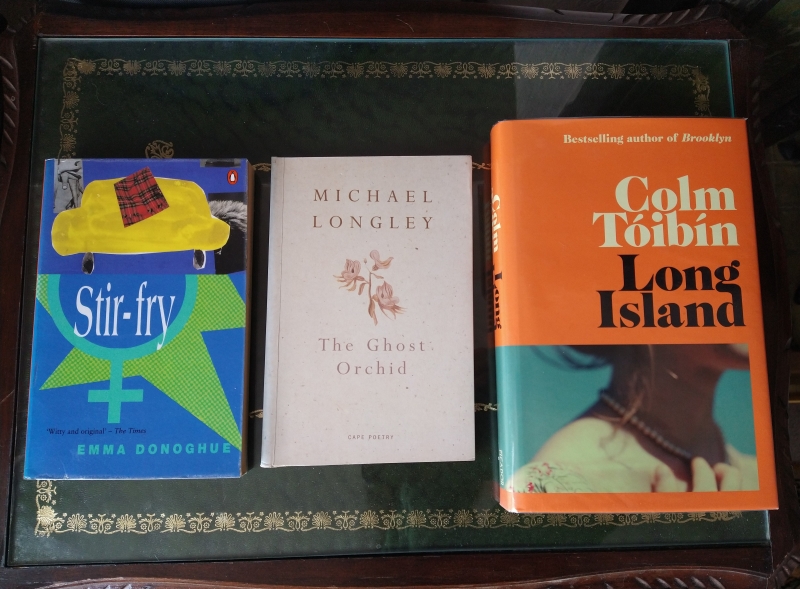
St. Patrick’s Day is a good occasion to compile my first set of contributions to Cathy’s Reading Ireland Month. Today I have an early novel by a favourite author, a poetry collection inspired by nature and mythology, and a sequel that I read for book club.
Stir-Fry by Emma Donoghue (1994)
After enjoying Slammerkin so much last year, I decided to catch up on more of Donoghue’s way-back catalogue. She tends to alternate between contemporary and historical settings. I have a slight preference for the former, but she can excel at both; it really depends on the book. I reckon this was edgy for its time. Maria (whose name rhymes with “pariah”) arrives in Dublin for university at age 17, green in every way after a religious upbringing in the countryside. In response to a flat-share advert stipulating “NO BIGOTS,” she ends up living with Ruth and Jael (pronounced “Yale”), two mature students. Ruth is the mother hen, doing all the cooking and fretting over the others’ wellbeing; Jael is a wild, henna-haired 30-year-old prone to drinking whisky by the mug-full. Maria attends lectures, takes a job cleaning office buildings, and finds a friend circle through her backstage student theatre volunteering. She’s mildly interested in American exchange student Galway and then leather-clad Damien (until she realizes he has a boyfriend), but nothing ever goes further than a kiss.
 It’s obvious to readers that Ruth and Jael are a couple, but Maria doesn’t work it out until a third of the way into the book. At first she’s mortified, but soon the realization is just one more aspect of her coming of age. Maria’s friend Yvonne can’t understand why she doesn’t leave – “how can you put up with being a gooseberry?” – but Maria insists, “They really don’t make me feel left out … I think they need me to absorb some of the static. They say they’d be fighting like cats if I wasn’t around to distract them.” Scenes alternate between the flat and the campus, which Donoghue depicts as a place where radicalism and repression jostle for position. Ruth drags Maria to a Tuesday evening Women’s Group meeting that ends abruptly: “A porter put his greying head in the door to comment that they’d have to be out in five minutes, girls, this room was booked for the archaeologists’ cheese ’n’ wine.” Later, Ruth’s is the Against voice in a debate on “That homosexuality is a blot on Irish society.”
Mostly, this short novel is a dance between the three central characters. The Irish-accented banter between them is a joy. Jael’s devil-may-care attitude contrasts with Ruth and Maria’s anxiety about how they are perceived by others. Ruth and Jael are figures in the Hebrew Bible and their devotion/boldness dichotomy is applicable to the characters here, too. The stereotypical markers of lesbian identity haven’t really changed, but had Donoghue written this now I think she would at least have made Maria a year older and avoided negativity about Damien and Jael’s bisexuality. At heart this is a sweet romance and an engaging picture of early 1990s feminism, but it doesn’t completely steer clear of predictability and I would have happily taken another 50–70 pages if it meant she could have fleshed out the characters and their interactions a little more. [Guess what was for my lunch this afternoon? Stir fry!] (Secondhand – Awesomebooks.com) 
The Ghost Orchid by Michael Longley (1995)
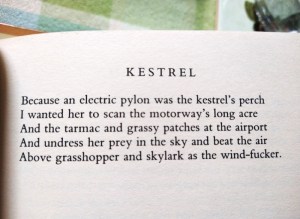
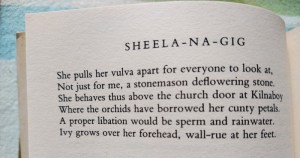
 Longley’s sixth collection draws much of its imagery from nature and Greek and Roman classics. Seven poems incorporate quotations and free translations of the Iliad and Odyssey; elsewhere, he retells the story of Baucis and Philemon and other characters from Ovid. The Orient and the erotic are also major influences; references to Hokusai bookend poems about Chinese artefacts. Poppies link vignettes of the First and Second World Wars. Longley’s poetry is earthy in its emphasis on material objects and sex. Alliteration and slant rhymes are common techniques and the vocabulary is always precise. This was the third collection I’ve read by the late Belfast poet, and with its disparate topics it didn’t all cohere for me. My two favourite poems are naughty indeed:
(Secondhand – Green Ink Booksellers, Hay-on-Wye) 
Long Island by Colm Tóibín (2024)
{SPOILERS in this one}
 I read Brooklyn when it first came out and didn’t revisit it (via book or film) before reading this. While recent knowledge of the first book isn’t necessary, it probably would make you better able to relate to Eilis, who is something of an emotional blank here. She’s been married for 20 years to Tony, a plumber, and is a mother to two teenagers. His tight-knit Italian American family might be considered nurturing, but for her it is more imprisoning: their four houses form an enclave and she’s secretly relieved when her mother-in-law tells her she needn’t feel obliged to join in the Sunday lunch tradition anymore.
When news comes that Tony has impregnated a married woman and the cuckolded husband plans to leave the baby on the Fiorellos’ doorstep when the time arrives, Eilis checks out of the marriage. She uses her mother’s upcoming 80th birthday as an excuse to go back to Ireland for the summer. Here Eilis gets caught up in a love triangle with publican Jim Farrell, who was infatuated with her 20 years ago and still hasn’t forgotten her, and Nancy Sheridan, a widow who runs a fish and chip shop and has been Jim’s secret lover for a couple of years. Nancy has a vision of her future and won’t let Eilis stand in her way.
I felt for all three in their predicaments but most admired Nancy’s pluck. Ironically given the title, the novel spends more of its time in Ireland and only really comes alive there. There’s also a reference to Nora Webster – cute that Tóibín is trying out the Elizabeth Strout trick of bringing multiple characters together in the same fictional community. But, all told, this was just a so-so book. I’ve read 10 or so works by Tóibín now, in all sorts of genres, and with its plain writing this didn’t stand out at all. It got an average score from my book club, with one person loving it, a couple hating it, and most fairly indifferent. (Public library)
Another batch will be coming up before the end of the month!
 Bookish Beck = Rebecca Foster. American transplant to England. Freelance proofreader and book reviewer.
 Bookish Beck
Yup, indifference was my reaction to Long Island – and I’d loved Brooklyn, so disappointment too. It’s an age since I’ve read any Emma Donoghue. Time to revisit her, I think! Though possibly not this one.
LikeLiked by 1 person
I only realized afterwards that this was Donoghue’s debut novel — pretty darn good for all that!
LikeLiked by 1 person
I have gotten so wrapped up in trying to finish my A Century of Books project that I still haven’t read Long Island, even though it’s been in my pile for months! My pile is getting bigger and bigger while I check the last few books for my ACoB project out of the library. For some reason, I have picked tomes for the last few books! I guess as well as picking books that sounded interesting, I should have looked at the page counts!
LikeLiked by 1 person
Long Island is a quick read, luckily. How many books does your library system let you reserve and/or borrow at once, and how long can you keep them?
LikeLiked by 1 person
I don’t know how many because I usually have only three to five out at a time, but we have three weeks, and if they’re not returned by then, they are automatically reserved again unless someone has put a hold on them.
LikeLiked by 1 person
Ooh, automatic renewal is a nice service!
LikeLike
Nice work–I was generous in my score for Long Island, but honestly the hype it got! My review went up today.
LikeLiked by 1 person
I’m not sure Brooklyn really warranted a sequel.
LikeLiked by 1 person
Lol I thought both books were ok–just nowhere near “book of the year” status!
LikeLike
I admired Brooklyn but I just didn’t love it enough to want to pick up a sequel.
You have the same copy of Stir-Fry as I do! I’ve read it twice and it remains one of my absolute favourite Donoghues. What’s fascinating about reading it today is that it’s a contemporary novel that reads like historical fiction – so it brings together those two strands of her writing. I do agree that it could have been longer, though – although her second novel, Hood, is IMO too long.
LikeLiked by 1 person
I’m not really sure why I suggested the sequel for book club! But it got a lot of votes, so I’m not the only one to blame for choosing it 😉
Yeah, Stir-Fry was great, especially considering it was her debut novel. And that’s a good point, that it does feel like a period piece now. Hood is another one I acquired on my secondhand binge, so I’ll make it my next Donoghue after her new one I’m reading now, The Paris Express.
LikeLiked by 1 person
I loved Stir-Fry too, at the time. It felt so vibrant. And there’s still a lot of grumbling about bisexuality (the enduring complaint that one doesn’t actually prefer both ends of the spectrum but is only keeping their honest preference in the closet) so I wonder if that negativity you’ve identified could still resonate in some ways? Ohhh, noooo, Laura, Hood wasn’t too long…it was just too sad. I’m just kidding. It’s been so long since I’ve read it, I don’t have an opinion on that. Only the broader opinion that I scrounged to buy early Donoghue in hardcover when I should have been buying fresh vegetables, but skip more than I read now.
LikeLiked by 1 person
Some of her recent historical fiction has been distinctly lacklustre.
It’s still a stigma for sure — one that the authors of the two books I’ve read on bisexuality are trying to dispel (Sam Mills and Julia Shaw).
LikeLike
I’d love to read Stir Fry based on this description! It sounds a little bit like Kate Atkinson’s Emotionally Weird, which is a very early book of hers that also doesn’t stick the landing but is very interesting and endearing and engaging before that.
LikeLiked by 1 person
I don’t know that particular one, but early Atkinson is a good comparison tone-wise. Also some earlier Atwood.
LikeLiked by 1 person
I’ve just finished The Paris Express, which I quite enjoyed, and think I now need to read more of her back catalogue. I love that you’ve chosen two of Longley’s cheeky poems, he had such a great sense of humour and it doesn’t always get noted.
LikeLiked by 1 person
I’m reading The Paris Express now as well. I’m a bit bored with it but perhaps it will pick up!
LikeLiked by 1 person
[…] Reading Ireland Month 1: Donohue, Longley, Toibin – Rebecca at Bookish Beck […]
LikeLike
[…] I’ve only read Room (hasn’t everyone?) and her latest, The Paris Express. Rebecca sold me on Stir-fry, her debut, published in 1994 which is a coming-of-age story about Maria, a seventeen-year-old girl […]
LikeLike
Good work! I did one for Ireland and one for Wales, but normally I do one or the other so I’m counting that as a win!
LikeLiked by 1 person
I’m amazed I’ve managed both. It was really only when I saw someone else on Instagram reading the Doshi towards Reading Wales that it twigged for me that I could count it.
LikeLiked by 1 person
[…] second set of contributions to Cathy’s Reading Ireland Month. Emma Donoghue also appeared in my first instalment of reviews. Today I’m featuring her latest novel, published just a couple of weeks ago, and […]
LikeLike