Neither of these appeared on my initial list, but I thought a middle-grade novel and a classic would be good for variety. Though I have an MA in Victorian Literature, I don’t often read from the period anymore because I’m allergic to wordy triple-deckers, so it was a delight to encounter something short and lighthearted. I’ve always been partial to a contemporary Victorian pastiche, though.
Heap House (Iremonger, #1) by Edward Carey (2013)
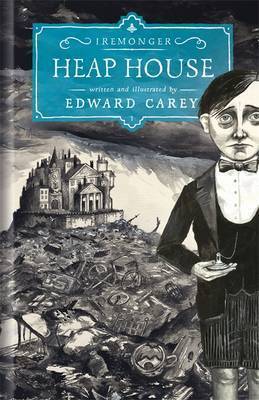 The Iremonger family wealth came from salvaging treasure from the rubbish heaps surrounding their London mansion. Every Iremonger has a birth object (like a daemon?) associated with them. Clodius Iremonger, adolescent descendant of the great family, has a special skill: he hears each birth object speaking its name. His own bath plug, for instance, cries out, “James Henry Hayward.” These objects house enchanted souls; people can change back into objects and vice versa. The narration alternates between Clod and plucky Lucy Pennant, who arrives from a local orphanage to work as a house servant. All staff and heap-workers are called “Iremonger,” but Lucy refuses to cede her identity and wants justice for the oppressed workers. She and Clod form a bond against the odds and there’s an upstairs–downstairs tinge to their ensuing adventures in the house and on the heaps.
Carey’s trademark twisted combination of Dickensian charm and Gothic gloom is certainly on display here. All the other names are slightly off-kilter: Rosamud, Moorcus, Aliver, Pinalippy and so on. I laughed out loud at a passage about the dubious purpose of doilies. Little truly won me over, but all my experiences with Carey’s work since then (also including The Swallowed Man, B: A Year in Plagues and Pencils, and Edith Holler) have been a slight letdown. This was highly readable and I galloped through the midsection, but I found the whole thing overlong; I’m undecided about reading the other books, though they do have higher average ratings on Goodreads. I got the second, Foulsham, from the Little Free Library and it’s significantly shorter. Shall I continue? (Secondhand – Awesomebooks.com) 
The Diary of a Nobody by George Grossmith; illus. Weedon Grossmith (1892)
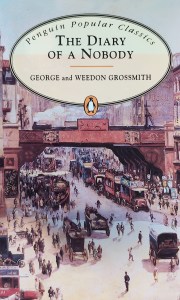 It must be rare for a fictional character to be memorialized in the dictionary. I was vaguely aware of the word “Pooterism” but thought it referred to small-minded, pompous, fussy individuals, so my preconception of City clerk Charles Pooter was probably more negative than is warranted. (In fact, “Pooterish” means taking oneself too seriously.) He’s actually a lovable, hapless Everyman who tries desperately to keep up with middle-class society but often gets it wrong. He can’t handle his champagne; and he wants so much to be funny – his are definite dad jokes avant la lettre – but only sometimes pulls it off. He regularly offends tradesmen, servants and neighbours alike, and tries but fails to ingratiate himself with his betters. Luckily, his mistakes are mild and just leave him out of favour – or pocket.

Charles and Lupin Pooter, as depicted by
Weedon Grossmith. Public domain, via Wikimedia Commons.
Originally serialized in Punch, the book is in short entries of one paragraph to a few pages, recounting the Pooters’ first 15 months in their new home. Events range from the mundane – home repairs and decoration – to the great excitement of being invited to the mayor’s ball. Charles and Carrie’s young adult son, Lupin (surely a partial inspiration for Roger Mortimer’s Dear Lupin and its sequels?), who comes back to live with them partway through, is a feckless bounder always being taken in by new money-making schemes and unsuitable ladies. Charles hopes to find Lupin steady employment and steer him away from his infatuation with Daisy Mutlar.
It’s well worth reading for its own sake, but also for the window onto daily Victorian life, including things that aren’t always recorded, such as fashion and slang. And it’s clever how Pooter’s pretensions get punctured by the others around him: longsuffering Carrie (“He tells me his stupid dreams every morning nearly”), insolent Lupin (“Look here, Guv.; excuse me saying so, but you’re a bit out of date”), and testy Gowing – that’s right, the neighbours are named Cummings and Gowing (“I would add, you’re a bigger fool than you look, only that’s absolutely impossible”). All very amusing. (Free from mall bookshop c. 2020) 

Never fear, I’m still on track to finish the challenge by the 31st!
 Bookish Beck = Rebecca Foster. American transplant to England. Freelance proofreader and book reviewer.
 Bookish Beck
Diary of a Nobody is so delightful – I remember reading that and Three Men in a Boat to feed my longing for Britain when I was stuck as a teenager in Romania.
LikeLiked by 1 person
That’s another great comic novel! Proof that the Victorians could write short books and weren’t always po-faced.
LikeLike
There’s some very visible Dickens in Heap House, but also, it seems, some Gormenghast! The gothic house and the way everyone seems to be tied to it and its traditions, semi-willingly. There’s definitely something there.
In similar influence-tracking vein, have you read any of the Adrian Mole books? When I finally read Diary of a Nobody, I realised that Grossmith’s fingerprints were all over Adrian Mole. (They are fantastic novels in diary form, following a hapless British everyman from teenhood to fatherhood, from Thatcher’s ’80s to Blair’s ’00s. Absolutely brilliant, so funny.)
LikeLiked by 1 person
Well spotted! I didn’t make it far at all with Titus Groan so gave up on that trilogy. That makes sense about Adrian Mole, too. I read the first book, 13 and 3/4, 13.5 years ago, and found it amusing but didn’t persist with the series. (I’m so bad at series!)
LikeLike
Absolutely fair enough! I feel the whole Adrian Mole series would fit well into a welcome-to-Britain cultural starter pack for new inhabitants…
LikeLiked by 1 person
I haven’t read the Grossmith for decades but I remember loving it – and totally agree about Three Men in a Boat, one of the funniest books I’ve ever read!!
LikeLiked by 1 person
The Jerome is one to reread for sure.
LikeLiked by 1 person
I might try Heap House. Like you, I loved Little but was disappointed by The Swallowed Man and haven’t read anything else by Carey since.
LikeLiked by 1 person
I don’t think you often read children’s or YA? I wanted to be more engrossed in it than I was. Knowing that there are two more books to come makes me wonder if I’d be missing something if I stopped now.
LikeLiked by 1 person
Ah, I missed that it was YA. Maybe not for me then although it does sound amusing
LikeLike
It’s described as “middle-grade” which tends to mean ages 10-13, I suppose. I didn’t find it juvenile, though.
LikeLike
Interesting selections that I may have to add to my ever-growing TBR list.
LikeLiked by 1 person
I’m glad they appeal!
LikeLike
I love Diary of a Nobody! And I’m sure you’re reading all the other ones at the same time and will end up with a triumph. I had to discard the novel for this month (too depressing!) but have added in Rick Astley’s autobiography which is actually fewer pages, so I have 10 days to read and review two books and should manage.
LikeLiked by 2 people
You’re absolutely right, I’m 3/4 or more through all the rest.
Too bad you had a DNF. You didn’t need to replace it, but I’m glad it was easy enough to do so.
LikeLiked by 1 person
I always replace DNFs so it’s 20 books read. My 20 Books is always designed to get books off the TBR shelf so every little helps!
LikeLiked by 1 person
I liked Little, but I haven’t even looked for anything else by Carey. Diary of a Nobody sounds like a great suggestion for my next Classics Club list.
LikeLiked by 1 person
I’d definitely recommend the Grossmith — I’m sure you’d appreciate having a short, comic novel on your list!
LikeLiked by 1 person
Yes, it sounds good!
LikeLike
I had the same reaction to Edward Carey, loved Little, but felt let down by Edith Holler. I don’t think I’d read more by him, especially given your reaction. I have not read a good Victorian pastiche in a while.
LikeLiked by 1 person
Babel is the other one I’ve read most recently. I love the Victorian period but I’m too often disappointed by books about it.
LikeLiked by 1 person
Was it the MA that made you allergic to long Victorian novels or were you already so and didn’t know it?? I feel for you!
I was also convinced that Pooterism meant somebody who was very fastidious, overly pernickety and narrow-minded, with a definite lower middle class connotation. I’m sure it is used that way sometimes but interesting to know that wasn’t the original intention (except for the class bit).
LikeLiked by 1 person
I happily sped through the likes of Daniel Deronda, North and South and Phineas Finn that year (though also shorter stuff like Dracula and On the Origin of Species). It’s since then that I’ve struggled. I’ve tried three or more different Dickens novels over the years and not managed a single one. And it’s not just Dickens; I’ve also failed with doorstoppers by Harriet Martineau and others. The flood of words, in such small type, often with piles of unnecessary descriptive writing … I just can’t anymore! (Don’t worry, I still plan to join in with your Doorstopper challenge, but it’ll be modern stuff.)
I found Pooter quite sweet.
LikeLiked by 1 person
Ah, I love all the MA texts you name but I think Dickens and Martineau would defeat me as well!
LikeLiked by 1 person
Hah, I hear you can develop an allergy to almost everything if you overdo it for long enough and voraciously enough!
LikeLiked by 1 person