(Part I covered Berlin.) Three works of short fiction embodied the rest of our journeying, from Berlin to Lübeck to home. We were sad to say goodbye to Lemmy and Roxanne, the affectionate, fluffy cats who came with our Berlin flat, but there were further adventures to be had. The hosts of our Lübeck Airbnb apartment also owned two cats we briefly met, but it wasn’t the same as having surrogate pets around.
Goodbye to Berlin by Christopher Isherwood (1939)
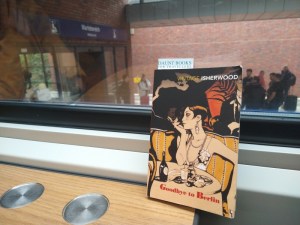 Isherwood intended for these six autofiction stories to contribute to a “huge episodic novel of pre-Hitler Berlin” titled The Lost. Two “Berlin Diary” segments from 1930 and 1933 bear witness to a change in tenor accompanying the rise of Nazism. Even in lighter pieces about a holiday at the Baltic coast and his friendship with a family who run a department store, menace creeps in through characters’ offhand remarks about “dirty Jews” ruining the country. The narrator, Christopher Isherwood, is a private English tutor staying in squalid boarding houses or spare rooms. His living conditions are mostly played for laughs – his landlady, Fraulein Schroeder, calls him “Herr Issyvoo” – but I was also reminded of George Orwell’s didactic realism. I had it in mind that Isherwood was homosexual; the only evidence of that here is his observation of the homoerotic tension between two young men, Otto and Peter, whom he meets on the Ruegen Island vacation, so he was still being coy in print. Famously, the longest story introduces Sally Bowles (played by Liza Minnelli in Cabaret), the lovable club singer who flits from man to man and feigns a carefree joy she doesn’t always feel. This is the second of two Berlin books; I will have to find the other and explore the rest of Isherwood’s work as I found this witty and humane, restrained but vigilant. (Little Free Library)
On balance, we planned the division well: busy city days first, followed by a more restful long weekend; reliable English-speaking opportunities while we built up our confidence, then a more provincial setting where we could try out a bit of German. Friends were curious why we chose Lübeck. Two charitably assumed that I went for the Thomas Mann connections, but that was an incidental side benefit. (I quailed at the prospect of reading the 700+-page debut novel based on his family history, Buddenbrooks; instead, I intended to reread Death in Venice, but my Project Gutenberg download didn’t work, so I’ve earmarked it for Novellas in November instead.)
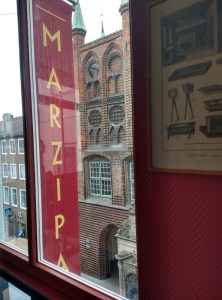
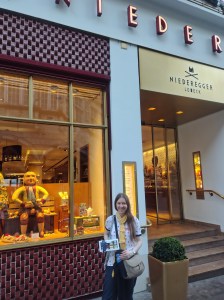
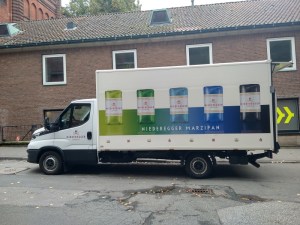
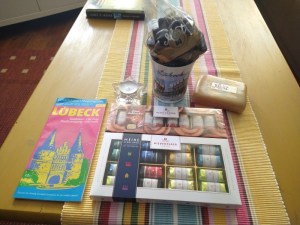
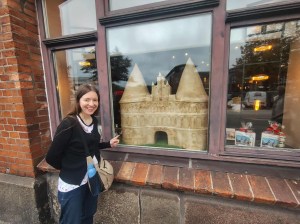
Nope, I was in it for the marzipan. Lübeck has been known for its marzipan since 1795. In 1926, there were 36 marzipan manufacturers in this northern city; three remain today and of course we visited both cafes and all three shops. Niederegger has a small museum above the Bettys-like café. You would not believe the scale or number of tableaux made entirely of almond paste! Nor the variety of flavours and packaging in the shop downstairs. We enjoyed marzipan hot chocolate, cappuccino and cakes, and came away with a modest supply of treats. We also dropped into a trendy restaurant where I had a “Lübecker martini” combining rum, marzipan liqueur and espresso.
-
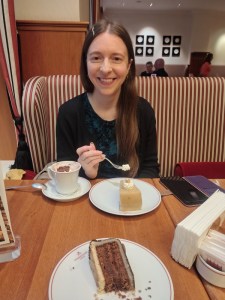
- Marzipan hot chocolate and traditional nusstorte at the Niederegger cafe.
-
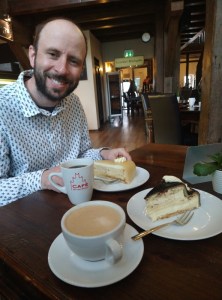
- Marzipanland was better! I had Othello Torte and a marzipan cappuccino.


In a German Pension by Katherine Mansfield (1911)
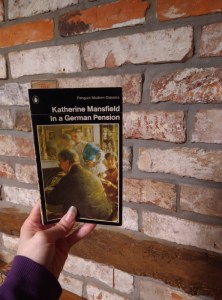 Mansfield was 19 when she composed this slim debut collection of arch sketches set in and around a Bavarian guesthouse. The narrator is a young Englishwoman traveling to take the waters for her health. A quiet but opinionated outsider (“I felt a little crushed … at the tone – placing me outside the pale – branding me as a foreigner”), she crafts pen portraits of a gluttonous baron, the fawning Herr Professor, and various meddling or air-headed fraus and frauleins. There are funny lines that rest on stereotypes (“you English … are always exposing your legs on cricket fields, and breeding dogs in your back gardens”; “a tired, pale youth … was recovering from a nervous breakdown due to much philosophy and little nourishment”) but also some alarming scenarios. One servant girl narrowly escapes being violated, while “The-Child-Who-Was-Tired” takes drastic action when another baby is added to her workload. Most of the stories are unmemorable, however. Mansfield renounced this early work as juvenile and inferior – her first publisher went bankrupt and when war broke out in Europe, sparking renewed interest in a book that pokes fun at Germans, she refused republishing rights. (Secondhand – Well-Read Books, Wigtown)
On our travels, I also read…
- portions of various e-books for paid Shelf Awareness reviews: Benbecula by Graeme Macrae Burnet, Beard by Kelly Foster Lundquist, Wreck by Catherine Newman;
- part of Bright Lights, Big City by Jay McInerney, which I’ll finish for Novellas in November;
- and portions of e-books for fun: Startlement by Ada Limón and An Oral History of Atlantis by Ed Park (more short story catch-up reviews to come).
Aside from marzipan, Lübeck has a lot going for it: lovely medieval Brick Gothic architecture – the iconic Holstentor gate once featured on the 50-mark note; proximity to the Baltic Sea; and connections with three Nobel Prize winners, two for literature – the other being Günter Grass. On the Saturday morning, we took a bus to Travemünde, a popular seaside resort town, for a walk along the cliffs. The path was busy with cyclists but the dog beach was nearly deserted. We watched a ferry setting off for Sweden. (Had we had a few more days to play with, we would have liked to tack on trips to Denmark from here and into Poland from Berlin.)


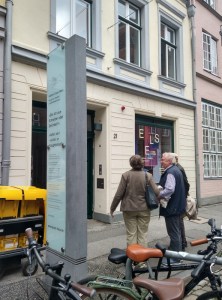
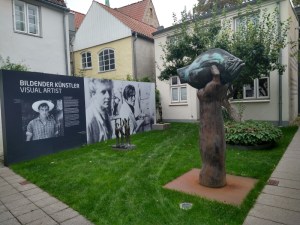
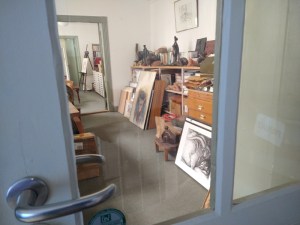
Buddenbrookhaus, the home of Mann’s grandparents, is undergoing a several-year renovation and expansion project. I wasn’t too upset about missing out on it, and there was a Mann exhibit in the tourist information centre. Instead, I went to the Günter Grass House museum, which opened in 2002. Grass spent his last 20 years living 15 miles south of Lübeck and kept an office in this building. For future reference, there’s a good-value day-ticket one can buy that covers all the museums in Lübeck. My husband went to the natural history museum while I learned about Grass, whom I’d never read before, and about Else Lasker-Schüler, whose works were on display in the rotating upstairs exhibit featuring figures who, like Grass, were writers and visual artists.


Grass grew up in what is now Danzig, Poland and was drafted into the Waffen-SS at age 17. He was lucky in that he soon received a minor injury that landed him in American custody. The Tin Drum, his well-known debut novel, drew on his military background, which he otherwise rarely discussed. Formally trained in art, he illustrated his works with the same motifs that appear in words. Flora and fauna run all through: fruit, onions; birds, snails, the flounder, cats and dogs. A multitalented writer, he also produced plays, poetry and political commentary. He won the Nobel Prize in 1999 and died in 2015. I found the material on his life and work unexpectedly diverting. I read the short volume below as soon as we got back.
-
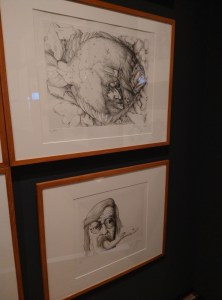
- Some of Grass’s grotesque hybrid animal drawings
-
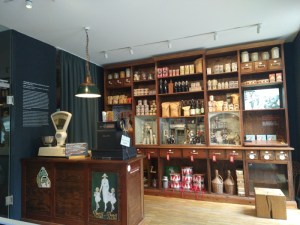
- Replica of the Grass family’s store in Danzig
-
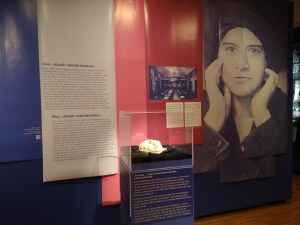
- Else Lasker-Schüler exhibit, including her death mask
Of All that Ends by Günter Grass (2015)
[Translated from German by Breon Mitchell]
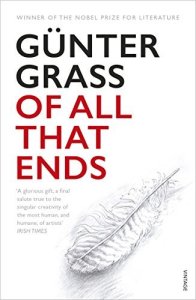 This posthumous prosimetric collection contains miniature essays, stories and poems, many of which seem autobiographical. By turns nostalgic and morbid, the pieces are very much concerned with senescence and last things. The black-and-white sketches, precise like Dürer’s but looser and more impressionistic, obsessively feature dead birds, fallen leaves, bent nails and shorn-off fingers. The speaker and his wife order wooden boxes in which their corpses will lie and store them in the cellar. One winter night they’re stolen, only to be returned the following summer. He has lost so many friends, so many teeth; there are few remaining pleasures of the flesh that can lift him out of his naturally melancholy state. Though, in Lübeck for the Christmas Fair, almonds might just help? The poetry happened to speak to me more than the prose in this volume. I’ll read longer works by Grass for future German Literature Months. My library has his first memoir, Peeling the Onion, as well as The Tin Drum, both doorstoppers. (Public library)


Of all that ends: books, holidays, seasons. It was a trip that, like so many we take these days, was sometimes irksome and exhausting, and could be overwhelming (Berlin) or boring (Lübeck) by turns – yet was still far preferable to the humdrum of home life. And – isn’t it always the way? – just as we’d gotten comfortable with greetings, farewells and other everyday phrases in a new language, it was time to leave. We were more comfortable with French when ordering a vegan supper at a café and drinks in a bustling Art Deco bar during our quick overnight stay in Brussels, then it was onto the Eurostar to come back home. Somewhere on those many train rides back, I caught this monster cold that will not die after 10 days and counting. And the very day we arrived back in the UK, we felt a sudden shift to late autumn weather.
November will be here before we know it.
 Bookish Beck = Rebecca Foster. American transplant to England. Freelance proofreader and book reviewer.
 Bookish Beck
Sounds like a great trip, and you didn’t deserve the cold at the end of it; hope you’re on the mend now. I too enjoyed ‘Goodbye to Berlin’, and I love marzipan, so maybecI need to say hello to Berlin and get over there. ‘Death in Venice’ is a great story, so I’m looking forward to your opinion of that, and I’ll have to look up the Mansfield and Grass books. Thanks for sharing. 🙂
LikeLiked by 1 person
I’m still feeling a little under the weather, but better than I was. That and the cold drizzle have made for a melancholy start to autumn! I don’t know about where you are, but I can buy a decent range of marzipan here in the UK. Niederegger exports their products widely.
LikeLiked by 1 person
Lübeck sounds great! I LOVE that you were drawn by marzipan tourism. I did similar unashamed chocolate touring in Brussels when I was there a few years ago, and had a great time. Even though Buddenbrooks is a doorstopper, it’s *so* readable – I absolutely loved it. Have never gotten around to The Tin Drum, though I’ve tried a few times; the narrator is rather repellent, and I’ve never had the requisite perseverance. Maybe one day. Did you do the whole trip by train? How do you get Interrail passes?
LikeLiked by 1 person
I’m impressed that you’ve read Buddenbrooks! I’ve been daunted by all of Mann’s proper novels but I’m a big fan of Death in Venice. Grass’s major books seem to be just as chunky.
With just an overnight in Brussels this time, we stayed around the Midi station neighbourhood and didn’t venture into the centre of town, so no chocolates for us this time, but I remember stocking up on varied and interesting flavours a previous time we were in Belgium.
Yes, it was all on Interrail, which includes an outward and return journey (but you do have to pay extra for Eurostar reservations and any other seat reservations). C bought the tickets back in December or January in a sale. They were technically valid for 14 days but we didn’t use that many. For ages we thought we’d have to cancel the passes and take the loss of a certain percentage, but at the last minute we decided to just go ahead with the trip. It meant we were a little bit unprepared and had to plan each day as we went along, which was stressful at times. But I’m glad we did it.
LikeLike
I’m very keen to go to Lübeck although (whisper it) I’m not a marzipan fan! Should you ever go to Gdansk I’d recommend the tiny, old fashioned and very moving museum which commemorates the postal workers who did their best to repel the German invasion. It’s still a working Post Office.
LikeLiked by 1 person
That’s okay, we can still be friends 😉 I actually know a few other people who aren’t keen on it either. All the more for me!
Oh yes, I recall that you went to Poland. Perhaps some day. I do fancy Prague, so that could be part of another Interrail trip.
LikeLiked by 1 person
The weather has changed with a vengeance hasn’t it. I do hope your cold goes away very soon.
LikeLiked by 1 person
It looks like you had a great time and thanks for taking us for this armchair journey with you.
I think I could go to Lübeck only for the marzipan too. 🙂
LikeLiked by 1 person
What fun, and I am intrigued that you hadn’t expected to be so diverted by GG but found yourself reading that volume straight through. (The Tin Drum is on my list for December.) I wonder if the Mann building being open would have opened up new curiosity about TM too. Just visiting cats wouldn’t be as fun as resident cats, for sure. Museum bundles are always fun, aren’t they?! Next, next, next! We were around the corner from an authentic French bakery for several years and, although I no longer recall the different terms for it, there were certain baked goods only available in January and, when you ordered them, there were three different options, all of which revolved around distinctions in marzipan. Even my partner, who isn’t normally a marzipan lover (I love most of them) found that one of the options was very tasty. Who would have thought it was such a Thing!
LikeLiked by 1 person
I’m daunted by the length of The Tin Drum (and what Eleanor said above) but I can only try.
I somehow hadn’t twigged that Mann was a closeted homosexual like Maugham.
A number of the pastries we had through the week had marzipan, but it kicked up a notch when we got to Lubeck. The (German) supermarket chain Lidl carries a lot of marzipan treats during the Christmas season and we usually stock up.
LikeLike
Ohhh, that’s good to know. I did already have in mind that it would be a difficult read but only for length and theme, not voice/character. But had I fallen into Buddenbrooks first, like Elle, I can see where I might have had a different set of expectations (that’s another I’d like to read, but not this year). Like you, I’d probably end up reading any writer about whom I’d learned on a vacation, especially seeing their home. The curators do such a great job of adding to our TBRs!
LikeLike
[…] other reviews: Heiny, Mackay, McEwan; the BBC National Short Story Award 2025 anthology; Donoghue, Grass, Isherwood, Mansfield as part of my Germany reading.) To keep it simple and get the basics across before I forget any […]
LikeLike
[…] Literature Month: Our recent trip to Berlin and Lübeck whetted my appetite to read more German and German-language fiction. I’ll try to coincide with […]
LikeLike
The home of marzipan – how superb! I accidentally went to the nougat capital of (Spain? the world?) Alicante, and that was good but marzipan!
LikeLiked by 1 person
Next my husband will be wanting to go to Portugal for the port!
LikeLiked by 1 person
[…] trip to Germany in September whetted my appetite to read more German-language fiction, and November also being […]
LikeLike
[…] Single Man by Christopher Isherwood (1964) lured me because I’d so loved Goodbye to Berlin and I remember liking the Colin Firth film. But this story of an Englishman secretly mourning his […]
LikeLike
[…] Goodbye to Berlin by Christopher Isherwood: Isherwood intended for these autofiction stories to contribute to a “huge episodic novel of pre-Hitler Berlin.” Two “Berlin Diary” segments from 1930 and 1933 reveal a change in tenor accompanying the rise of Nazism. Even in lighter pieces, menace creeps in through characters’ offhand remarks about “dirty Jews” ruining the country. Famously, the longest story introduces club singer Sally Bowles. I later read Mr Norris Changes Trains as well. Witty and humane, restrained but vigilant. […]
LikeLike
[…] in Hay-on-Wye; the Outer Hebrides; Suffolk; Berlin and Lübeck, […]
LikeLike