Classic of the Month: George Orwell’s 1984
Big Brother, the Thought Police, Newspeak, doublethink, 2 + 2 = 5, Room 101. I’d never read George Orwell’s Nineteen Eighty-Four until this month, but so many of its concepts and catchphrases were familiar to me; they’ve entered into popular culture to a remarkable extent. I found that the basics of the plot, and even the specifics of the horrifying climax, were already somewhere in the back of my mind. That’s how much of a household story this is. And, given the recent rise of authoritarian regimes, 1984 is back in style – if it ever went out.

Published in 1949, just four years after Animal Farm, the novel imagines a post-Revolution future in which Oceania (England) is alternately at war with Eurasia and Eastasia. It’s a dystopian vision of bombing raids, public hangings and triumphant film reels of refugees drowning. Absolute loyalty to Big Brother and his Party and total hatred of dissidents are required. Winston Smith works for the Ministry of Truth – an ironic name if ever there was one. His job is to doctor newspaper articles to ‘rectify’ the past. Scrutinized constantly by a telescreen, he ‘corrects’ the written record and burns the evidence in memory holes.
But Winston can’t forget that he once saw a photograph proving that several scapegoats who were executed were actually innocent, and ever since he has been unfaithful to the Party in his heart. “There was truth and there was untruth, and if you clung to the truth even against the whole world, you were not mad.” He makes two bids for freedom: his thought life, as revealed in his diary, and (in Part II) an affair with Julia, a fellow rebel he meets in a rented room above a pawnbroker’s. They join the Brotherhood, Emmanuel Goldstein’s anti-Party movement, and read from his manifesto. Impossible to forget, though, that there’s a Part III to come, and their happy nonconformity is unlikely to survive the Thought Police’s vigilance.
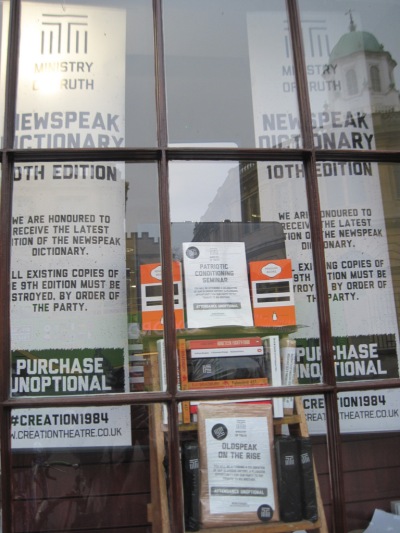
A 1984-themed window at Blackwells in Oxford.
I can’t say I enjoyed this novel exactly. It was more a case of recognizing its cultural importance and prescience about perennial political trends. What I most liked was the irony of the Party’s rebranding: the Ministry of Love is the torture headquarters, for instance, and the propaganda is rife with oxymorons (“WAR IS PEACE. FREEDOM IS SLAVERY. IGNORANCE IS STRENGTH.”). I also appreciated Orwell’s efforts to humanize Winston via his memories of his mother and sister, his estranged wife, and his simple love of beauty – as when he buys a glass and coral paperweight on a whim. Reassuringly, the relationship with Julia isn’t just about sex but is an example of true love against the odds: when Winston tells her “I’m thirty-nine years old. I’ve got a wife that I can’t get rid of. I’ve got varicose veins. I’ve got five false teeth,” she replies “I couldn’t care less.”
And yet there are parts of the book that are truly tedious, like the extracts from Goldstein’s manifesto and the appendix on Newspeak. Like many dystopians, this somewhat sacrifices story in the service of ideas. It certainly could have been cut by up to one-third. However, it’s still full of potent reminders like these about resisting misinformation:
I don’t imagine that we can alter anything in our own lifetime. But one can imagine little knots of resistance springing up here and there—small groups of people banding themselves together, and gradually growing, and even leaving a few records behind, so that the next generation can carry on where we leave off.
At present nothing is possible except to extend the area of sanity little by little. … We can only spread our knowledge outwards from individual to individual, generation after generation. In the face of the Thought Police, there is no other way.
If he [the average citizen of Oceania] were allowed contact with foreigners he would discover that they are creatures similar to himself and that most of what he has been told about them is lies. The sealed world in which he lives would be broken, and the fear, hatred and self-righteousness on which his morale depends might evaporate.
I found it rewarding to follow this with Margaret Atwood’s 2003 essay on Orwell. Nineteen Eighty-Four was the direct model for the feminist dystopia she started writing in the real 1984, The Handmaid’s Tale. She helped me realize something I hadn’t due to my eyes glazing over during the appendix: it’s in the past tense, looking back on a repressive government. In other words, she writes, “the regime has fallen … language and individuality have survived. For whoever has written the essay on Newspeak, the world of Nineteen Eighty-Four is over. … Orwell had much more faith in the resilience of the human spirit than he’s usually been given credit for.” In homage, she ended The Handmaid’s Tale with a section set hundreds of years in the future, when Offred’s world is studied by academics.
That’s important to remember: one day our current situation, horrible as it might feel to live through, will be nothing but a brief chapter in the history books. It’s up to us, though, to help ensure that whatever succeeds it is much better.
My rating: 
Next month: I plan to choose a short classic from “The Ten Best Novels for Thirtysomethings” list in The Novel Cure; my options are The Tenant of Wildfell Hall (Anne Brontë), The Rector’s Daughter (F.M. Mayor), and The Jungle (Upton Sinclair), all of which I own. Let me know which would be your pick.
Classics of the Month: Hardy and Sackville-West
This is the first post in a new monthly series intended to encourage myself to read more of the classics I own. In January I read two works of classic literature: Under the Greenwood Tree by Thomas Hardy and No Signposts in the Sea by Vita Sackville-West.
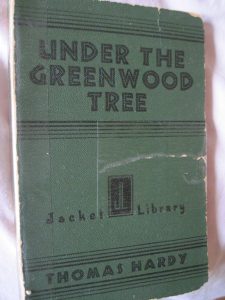
My battered Jacket Library edition.
Between college and grad school I read Hardy’s five major novels, but it’s probably been ten years or more since I tried a new one. Far from the Madding Crowd is one of my favorite books of all time, so I couldn’t help but compare Under the Greenwood Tree* to it – unfavorably, alas – as I was reading.
Greenwood was Hardy’s second novel, published in 1872. That’s just two years before Madding Crowd, and the two are quite similar in a few ways: the main female character is a conceited flirt who has to decide between three potential suitors; the supporting cast is made up of “rustics” who speak in country dialect; and the Dorset setting, including the landscape, weather and traditional activities, is a strong presence in its own right.
But where Bathsheba Everdene, though periodically maddening, is ultimately a sympathetic figure, Greenwood’s Fancy Day is a character I could never warm to. As the new schoolteacher and organist in Mellstock village, she puts on airs and imagines she’s too good for Dick Dewy, a salt-of-the-earth peddler. She’s also incurably vain. “Yes, I must wear the hat, dear Dicky, because I ought to wear a hat, you know,” she says, even though Dick calls the hat “Rather too coquettish.”
A bare-bones summary of the novel makes it sound more entertaining than it actually is: A set of country musicians (the “Mellstock Quire”) learns their services are no longer required at the local church; they are to be replaced by an organ. The novel opens on Christmas Eve and in the early chapters proceeds by way of caroling, cider drinking and dances. It’s rather jolly, but where is it all going? Then, once the plot takes over, Fancy’s weighing up of the wooing attentions of Dick, Mr. Shiner and Parson Maybold soon grows tedious.
Whereas the passages about the rustics are brief, welcome interludes in Madding Crowd, here they are nearly constant and start to feel overpowering. “You are charmed on condition that you accept Hardy’s condescension towards his characters,” Claire Tomalin observes in Thomas Hardy: The Time-Torn Man. They are harmless folk, but their rural way of life will soon be superseded. The novel is set a generation back, in about the 1840s, so has an elegiac tone to it, and Hardy’s subtitles suggest he was trying to freeze an image of a bygone time.
Fancy’s directives for her wedding reception make clear the divide between old and new:
The propriety of every one was intense by reason of the influence of Fancy, who, as an additional precaution in this direction, had strictly charged her father and the tranter [Dick’s father] to carefully avoid saying ‘thee’ and ‘thou’ in their conversation, on the plea that those ancient words sounded so very humiliating to persons of newer taste; also that they were never to be seen drawing the back of the hand across the mouth after drinking—a local English custom of extraordinary antiquity, but stated by Fancy to be decidedly dying out among the upper classes of society.
This is a pleasant enough book, and at just 160 or so pages goes by fairly quickly, yet I found myself losing interest at many points and often could not bear to read more than one short chapter at a time. At this rate, will I ever get to decidedly minor Hardy novels like The Hand of Ethelberta, The Trumpet-Major, A Pair of Blue Eyes, and A Laodicean?

*“Under the greenwood tree” is a line from Shakespeare’s As You Like It.
Favorite unrelated line: “Clar’nets were not made for the service of the Lard; you can see it by looking at ’em.”
No Signposts in the Sea (1961) is my second taste of Sackville-West’s fiction (after All Passion Spent). It was her last novel, published just one year before her death, and was inspired by world cruises she and her husband, Harold Nicolson, took in later life. She was at this point already ill with the cancer that would kill her, though it was as yet undiagnosed.
That context goes a long way towards explaining the preoccupations of No Signposts, set on board a cruise ship and narrated by fifty-year-old Edmund Carr, a journalist who has been told by his doctor that he has just a few months to live. He’s embarked on the voyage to be close to the woman he loves, forty-year-old war widow Laura Drysdale. She has no idea that he’s ill, and as the weeks pass and they share tender moments – dinner on shore at an island based on Macao, a lightning storm viewed from her private balcony – he dares to hope that she might return his feelings but still doesn’t tell her about his imminent death, even as she makes tentative plans for excursions they might take once they’re back in London.
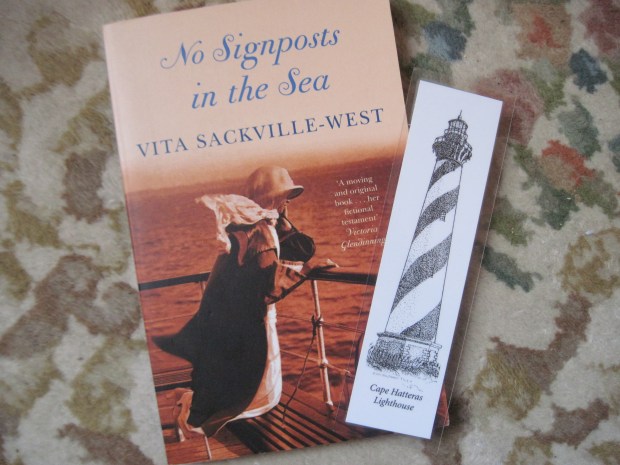
The novel is presented as Edmund’s diary, found after his eventual death. It’s full of his solitary musings but also his conversations with Laura, who is refreshingly unconventional in her approach to relationships:
I can’t abide the Mr. and Mrs. Noah attitude towards marriage; the animals went in two by two, forever stuck together with glue. I resent it as much for other people as I should for myself. It seems to me a degradation of individual dignity.
She also tells a story about a lesbian couple she knows who are aging happily together; it feels a bit out of place, but its inclusion is striking given Sackville-West’s history of lesbian relationships.
I’d recommend this short novel to anyone who’s looking for a quick women’s classic with plenty to say about what matters in life.

Next month: I’ve never read George Orwell’s Nineteen Eighty-Four and it seems to be having something of a resurgence in popularity at the moment, so perhaps now is the time?
 Bookish Beck = Rebecca Foster. American transplant to England. Freelance proofreader and book reviewer.
 Bookish Beck