Three on a Theme: English Seasons and Flora (Brazier, Lamb and Parker)
These three books trace the turning of a typical year of the English seasons, especially as experienced through flora: produce for a veg stall, plants laid into a traditional hedge, and “weeds” celebrated for their wild beauty.
The Honesty Box: The diary of a broken marriage, a mental health crisis and a large marrow by Lucy Brazier (2025)
 From one Christmas season to the next, Brazier highlights the delights and challenges of rural living (in the Bridport–Lyme Regis area of Dorset). She takes on a project of setting up and stocking her own honesty box – an unmanned roadside produce stall where visitors pay into a cashbox – with garden produce, preserves and baked goods, plus friends’ crafts. All along, her marriage is in an extended, low-level crisis: Steve’s bluntness, lack of social skills, and panicked inability to do his share of household tasks have long been issues. When he gets a combined ADHD and autism diagnosis, he has a roadmap but no easy solution. Going on medication and finding peers in a similar situation help somewhat, but he still struggles.
Brazier draws clever parallels between the turning of the seasons and the ebb and flow of a marriage. Wild swimming with friends and countryside walks with Margot the dog are ways of communing with nature. She incorporates all the daily concerns of her midlife existence, including home repairs, menopause and seeing Raff, the oldest of their three children, off to university. Brazier used to be a PFD talent agent in London, dealing with the likes of Anna Maxwell Martin, then worked for Hugh Fearnley-Whittingstall and his River Cottage cookery empire (she wrote their Christmas book); she’s now a freelance ghostwriter. She’s gently nostalgic for the days of balancing early motherhood and a stressful career, but also grateful for the slower pace of life she’s found in the countryside. There are also some amusingly ill-fated holidays (camping and boating), contrasted with a luxurious one in Italy.
It’s all very affable, the month-by-month present-tense write-ups offering an appealing blend of realism about life’s unpredictability and strategies for muddling through. While it may mean most to women of a certain age or those with neurodivergence in the family, anyone in a long-term relationship will find much to relate to. (Public library) 
Of Thorn and Briar: A Year with the West Country Hedgelayer by Paul Lamb (2025)
I picked this up after it was shortlisted (and highly commended) for the Wainwright Prize for Nature Writing. Lamb’s lifestyle could be from the 19th century: he lives in a sparse, cosy wagon, driving it from place to place and pausing for weeks-long projects laying traditional hedges across southwest England. Autumn through late winter is his key work period, to avoid the bird-nesting season. It’s gruelling physical labour. Sometimes he sees he’s made a difference; when he gets discouraged, he has to remind himself to take a longer view. “The hedger, like the forester, has to think of his work not as something completed in days or weeks or even months, but instead in years, decades and centuries.” Lamb can’t help but notice the daily shifts in weather adding up to changing seasons; it all affects his daily work.
 This gets reasonably technical about the different qualities of tree species and what they’re like to work with. I learned, or at least was reminded of, the vocabulary word “pleaching,” which means cutting a thin tree trunk vertically – almost but not all the way through – and laying horizontal branches into the crease. It takes skill to describe practical actions in a way that laypeople can picture. However, this account, which covers one August through the following July, is quite monotonous and repetitive. I blame the simple past-tense narration, which quickly becomes an ‘I did this, then I did that’ rundown and had me skimming more than half of the time. Literary techniques would have helped break up the format: extended flashbacks to his apprenticeship or family life, more scenes and dialogue, and some lyrical or imagined passages. (There is one particularly nicely done Hardy-esque vignette where he converses with Dorset locals in a pub.)
During the pandemic, Lamb’s daughters encouraged him to start an Instagram account, which now has 195,000 followers. No doubt it was his social media fame that led to this book deal. His writing, though serviceable, lacks sparkle. I enjoyed it as a window onto a rare profession and nearly forgotten way of life, but would hesitate to recommend unless you have patience and a greater-than-average interest in the subject matter. (Public library) 
Understorey: A Year Among Weeds by Anna Chapman Parker (2024)
 (One of my best backlist reads of last year.) Parker set out to study and sketch weeds as a way of cultivating attention and stillness as well as celebrating the everyday and overlooked. Her quick black-and-white drawings and written observations bear witness to the seasons changing but also to the minute alterations she observes in herself and her children. Here are a couple of examples of shorter entries:
25 April
Wild garlic flowers are explosive. As so often in drawing[,] there is a slippery negotiation between fidelity (getting the shape right) and spirit (capturing the feel of it). By the third drawing I’ve got my eye in and the balance between the two is nearer the mark. If I stayed here a week in the grass, drawing a single flower in a single stroke with my eyes closed, maybe eventually I’d hit it bang-on true.
10 December
On my way back from the shops, I find myself detouring to check in on the sowthistle again. Its leaves are drier now and the crisping at the edges is spreading inward. The leftward lean is more pronounced. A few more of the flowers have gone over. But there’s something else, as well – some impression of a former intimacy. A sensation not only of the past flower, but of my past self here, two days ago. Through the drawn encounter, the plant allows me to recognise myself, passing.
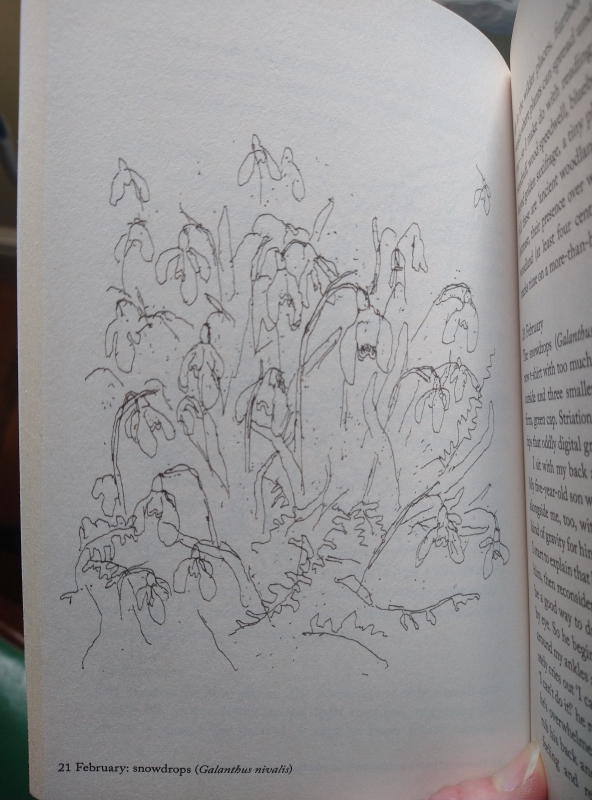
Taking a half-hour out of her day to find a subject feels transgressive in one sense, but dutiful – even holy – in another. Along with her frequent illustrations, there are reproductions of other artworks that depict wildflowers in situ, such as Albrecht Dürer’s Great Piece of Turf (1503). The tone is high-brow, meditative, introspective as she focuses on being present. This was just my kind of nature book, and all the more special because I’ve holidayed in her home of Berwick-on-Tweed so could picture some of the ‘overgrown’ spaces she honours. 
With thanks to Duckworth for the proof copy for review.
Spring Reads, Part I: Violets and Rain
We had both rain and spring sunshine on a recent overnight trip to Bridport, Dorset – a return visit after enjoying it so much in 2019. Several elements were repeated: Dorset Nectar cider farm, dinner at Dorshi, and a bookshop and charity shop crawl of the main streets. While we didn’t revisit Thomas Hardy sites, I spent plenty of time at Max Gate by reading Elizabeth Lowry’s The Chosen. Beach walks plus one in the New Forest on the way back were splendid. This was my haul from Bridport Old Books. Stocking up on novellas and poetry, plus a novel by a Canadian author I’ve enjoyed work from before.
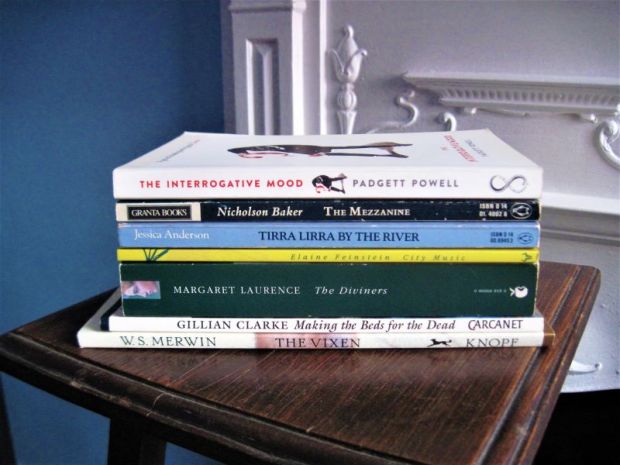
Now for a quick look at two tangentially spring-related books I’ve read recently: a short novel about two women’s wartime experiences of motherhood and an elegiac and allusive poetry collection.
Violets by Alex Hyde (2022)
I was intrigued by the sound of this debut novel, which juxtaposes the lives of two young British women named Violet at the close of the Second World War. One miscarries twins and, told she’ll not be able to bear children, has to rethink her whole future; another sails from Wales to Italy on ATS war service, hiding the fact that she’s pregnant by a departed foreign soldier. Hyde’s spare style – no speech marks; short paragraphs or solitary lines separated by spaces – alternates between their stories in brief numbered chapters, bringing them together in a perhaps predictable way that also forms a reimagining of her father’s life story. The narration at times addresses this future character in poems that I think are supposed to be fond and prophetic but I instead found strangely blunt and even taunting (as in the excerpt below). There’s inadequate time to get to know, or care about, either Violet. 

Can you feel it, Pram Boy?
Can you march in time?
A change, a hardening,
the jarring of the solid ground as she treads,
gets her pockets picked.
[…]
Quick! March!
And your Mama, Pram Boy,
yeasty in her private parts.
Granta sent a free copy. Violets came out in paperback in February.
Rain by Don Paterson (Faber, 2009)
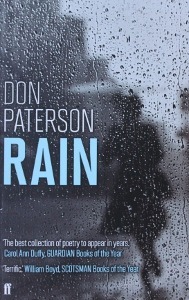 I’d previously read Paterson’s 40 Sonnets, in 2015. This collection is in memoriam of the late poet Michael Donaghy, the subject of the late multi-part “Phantom.” There are a couple of poems in Scots and a sequence of seven nature-infused ones designated as being “after” poets from Li Po to Robert Desnos. Several appear to express concern for a son. There’s a haiku-like rhythm to the short stanzas of “Renku: My Last Thirty-Five Deaths.” I didn’t understand why “Unfold i.m. Akira Yoshizawa” was a blank page until I looked him up and learned that he was a famous origamist. The title poem closes the collection:
I love all films that start with rain:
rain, braiding a windowpane
or darkening a hung-out dress
or streaming down her upturned face;
one big thundering downpour
right through the empty script and score
before the act, before the blame,
before the lens pulls through the frame
to where the woman sits alone
beside a silent telephone
I liked individual passages or images but didn’t find much of a connecting theme behind Paterson’s disparate interests. (University library) 
Another favourite passage:
So I collect the dull things of the day
in which I see some possibility
[…]
I look at them and look at them until
one thing makes a mirror in my eyes
then I paint it with the tear to make it bright.
This is why I sit up through the night.
(from “Why Do You Stay Up So Late?”)
And a DNF:
 Corpse Beneath the Crocus by N.N. Nelson – I loved the title and the cover, and a widow’s bereavement memoir in poems seemed right up my street. I wish I’d realized Atmosphere is a vanity press, which would explain why these are among the worst poems I’ve read: cliché-riddled and full of obvious sentiments and metaphors as she explores specific moments but mostly overall emotions. Three excerpts:
All things die
In the flowering cycle
Of growth and life
Time passes
Like sand in an hourglass
Feelings are changeful
Like the tide
Ebbing and flowing
“Love Letter,” a prose piece, held the most promise, which suggests Nelson would have been better off attempting memoir. I slogged (hate-read, really) my way through to the halfway point but could bear it no longer. (NetGalley) 
I have a few more spring-themed books on the go: Hoping for a better set next time!
Any spring reads on your plate?
Thomas Hardy Tourism in Dorset
We fancied a short break before term starts (my husband is a teaching associate in university-level biology), so booked a cheap Airbnb room in Bridport for a couple of nights and headed to Dorset on Wednesday, stopping at the Thomas Hardy birthplace cottage on the way down and returning on Friday via Max Gate, the home he designed on the outskirts of Dorchester.
I’d been to both before, but over 15 years ago. In the summer of 2004, at the end of my study abroad year, I used a travel grant from my college to spend a week in Dorset and Nottinghamshire, researching the sense of place in the works of Hardy and D.H. Lawrence. I marvel at my bravery now: barely out of my teens, there I was traveling alone by train and bus to places I’d never been before, finding my own B&B accommodation, and taking long countryside walks to arrive at many sites on foot.

Max Gate
I found that much had changed in 15 years. The main difference is that both properties have now been given the full National Trust treatment, with an offsite visitor centre and café down the lane from Hardy’s Cottage, and the upper floors of Max Gate now open to the public after the end of private tenancies in 2011.* This could be perceived as a good thing or a bad thing: Everything is more commercial and geared towards tourists, yes, but also better looked after and more inviting thanks to visitor income and knowledgeable volunteers. Fifteen years ago I remember the two sites being virtually deserted, with the cottage’s garden under black plastic and awaiting a complete replanting. Now it’s flourishing with flowers and vegetables.
*In 2004 only a few ground-floor rooms were open to the public. I happened to spot in the visitor’s book that novelist Vikram Seth had signed in just before me. When I made the caretakers aware of this, they expressed admiration for his work and offered him an exclusive look at the study where Hardy wrote Tess of the d’Urbervilles. I got to tag along! The story is less impressive since it’s been a standard part of the house tour for eight years now, but I still consider it a minor claim to fame.
The thatched cottage doesn’t possess anything that belonged to the Hardy family, but is decorated in a period style that’s true to its mid-1800s origin. Hardy was born here and remained until his early thirties, completing an architecture apprenticeship and writing his first few books, including Under the Greenwood Tree. Even if you’re not particularly familiar with or fond of Hardy’s work, I’d recommend an afternoon at the cottage for a glimpse of how simple folk lived in that time. With wood smoke spooling out of the chimney and live music emanating from the door – there are two old fiddles in the sitting room that guests are invited to play – it was a perfectly atmospheric visit.

 Afterwards, we headed to Portland, an isthmus extending from the south coast near Weymouth and known for its stone. It’s the setting of The Well-Beloved, which Hardy issued in serial form in 1892 and revised in 1897 for its book publication. Jocelyn Pierston, a sculptor whose fame is growing in London, returns to “the Isle of Slingers” (Hardy gave all his English locales made-up names) for a visit and runs into Avice Caro, a childhood friend. On a whim, he asks her to marry him. Before long, though, following a steamy (for Victorian literature, anyway) scene under an upturned boat during a storm, he transfers his affections to Miss Bencomb, the daughter of his father’s rival stone merchant. The fickle young man soon issues a second marriage proposal. I read the first 30 pages, but that was enough for me.

St. George’s Church, Portland, in a Christopher Wren style.
 [I failed on classics or doorstoppers this month, alas, so look out for these monthly features to return in October. I did start The Warden by Anthony Trollope, my first of his works since Phineas Finn in 2005, with the best of intentions, and initially enjoyed the style – partway between Dickens and Hardy, and much less verbose than Trollope usually is. However, I got bogged down in the financial details of Septimus Harding’s supposed ripping-off of the 12 old peasants who live in the local hospital (as in a rest center for the aged and infirm, like the Hospital of St Cross at Winchester). He never should have had his comfortable £800 a year, it seems. His son-in-law, the archdeacon Dr. Grantly, and his would-be son-in-law, gadfly John Bold, take opposing sides as Harding looks to the legal and religious authorities for advice. I read the first 125 pages but only briefly skimmed the rest. Given how much longer the other five volumes are, I doubt I’ll ever read the rest of the Barchester Chronicles.]
My other appropriate reading of the trip was Moon Tiger by Penelope Lively, in which Claudia Hampton, a popular historian now on her deathbed, excavates the layers of her personal past and dwells on the subjectivity of history and memory. She grew up in Dorset and mentions ammonites and rock strata, which we encountered on our beach walks.

Bridport isn’t so well known, but we thought it a lovely place, full of pleasant cafés, pubs and charity shops. It also has an independent bookshop and two secondhand ones, and we had an excellent meal of dumplings and noodle bowls at the English/Asian fusion restaurant Dorshi. It’s tucked away down an alley, but well worth a special trip. Our other special experience of the trip was a tour of Dorset Nectar, a small, family-run organic cider farm just outside of Bridport, which included a tasting of their 10+ delicious ciders. We had splendid late-summer weather for our three days away, too – we really couldn’t have asked for better.


Three secondhand books purchased, for a total of £4.10.
 Bookish Beck = Rebecca Foster. American transplant to England. Freelance proofreader and book reviewer.
 Bookish Beck