Doorstopper of the Month: By Gaslight by Steven Price
My 2017 goal of reading one book of 500+ pages per month has been a mixed success. With the best doorstoppers the pages fly by and you enjoy every minute spent in a fictional world. From this past year Murakami’s The Wind-Up Bird Chronicle fits that bill, and a couple of novels I read years ago on holidays also come to mind: Susanna Clarke’s Jonathan Strange and Mr. Norrell and Michel Faber’s The Crimson Petal and the White. But then there are the books that feel like they’ll never end and you have to drag yourself through page by page.
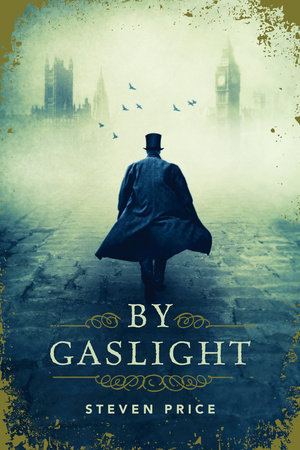 Unfortunately, Steven Price’s second novel, By Gaslight, a Victorian cat-and-mouse mystery, tended more towards the latter group for me. Like Eleanor Catton’s The Luminaries, it has the kernel of a fascinating story but piles up the words unnecessarily. Between July and August I read the first 300 pages and then skimmed the rest (in total the paperback has 731 small-type pages). This is the story of William Pinkerton, a 39-year-old Civil War veteran and private investigator from Chicago who comes to London in 1885 to chase up a name from his father’s files: Edward Shade. His best lead comes to nothing when Charlotte Reckitt evades him and turns up as a set of dismembered remains in the Thames. Keeping in mind the rudimentary state of forensics, though, there’s some uncertainty about the corpse’s identity.
The other central character in this drama is Adam Foole, a master thief. Half Indian and half English, he has violet eyes and travels in the company of Molly, a young pickpocket he passes off as his daughter, and Japheth Fludd, a vegetarian giant just out of prison. Foole was Charlotte’s lover ten years ago in South Africa, where they together pulled off a legendary diamond heist. Now he’s traveling back to England: she’s requested his help with a job as she knows she’s being tailed by a detective. The remaining cast is large and Dickensian: a medium and her lawyer brother, Charlotte’s imprisoned uncle, sewer dwellers, an opium dealer, and so on. Settings include a rare goods emporium, a Miss Havisham-type lonely manor house, the Record Office at Chancery Lane, and plenty of shabby garrets.
What I most enjoyed about the book was the restless, outlaw spirit of both main characters, but particularly Pinkerton. His troubled relationship with his father, in whose footsteps he’s following as a detective, is especially poignant: “William feared him and loved him and loathed him every day of his life yet too not a day passed that he did not want to be him.”
Price’s style is not what you’d generally expect of a Victorian pastiche. He uses no speech marks and his punctuation is non-standard, with lots of incomplete or run-in sentences like the one above. The critics’ blurbs liken By Gaslight to William Faulkner or Cormac McCarthy, apt comparisons that tell you just how unusual a hybrid it is.
I liked Price’s writing and starting around page 150 found the book truly gripping for a time, but extended flashbacks to Pinkerton and Foole’s earlier years really drag the story down, taking away from the suspense of the hunt. Meanwhile, the two major twists aren’t confirmed until over halfway through, but are hinted at so early that the watchful reader will know what’s going on long before the supposedly shrewd Pinkerton does. The salient facts about both characters’ past might have been conveyed in one short chapter each and the 1885 plot streamlined to make a taut novel of less than half the length.
There are many reasons to admire this Canadian novelist’s achievement, but whether it’s a reading experience you’d enjoy is something you’ll have to decide for yourself.
A favorite passage:
There is in every life a shadow of the possible, she said to him. The almost and the might have been. There are the histories that never were. We imagine we are keeping our accounts but what we are really saying is, I was here, I was real, this did happen once. It happened.
My rating: 
By Gaslight was first published in the UK by Oneworld in September 2016. My thanks to Margot Weale for sending a free paperback for review.
Fun trivia: Steven Price is married to Esi Edugyan, author of the Booker Prize-shortlisted novel Half Blood Blues.
A Jest of God by Margaret Laurence
A Jest of God (1966) is the second in Margaret Laurence’s five-novel Manawaka sequence; it followed The Stone Angel (1964), which I reviewed here back in December. Recently reissued as part of the Apollo Classics imprint from Head of Zeus Books, these two books have been a wonderful opportunity for me to further my knowledge of Canadian literature.
Although Rachel Cameron, the narrator of A Jest of God, is a 34-year-old second-grade teacher who still lives with her mother, she has attributes in common with 90-year-old Hagar Shipley, the unforgettable central character of The Stone Angel. Both have a history of sexual hang-ups – Rachel’s in the form of erotic dreams – and experience temporary losses of self-control. The most striking example is when Rachel reluctantly accepts her fellow teacher Calla’s invitation to her Pentecostal church and, though she is mortified at hearing others speaking in tongues, involuntarily enters in herself with hysterical crying.
I loved this sequence. The Tabernacle of the Risen and Reborn provides such a contrast to Rachel’s mother’s staid church tradition, and it’s a perfect introduction to Rachel’s patterns of pride and embarrassment (another link to Hagar). Although Rachel frequently issues stern orders to herself – “Now, then. Enough of this. The main thing is to be sensible, to stop thinking and to go to sleep” – she can’t seem to stop worrying and second-guessing. This applies to her career as well as to her personal relationships. With her principal’s support, she takes surprisingly stern action against her favorite pupil when he starts playing truant.

It’s hard to say much more about the plot without giving too much away. Do I emulate the vagueness of the back cover blurb and simply explain that Rachel unexpectedly “falls in love for the first time, and embarks upon an affair that will change her life in unforeseen ways”? I’d prefer to go into a bit more depth, so if you want to avoid learning what happens I suggest skipping over my next few paragraphs.
To start with it seems Rachel’s best romantic prospect is Calla, who’s certainly interested. But about a third of the way into the novel, as the boredom of the long summer vacation is setting in, Nick Kazlik returns to town. He was the milkman’s son and Rachel’s childhood acquaintance, and is now a high school teacher in another town. They go out to a movie and share a kiss, and from there their relationship progresses rapidly. Rachel loses her virginity to him out in a field, and the more sex they have the more she’s seized with a belated terror of pregnancy. No doubt her anxiety about motherhood is colored by her passive-aggressive relationship with her own mother, whose dodgy heart leaves her utterly dependent on Rachel.
The novel reminded me most of Margaret Drabble’s The Millstone and Carrie Snyder’s Girl Runner. Like the protagonists of those novels, Rachel’s options seem stark: acquiring a secret abortion, or changing her life irrevocably by having a child out of wedlock. As the title phrase suggests, Rachel feels God is laughing at her presumptuousness: first for believing she might be loved in proportion to her own passion, and then for thinking she could become a mother. I wasn’t fond of the way the book backtracked on this main source of tension at the end. A retreat from calamity might seem fitting given Rachel’s usual overthinking, but the resolution felt to me like too much of a deus ex machina reprieve.
Ultimately, I found Nick and Rachel’s affair the least interesting element of this novel. Compared with the friendship with Calla, the startling religious experience, the interactions with pupils and the school principal, the troubled mother–daughter relationship, and an odd late-night encounter with the new owner of her late father’s funeral parlor, what’s a bit of sex? We’re meant to rejoice at Rachel’s chance at romance, I think, but also to recognize it as a fleeting but necessary spur to an altered life.
Two aspects of this reprint edition deserve a mention. There’s a terrific afterword from Margaret Atwood recalling meeting Laurence, her literary idol, at the Governor General’s Awards ceremony in 1967 (Atwood won for poetry and Laurence won for fiction with this novel). Apollo Classics have also chosen an excellent cover image: a 1960 photograph by Rosemary Gilliat Eaton entitled Woman preparing paint for an art class, Frobisher Bay.

The Margaret Laurence House in Neepawa, Manitoba, Canada. By Amqui (Own work) [CC BY-SA 3.0 (http://creativecommons.org/licenses/by-sa/3.0)%5D, via Wikimedia Commons.
With thanks to Blake Brooks at Head of Zeus/Apollo Classics for the free copy for review.
My rating: 
A CanLit Classic: The Stone Angel by Margaret Laurence
Hagar Shipley has earned the right to be curmudgeonly. Now 90 years old, she has already lived with her son Marvin and his wife Doris for 17 years when they spring a surprise on her: they want to sell the house and move somewhere smaller, and they mean to send her to Silver Threads nursing home. What with a recent fall, gallbladder issues and pesky constipation, the old woman’s health is getting to be more than Doris can handle at home. But don’t expect Hagar to give in without a fight.
This is one of those novels where the first-person voice draws you in immediately. “I am rampant with memory,” Hagar says, and as the book proceeds she keeps lapsing back, seemingly involuntarily, into her past. While in a doctor’s waiting room or in the derelict house by the coast where she runs away to escape the threat of the nursing home, she loses the drift of the present and in her growing confusion relives episodes from earlier life.
Many of these are melancholy: her mother’s early death and her difficult relationship with her father, an arrogant, self-made shopkeeper (“Both of us were blunt as bludgeons. We hadn’t a scrap of subtlety between us”); her volatile marriage to Bram, a common fellow considered unworthy of her (“Twenty-four years, in all, were scoured away like sand-banks under the spate of our wrangle and bicker”); and the untimely deaths of both a brother and a son.

The stone angel of the title is the monument on Hagar’s mother’s grave, but it is also an almost oxymoronic description for our protagonist herself. “The night my son died I was transformed to stone and never wept at all,” she remembers. Hagar is harsh-tongued and bitter, always looking for someone or something to blame. Yet she recognizes these tendencies in herself and sometimes overcomes her stubbornness enough to backtrack and apologize. What wisdom she has is hard won through suffering, but she’s still standing. “She’s a holy terror,” son Marvin describes her later in the novel: another paradox.
Originally from 1964, The Stone Angel was reprinted in the UK in September as part of the Apollo Classics series. It’s the first in Laurence’s Manawaka sequence of five novels, set in a fictional town based on her hometown in Manitoba, Canada. It could be argued that this novel paved the way for any number of recent books narrated by or about the elderly and telling of their surprise late-life adventures: everything from Jonas Jonasson’s The Hundred-Year-Old Man Who Climbed Out of the Window and Disappeared to Emma Hooper’s Etta and Otto and Russell and James. I was also reminded of Jane Smiley’s Midwest novels, and wondered if Carol Shields’s The Stone Diaries was possibly intended as an homage.
I loved spending time in Hagar’s company, whether she’s marveling at how age has crept up on her—
I feel that if I were to walk carefully up to my room, approach the mirror softly, take it by surprise, I would see there again that Hagar with the shining hair, the dark-maned colt off to the training ring
trying to picture life going on without her—
Hard to imagine a world and I not in it. Will everything stop when I do? Stupid old baggage, who do you think you are? Hagar. There’s no one like me in this world.
or simply describing a spring day—
The poplar bluffs had budded with sticky leaves, and the frogs had come back to the sloughs and sang like choruses of angels with sore throats, and the marsh marigolds were opening like shavings of sun on the brown river where the tadpoles danced and the blood-suckers lay slimy and low, waiting for the boys’ feet.
It was a delight to experience this classic of Canadian literature.
(The Apollo imprint will be publishing the second Manawaka book, A Jest of God, in March.)
With thanks to Blake Brooks at Head of Zeus/Apollo for the free copy for review.
My rating: 
Review: The Heart Goes Last, Margaret Atwood
 Last month an unsolicited e-copy of The Heart Goes Last landed in my inbox: a random Thursday afternoon present for this Margaret Atwood fan. I was meant to review it for one of the websites I write for, but a misunderstanding meant the book was also assigned to someone else. So while I won’t be getting paid for my review (Boooooo!), I was still grateful for the opportunity to read the book early.
Atwood’s last project before this was the Maddaddam dystopian trilogy, and while there are still some dystopian elements here, she is blending speculative elements with realist social commentary in a way that makes me hope she is leaving some of the overt absurdity of her science-fiction scenarios behind.
 I didn’t dislike the Maddaddam books per se, but nor did I feel that it was necessary to turn Oryx and Crake into a trilogy, especially when the two following novels only re-examined events from different perspectives, filling in backstory rather than adding new present action (see my Maddaddam review on For Books’ Sake). It felt like a fairly indulgent ten-year project distracting Atwood from producing potential gems along the lines of The Blind Assassin, one of my favorites.
The Heart Goes Last began as four Positron short stories that appeared on the Byliner website between 2012 and 2013. We’re in a vague post-financial crisis, post-environmental apocalypse world, a little like California or The Road but not quite as drastic. Stan and Charmaine are a married couple reduced to living in their car. Charmaine works in a bar, but Stan has lost his job and won’t quite stoop to his brother Conor’s level of moving money around offshore. (It’s no coincidence his brother’s nickname is “Con.”)
One day Charmaine sees an ad for the Positron Project and convinces Stan to sign them up. Participants spend every other month working in the model community of Consilience…and every other month in prison. “DO TIME NOW, BUY TIME FOR OUR FUTURE!” one slogan reads. They share their home with another couple on an alternate schedule.
It’s a little like Pleasantville or The Truman Show: Consilience is stuck somewhere between the 1950s and a sustainable future. Doris Day and Bing Crosby play over the speakers (“The past is so much safer, because whatever’s in it has already happened”), but everyone rides scooters and cheerfully goes about their jobs – Stan as a poultry inspector, and Charmaine in hospital procurement.
Yet Positron has some sordid and even sinister side-projects. With an echo of Animal Farm, Atwood emphasizes how seductive this ultimately oppressive community can seem:
“Hey. Everyone’s different.” / “But some are more different than others.”
Things get weird as foul-mouthed Stan becomes obsessed with the sex lives of their alternates, Max and Jasmine. He imagines their lovemaking to be so much more passionate than his with Charmaine. Yet Charmaine, so seemingly bland and innocent (her worst curse is “Darn it to heck”), is up to something. What is she doing sneaking around derelict houses, and what is her top-secret job within the prison?
Gradually both Stan and Charmaine, separately, get caught up in a conspiracy to take Positron down from the inside. The wacky plot involves “prostibot” sex dolls (tagline: “Better than real”), Elvis Presley and Marilyn Monroe impersonators, and a Midsummer Night’s Dream-esque procedure that reprograms people so they fall in love with the first creature they see after they wake up.
This is all reasonably good fun, but, as with the Maddaddam books, the technology and naming tip over into pure silliness, and here there’s an added layer of raunchiness I’m not accustomed to seeing from Atwood. In distinguishing the fake from the real, the novel goes deep into unpleasant themes of fetishism and voyeurism.
I’m not as down on the book as the Kirkus reviewer (their hatchet job is quite amusing), but I did find it problematic. Charmaine is whiny and annoying throughout, as well as implausibly naïve. All the characters are similarly one-dimensional, even those with secrets. Moreover, the plot takes plenty of unexpected turns with some Shakespearean comedy reversals, but it’s downright ludicrous at times. There’s even a situation straight out of Ted, one of the worst movies I’ve had the bad luck to sample.
In short, a somewhat disappointing one-off from Atwood. Almost the best thing about it is the title, which refers to both biological death and the difficulty of faking true love. I long for the doyenne of Canadian fiction to return to contemporary realism or even historical fiction. There’s just as much scope in those genres for serious social commentary as there is in speculative fiction. Or maybe I should just delve into her extensive back catalogue instead.
My rating: 
Have you read Atwood’s recent books? What’s your take?
 Bookish Beck = Rebecca Foster. American transplant to England. Freelance proofreader and book reviewer.
 Bookish Beck