Young Writer of the Year Award Shortlist: Larger than an Orange by Lucy Burns
Looking back, being on the 2017 shadow panel for the Sunday Times Young Writer of the Year Award was still one of the best things I’ve achieved in my time as a book blogger. Each year I eagerly look out for this award’s shortlist to see how many titles I’ve read and who I think the judges will choose as the winner. For a couple years the prize has had a higher cash fund thanks to sponsorship from the Charlotte Aitken Trust, and is now, like the McKitterick Prize that I’ve judged the past two years, administered by the Society of Authors.

This year’s four nominees include two novels and two nonfiction works: Oxblood by Tom Benn is said to be a “poignantly rendered exploration of domesticity and violence” and Maddie Mortimer’s Maps of our Spectacular Bodies, which won the Desmond Elliott Prize and was longlisted for the Booker Prize, is a “lyrical and captivating look at mortality, desire and forgiveness”; Lucy Burns’s debut memoir is an examination of abortion through the prism of her personal experience; and Katherine Rundell’s Super-Infinite (winner of the Baillie Gifford Prize for Non-Fiction) is a biography of John Donne.
I was intrigued by the premise (narration by a young woman – and her cancer) of the Mortimer when it was longlisted for the Booker so bought a sale copy with a Christmas voucher, but the style and over-400-page length has been defeating me. I might try again, but for a debut author’s experimental work I think 200 pages would have been sufficient. I’m not keen to try the Benn, but would gladly read the Rundell from the library another time. The final book is one I requested as a review copy.
Larger Than an Orange by Lucy Burns (2021)
I’ve only read one other memoir of an abortion (as opposed to a memoir in which an abortion is simply one event of many), Happening by Annie Ernaux, so it was perhaps inevitable for me to get similar vibes from the two works. Both are fragmentary, spare; matter of fact in tone to avoid melodramatic extremes of emotion. The difference, of course, is that in the 1960s abortion was illegal in France and so ending a pregnancy required clandestine action. However, even in 2017, when the then 26-year-old Burns had a medical abortion in England, where it had been legal for 50 years, she found that the process was invasive and officious. She presents the experience as infantilizing – not trusting the patient, and lacking in compassion. And although it was the only practical choice for her at the time and she remains firmly committed to women’s right to an abortion, it sparked feelings of guilt, shame and depression that lingered and affected her work and personal life. At counselling appointments she expressed disgust at herself, and she became obsessed with looking up American pro-life propaganda and testimonials from former abortion clinic workers online.
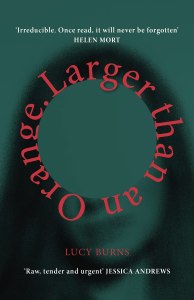 The book is, collage-like, assembled from pieces – sometimes as little as one paragraph or one line to a page – of dated autobiographical material, going back and forth between the summer of the abortion and the few-year aftermath as she suffers with irregular bleeding, chooses a new contraceptive method and has a short-term relationship; transcripts of radio debates; alphabetical lists of predicted search terms and so on. She even requests her medical records, including sections from it plus ultrasound images, and marks her baby’s would-be birthday.
I could imagine this working very well as a play for voices, especially because Burns is in the habit of counting each person she tells about the abortion and referring to them by their number until, at fifty-something, she gives up. Friends, receptionists, the people at work who adjudicate her petition to be granted two weeks’ leave: there are those she tells willingly and those she feels duty-bound to inform to explain her health or behaviour. Some remain a part of her life and others, awkward or judgemental, fade out of it.
This is a powerful read I can’t say I necessarily enjoyed, but did admire for its uncompromising clarity and honesty, and its willingness to probe both sides of ethical issues in a way that ‘good feminists’ might think they cannot.
With thanks to FMcM Associates and Chatto & Windus for the free copy for review.
Tomorrow we’ll hear the Young Writer of the Year results. My feeling is that Katherine Rundell, though already a prize winner for this book and an established author due to her children’s oeuvre, will win for Super-Infinite.
Have you read anything from this year’s shortlist?
Young Writer of the Year Award 2021 Shortlist: Reactions and Prediction
Being on the shadow panel for the Sunday Times Young Writer of the Year Award was a bookish highlight of 2017 for me and, looking back, still one of the best things I’ve achieved in my time as a book blogger. Each year I eagerly keep an eye out for the award shortlist to see how many I’ve read and who I think the judges will choose as the winner. The prize has a higher profile and cash fund this year thanks to new sponsorship from the Charlotte Aitken Trust and partnership with Waterstones.
Last May I started a list of books and authors I expected would be eligible, and continued updating it throughout the year. I was certainly expecting Open Water to make the cut, but I had a lot of other wishes that didn’t come true, particularly Charlie Gilmour for Featherhood, Daisy Johnson for Sisters, Will McPhail for In, Merlin Sheldrake for Entangled Life, and Eley Williams for The Liar’s Dictionary.
Yesterday the five nominees – three debut novels, one work of nonfiction, and one poetry collection – were announced in the Sunday Times and on the website. I happen to have already read three of them. I was vaguely interested in Megan Nolan’s novel already so will get it out from the library to read soon; I had not heard of Anna Beecher’s at all but would be willing to read a review copy if one came my way.

 Here Comes the Miracle by Anna Beecher: Sounds potentially mawkish in a Jodi Picoult or Sarah Winman way. Publisher’s blurb: “It begins with a miracle: a baby born too small and too early, but defiantly alive. This is Joe. Decades before, another miracle. In a patch of nettle-infested wilderness, a seventeen-year-old boy falls in love with his best friend, Jack. This is Edward. Joe gains a sister, Emily. From the outset, her life is framed by his. She watches him grow into a young man who plays the violin magnificently and longs for a boyfriend. A young man who is ready to begin. Edward, after being separated from Jack, builds a life with Eleanor. They start a family and he finds himself a grandfather to Joe and Emily. When Joe is diagnosed with stage 4 cancer, Emily and the rest of the family are left waiting for a miracle.”
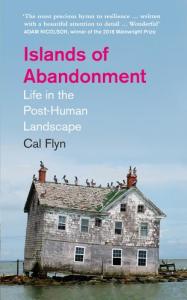 Islands of Abandonment by Cal Flyn: One of my top nonfiction books of 2021, but I’ll confess I hadn’t realized Flyn was eligible. (Now that I’m, ahem, a few years past the cutoff age myself, I can find it difficult to gauge the difference between early 30s and late 30s in appearance.) Flyn travels to neglected and derelict places, looking for the traces of human impact and noting how landscapes restore themselves – how life goes on without us. Places like a wasteland where there was once mining, nuclear exclusion zones, the depopulated city of Detroit, and areas that have been altered by natural disasters and conflict. The writing is literary and evocative, at times reminiscent of Peter Matthiessen’s. It’s a nature/travel book with a difference, and the poetic eye helps you to see things anew.
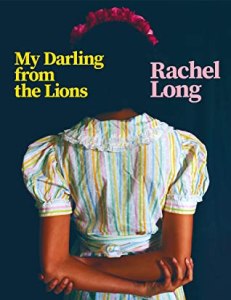 My Darling from the Lions by Rachel Long: I read this when it was shortlisted for last year’s Costa Awards and reviewed it when it was shortlisted for the Folio Prize. It’s had a lot of critical attention now, but wasn’t my cup of tea. Race, sex, and religion come into play, but the focus is on memories of coming of age, with the voice sometimes a girl’s and sometimes a grown woman’s. Her course veers between innocence and hazard. She must make her way beyond the world’s either/or distinctions and figure out how to be multiple people at once (biracial, bisexual). Her Black mother is a forceful presence; “Red Hoover” is a funny account of trying to date a Nigerian man to please her mother. Much of the rest of the book failed to click with me, but the experience of poetry is so subjective that I find it hard to give any specific reasons why that’s the case.
 Open Water by Caleb Azumah Nelson: I always enjoy the use of second person narration. It works pretty well in this love story between two young Black British people in South London. The title is a metaphor for the possibilities and fear of intimacy. The protagonist, a photographer, doesn’t know what to do with his anger about how young Black men are treated. I felt Nelson was a little heavy-handed in his treatment of this theme, though I did love that the pivotal scene is set in a barbershop, a place where men reveal more of themselves than usual – I was reminded of a terrific play I saw a few years ago, Barber Shop Chronicles. Ultimately, I wasn’t convinced that fiction was the right vehicle for this story, especially with all the references to other authors, from Hanif Abdurraqib to Zadie Smith (NW, in particular); I think a memoir with cultural criticism was what Nelson really intended. I’ll keep an eye out for him, though – with his next book he might truly find his voice.
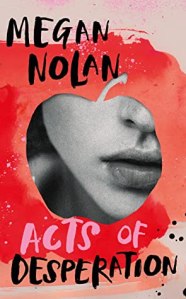 Acts of Desperation by Megan Nolan: Another debut from an Irish writer – heir to Sally Rooney? Publisher’s blurb: “In the first scene of this provocative gut-punch of a novel, our unnamed narrator meets a magnetic writer named Ciaran and falls, against her better judgment, completely in his power. After a brief, all-consuming romance he abruptly rejects her, sending her into a tailspin of jealous obsession and longing. … Part breathless confession, part lucid critique, Acts of Desperation renders a consciousness split between rebellion and submission, between escaping degradation and eroticizing it, between loving and being lovable. With unsettling, electric precision, Nolan dissects one of life’s most elusive mysteries: Why do we want what we want, and how do we want it?”
You can read more about these books and the judges’ reactions to them on the website. This year’s judges are authors Tahmima Anam, Sarah Moss, and Andrew O’Hagan; critic Claire Lowdon; and creative writing teacher Gonzalo C. Garcia. The chair, as always, is Sunday Times literary editor Andrew Holgate.
Reasoning and Prediction
- Poetry has won the last two years in a row.
- Nelson has just won the Costa First Novel Award (though the judges chose Raymond Antrobus, at that time already a recipient of multiple major awards).
- We haven’t had a female winner since 2017, so it’s past time.
- We haven’t had a nonfiction winner since Adam Weymouth in 2018 for Kings of the Yukon.
So, I’d love for Cal Flyn to win for the excellent and timely Islands of Abandonment. She’s had a few nominations (the Baillie Gifford Prize, the Saltire Award, the Wainwright Prize) but not won anything, and richly deserves to.

I haven’t heard yet if there will be a shadow panel this year. Anyone got any intel on this? If it goes ahead in person this year, I’ll hope to attend the awards ceremony in London on 24 February. In any case, I’ll be looking out for the winner announcement.
 Bookish Beck = Rebecca Foster. American transplant to England. Freelance proofreader and book reviewer.
 Bookish Beck