#ReadIndies Wrap-Up: February Releases (Jukes, Spence) & Review Catch-Up (Buttery, Foust)
Good riddance to February, which added insult to injury on its final day when my in-laws’ neighbour reversed into the car we were borrowing from a book club friend and smashed the driver’s-side window. The blue skies and crocuses of recent days have been most welcome. The best I can say for the month just departed is that I managed to review 15 books for Kaggsy and Lizzy Siddal’s Reading Independent Publishers Month challenge. These came from 10 splendid publishers: Atlantic Books, Backbone Press, Carcanet Press, Counterpoint, Elliott & Thompson, The Emma Press, Faber, Icon Books, Saraband and Sort Of Books.
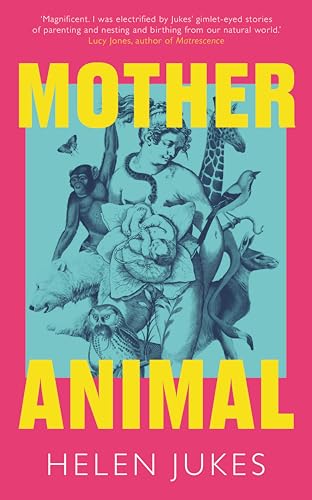
Mother Animal by Helen Jukes
When she found out she was pregnant, Jukes (author of A Honeybee Heart Has Five Openings) lost herself in research, looking for parallels in the natural world. A friend had told her that “childbirth puts you more in touch with your animal side.” Her daughter was born at the start of the pandemic and so early motherhood was perhaps more than usually isolated and emotionally challenging for her. She had an unexpected C-section after the placenta failed to nourish her daughter sufficiently, and then struggled to breastfeed. “I was, I realised, a little afraid of the baby. I’d expected to feel a sense of recognition – to see in her face some sign of familiarity,” but that wasn’t the case. “She was so … other.”
The long thematic chapters present Jukes’s experiences in parallel to those of other mothering creatures with pregnancy, birth, lactation, making a home (nesting) and enlisting the help of the community. Peppered throughout are trivia she shares with boyfriend, baby and readers. Such as that burying beetles lay eggs on a carcass so their babies feed on carrion from day one. That bonobo females attend births, acting as midwives for each other. That Madrid’s storks have started eating and lining their nests with what they find in landfill instead of migrating to Africa. The “Did you know?” litany quickly becomes precious. The details are not that interesting in themselves, and not sufficiently synthesized to be meaningful. The same factoid about leopard tree iguanas is repeated seven pages apart. A significant amount of information comes from Bitch by Lucy Cooke, which I would recommend instead.
As hybrid scientific memoirs of motherhood go, Lucy Jones’s Matrescence can’t be beat. For its social and political engagement, Jennifer Case’s We Are Animals is a valuable companion. Jukes’s offering pales by comparison because her story – not having the delivery she wanted, struggling to connect with her baby, her relationship with the father falling apart – is all too common, and she doesn’t have the scientific bona fides for readers to accept her as a valid source of zoological facts.
I would make an exception, though, for the central chapter, “Forever Milk,” which might be condensed and published in a big-name newspaper as a Rachel Carson-like exposé about endocrine disruptors and forever chemicals. Like any mother, Jukes wants nothing more than to protect her daughter, but how can she when household products (waterproof clothing, non-stick pans, cleaning sprays) contain toxic chemicals and her breastmilk is sure to be contaminated? Add in microplastics and the situation is bleak. We don’t know singly, let alone collectively, what these pollutants are doing to species in the long term, but most likely they interfere with reproduction and alter behaviour. The central message of this chapter, and the book as a whole, is that animals are amazing but vulnerable. “What is this world if nowhere is separate – nowhere safe?” If you think about this stuff much, you can’t bear it. Yet it’s a truth we all have to live with. It’s a brave author who dares sit with the unthinkable.
With thanks to Elliott & Thompson for the free copy for review.
Daughter of the Sun by Rachel Spence
 The Emma Press has published poetry pamphlets before, but this is their inaugural full-length work. Rachel Spence’s second collection is in two parts: first is “Call & Response,” a sonnet sequence structured as a play and considering her relationship with her mother. Act 1 starts in 1976 and zooms forward to key moments when they fell out and then reversed their estrangement. The next section finds them in the new roles of patient and carer. “Your final check-up. August. Nimbus clouds / prised open by Delft blue. Waiting is hard.” In Act 3, death is near; “in that quantum hinge, we made / an alphabet from love’s ungrammared stutter.” The poems of the last act are dated precisely, not just to a month and year as earlier but down to the very day, hour and minute. Whether in Ludlow or Venice, Spence crystallizes moments from the ongoingness of grief, drawing images from the natural world.
The second part of the book, “Medea’s Song,” is looser in style and more dispersed across the page. It’s a feminist reinterpretation that refuses to make of Medea a simple murderess, instead redeeming her as a wise woman. “Do not call them seers or sisters // They are the owls of history // nightfliers outliers”. I’m not drawn to Greek myth updates but I expect this would be rewarding for fans of similar projects by Fiona Benson and Anne Carson. Some of the specific vocabulary from the first section recurs, linking the two in a satisfying way.
With thanks to The Emma Press for the free copy for review.
I’m also catching up on two 2024 releases from indie publishers that I was sent for review:
Knead to Know: A History of Baking by Neil Buttery
 Not only the pun-tastic title, but also the excellent nominative determinism of chef and food historian Dr Neil Buttery’s name, earned this a place in my 2024 Superlatives post. In not quite 240 pages, it achieves the improbable, producing an exhaustive history of baked goods through miniature essays about every conceivable subcategory. Although the focus is on British baking, the story begins in ancient times with the first grains and the earliest cooking technique of making griddlecakes on a hearthstone. (Speaking of which, make sure you’re prepared for Pancake Day, aka Shrove Tuesday, this week!) Across multi-part chapters about bread, biscuits and cakes, pies and puddings, and patisserie, Buttery spotlights regional specialties, many of them familiar (Cornish pasties and Eccles cakes); a few have fallen into obscurity (Gloucester pancakes and Yorkshire Christmas pyes). Some dishes’ origin stories are apocryphal, while others can be traced back to historical cookbooks.
I was fascinated by the evolution of traditional holiday bakes. “The long tapering shape of the stollen is supposed to represent the infant Christ wrapped in His swaddling.” In general, there is just the right amount of chemistry, and while in places the writing is shaky or at least poorly edited (“populous” instead of populace!), there are good quips, too: “dried fruit haters do have a miserable time at Christmas to be fair.” I read the book in bites across a number of months, which felt appropriate because it’s more a reference text for the kitchen shelf than a narrative to read straight through. Good for picking up now and then over a cup of tea.
With thanks to Icon Books for the free copy for review.
You Are Leaving the American Sector: Love Poems by Rebecca Foust
 Foust’s fifth collection – at 41 pages, the length of a long chapbook – is in conversation with the language and storyline of 1984. George Orwell’s classic took on new prescience for her during Donald Trump’s first presidential term, a period marked by a pandemic as well as by corruption, doublespeak and violence. “Rally Insurrection” is a clever erasure poem illustrating how a propagandist might rebrand the storming of the Capitol on 6 January 2021: instead of “a mob came to Washington to / disrupt the peaceful transfer of power,” the Ministry of Truth bulletin would read “a crowd came to Washington to fight / for their country”. “Language Matters” insists that “language / is the most dangerous weapon in any totalitarian arsenal” and warns “A dictator / might do these things, but surely not // a president.” How much more strongly does this resonate in 2025.
The second and third sections engage directly with the story of Julia and Winston – the collection takes its seemingly inapt subtitle from Foust’s appreciation of 1984’s “idea of love as a subversive act affirming free will, expression, and personal privacy”. Her bold verse also confronts the repeal of abortion rights (“Breaking News”) and toxic masculinity (“Consent: A Primer”). There are some internal rhymes and slant rhymes, as well as a few end rhymes all the more striking for their rarity. I only wish this had been published a few years sooner, when its message might have seemed timelier – though, unfortunately, it is still apropos.
Some favorite lines:
“How can a future exist if we can erase or revise the past?”
“2016, dark year / of the ascension / of our Lord the Mad Clown”
“It’s happening now, / somewhere. Not here, // not yet. But so long as Big Brother is out there— / & he will always be out there—it could, // & one day, maybe it will.”
Published by Backbone Press in the USA. With thanks to the author for the e-copy for review.
Which of these appeal to you? What indie publishers have you read from recently?
 Bookish Beck = Rebecca Foster. American transplant to England. Freelance proofreader and book reviewer.
 Bookish Beck