Reading Ireland Month, Part II: Barrett, More Donoghue, O’Farrell x 2
My second set of contributions to Cathy’s Reading Ireland Month. Emma Donoghue also appeared in my first instalment of reviews. Today I’m featuring her latest novel, published just a couple of weeks ago, and taking a quick look at a few other Irish books I’ve read recently: a light-hearted debut featuring small-town criminals, and two by Maggie O’Farrell: a reread of her only nonfiction work to date (for book club), and her newest children’s book.
Wild Houses by Colin Barrett (2024)
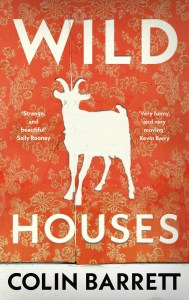 When Doll English is kidnapped by the Ferdia brothers in revenge for a huge loss on a drug deal, his girlfriend, mother and brother must go to unexpected lengths to set him free. There’s plenty of cursing and violence in this small-town crime caper, yet Barrett has a light touch; the dialogue, especially, is funny. The dialect is easy enough to decipher. Nicky, Doll’s girlfriend, lost both parents young and works in a hotel bar. She’s a strong character reminiscent of the protagonist in Trespasses. Overall, I felt that this was nicely written but that Barrett’s talent was somewhat wasted on a thin story. I’ve encountered similar plots in better books by Paul Murray and Donal Ryan. (Free from the publisher)
The Paris Express by Emma Donoghue
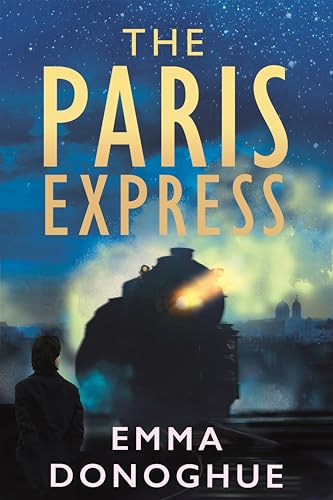 Inspired by a real-life disaster involving a train on the approach to Paris’s Montparnasse station in 1895. The Author’s Note at the end reveals the blend of characters included: people known to have been on that particular train, whether as crew or passengers; those who might have journeyed on it because they spent time in Paris at around that period (such as Irish playwright John Millington Synge); and those made up from scratch. It’s a who’s-who of historical figures, many of whom represent different movements or social issues, such as a woman medical student and an African American painter who can pass as white in certain circumstances. Donoghue clearly intends to encompass the entire social hierarchy, from a maid to a politician with a private carriage. She also crafts a couple of queer encounters.
The premise is appealing: a train hurtling toward catastrophe is in a sense a locked room, seeding much drama and intrigue. A young female radical is on board with a bomb, so all along you speculate about whether she’ll set it off and when. While I found the general thrust engaging, it was harder to develop interest in the large cast of characters. I also found the passages personifying the train (she “carries death in her belly”) hokey and thought that, as has sometimes been the case with Donoghue’s historical work, there’s too much research that’s there just for the sake of it, because she came across a fact she found fascinating and couldn’t bear to leave out (“These days every public building has three rubbish bins—one for the reclaiming of paper and cloth, the next for glass, ceramics, and oyster shells, and the last for perishables, which is where she drops the handkerchief.”). So this was enjoyable enough but not among her best.
With thanks to Picador for the proof copy for review.
I Am, I Am, I Am: Seventeen Brushes with Death by Maggie O’Farrell (2017)
 This was a reread for book club, and oh how brilliant it is. I’m more convinced than ever that the memoir-in-essays is a highly effective form because it focuses on themes or moments of great intensity and doesn’t worry about accounting for all the boring intermediate material. A few of these pieces feel throwaway, but together they form a vibrant picture of a life and also inspire awe at what the human body can withstand. No doubt on Wednesday we will each pick out different essays that resonated the most with us, perhaps because they run very close to our own experience. I imagine our discussion will start there – and with sharing our own NDEs. Stylistically, the book has a lot in common with O’Farrell’s fiction, which often employs the present tense and a complicated chronology. The present tense and a smattering of second person make the work immediate and invite readers to feel their way into her situations. Otherwise, my thoughts are as before – the last two essays are the pinnacle.
My original review from 2018:
We are, all of us, wandering about in a state of oblivion, borrowing our time, seizing our days, escaping our fates, slipping through loopholes, unaware of when the axe may fall.
O’Farrell captures fragments of her life through 17 essays on life-threatening illnesses and other narrow escapes she’s experienced. The pieces aren’t in chronological order and aren’t intended to be comprehensive. Instead, they crystallize the fear and pain of particular moments in time, and are rendered with the detail you’d expect from a scene in one of her novels. (Indeed, you can spot a lot of the real-life influences on her fiction, particularly This Must Be the Place – travels in China and Chile; eczema and stammering.)
She’s been mugged at machete point, has nearly drowned several times, had a risky first labour, and was almost the victim of a serial killer. (My life feels awfully uneventful by comparison!) But the best section of the book is its final quarter: an essay about her childhood encephalitis and its lasting effects, followed by another about her daughter’s extreme allergies. Only now, as a mother, can she understand how terrifying it must have been for her parents to wait at her side during days when she might not have survived. O’Farrell depicts parenthood better than any other author I can think of – letting those of us who haven’t experienced it do so vicariously. (Gift from my wish list)
My original rating (2018): 
My rating now: 
When the Stammer Came to Stay by Maggie O’Farrell (2024)
 This is actually her third children’s book, after Where Snow Angels Go (2020) and The Boy Who Lost His Spark (2022). All are illustrated by Daniela Jaglenka Terrazzini, who has a richly colourful and slightly old-fashioned style; she makes kids look as dignified as adults. The books are intended for slightly older children in that they’re on the longer side, have more words than pictures, and are more serious than average. They all weave in gentle magic as a way of understanding and coping with illness, a mental health challenge, or a disability.
When the Stammer Came to Stay is a perfect follow-on to I Am, I Am, I Am because it, too, draws on O’Farrell’s personal struggles. It’s the fable-like story of two sisters, Bea and Min, who share an attic room. The one is perfectly tidy; the other is a messy tomboy. When the stammer, pictured as a blob of silver ectoplasm above the shoulder, starts stealing Min’s words, they gather advice from their parents and the lodgers about how she can accept her new reality instead of fighting it or closing herself off by not speaking at all. The mycologist’s symbiosis metaphor is perhaps a bit too neat, but it contrasts with the impish connotations of the dibbuk, another useful parallel the girls discover. With this I’ve now read O’Farrell’s complete published works!
Love Your Library Begins: October 2021
It’s the opening month of my new Love Your Library meme! I hope some of you will join me in writing about the libraries you use and what you’ve borrowed from them recently. I plan to treat these monthly posts as a sort of miscellany.
Although I likely won’t do thorough Library Checkout rundowns anymore, I’ll show photos of what I’ve borrowed, give links to reviews of a few recent reads, and then feature something random, such as a reading theme or library policy or display.

Do share a link to your own post in the comments, and feel free to use the above image. I’m co-opting a hashtag that is already popular on Twitter and Instagram: #LoveYourLibrary.
Here’s a reminder of my ideas of what you might choose to post (this list will stay up on the project page):
- Photos or a list of your latest library book haul
- An account of a visit to a new-to-you library
- Full-length or mini reviews of some recent library reads
- A description of a particular feature of your local library
- A screenshot of the state of play of your online account
- An opinion piece about library policies (e.g. Covid procedures or fines amnesties)
- A write-up of a library event you attended, such as an author reading or book club.
If it’s related to libraries, I want to hear about it!
Recently borrowed


Stand-out reads
The Echo Chamber by John Boyne
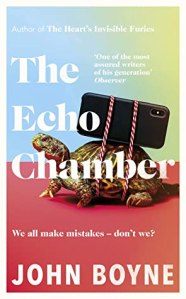 John Boyne is such a literary chameleon. He’s been John Irving (The Heart’s Invisible Furies), Patricia Highsmith (A Ladder to the Sky) and David Mitchell (A Traveller at the Gates of Wisdom). Now, with this Internet-age state-of-the-nation satire featuring variously abhorrent characters, he’s channelling the likes of Jamie Attenberg, Jonathan Coe, Patricia Lockwood, Lionel Shriver and Emma Straub. Every member of the Cleverley family is a morally compromised fake. Boyne gives his characters amusing tics, and there are also some tremendously funny set pieces, such as Nelson’s speed dating escapade and George’s public outbursts. He links several storylines through the Ukrainian dancer Pylyp, who’s slept with almost every character in the book and has Beverley petsit for his tortoise.
What is Boyne spoofing here? Mostly smartphone addiction, but also cancel culture. I imagined George as Hugh Bonneville throughout; indeed, the novel would lend itself very well to screen adaptation. And I loved how Beverley’s new ghostwriter, never given any name beyond “the ghost,” feels like the most real and perceptive character of all. Surely one of the funniest books I will read this year. (Full review). 
Beautiful World, Where Are You by Sally Rooney
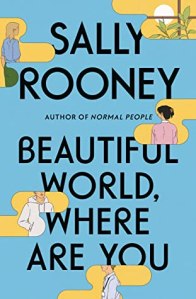 I was one of those rare readers who didn’t think so much of Normal People, so to me this felt like a return to form. Conversations with Friends was a surprise hit with me back in 2017 when I read it as part of the Sunday Times Young Writer of the Year Award shadow panel the year she won. The themes here are much the same: friendship, nostalgia, sex, communication and the search for meaning. BWWAY is that little bit more existential: through the long-form e-mail correspondence between two friends from college, novelist Alice and literary magazine editor Eileen, we imbibe a lot of philosophizing about history, aesthetics and culture, and musings on the purpose of an individual life against the backdrop of the potential extinction of the species.
Through their relationships with Felix (a rough-around-the-edges warehouse worker) and Simon (slightly older and involved in politics), Rooney explores the question of whether lasting bonds can be formed despite perceived differences of class and intelligence. The background of Alice’s nervous breakdown and Simon’s Catholicism also bring in sensitive treatments of mental illness and faith. (Full review).
This month’s feature
I spotted a few of these during my volunteer shelving and then sought out a couple more. All five are picture books composed by authors not known for their writing for children.
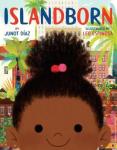 Islandborn by Junot Díaz (illus. Leo Espinosa): “Every kid in Lola’s school was from somewhere else.” When the teacher asks them all to draw a picture of the country they came from, plucky Lola doesn’t know how to depict the Island. Since she left as a baby, she has to interview relatives and neighbours for their lasting impressions. For one man it’s mangoes so sweet they make you cry; for her grandmother it’s dolphins near the beach. She gathers the memories into a vibrant booklet. The 2D cut-paper style reminded me of Ezra Jack Keats.
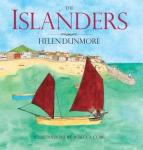 The Islanders by Helen Dunmore (illus. Rebecca Cobb): Robbie and his family are back in Cornwall to visit Tamsin and her family. These two are the best of friends and explore along the beach together, creating their own little island by digging a channel and making a dam. As the week’s holiday comes toward an end, a magical night-time journey makes them wonder if their wish to make their island life their real life forever could come true. The brightly coloured paint and crayon illustrations are a little bit Charlie and Lola and very cute.
 Rose Blanche by Ian McEwan (illus. Roberto Innocenti): Patriotism is assumed for the title character and her mother as they cheer German soldiers heading off to war. There’s dramatic irony in Rose being our innocent witness to deprivations and abductions. One day she follows a truck out of town and past barriers and fences and stumbles onto a concentration camp. Seeing hungry children’s suffering, she starts bringing them food. Unfortunately, this gets pretty mawkish and, while I liked some of the tableau scenes – reminiscent of Brueghel or Stanley Spencer – the faces are awful. (Based on a story by Christophe Gallaz.)
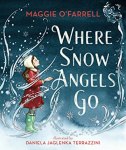 Where Snow Angels Go by Maggie O’Farrell (illus. Daniela Jaglenka Terrazzini): The snow angel Sylvie made last winter comes back to her to serve as her guardian angel, saving her from illness and accident risks. If you’re familiar with O’Farrell’s memoir I Am, I Am, I Am, this presents a similar catalogue of near-misses. For a picture book, it has a lot of words – several paragraphs’ worth on most of its 70 pages – so I imagine it’s more suitable for ages seven and up. I loved the fairy tale atmosphere, touches of humour, and drawing style.
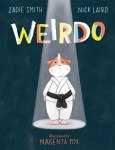 Weirdo by Zadie Smith and Nick Laird (illus. Magenta Fox): Kit’s birthday present is Maud, a guinea pig in a judo uniform. None of the other household pets – Derrick the cockatoo, Dora the cat, and Bob the pug – know what to make of her. Like in The Secret Life of Pets, the pets take over, interacting while everyone’s out at school and work. At first Maud tries making herself like the others, but after she spends an afternoon with an eccentric neighbour she realizes all she needs to be is herself. It’s not the first time married couple Smith and Laird have published an in-joke (their 2018 releases – an essay collection and a book of poems, respectively – are both entitled Feel Free): Kit is their daughter’s name and Maud is their pug’s. But this was cute enough to let them off.
 Bookish Beck = Rebecca Foster. American transplant to England. Freelance proofreader and book reviewer.
 Bookish Beck