Autumn Reads: Don Freeman, Seamus Heaney, Jo Lindley, Alice Oseman
I keep a whole box full of future seasonal reads. Winter is the largest contingent because it includes Christmas, cold, snow and ice; followed by summer, which also covers heat, sun and so on. Every once in a while, I’ll come across a spring-related book. Autumn may be great for misty canal walks, vibrant leaves and variegated squashes, but it’s the hardest of the seasons to find books for. I’ve read all the obvious ones by now. Some of the below connections are more abstract but not too much of a stretch, I hope.


Corduroy by Don Freeman (1968)
Autumn is when I wear the most corduroy, sometimes (accidentally) head to toe.
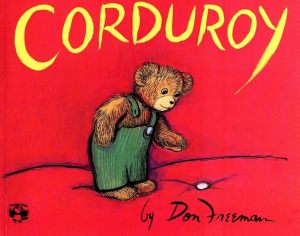
 I knew I’d read this as a child, but didn’t expect individual pages to feel so familiar. It must have been on frequent rotation in my house growing up. Corduroy the bear is among the toys on offer in a large department store. One morning Lisa, a little Black girl, picks him out, but her mother says no, they’ve spent too much already – and besides, the toy is damaged. He didn’t realize until her mother said: his green overall is missing a button. That night he rides the escalator to go look for the button, thinking he’ll never be loved until he’s complete. His adventure doesn’t turn out as planned, but Lisa hasn’t stopped thinking about him. Long before Toy Story, here was a sweet book about what toys get up to when we’re not around. And the repeated expressions of the bear’s meek wonderment – “This must be home,” “You must be a friend” – gave me the warm fuzzies. (Little Free Library)
Field Work by Seamus Heaney (1979)
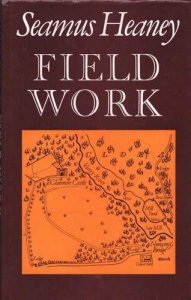 Harvest is a secondary theme in this poetry collection, which also has an overall melancholy tone that seems appropriate to the season of All Souls. Two poems are headed “In Memoriam” and another is titled “Elegy.” Even when they are not the stated topic, the Troubles rear up, as in the first section of “Triptych”: “Two young men with rifles on the hill, / Profane and bracing as their instruments. // Who’s sorry for our trouble?” The countryside can nevermore be an idyll when armoured cars and bombs could be anywhere. “The end of art is peace,” a late line from “The Harvest Bow,” may well be the poet’s motto (so long as “end” is interpreted as “goal”). There is a sequence of 10 sonnets and several poems devoted to animals. I experience Heaney’s poetry as linguistically fertile and formally rigorous; probably best heard out loud. (Secondhand – Oxfam, Marlborough)
Autumnal passages I marked:
“We toe the line / between the tree in leaf and the bare tree.” (from “September Song”)
“the sunflower, dreaming umber” (from “Field Work”)
“A rowan like a lipsticked girl” (from “Song”)
“the sunset blaze / of straw on blackened stubble, a thatch-deep, freshening barbarous crimson burn” (from “Leavings”)
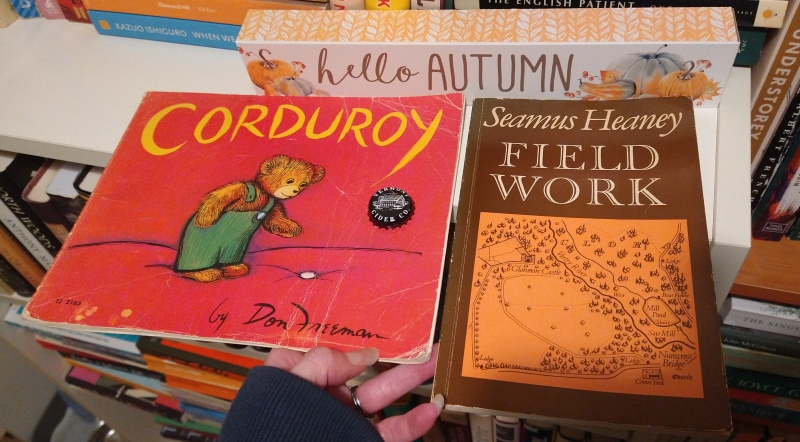
But none of those stood out to me as much as “Oysters,” the opening poem, which I photographed here. I’ve read and savoured every line of it five times now. It’s gold.
Hello Autumn by Jo Lindley (2023)
 Depicted as elfin children, the seasons take turns wearing a single crown. Autumn is a timid soul worried about what might go wrong. But when one of the others is at risk, he rushes to help even if it might take him outside his comfort zone. By doing so, he realizes how much there is to enjoy in every season. This is part of a didactic series (Little Seasons/Best Friends with Big Feelings) about coping with anxiety. I’m surprised it wasn’t classified in the mostly-nonfiction “Family Matters” section of the children’s library, which includes books on feelings, illnesses, death, divorce, siblings, first experiences, etc. It was a little heavy-handed for me and I wasn’t sure why the characters had to be elves. (Public library)
Heartstopper: Volume 1 by Alice Oseman (2019)
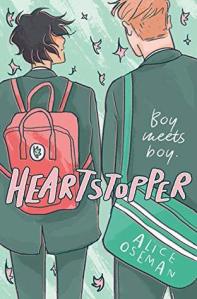 I’ve been rereading the series through the hardback reissue; I’m now on Volume 5 (and WHERE is Volume 6, huh?). I’ve included the first book because of the falling leaves motif on the cover, which fits the back-to-school vibe. (Public library)
What I thought this time: Just as cute the second time around. All the looks, all the blushes, all the angst! I’d forgotten the details of how Nick and Charlie met and got together. Single best page: when Tori appears out of nowhere and says to Charlie of Nick, “I don’t think he’s straight.”
Original review: It’s well known at Truham boys’ school that Charlie is gay. Luckily, the bullying has stopped and the others accept him. Nick, who sits next to Charlie in homeroom, even invites him to join the rugby team. Charlie is smitten right away, but it takes longer for Nick, who’s only ever liked girls before, to sort out his feelings. This black-and-white YA graphic novel is pure sweetness, taking me right back to the days of high school crushes.
 Bookish Beck = Rebecca Foster. American transplant to England. Freelance proofreader and book reviewer.
 Bookish Beck