Where My Books Come From
This challenge Laura (Reading in Bed) posted the other day is just too fun for me to pass up, plus it allows me to get a jump on my 2017 statistics. The idea is to look at the last 30 books you’ve read and note where you got hold of each one – whether from the publisher, the library, new or secondhand at a bookshop, etc. If you wish, you can also look at the whole year’s books and work out percentages. Leave a comment to let me know what you figure out about your own books’ provenance.

My bedside table (and environs): always a mix of secondhand, library and review copies.
Fall Down 7 Times Get Up 8: A Young Man’s Voice from the Silence of Autism, Naoki Higashida: Public library
A Girl Walks into a Book: What the Brontës Taught Me about Life, Love, and Women’s Work, Miranda K. Pennington: E-book from Edelweiss
The Great Profundo and Other Stories, Bernard MacLaverty: Secondhand copy from Book-Cycle, Exeter
Dakota: A Spiritual Geography, Kathleen Norris: Free from the Book Thing of Baltimore
Finding Myself in Britain: Our Search for Faith, Home and True Identity, Amy Boucher Pye: Christmas gift from my Amazon wish list last year
No Apparent Distress: A Doctor’s Coming-of-Age on the Front Lines of American Medicine, Rachel Pearson: PDF from publisher
At Seventy: A Journal, May Sarton: Secondhand copy from Wonder Book and Video
A Wood of One’s Own, Ruth Pavey: Free from publisher
A Sand County Almanac and Sketches Here and There, Aldo Leopold: University library
Ghost Stories of an Antiquary Vol. II, M.R. James: Free from publisher
This Little Art, Kate Briggs: Free from publisher
Reputations, Juan Gabriel Vásquez: Gift from a Goodreads friend
The Rector’s Daughter, F.M. Mayor: Secondhand copy from a charity shop
An English Guide to Birdwatching, Nicholas Royle: Gift from a Goodreads friend
The Fact of a Body: A Murder and a Memoir, Alexandria Marzano-Lesnovich: E-book from Edelweiss
Unruly Creatures: Stories, Jennifer Caloyeras: PDF from author
One Year Wiser: An Illustrated Guide to Mindfulness, Mike Medaglia: Free from publisher
A Glorious Freedom: Older Women Leading Extraordinary Lives, Lisa Congdon: PDF from publisher
Dreadful Wind and Rain: A Lyrical Fairy Tale, Diane Gilliam: Won in Twitter giveaway
As a God Might Be, Neil Griffiths: Free from publisher
Devil’s Day, Andrew Michael Hurley: E-book from NetGalley
Interlibrary Loan Sharks and Seedy Roms: Cartoons from Libraryland, Benita L. Epstein: University library
Skating at the Vertical: Stories, Jan English Leary: E-book from NetGalley
Master Georgie, Beryl Bainbridge: Free from work staff room years ago
The Immortalists, Chloe Benjamin: Free proof copy for Bookbag review
Jacob’s Room Is Full of Books, Susan Hill: Free from publisher
Slade House, David Mitchell: Public library
The Lauras, Sara Taylor: Free for Sunday Times Young Writer of the Year Award shadow panel reading
Survival Lessons, Alice Hoffman: Birthday gift from my Amazon wish list
A Field Guide to the North American Family, Garth Risk Hallberg: Free from publisher
And the statistics for 2017 so far:
- Free print or e-copy from publisher: 30.11% (Wow – how lucky am I?!)
- Downloaded from NetGalley or Edelweiss: 22.3%
- Public library: 18.22%
- Secondhand purchase: 15.24%
- Free (other) = from giveaways or Book Thing of Baltimore: 6.69%
- Gifts: 6.32%
- University library: 1.12%
Five Reasons I Love My E-Readers
As an inveterate book sniffer and hoarder of musty paperbacks, I was always skeptical about e-readers—that is, until I got my first one three years ago. A birthday present from my husband, my Nook soon became an essential tool in my working life. A year and a bit later, I was sent a Kindle on “permanent loan” through one of my reviewing gigs, and it has quickly become one of my most prized possessions. I know some of my blog readers don’t read e-books at all, and I can sympathize with certain of your feelings. But here are five reasons I love my e-readers, followed by why they will never replace print books for me.
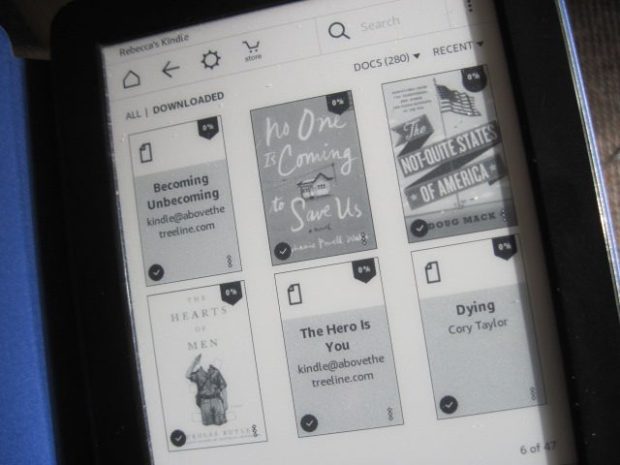
Some recent and upcoming titles I’m keen to try.
- A portable library. I often have between 250 and 300 books on my Kindle. Hundreds of books right at my fingertips, all in a slim 4 x 6 ″ rectangle! If I’m ever stuck somewhere due to delayed or broken-down transport, I’ll never be without ample choices of reading material. E-readers are perfect for cutting down on luggage when traveling (I had to cull 14 books from my suitcase on my last trip to America to stay under the weight limit) and are my usual choice for reading in the car. The Nook’s built-in light is especially useful on nighttime drives. As much as I love my print library, moving house frequently—as we have done over the past decade—always reminds you just how much weight and space books represent.
- Digital review copies. Being willing and able to read PDF and ePUB books is the only thing that has allowed me to work for lots of American companies, which is where the reviewing money seems to be. I can also request advance access to books through NetGalley and Edelweiss, particularly titles not yet published in the UK; and any Kindle downloads do not expire. When traveling I have occasionally found it useful to put other kinds of documents on my Kindle as PDFs, too, like maps and confirmation e-mails. Since I’ve never had a smartphone, this is a kind of compromise between all print and all online.
- Searching and fact-checking. My e-readers’ search function has been invaluable when writing reviews. Often I’ll need to check facts like a character’s last name, the exact city in California, when someone makes their first appearance, or how often a particular word or phrase appears. For instance, I felt that a certain quotation was overused in a memoir, so did a search for it and, indeed, found 12 occurrences!
- Moving between books. I generally have 3 or 4 Kindle books of different genres on the go at any one time, and it couldn’t be easier to move between them with a few finger taps. I’ll often switch books after every couple of chapters, or when I reach a milestone percentage.
- Perfect for certain situations. An e-reader is less obtrusive for reading in public, especially now that etiquette doesn’t seem to preclude phone and tablet use in company. It’s also easier to get one out when you’re going just a few stops on a crowded subway system. I turn to my Kindle for reading over solitary meals/snacks or any other activity that requires my hands, like using a hairdryer. When I think about the lengths I once went to in my former life as a library assistant to read print books—holding pages open with a precariously balanced apple or the edge of a plate during meal breaks; hiding books under the service desk for surreptitious reading at a quiet moment—I think how silly I was not to get an e-reader sooner!
Some of my current reading and review books.
Yet there are definitely things I don’t like about using an e-reader:
- E-books don’t feel like “real” books; I treat them as temporary and disposable and don’t do any nostalgic rebrowsing.
- Battery life can be an issue, though not as often as you might think. (During a period of average use my Kindle probably lasts two weeks, and you can charge it either via a USB cable or at a wall plug.)
- My Nook has a pretty small capacity.
- There are no page numbers on Kindle, just percentages and numerical locations.
- (A pathetic admission) I still haven’t figured out how to highlight passages on my e-readers!
- Because I’m fine with e-copies I don’t get free print books out of most of my review gigs.
- I can’t easily browse the covers/blurbs/first few pages of books to remind myself what they are and decide what I’m in the mood for—as a result, there are dozens of books on my Kindle whose titles I barely recognize.
- I sometimes wonder whether my concentration on and retention of words read on a screen are inevitably lower.
I still love books as physical objects: beautiful covers, delicious smells, the heft of them in your hand and the chance to flick through pages. I like having big stacks of them around as visible signs of progress made and challenges still to come. Arranging and rearranging my library on bookshelves is a periodic treat. So although my e-readers are extremely useful tools, using them is not an unadulterated joy; they will only ever supplement paper books for me, not replace them. I think it’s telling that when given a choice between print and electronic formats—like if I come across an available public library copy of a book I know I have on my Kindle—I’ll choose the print book every time.
How do you feel about e-readers?
How Many Books Is Too Many? (to be reading at once)
You can never have too many books. But it’s entirely possible to have too many on the go at one time, or too many on the physical to-read pile (as opposed to the virtual to-read list; mine currently numbers in the thousands over at Goodreads). I was prompted to think about this at the end of 2014, when I went around our flat and counted all my owned but unread books that I still wanted to read. At that point I counted 155.
One of my reading goals for 2015 was born: I would attempt to read more of the books I actually own – at least enough to keep pace with my secondhand book buying habit. So yesterday afternoon, expecting to be heartened by my progress, I did a recount. Result? 180.
WHAT?! The number went up! Gah!
It must be that all-paperbacks-for-£1 shopping spree we did at the bookshop in Henley-on-Thames…and then I brought some books back in my suitcase on our last trip to America…plus a few more review copies have arrived.
There are books all over the flat: in the spare room, on the bedroom bookcase, on the bedside tables, on the hallway bookcase, on a big four-shelf case in the lounge, on desk shelves, even in an overflow area on the shelving unit of board games, jigsaw puzzles, CDs and DVDs.
And that’s not counting the dozens of approved e-books awaiting download on NetGalley and Edelweiss, and the others already on my Nook and Kindle e-readers. It’s nigh on impossible to say no to free books, after all.
Okay, so I’ve established that I have a book hoarding obsession that extends into both the print and electronic realms. (It’s no surprise I worked for a website called Bookkaholic for two years, is it?) But is this really such a problem? It’s somehow comforting to know that I’ll never run out of reading material.
A related concern, though, is this: Am I reading too many books at once? I have 13 on the go at the moment (8 print and 5 electronic). Especially since I got my Nook, I find that I’ve developed a kind of ADHD when it comes to books. It’s so easy to click from one book to another that I sometimes don’t stick with one for more than a chapter at a time. Sometimes, if I’m in a rut, I’ll read the first few pages of 10 or more books before I manage to settle on one.
Up until college, I was the kind of person who faithfully read just one book at a time. Since then, though, I’ve become convinced of the merit of having two or more on the go at a time: at least one novel and at least one work of nonfiction, maybe with some poetry thrown in. If you have nonfiction from very different genres – for instance, a spiritual autobiography and a nature book; or a travel book and a foodie memoir – you could read multiple nonfiction books at the same time.
The benefits are multiple.
- If you’re bored with one book, spend time with another one. You can always go back.
- Sometimes a pairing is fortuitous – what you’re learning in one book will have bearing on another, or the same historical figure will turn up in both.
- The psychological burden of having a tall stack of books staring you down may encourage you to read more.
Yet there are disadvantages.
- With novels and short story collections, you may get characters and storylines mixed up if you have too many in your head at once.
- You’ll make progress in all the books more slowly.
- If you get gripped by one, you might abandon the others temporarily.
Your turn:
How many books do you read at once?
What do you think is an ideal number?
How do you manage your (physical or virtual) to-read shelf?
 Bookish Beck = Rebecca Foster. American transplant to England. Freelance proofreader and book reviewer.
 Bookish Beck