Three on a Theme: English Seasons and Flora (Brazier, Lamb and Parker)
These three books trace the turning of a typical year of the English seasons, especially as experienced through flora: produce for a veg stall, plants laid into a traditional hedge, and “weeds” celebrated for their wild beauty.
The Honesty Box: The diary of a broken marriage, a mental health crisis and a large marrow by Lucy Brazier (2025)
 From one Christmas season to the next, Brazier highlights the delights and challenges of rural living (in the Bridport–Lyme Regis area of Dorset). She takes on a project of setting up and stocking her own honesty box – an unmanned roadside produce stall where visitors pay into a cashbox – with garden produce, preserves and baked goods, plus friends’ crafts. All along, her marriage is in an extended, low-level crisis: Steve’s bluntness, lack of social skills, and panicked inability to do his share of household tasks have long been issues. When he gets a combined ADHD and autism diagnosis, he has a roadmap but no easy solution. Going on medication and finding peers in a similar situation help somewhat, but he still struggles.
Brazier draws clever parallels between the turning of the seasons and the ebb and flow of a marriage. Wild swimming with friends and countryside walks with Margot the dog are ways of communing with nature. She incorporates all the daily concerns of her midlife existence, including home repairs, menopause and seeing Raff, the oldest of their three children, off to university. Brazier used to be a PFD talent agent in London, dealing with the likes of Anna Maxwell Martin, then worked for Hugh Fearnley-Whittingstall and his River Cottage cookery empire (she wrote their Christmas book); she’s now a freelance ghostwriter. She’s gently nostalgic for the days of balancing early motherhood and a stressful career, but also grateful for the slower pace of life she’s found in the countryside. There are also some amusingly ill-fated holidays (camping and boating), contrasted with a luxurious one in Italy.
It’s all very affable, the month-by-month present-tense write-ups offering an appealing blend of realism about life’s unpredictability and strategies for muddling through. While it may mean most to women of a certain age or those with neurodivergence in the family, anyone in a long-term relationship will find much to relate to. (Public library) 
Of Thorn and Briar: A Year with the West Country Hedgelayer by Paul Lamb (2025)
I picked this up after it was shortlisted (and highly commended) for the Wainwright Prize for Nature Writing. Lamb’s lifestyle could be from the 19th century: he lives in a sparse, cosy wagon, driving it from place to place and pausing for weeks-long projects laying traditional hedges across southwest England. Autumn through late winter is his key work period, to avoid the bird-nesting season. It’s gruelling physical labour. Sometimes he sees he’s made a difference; when he gets discouraged, he has to remind himself to take a longer view. “The hedger, like the forester, has to think of his work not as something completed in days or weeks or even months, but instead in years, decades and centuries.” Lamb can’t help but notice the daily shifts in weather adding up to changing seasons; it all affects his daily work.
 This gets reasonably technical about the different qualities of tree species and what they’re like to work with. I learned, or at least was reminded of, the vocabulary word “pleaching,” which means cutting a thin tree trunk vertically – almost but not all the way through – and laying horizontal branches into the crease. It takes skill to describe practical actions in a way that laypeople can picture. However, this account, which covers one August through the following July, is quite monotonous and repetitive. I blame the simple past-tense narration, which quickly becomes an ‘I did this, then I did that’ rundown and had me skimming more than half of the time. Literary techniques would have helped break up the format: extended flashbacks to his apprenticeship or family life, more scenes and dialogue, and some lyrical or imagined passages. (There is one particularly nicely done Hardy-esque vignette where he converses with Dorset locals in a pub.)
During the pandemic, Lamb’s daughters encouraged him to start an Instagram account, which now has 195,000 followers. No doubt it was his social media fame that led to this book deal. His writing, though serviceable, lacks sparkle. I enjoyed it as a window onto a rare profession and nearly forgotten way of life, but would hesitate to recommend unless you have patience and a greater-than-average interest in the subject matter. (Public library) 
Understorey: A Year Among Weeds by Anna Chapman Parker (2024)
 (One of my best backlist reads of last year.) Parker set out to study and sketch weeds as a way of cultivating attention and stillness as well as celebrating the everyday and overlooked. Her quick black-and-white drawings and written observations bear witness to the seasons changing but also to the minute alterations she observes in herself and her children. Here are a couple of examples of shorter entries:
25 April
Wild garlic flowers are explosive. As so often in drawing[,] there is a slippery negotiation between fidelity (getting the shape right) and spirit (capturing the feel of it). By the third drawing I’ve got my eye in and the balance between the two is nearer the mark. If I stayed here a week in the grass, drawing a single flower in a single stroke with my eyes closed, maybe eventually I’d hit it bang-on true.
10 December
On my way back from the shops, I find myself detouring to check in on the sowthistle again. Its leaves are drier now and the crisping at the edges is spreading inward. The leftward lean is more pronounced. A few more of the flowers have gone over. But there’s something else, as well – some impression of a former intimacy. A sensation not only of the past flower, but of my past self here, two days ago. Through the drawn encounter, the plant allows me to recognise myself, passing.
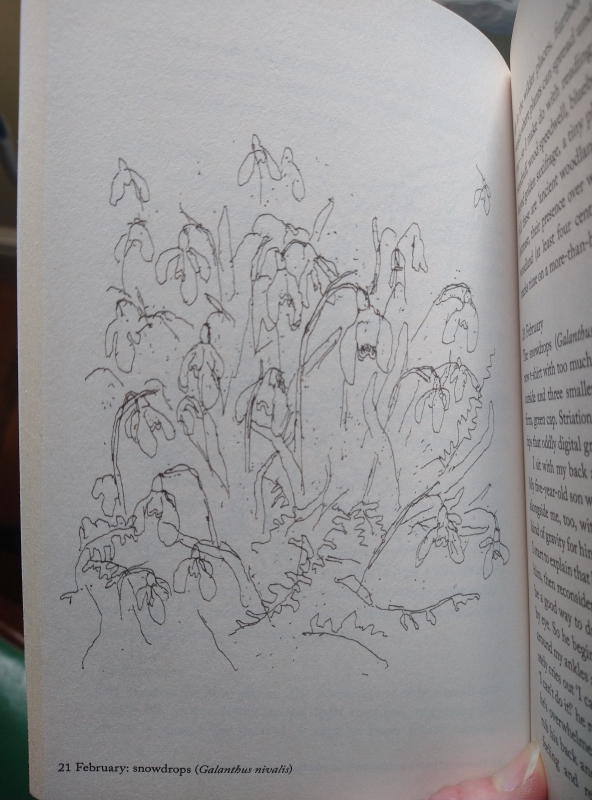
Taking a half-hour out of her day to find a subject feels transgressive in one sense, but dutiful – even holy – in another. Along with her frequent illustrations, there are reproductions of other artworks that depict wildflowers in situ, such as Albrecht Dürer’s Great Piece of Turf (1503). The tone is high-brow, meditative, introspective as she focuses on being present. This was just my kind of nature book, and all the more special because I’ve holidayed in her home of Berwick-on-Tweed so could picture some of the ‘overgrown’ spaces she honours. 
With thanks to Duckworth for the proof copy for review.
20 Books of Summer, #3–4: Ella Minnow Pea & Eating for England
June hasn’t seen much progress on this project – though I’m currently on my fifth read, Kitchen Confidential by Anthony Bourdain, and enjoying it a lot – so July and August will need to include eight food- and drink-themed books each.
Today I have a reread of a funny (yet more serious than I remembered) favorite and a light collection of mini-essays on the English love affair with particular foodstuffs.
Ella Minnow Pea by Mark Dunn (2001)
From my original Bookkaholic review from 2013:
Dunn’s debut is a book of letters – in more senses than one. It is a fairly traditional epistolary novel, but also toys with the letters of the alphabet: the wordy citizens of the island nation of Nollop are zealously engaged in creating pangrams (pithy sentences that contain each letter of the alphabet) in tribute to their founder, Nevin Nollop, who authored “The quick brown fox jumps over the lazy dog,” the original pangram displayed in ceramic tiles on his statue in the public square. But things go awry when particular letters start falling off the monument.
A superstitious lot, the Nollop Council decide that the fallen letters can no longer be used, and the characters’ missives become increasingly constrained as they have to avoid certain vowels and consonants. Their writing grows exponentially avant-garde and hilarious as they resort to circumlocutions and phonetic spellings. Before long only L, M, N, O, and P can be used – which, handily, still allows for an approximation of the title character’s name. A madcap journey through the English language and its use in literature: enjoy the ride.
On this rereading…
 I engaged more with the individual characters: Ella and her parents, aunt and cousin; other members of the community; and a few off-island visitors who lead the research into what’s happening with the letters. I was also struck much more by the political satire: freedom of speech is endangered in a repressive society slavishly devoted to a sacred text. Those who continue to use forbidden letters are turned in by their neighbors or enemies and get 1) a warning, 2) a flogging or time in the headstocks, and 3) banishment. The council members see themselves as interpreting the will of Nollop, and believe the pangram to be a miraculous sentence that can never be bettered – but the citizens prove them wrong by creating a superior example (using only 32 letters, versus the fox’s 35) purely by accident.
A remembered favorite line that my husband and I often quote to each other – “No mo Nollop poop!” – doesn’t exist (it’s actually “No mo Nollop pomp! No mo Nollop poo poo!”). My favorite alternative phrase is “terminal-cot” for deathbed once D is disallowed. I also love the new days of the week: Sunshine, Monty, Toes, Wetty, Thurby, Fribs and Satto-Gatto.
Laugh-out-loud silliness plus a sly message about science and reason over superstition: a rare combination that makes this an enduring favorite. I also recommend Dunn’s Ibid: A Life (2004), which is told entirely through the footnotes of a biography, taking “reading between the lines” to a whole new level. I haven’t enjoyed his other novels as much as these two.
Source: Salvation Army store, Cambridge (September 2016)
My original rating (Borrowed from a friend – in 2007?): 
My rating now: 
Eating for England by Nigel Slater (2007)
 Nigel Slater is a foodie known in the UK for his television programs and newspaper columns. Not as edgy as Gordon Ramsay, as matey as Jamie Oliver, or as ethically clued-in as Hugh Fearnley-Whittingstall, he doesn’t have a particular shtick. A middle-of-the road, middle-class type, he’s all about simple comfort food. We have a few of his cookbooks.
As in his memoir, Toast (2004), food links in to nostalgia for childhood. In 200 or so essays that range from a paragraph to a few pages in length, Slater extols everything from marmalade to Brussels sprouts. He devotes by far the most time to the sweet stuff, though, considering the respective merits of every type of biscuit, candy, chocolate bar and pudding. There’s a clear love here for teatime treats (“Afternoon tea may be the only meal we take that is purely and utterly for pleasure”) and for stodge (“Is there something in our demeanour, our national psyche, which makes heavy, rather bland food sit so comfortably with us?”).
This was all pleasant, if inconsequential. I enjoy ‘observing the English’-type books because I’m familiar enough to recognize everything but still foreign enough to enjoy the quaintness and contradictions. What rubbed me the wrong way, though, were the arch portraits of kinds of cooks. I don’t often write in my books, but I found myself leaving corrective comments in the margins in a few places, especially on “The Slightly Grubby Wholemeal Cook,” an unhelpful stereotype of the “dirty hippie.” His ideas about hygiene and political correctness are a little off in this one. I also objected to his annoyance at people who won’t simply split the bill after a meal out (I’ll pay for what I ordered, thank you), and his defense of the gollywog used in Robertson’s advertising seems particularly ill judged at the current moment.
Source: Charity shop in Newton Stewart (Wigtown trip, April 2018)
My rating: 
A Nonfiction Bonanza
For much much of the summer I was sunk deep into several very good but not particularly page-turning works of nonfiction from my shelves. I spent months reading some of them, which is very unusual for me and often a sign that I’m not enjoying something, but this time that wasn’t the case. One of these nonfiction reads – the Fermor – ended up being among my favorite books of the year so far. Below I give quick write-ups of what I’ve finished lately and recall how these books came to be in my collection.
 Lincoln: A Foreigner’s Quest by Jan Morris: Like grape jelly, the obsession with Abraham Lincoln was something about American life that world traveler Jan Morris could never understand. Here she sets out to discover the melange of history and myth that composes the 16th president. She succeeds in giving not only the salient facts of Lincoln’s life but also a fair assessment of his character, in a lighthearted and accessible book that has neither the heft nor the heavygoing tone of a standard biography. Her discussion of his rhetorical style is especially good, and in a few passages she imagines the reader into scenes. Here’s one of the best pithy observations: “Academic historians cannot allow themselves such flip idiomatic judgments, but to an outsider like me that seems about the truth of it. He was a nice man. He could be scheming, irritable, disingenuous, but he was never pompous or overbearing.” [Remainder copy bought for $3.99 at Wonder Book and Video, Frederick, Maryland.]
 The Omnivore’s Dilemma by Michael Pollan: I made the mistake of reading this a decade after its publication, which means I already knew most of its facts about industrialized farming and the insidiousness of processed foods. I found Part I to be overly detailed and one-note, constantly harping on about corn. The book gets better as it goes on, though, with Pollan doing field research at Joel Salatin’s Polyface Farm in Virginia to compare large-scale organic agriculture with more sustainable grassroots operations. Pollan’s assessment of the ethics of eating meat is not quite as thorough as Jonathan Safran Foer’s (in Eating Animals), but he does a good job of showing all sides of the issue. This would make an excellent, comprehensive introduction to where food comes from for people who have never given it much thought. But then again, the people who need it most would never pick up a dense 400+-page book by a liberal journalist. [Bought in one of the Hay-on-Wye shops for £2.]
 The Naming of the Shrew by John Wright: Wright is known in the UK as TV chef Hugh Fearnley-Whittingstall’s go-to expert on foraging, especially fungi. His enthusiasm for the arcane details of Latin naming comes through clearly in this thorough history of taxonomy. At first I thought it would be a groaningly pun-filled book of arbitrarily arranged trivia, but by Chapter 2 Wright won me over. You’ll learn all about Carl Linnaeus and the taxonomists who preceded and followed him; rules for species naming and the meaning of common Latin prefixes and suffixes; the wildly divergent sources of names, from discoverers’ names to mythology; and the endless complications of a field where species are always being lumped, split, or re-evaluated. One of my favorite facts was that aloe vera and the boa constrictor are among the few species whose English names are the same as their Latin ones. [A birthday gift from my brother-in-law last year.]
 A Time of Gifts by Patrick Leigh Fermor: A true masterwork of travel writing. Over the course of three years, starting when he was just 18, Fermor walked from Holland to Constantinople. I was particularly eager to read this because he passes through a lot of places I went on my travels this past summer, including Germany, Austria and Bratislava. This first of three volumes covers up until his entry into Hungary. His descriptions of the landscape and the people he interacted with are as fresh as if they happened yesterday, and yet he was reconstructing this journey nearly 40 years after the fact. Although he was basically traveling rough, he managed to wangle invitations into castles and aristocrats’ homes. This gives him a broad base of observation such that you feel you’re getting a complete picture of European life in the early 1930s. It’s a precious glimpse of pre-war history, but Fermor doesn’t use too heavy a hand when recalling signs of rising Nazism. Lastly, this is simply damn fine writing:
Beer, caraway seed, beeswax, coffee, pine-logs and melting snow combined with the smoke of thick, short cigars in a benign aroma across which every so often the ghost of sauerkraut would float.
The Romanesque nave was packed and an anthem of great choral splendour rose from the gothic choir stalls, while the cauliflowering incense followed the plainsong across the slopes of the sunbeams.
When no buildings were in sight, I was back in the Dark Ages. But the moment a farmhouse or a village impinged, I was in the world of Peter Brueghel.
[Bought for £1 from a secondhand bookstore in Henley-on-Thames.] 
 The House by the Sea by May Sarton: This is the sixth of Sarton’s journals I’ve read. It covers 1975–6, when she was 63–4 and in her second year in Maine. Her health is not yet a worry, at least as compared to later journals, but there is a faint sense of diminished abilities and an awareness of death’s approach. Poetry has run dry for her, but in the course of writing this journal she publishes a series of biographical reflections and prepares to begin a new novel. Tamas the dog and Bramble the cat are faithful companions. Her former lover, Judy, suffers from dementia and visits with her are mostly painful reminders of what has been lost. These journals are not the place to turn if you want momentous events. Rather, read them for deep insight into a writer’s psyche, meditations on the benefits of solitude, and affirmation of the quiet joys of gardening and an ocean view. [Bought from a library book sale in America for 50 cents.]
 Bookish Beck = Rebecca Foster. American transplant to England. Freelance proofreader and book reviewer.
 Bookish Beck