20 Books of Summer, 1: Small Fires by Rebecca May Johnson
So far I’m sticking to my vague plan and reading foodie lit, like it’s 2020 all over again. At the same time, I’m tackling a few books that I received as review copies last year but that have been on my set-aside pile for longer than I’d like to admit. Later in the summer I’ll branch out from the food theme, but always focusing on books I own and have been meaning to read.
Without further ado, my first of 20 Books of Summer:
Small Fires: An Epic in the Kitchen by Rebecca May Johnson (2022)
“I tried to write about cooking, but I wrote a hot red epic.”
Johnson’s debut is a hybrid work, as much a feminist essay collection as it is a memoir about the role that cooking has played in her life. She chooses to interpret apron strings erotically, such that the preparation of meals is not gendered drudgery or oppression but an act of self-care and love for others.
“The kitchen is a space for theorizing!”
While completing a PhD on the reception of The Odyssey and its translation history, Johnson began to think about dishes as translations, or even performances, of a recipe. In two central chapters, “Hot Red Epic” and “Tracing the Sauce Text,” she reckons that she has cooked the same fresh Italian tomato sauce, with nearly infinite small variations, a thousand times over ten years. Where she lived, what she looked like, who she cooked for: so many external details changed, but this most improvisational of dishes stayed the same.

Just a peek at the authors cited in her bibliography – not just the expected subjects like MFK Fisher and Nigella Lawson but also Goethe, Lorde, Plath, Stein, Weil, Winnicott – gives you an idea of how wide-ranging and academically oriented the book is, delving into the psychology of cooking and eating. Oh yes, there will be Freudian sausages. There are also her own recipes, of a sort: one is a personal prose piece (“Bad News Potatoes”) and another is in poetic notation, beginning “I made Mrs Beeton’s / recipe for frying sausages”.
“The recipe is an epic without a hero.”
I particularly enjoyed the essay “Again and Again, There Is That You,” in which Johnson determinedly if chaotically cooks a three-course meal for someone who might be a lover. The mixture of genres and styles is inventive, but a bit strange; my taste would call for more autobiographical material and less theory. The most similar work I’ve read is Recipe by Lynn Z. Bloom, which likewise pulled in some seemingly off-topic strands. I’d be likely to recommend Small Fires to readers of Supper Club. 
With thanks to Pushkin Press for the free copy for review.

The Reading Cure: How Books Restored My Appetite by Laura Freeman
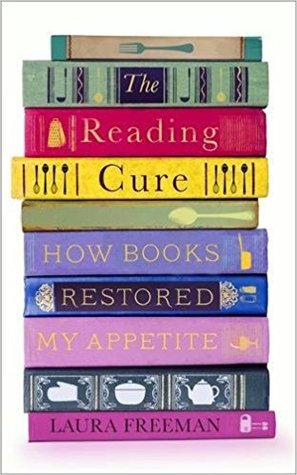 A debut memoir with food, medical and literary themes and a bibliotherapy-affirming title – this book ticks a whole lot of boxes for me. The very day I saw it mentioned on Twitter I requested a copy, and it was a warming, cozy read for the dark days of late December. As a teenager, freelance journalist Laura Freeman suffered from anorexia, and ever since she has struggled to regain a healthy relationship with food. This is decidedly not an anorexia memoir; if that’s what you’re looking for, you’ll want to pick up Nancy Tucker’s grueling but inventive The Time in Between. Instead, it’s about the lifelong joy of reading and how books have helped Freeman in the years that she has been haltingly recovering a joy of eating.
If asked to name a favorite food, Freeman writes that it would be porridge – or, if she was really pressed, perhaps her mother’s roast chicken dinner. But it’s been so long since she’s thought of food in terms of pleasure that written accounts of feasting from the likes of M.F.K. Fisher or Parson Woodforde might as well be written in a foreign language. When in 2012 she decided to read the whole of Charles Dickens’s oeuvre in his bicentenary year, she was struck afresh by the delight his characters take in meals.
While I was reading Dickens something changed. I didn’t want to be on the outside, looking at pictures, tasting recipes at one remove, seeing the last muffin go to someone else. I began to want to want food. To share it, savour it, to have it without guilt.
This nascent desire for a broader and more sumptuous food repertoire fuels the author through her voracious reading: of war writers like Siegfried Sassoon and Robert Graves with their boiled eggs and cocoa; of travel writers Laurie Lee and Patrick Leigh Fermor and their enthusiastic acceptance of whatever food came their way on treks; and of rediscovered favorite children’s books from The Secret Garden through the Harry Potter series with the characters’ greedy appetite for sweets. Other chapters are devoted to Virginia Woolf, whose depression and food issues especially resonate for Freeman; food writers; famous gluttons; and the specific challenge of chocolate, which she can’t yet bring herself to sample because it’s “so tangled up in my mind with ideas of sin, greed and loss of control.”
It’s these psychological and emotional aspects of food that Freeman is so good at capturing. She recognizes a tendency to all-or-nothing thinking that makes her prey to clean eating fads and exclusion diets. Today she still works to stifle the voices that tell her she’ll never be well and she doesn’t deserve to eat; she also tries to block out society’s contradictory messages about fat versus thin, healthy versus unhealthy, this diet versus that one. Channeling Dickens, she advises, “Don’t make a Marshalsea prison of rules for yourself – no biscuits at tea, no meat in the week, no pudding, not ever. Don’t trap yourself in lonely habits.”
Freeman’s taste in both food and literature seems a trifle old-fashioned, leaning towards jolly ol’ English stuff, but that’s because this is about comfort reading as much as it is about rediscovering comfort eating. Her memoir delicately balances optimism with reality, and encourages us to take another look at the books we love and really notice all those food scenes. Maybe our favorite writers have been teaching us how to eat well all along.
My rating:
The Reading Cure: How Books Restored My Appetite is published in the UK by Weidenfeld & Nicolson. My thanks to Virginia Woolstencroft for the review copy.
 Bookish Beck = Rebecca Foster. American transplant to England. Freelance proofreader and book reviewer.
 Bookish Beck