The Novel Cure—Bibliotherapy in Action
A good book, read at the right moment, should leave you uplifted, inspired, energized and eager for more. With so many books to choose from, what’s the point of reading even one more that leaves you cold?
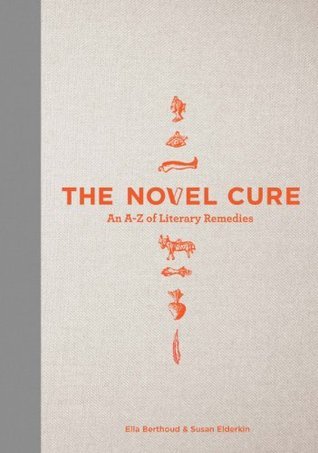
I’ve mentioned my interest in bibliotherapy before. Well, for anyone new to the concept or interested in finding out more, The Novel Cure by Ella Berthoud and Susan Elderkin, two of the bibliotherapists at London’s School of Life, is an accessible introduction. Subtitled “An A–Z of Literary Remedies,” this is a learned and at times tongue-in-cheek book of advice about what fiction to read if you’re suffering from any sort of malady – physical, psychological, or imagined.
 The alphabetical format and “see also” asides make it more like a cross-referenced encyclopedia than a book to read straight through, though I tried it both ways. Initially I flipped through at random, letting one entry take me to another related one and so on, but after a while I went back to the start and caught up on unread entries to finish within a year.
“It helps enormously at times of stress to read about other people who are going through similar things; watching how other people cope or fail to cope will make you feel less alone and give you strength,” the authors write to introduce the “cancer, caring for someone with” entry. I found this to be true when my sister lost her husband to cancer last year. She had never been a reader – apart from celebrity magazines – but in the past year she’s read nearly 90 books, many of them memoirs about illness and bereavement. Books are how I’ve always made sense of the world, so it’s been incredibly gratifying to see her turn to them as well. There are plenty of recommendations I’ll pass on to her from this book, especially “death of a loved one” (After You’d Gone by Maggie O’Farrell and Extremely Loud and Incredibly Close by Jonathan Safran Foer) and “widowed, being” (The Same Sea by Amos Oz and Major Pettigrew’s Last Stand by Helen Simonson).
You’ll be amazed at the range of conditions and circumstances for which the book offers prescriptions. Newly retired? “Bucolic and tranquil, The Enigma of Arrival [by V.S. Naipaul] will encourage you to take stock of your life and enjoy the unfolding of new possibilities.” Workaholic? “Immerse your desiccated soul in something very simple, very rustic, very small. We suggest [Thomas] Hardy’s gentlest, most innocent novel, Under the Greenwood Tree.” Two sections that felt particularly relevant to me as a vertically challenged freelancer were “short, being” and “tax return, fear of doing.” Meanwhile I’ll be pointing my husband to “baldness,” “flying, fear of,” “stress” and “tinnitus” (poor chap). But some of these entries surely resulted from the authors thinking “hey, here’s a great book we have to mention,” and then coming up with a category to fit it into, like “determinedly chasing after a woman even when she’s a nun” for In the Skin of a Lion by Michael Ondaatje.

I think I prefer this U.S. cover.
Indeed, there’s a certain levity to this book that I think some reviewers have missed. These aren’t all entirely serious suggestions, though they are all worthwhile books. I especially liked the sections where the authors incorporate pastiche of the book in question. A piece recommending Pamela by Samuel Richardson is in the form of an old-fashioned letter, for example, while “single, being” apes Bridget Jones’s diary entries. They even imitate certain authors’ prose style, as in “Who poses questions without question marks and observes the subtle changes in the light with exquisite brevity.” Answer: J.P. Donleavy, apparently.
The book is also a great source of top ten lists (I’m working through their novels for thirty-somethings) and advice for how to deal with reading crises (e.g. “busy to read, being too” and “giving up halfway through, tendency to”). My only criticism of the book – and this is one I level against many examples from the ‘books about books’ genre – is that there’s a fair bit of plot summary, sometimes so much so that it puts me off reading a book rather than whets my appetite for it.
It’s a bit belated (or early) for suggesting this as a Christmas gift for a book lover, but perhaps you can hand it over as a birthday gift or an anytime present – even to yourself. I got my copy on Amazon for £4, quite a bargain for a book I’ll be returning to again and again over the years.
My rating: 
Do you agree that novels have the power to cure, or at least help with, problems?
Review: Early One Morning by Virginia Baily
Like the Roberto Benigni film Life Is Beautiful, Virginia Baily’s second novel* shows how the Holocaust affected Italy’s Jews. It’s not a Holocaust novel, though; it’s a before-and-after story that’s more about adoption, coming of age when you don’t know who you are, and adapting to motherhood. It’s about choices, inevitabilities, regrets and a love that endures.
 October 1943: Chiara Ravello is walking near Rome’s Jewish ghetto when she spots a large group of people being herded into trucks. A Jewish woman catches her eye and directs her seven-year-old son to go with Chiara. Pretending the boy is her nephew, Chiara saves him from certain death. The war years have been a hard time for the Ravello family: Chiara’s father and her fiancé both died about five years ago, and her mother perished in a bombing a few months ago. Now she and her epileptic sister Cecilia are preparing to flee the occupation by taking refuge in their grandmother’s home in the hills above Rome. Chiara never expected to be a mother after Carlo’s death, but now she has the chance to raise Daniele Levi as her own.
That’s where many novels would have ended it: with a hopeful conclusion after a time of hardship; with a new beginning spooling out in the future. Instead, this is where Baily starts her bittersweet tale. It’s no happily ever after for Chiara and Daniele; indeed, over the years that Daniele is a silent, sullen boy, then a rebellious teenager, and finally a drug addict, Chiara will frequently question the impulsive choice she made that morning in 1943. She seems doomed, in Daniele’s eyes at least, to be “the wicked stepmother, half-provider, half-tyrant.” This gives the novel something of the flavor of Lionel Shriver’s We Need to Talk about Kevin, another rare instance of fictional ambivalence about motherhood.
There’s an extra layer to the novel, however. In 1973, Chiara learns that Daniele has a daughter he never knew: Maria, now 16, lives with her mother in Wales. Angry and unsure of her new identity, Maria has boycotted her school leaving exams and asks to live with Chiara for the summer instead. Baily describes these two very different characters equally well, and does a great job of capturing the feel of Rome and its surroundings, especially through Maria’s viewpoint. She also moves deftly between the events of 1943–44 and those of 1973 in alternating chapters, giving subtle clues as to the time period through her interesting choice of tense: right up to the last chapter, she uses the present tense to describe past action, and the past tense for current action.
Through the flashbacks, we learn surprising truths about how Chiara abandoned a family member and gained a best friend. She made dubious choices during the war, but also showed great bravery and generosity. Baily gives just enough away, and so gradually that the novel’s nearly 400 pages pass quickly. In touching on World War II and the Holocaust only peripherally, the novel avoids well-worn, clichéd narratives and does something new.
The writing does not draw attention to itself; there are no long-winded descriptions or ornate sentences. Baily relies more on food (as in “[Maria’s] insides were lubricated with olive oil”) and period fashion to add detail and local color. Still, where there is metaphorical language it usually refers to animals and seems both appropriate and evocative. I also love the warm, earthy tones of the book’s cover, which reminds me of my time spent in Tuscany last year. However, I’m not sure the novel’s title works; it doesn’t say enough about the book.
Still, I admire how Baily takes what seems like a familiar Holocaust rescue story and turns it on its head. A late passage in which Chiara watches over Daniele as he sleeps off a hangover hints at the emotional ambiguities she conveys here:
Funny how sometimes she used to think that because he had this horseshoe birthmark, a talisman of good fortune imprinted in his skin, he carried his luck with him. How she persisted in thinking it was luck that had saved him when the rest of his family had perished, and not, as he seems to want to demonstrate to her, its opposite.
‘I don’t blame you, Ma,’ he has told her more than once.
‘So why are you so intent on throwing your life away?’ she has asked him, but he doesn’t seem to have an answer.
 I would particularly recommend this novel to fans of Maggie O’Farrell and Anthony Doerr. Read this alongside Julia Blackburn’s Thin Paths or another choice from my Italian summer reading list – it’s the next best thing to being there.
My rating: 
*At first I presumed this was a debut, but it turns out she wrote one novel previously, under the name Ginny Baily, Africa Junction (2011).
Many thanks to Virago for my free copy, received through a newsletter giveaway.
 Bookish Beck = Rebecca Foster. American transplant to England. Freelance proofreader and book reviewer.
 Bookish Beck