Two Final Wellcome Book Prize Longlist Reviews: Krasnostein & Moshfegh
I’ve now read eight of the 12 titles longlisted for the Wellcome Book Prize 2019 and skimmed another two, leaving just two unexplored.
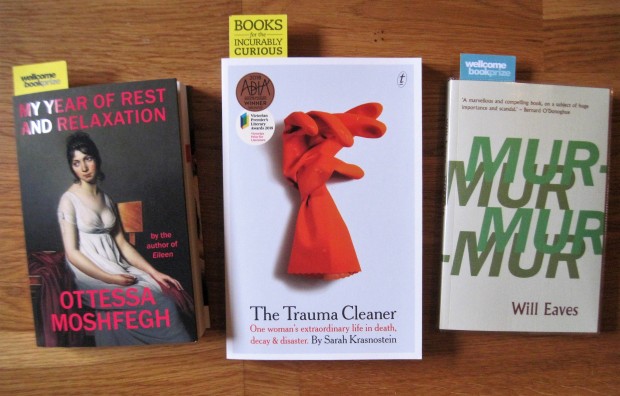
My latest two reads are books that I hugely enjoyed yet would be surprised to see make the shortlist (both  ):
):
The Trauma Cleaner: One Woman’s Extraordinary Life in Death, Decay and Disaster by Sarah Krasnostein (2017)
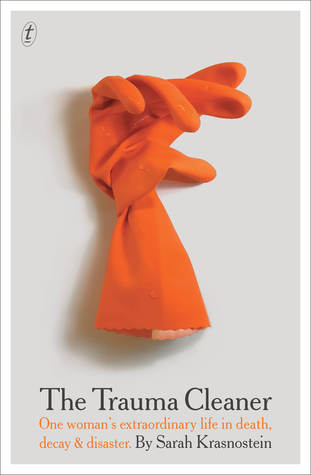 I guarantee you’ve never read a biography quite like this one. For one thing, its subject is still alive and has never been much of a public figure, at least not outside Victoria, Australia. For another, your average biography is robustly supported by archival evidence; to the contrary, this is a largely oral history conveyed by an unreliable narrator. And lastly, whether a biography is critical or adulatory overall, the author usually at least feigns objectivity. Sarah Krasnostein doesn’t bother with that. Sandra Pankhurst’s life is an incredible blend of ordinary and bizarre circumstances and experiences, and it’s clear Krasnostein is smitten with her. “I fall in love … anew each time I listen to her speak,” she gushes towards the book’s end. At first I was irked by all the fawning adjectives she uses for Sandra, but eventually I stopped noticing them and allowed myself to sink into this astonishing story.
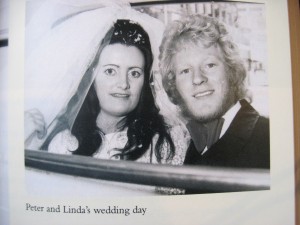
Sandra was born male and adopted by a couple whose child had died. When they later conceived again, they basically disowned ‘Peter’, moving him to an outdoor shed and making him scrounge for food. His adoptive father was an abusive alcoholic and kicked him out permanently when he was 17. Peter married ‘Linda’ at age 19 and they had two sons in quick succession, but he was already going to gay bars and wearing makeup; when he heard about the possibility of a sex change, he started taking hormones right away. Even before surgery completed the gender reassignment, Sandra got involved in sex work, and was a prostitute for years until a brutal rape at the Dream Palace brothel drove her to seek other employment. Cleaning and funeral home jobs nicely predicted the specialty business she would start after the hardware store she ran with her late husband George went under: trauma cleaning.
 Krasnostein parcels this chronology into tantalizing pieces, interspersed with chapters in which she accompanies Sandra and her team on assignments. They fumigate and clean up bodily fluids after suicides and overdoses, but also deal with clients who have lost control of their possessions – and, to some extent, their lives. They’re hoarders, cancer patients and ex-convicts; their homes are overtaken by stuff and often saturated with mold or feces. Sandra sympathizes with the mental health struggles that lead people into such extreme situations. Her line of work takes “Great compassion, great dignity and a good sense of humour,” she tells Krasnostein; even better if you can “not … take the smell in, ’cause they stink.”
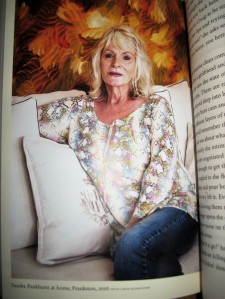 The author does a nice job of staying out of the narrative: though she’s an observer and questioner, there’s only the occasional paragraph in which she mentions her own life. Her mother left when she was young, which helps to explain why she is so compassionate towards the addicts and hoarders she meets with Sandra. Some of the loveliest passages have her pondering how things got so bad for these people and affirming that their lives still have value. As for Sandra herself – now in her sixties and increasingly ill with lung disease and cirrhosis – Krasnostein believes she’s never been unconditionally loved and so has never formed true human connections.
This book does many different things in its 250 pages. It’s part journalistic exposé and part “love letter”; it’s part true crime and part ordinary life story. It considers gender, mental health, addiction, trauma and death. It’s also simply a terrific read that should draw in lots of people who wouldn’t normally pick up nonfiction. I don’t expect it to advance to the shortlist, but if it does I’ll be not-so-secretly delighted.
A favorite passage:
Sometimes, listening to Sandra try to remember the events of her life is like watching someone reel in rubbish on a fishing line: a weird mix of surprise, perplexity and unexpected recognition. No matter how many times we go over the first three decades of her life, the timeline of places and dates is never clear. Many of her memories have a quality beyond being merely faded; they are so rusted that they have crumbled back into the soil of her origins. Others have been fossilised, frozen in time, and don’t have a personal pull until they defrost slightly in the sunlit air between us as we speak. And when that happens there is a tremor in her voice as she integrates them back into herself, not seamlessly but fully.
See also:
My Year of Rest and Relaxation by Ottessa Moshfegh (2018)
If you’ve read her Booker-shortlisted debut, Eileen, you’ll be unsurprised to hear that Moshfegh has written another love-it-or-hate-it book with a narrator whose odd behavior is hard to stomach. This worked better for me than Eileen, I think because I approached it as a deadpan black comedy in the same vein as Elif Batuman’s The Idiot. Its inclusion on the Wellcome longlist is somewhat tenuous: in 2000 the unnamed narrator, in her mid-twenties, gets a negligent psychiatrist to prescribe her drugs for insomnia and depression and stockpiles them so she can take pill cocktails to knock herself out for days at a time. In a sense this is a way of extending the numbness that started with her parents’ deaths – her father from cancer and her mother by suicide. But there’s also a more fantastical scheme in her mind: “when I’d slept enough, I’d be okay, I’d be renewed, reborn. I would be a whole new person.”
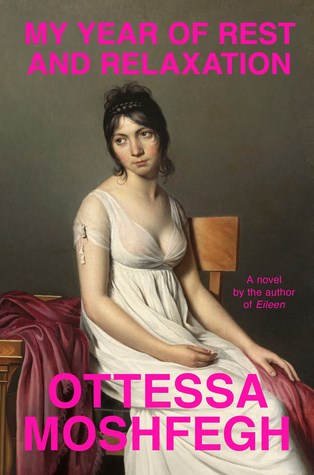 Ever since she was let go from her job at a gallery that showcases ridiculous modern art, the only people in this character’s life are an on-again, off-again boyfriend, Trevor, and her best (only) friend from college, longsuffering Reva, who keeps checking up on her in her New York City apartment even though she consistently treats Reva with indifference or disdain. Soon her life is a bleary cycle of sleepwalking and sleep-shopping, interspersed with brief periods of wakefulness, during which she watches a nostalgia-inducing stream of late-1990s movies on video (the kind of stuff I watched at sleepovers with my best friend during high school) – she has a weird obsession with Whoopi Goldberg.
It’s a wonder the plot doesn’t become more repetitive. I like reading about routines, so I was fascinated to see how the narrator methodically takes her project to extremes. Amazingly, towards the middle of the novel she gets herself from a blackout situation to Reva’s mother’s funeral – about the only time we see somewhere that isn’t her apartment, the corner shop, the pharmacy or Dr. Tuttle’s office – and this interlude is just enough to break things up. There are lots of outrageous lines and preposterous decisions that made me laugh. Consumerism and self-medication to deaden painful emotions are the targets of this biting satire. As 9/11 approaches, you wonder what it will take to wake this character up to her life. I’ve often wished I could hibernate through British winters, but I wouldn’t do what Moshfegh’s antiheroine does. Call this a timely cautionary tale about privilege and disengagement.
Favorite lines:
“Initially, I just wanted some downers to drown out my thoughts and judgments, since the constant barrage made it hard not to hate everyone and everything. I thought life would be more tolerable if my brain were slower to condemn the world around me.”
“Oh, sleep, nothing else could ever bring me such pleasure, such freedom, the power to feel and move and think and imagine, safe from the miseries of my waking consciousness.”
Reva: “you’re not changing anything in your sleep. You’re just avoiding your problems. … Your problem is that you’re passive. You wait around for things to change, and they never will. That must be a painful way to live. Very disempowering.”
See also:
And one more that I got out from the library and skimmed:
Murmur by Will Eaves (2018)
 The subject is Alec Pryor, or “the scientist.” It’s clear that he is a stand-in for Alan Turing, quotes from whom appear as epigraphs at the head of most chapters. Turing was arrested for homosexuality and subjected to chemical castration. I happily read the first-person “Part One: Journal,” which was originally a stand-alone story (shortlisted for the BBC National Short Story Award 2017), but “Part Two: Letters and Dreams” was a lot harder to get into, so I ended up just giving the rest of the book a quick skim. If this is shortlisted, I promise to return to it and give it fair consideration.
See also:
We will announce our shadow panel shortlist on Friday. Follow along here and on Halfman, Halfbook, Annabookbel, A Little Blog of Books, and Dr. Laura Tisdall for reviews, predictions and reactions.
Wellcome Book Prize Longlist: Mind on Fire by Arnold Thomas Fanning
“all these ideas are swirling around inside your head at once, hurling through your mind, it is on fire, so when you speak it all comes out muddled and confused and no one can understand you.”
Like the other Wellcome-longlisted title I’ve highlighted so far, Freshwater by Akwaeke Emezi, Mind on Fire explores mental health. Its subtitle is “A Memoir of Madness and Recovery,” and Irish playwright Fanning focuses on the ten years or so in his twenties and thirties when he struggled to get on top of his bipolar disorder and was in and out of mental hospitals – and even homeless on the streets of London for a short time.
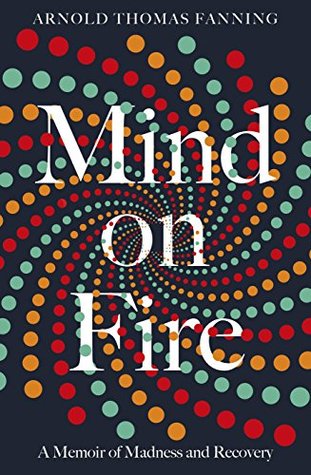 Fanning had suffered from periods of depression ever since his mother’s death from cancer when he was 20, but things got much worse when he was 28 and living in Dublin. It was the summer of 1997 and he’d quit a full-time job to write stories and film scripts. What with the wild swings in his moods and energy levels, though, he found it increasingly difficult to get along with his father, with whom he was living. He also got kicked out of an artists’ residency, and on the way home his car ran out of petrol – such that when he called the police for help, it was for a breakdown in more than one sense. This was the first time he was taken to a psychiatric unit, at the Tyrone and Fermanagh Hospital, where he stayed for 10 days.
In the years to come there would be many more hospital stays, delusions, medication regimes and odd behavior. There would also be time spent in America – an artists’ residency in Virginia, where he met Jennifer, and a fairly long-term relationship with her in New York City – and ups and downs in his writing career. For instance, he remembers that after reading Ulysses he was so despairingly convinced that he would never be a “real writer” like James Joyce that he burned hundreds of pages of work-in-progress.
This was a very hard book for me to rate. The prologue is a brilliant 6.5-page run-on sentence in the second person and present tense (I’ve quoted a fragment above) that puts you right into the author’s experience. It is a superb piece of writing. But nothing that comes after (a more standard first-person narrative, though still in the present tense for most of it) is nearly as good. As I’ve found in some other mental health memoirs, the cycle of hospitalizations and medications gets repetitive. It’s a whole lot of telling: this happened, then that happened. That’s also true of the flashbacks to his childhood and university years.
Due to his unreliable memory of his years lost to bipolar, Fanning has had to recreate his experiences from medical records, interviews with people who knew him, and so on. This insistence on documentary realism distances the reader from what should be intimate, terrifying events. I almost wondered if this would have worked better as a novel, allowing the author to invent more and thus better capture what it actually felt like to flirt with madness. There’s no denying the extremity of this period of his life, but I found myself unable to fully engage with the retelling. (Also, this is doomed to be mistaken for the superior Brain on Fire.)
My rating:
A favorite passage:
St John of God’s carries associations for me. I attended primary school not far from here, and used to see denizens of the hospital on their day outings, conspicuous in the way they walked: hunched over, balled up, constricted, eyes down to the ground, visibly disturbed. We cruelly referred to these people as ‘mentallers’, though never to their faces or within earshot, as we were frightened of them.
Now I, too, am a mentaller.
My gut feeling: There are several stronger memoirs on the longlist, so I don’t see this one making it through.
Longlist strategy:
- I’m about halfway through both The Trauma Cleaner by Sarah Krasnostein and My Year of Rest and Relaxation by Ottessa Moshfegh.
- I finally got hold of a library copy of Murmur by Will Eaves.
- The only two books I haven’t read and don’t have access to are Astroturf and Polio. I’ll only read these if they are on the shortlist. (Fingers crossed Astroturf doesn’t make it: it sounds awful!)
The Wellcome Book Prize shortlist will be announced on Tuesday, March 19th, and the winner will be revealed on Wednesday, May 1st.
We plan to choose our own shortlist to announce on Friday, March 15th. Follow along here and on Halfman, Halfbook, Annabookbel, A Little Blog of Books, and Dr. Laura Tisdall for reviews and predictions.
Wellcome Book Prize Longlist: Freshwater by Akwaeke Emezi
“This is all, ultimately, a litany of madness—the colors of it, the sounds it makes in heavy nights, the chirping of it across the shoulder of the morning.”
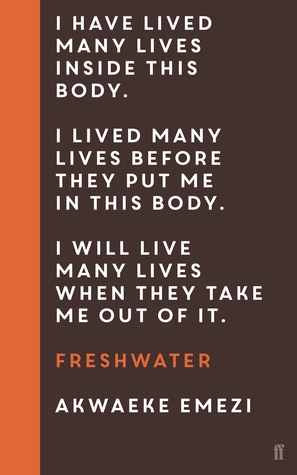 Magic realism and mental illness fuel a swirl of disorienting but lyrical prose in this debut novel by a Nigerian–Tamil writer. Much of the story is told by the ọgbanje (an Igbo term for evil spirits) inhabiting Ada’s head: initially we have the first person plural voice of “Smoke” and “Shadow,” who deem “the Ada” a daughter of the python goddess Ala and narrate her growing-up years in Nigeria; later we get a first-person account from Asụghara, who calls herself “a child of trauma” and leads Ada into promiscuity and drinking when she is attending college in Virginia.
The unusual choice of narrators links Freshwater to other notable works of Nigerian literature: a spirit child relates Ben Okri’s Booker Prize-winning 1991 novel, The Famished Road, while Chigozie Obioma’s brand-new novel, An Orchestra of Minorities, is from the perspective of the main character’s chi, or life force. Emezi also contrasts indigenous belief with Christianity through Ada’s troubled relationship with “Yshwa” or “the christ.”
These spirits are parasitic and have their own agenda, yet express fondness for their hostess. “The Ada should have been nothing more than a pawn, a construct of bone and blood and muscle … But we had a loyalty to her, our little container.” So it’s with genuine pity that they document Ada’s many troubles, starting with her mother’s departure for a mental hospital and then for a job in Saudi Arabia, and continuing on through Ada’s cutting, anorexia and sexual abuse by a boyfriend. Late on in the book, Emezi also introduces gender dysphoria that causes Ada to get breast reduction surgery; to me, this felt like one complication too many.

The U.S. cover
From what I can glean from the Acknowledgments, it seems Ada’s life story might mirror Emezi’s own – at the very least, a feeling of being occupied by multiple personalities. It’s a striking book with vivid scenes and imagery, but I wanted more of Ada’s own voice, which only appears in a few brief sections totalling about six pages. The conflation of the abstract and the concrete didn’t quite work for me, and the whole is pretty melodramatic. Although I didn’t enjoy this as much as some other inside-madness tales I’ve read (such as Die, My Love and Everything Here Is Beautiful), I can admire the attempt to convey the reality of mental illness in a creative way.
My rating:
My gut feeling: I’ve only gotten to two of the five novels longlisted for the Prize, so it’s difficult to say what from the fiction is strong enough to make it through to the shortlist. Of the two, though, I think Sight would be more likely to advance than Freshwater.
Do you think this is a novel that you’d like to read?
Longlist strategy:
- I’m about one-fifth of the way through Mind on Fire by Arnold Thomas Fanning, which I plan to review in early March.
- I’ve also been sent review copies of The Trauma Cleaner by Sarah Krasnostein and My Year of Rest and Relaxation by Ottessa Moshfegh and look forward to reading them, though I might not manage to before the shortlist announcement.
- I’ve placed a library hold on Murmur by Will Eaves; if it arrives in time, I’ll try to read it before the shortlist announcement, since it’s fairly short.
- Barring these, there are only two remaining books that I haven’t read and don’t have access to: Astroturf and Polio. I’ll only read these if they make the shortlist.
The Wellcome Book Prize shortlist will be announced on Tuesday, March 19th, and the winner will be revealed on Wednesday, May 1st.
We plan to choose our own shortlist to announce on Friday, March 15th. Follow along here and on Halfman, Halfbook, Annabookbel, A Little Blog of Books, and Dr. Laura Tisdall for reviews and predictions.
The Wellcome Book Prize 2019 Longlist: Reactions & Shadow Panel Reading Strategy
The 2019 Wellcome Book Prize longlist was announced on Tuesday. From the prize’s website, you can click on any of these 12 books’ covers, titles or authors to get more information about them.
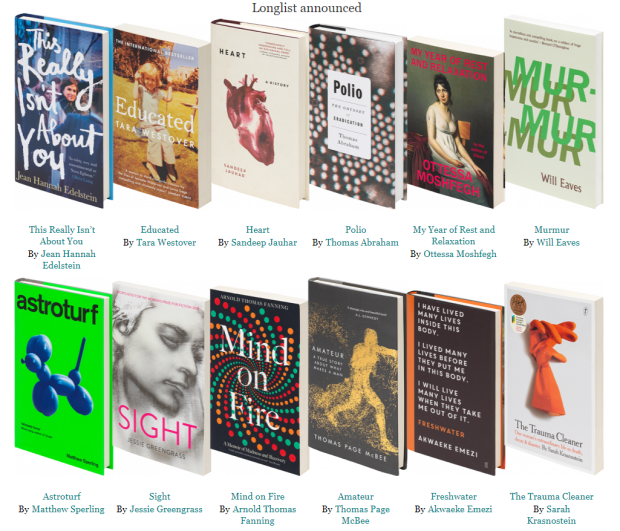
This year marks the 10th anniversary of the prize. As always, it’s a strong and varied set of nominees, with an overall focus on gender and mental health. Here are some initial thoughts (see also Laura’s thorough rundown of the 12 nominees):

- I correctly predicted just two, Sight by Jessie Greengrass and Heart: A History by Sandeep Jauhar, but had read another three: This Really Isn’t About You by Jean Hannah Edelstein, Amateur by Thomas Page McBee, and Educated by Tara Westover (reviewed for BookBrowse).
- I’m particularly delighted to see Edelstein on the longlist as her book was one of my runners-up from last year and deserves more attention.
- I’m not personally a huge fan of the Greengrass or McBee books, but can certainly see why the judges thought them worthy of inclusion.
- Though it’s a brilliant memoir, I never would have thought to put Educated on my potential Wellcome list. However, the more I think about it, the more health elements it has: her father’s possible bipolar disorder, her brother’s brain damage, her survivalist family’s rejection of modern medicine, her mother’s career in midwifery and herbalism, and her own mental breakdown at Cambridge.
- Books I knew about and was keen to read but hadn’t thought of in conjunction with the prize: The Trauma Cleaner by Sarah Krasnostein and My Year of Rest and Relaxation by Ottessa Moshfegh.
- Novels I had heard of but wasn’t necessarily interested in beforehand: Murmur by Will Eaves and Freshwater by Akwaeke Emezi. I went to get Freshwater from the library the afternoon of the longlist announcement and am now 60 pages in. I’d be tempted to call it this year’s Stay with Me except that the magic realist elements are much stronger here, reminding me of what I know about work by Chigozie Obioma and Ben Okri. The novel is narrated in the first person plural by a pair of (gods? demons? spirits?) inhabiting Ada’s head.
- And lastly, there are a few books I had never even heard of: Polio: The Odyssey of Eradication by Thomas Abraham, Mind on Fire: A Memoir of Madness and Recovery by Arnold Thomas Fanning, and Astroturf by Matthew Sperling. I’m keen on the Fanning but not so much on the other two. Polio will likely make it to the shortlist as this year’s answer to The Vaccine Race; if it does, I’ll read it then.

Some statistics on this year’s longlist, courtesy of a press release sent by Midas PR:
- Five novels (two more than last year – I think we can see the influence of novelist Elif Shafak), five memoirs, one biography, and one further nonfiction title
- Six debut authors
- Six titles from independent publishers (Canongate, CB Editions, Faber & Faber, Oneworld, Hurst Publishers, and The Text Publishing Company)
- Most of the authors are British or American, while Fanning is Irish (Emezi is Nigerian-American, Jauhar is Indian-American, and Krasnostein is Australian-American).

Chair of judges Elif Shafak writes: “In a world that remains sadly divided into echo chambers and mental ghettoes, this prize is unique in its ability to connect various disciplines: medicine, health, literature, art and science. Reading and discussing at length all the books on our list has been fascinating from the very start. We now have a wonderful longlist, of which we are all very proud. Although it sure won’t be easy to choose the shortlist, and then, finally, the winner, I am thrilled about and truly grateful for this fascinating journey through stories, ideas, ground-breaking research and revolutionary knowledge.”
We of the shadow panel have divided up the longlist titles between us as follows (though we may well each get hold of and read more of the books, simply out of personal interest) and will post reviews on our blogs within the next five weeks.
Amateur: A true story about what makes a man by Thomas Page McBee – LAURA
Astroturf by Matthew Sperling – PAUL
Educated by Tara Westover – CLARE
Freshwater by Akwaeke Emezi – REBECCA
Heart: A history by Sandeep Jauhar – LAURA
Mind on Fire: A memoir of madness and recovery by Arnold Thomas Fanning – REBECCA
Murmur by Will Eaves – PAUL
My Year of Rest and Relaxation by Ottessa Moshfegh – CLARE
Polio: The odyssey of eradication by Thomas Abraham – ANNABEL
[Sight by Jessie Greengrass – 4 of us have read this; I’ll post a composite of our thoughts]
The Trauma Cleaner: One woman’s extraordinary life in death, decay and disaster by Sarah Krasnostein – ANNABEL
This Really Isn’t About You by Jean Hannah Edelstein – LAURA
The Wellcome Book Prize shortlist will be announced on Tuesday, March 19th, and the winner will be revealed on Wednesday, May 1st.
We plan to choose our own shortlist to announce on Friday, March 15th. Follow along here and on Halfman, Halfbook, Annabookbel, A Little Blog of Books, and Dr. Laura Tisdall for reviews and predictions.
Are there any books on here that you’d like to read?
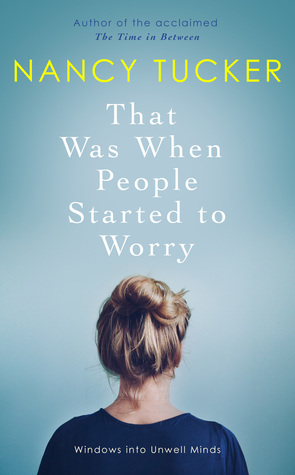
That Was When People Started to Worry by Nancy Tucker
Nancy Tucker’s first book, The Time in Between (2015), was a wrenching and utterly absorbing eating disorder memoir told in an original blend of forms: cinematic scenes of dialogue and stage directions, schedules, tongue-in-cheek dos and don’ts, imagined interrogations, and so on. She’s recreated that experimental/hybrid style here to capture the experiences of young women with mental health challenges.
At a time when she was still struggling with anorexia and suicidal thoughts, bouncing between her uni room and a psychiatric ward, Tucker felt the need to get beyond her own pain by engaging with others’ problems. She interviewed 70 women aged 16 to 25 for a total of more than 100 hours and chose to anonymize their stories by creating seven composite characters who represent various mental illnesses: depression, bipolar disorder, self-harm, anxiety, eating disorders, PTSD and borderline personality disorder.
Each chapter follows a similar format, focusing on a first-person narrative from the invented character but also interspersing other documents like e-mails, instant messages, conversations with a therapist, a video interview transcript or a self-interrogation. A different font then sets out a few-page section that, in a sardonic tone, suggests the problem really isn’t that serious and is easily solved with a handful of simple tips. After this point Tucker steps out of character to give statistics and commentary on the particular mental illness, as she heard it described by her interviewees. She returns to the character’s voice to close with a “What I wish I could tell you about my [depression, etc.]” section, a heartfelt plea for sympathy.
 These stories overlap with each other – anxiety and depression commonly co-occur with other mental illness, for instance. Yasmine’s bipolar means that sometimes she feels like she could run a marathon or write a novel in a few days, while other times she’s plunged into the depths of depression. Neither Abby (depression) nor Freya (anxiety) can face going to work; Maya (BPD, also known as emotionally unstable personality disorder) exhibits many of the symptoms from other chapters, including self-harm and feelings of emptiness.
Tucker is keen to emphasize how complex these disorders are: it’s never just a matter of being sad, having mood swings or seeking attention. She is sensitive to the way that certain ones might be belittled, such as binge eating disorder, which, because it isn’t as clinically recognized as anorexia or bulimia, can be equated with poor self-control. Also, mental health conditions exist on a continuum, so it’s hard to definitively announce a cure. In any case, “A binary perception of mental illness benefits no one,” Tucker explains: “the ‘insane’ may find themselves held at arms’ length, but the ‘sane’ may be denied rapid treatment, or accused of melodrama.”
The details of these narratives can be painful to read, like Georgia and friends browsing Tumblr for ideas of how to cut themselves with razors and take not-quite-overdoses of paracetamol, and Holly’s post-traumatic stress after not-quite-consensual sex with her boyfriend. But the voices are so intimately rendered, and the chapters so perfectly balanced between the general and the fictionalized particulars, that they illuminate mental health crises in a uniquely powerful way.
Reading this has helped me to understand friends’ and acquaintances’ behavior. I’ll keep it on the shelf as an invaluable reference book in the years to come. Based on what I’ve read thus far, this is my frontrunner for next year’s Wellcome Book Prize, which “aims to excite public interest and encourage debate around [medical] topics.” That Was When People Started to Worry seems to me to be just what the prize is looking for, as “Books that find stories in those brushes with medicine are ones that add new meaning to what it means to be human.”
My rating: 
That Was When People Started to Worry: Windows into Unwell Minds was published by Icon Books in May. My thanks to the publisher for a free copy for review.
 Bookish Beck = Rebecca Foster. American transplant to England. Freelance proofreader and book reviewer.
 Bookish Beck