Alive, Alive Oh!: Diana Athill in Person
Last night I was lucky enough to see 98-year-old literary legend Diana Athill in conversation with Erica Wagner at Foyles bookstore in London. Athill, born in 1917, has been an inspiration to me ever since I discovered her work five or so years ago. She didn’t publish anything until she was in her forties, and didn’t reach true acclaim until her eighties, when she released an incredible series of memoirs. Hers is an encouraging story of late-life success and what can be achieved with diligence and good fortune.
What strikes you immediately about Athill is her elegance. Although her hair is thinning and she speaks with a slight slur out of the left side of her mouth, she retains her eagle eye and hawkish profile. That cut-glass BBC pronunciation is not just “the Queen’s English” but a voice just like the Queen’s – she even occasionally used “One” to speak about her own experience. Her look, too, was perfectly put together: a beautiful, multicolored Nehru jacket over a blue silk blouse, accessorized with chunky blue and silver jewelry. Though she was brought in by wheelchair and needed a lot of help getting on the podium – she apologized for her belabored entry – she hardly seems on the brink of death.

Diana Athill and Erica Wagner.
Erica Wagner, too, is one of my heroes: an American expat who served as literary editor of the London Times from 1996 to 2013 and is now a contributing writer with New Statesman and a Harper’s Bazaar consulting literary editor. She drew Athill out on many of the topics from her latest memoir, Alive, Alive Oh! And Other Things that Matter, including the unexpected pregnancy and miscarriage she experienced in her forties, memories of visiting Tobago, and the downsizing that preceded her move into a retirement home.
 Athill recalled the absolute joy she felt upon waking up from her miscarriage, a medical emergency that could well have ended in her death. It was a feeling that started in her stomach and rose up through her body – “I’m alive!” she remembered exulting. Losing her chance at motherhood was not a haunting sadness for her, she remarked; to her surprise, she got over it easily. Part of it was that she had never felt maternal yearning; she vividly pictures being 19, looking at someone’s baby lying on a bed and wondering to herself how she should feel about this creature. Ultimately, she decided, “I’d much rather pick up a puppy!”
That sort of forthrightness was evident in a number of pithy responses Athill gave to audience members’ questions. Asked “is it better to have loved and lost than never to have loved?” she replied with a simple, emphatic “YES!” Does she have anything planned for her 100th birthday? “I choose not to think about it,” she quipped. Has age mellowed her? “A bit,” she hedged, before adding that she is now more tolerant and minds less what others think of her.
One of her key pieces of advice is to avoid romanticism and possessiveness. That certainly played out in her unconventional personal life: she never married but was with her partner, a black man, for some four decades, and after he divorced his wife they formed an unusual household arrangement with his new lover and her family.
If Athill was never possessive in love affairs, however, she did struggle with it in terms of belongings. It was agonizing, she noted, to give up most of her things – especially her books – when moving into a tiny room in a Highgate retirement home. Now, though, she doesn’t mind at all. “When you get very old you really don’t need much,” she insisted. Early on she adopted Montaigne’s practice of thinking about death once a day to get used to the idea. None of the 40 residents at her home minds the thought of being dead; what they don’t like is the idea of dying. Each one hopes to bypass the horrid death and have the easy one instead.
Writing started as a therapeutic exercise for Athill. She wrote Instead of a Letter, about a painful love affair from her youth, because she had a deep sense of failure as a woman. After writing about it, though, she felt completely better, like a new person. Several of her other nonfiction books had a similar motivation: they were a way of getting rid of sad experiences, her own or others’ that she was close to.
 When encouraged to write about her long career as a literary editor, she initially thought she couldn’t do it; she only wrote to “cure nasty things” by getting to the bottom of them as honestly as possible. However, she managed to convince herself she could also write for fun, and Stet, about her work with André Deutsch, was the delightful result. Asked for some of her favorite authors, she named Molly Keane (as a person as well as a writer), Jean Rhys, and Philip Roth (not as a person, she hastened to add!). Rhys and V.S. Naipaul, two of her illustrious clients, never needed a word editing, she recalled; however, they did occasionally need a nanny.
Having seen publishing from the other side now, as an author, Athill believes that being read with absolute attention by an editor – as opposed to getting halfway through a review and finding one’s work hasn’t been understood at all – is heaven. So although she was initially surprised that she would be given an editor, she joked, in the end she was grateful. Publishing is now much more of a business, she acknowledges, but she still feels that many people are in it for the right reason: simply because they love books.
 In the wider world, so much has changed for the worse over the past near-century she’s been alive, but medicine and education are two things that have gotten better. “Long live the National Health!” she cried. (Hear, hear!) On the other hand, it was particularly interesting to hear Athill sigh that she hasn’t been a very good feminist; although she supports the idea, she feels she should have been more engaged. For example, she knew very well that she earned less than a man in her position would have at André Deutsch, but never made anything of it.
In the end, Athill thinks of luck as what’s given to you rather than something you make. “On the whole, I have been so lucky in my life,” she marveled towards the close of last night’s wonderful event. “I can’t really complain about anything.”
 I’ve now read all Athill’s work, even her rather obscure novel and short story collection. Her latest book doesn’t live up to her few best memoirs, but it’s an essential read for a devoted fan. For readers new to her work, I’d recommend starting with Somewhere Towards the End, followed by Stet. From there you might try her book of correspondence with American poet Edward Field, Instead of a Book, or her memoir of childhood, Yesterday Morning.
Psssssst! I have the dirt on a forthcoming Athill publication – and here I thought Alive, Alive Oh! would be her last book for sure. It will be the diary of a trip she took to Florence in 1948. Italy seemed to have bounced back from six years of wartime much more quickly than England, so after that sense of imprisonment it was a chance to enjoy life once again. I’ll be keen to read this rare ‘found document’.
Reviews Roundup, December–January
It’s been a slow period for reviewing; I was mostly focusing on ongoing projects and year-end lists, and didn’t take the time to review a lot of the books I borrowed from libraries while in the States visiting family. Enjoy the respite! And I promise more productivity next month. There’s a rating (below each description) and a taster so you can decide whether to read more.
Fig Tree Books
 Everyman by Philip Roth: It has now been about three years since Philip Roth, then 79, famously announced his retirement from fiction writing. In a look back over Roth’s career—spanning half a century and 30 books—Everyman (2006) might fade into the background, especially given the book’s novella length. But to overlook it would be a mistake: This is a near-perfect fable about the life we build through decades of small choices and the death that is always lying in wait, whether we feel ready or not.
(Have a look around at the great work this publisher does in highlighting the American Jewish Experience; for instance, they released Safekeeping by Jessamyn Hope, which I loved this past summer.)

Foreword Reviews
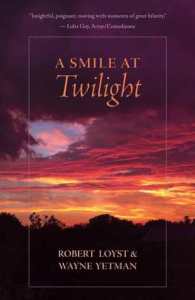 A Smile at Twilight by Robert Loyst and Wayne Yetman: Loyst gives a candid account of the joys and difficulties of helping to care for Poppy, an Alzheimer’s patient he met through a Toronto-based “Seniors Helping Seniors” organization. It’s an appealing “opposites attract”/“odd couple” scenario: Poppy was a perfectionist with a foul mouth and a withering glare of disapproval, while Loyst describes himself as “more of a take-it-as-it-comes type of guy.” Those who have family members or friends struggling with dementia will probably benefit most from the memoir, but readers of Still Alice might enjoy trying a real-life story.
I also post reviews of most of my casual reading and skimming on Goodreads.
My Name is Lucy Barton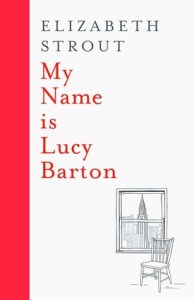 by Elizabeth Strout: Lucy Barton is in the hospital for nine weeks following an appendectomy. The novel zeroes in on the five days her mother comes to stay by her bedside, a pinnacle in their often difficult relationship. For a short book, this packs a lot in: an artist’s development, the course of a marriage, poverty and class distinctions. Lucy grew up in rural Illinois, where words like “cheap” and “trash” could easily have been applied to her family. I read this in one sitting on a plane ride and found it to be a powerful portrayal of the small connections that stand out in a life.
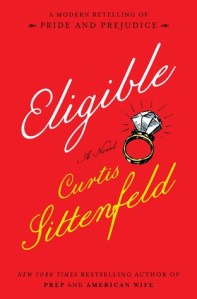 Eligible: A modern retelling of Pride and Prejudice by Curtis Sittenfeld: Pride and Prejudice transplanted to Cincinnati in 2013? That might sound like a stretch, but Sittenfeld pretty much pulls it off. The characters and underlying plot are virtually identical to the original, with just a few tweaks here and there. What Sittenfeld does update are the particular scenes and situations, as well as the cultural norms and sexual practices. My main problem is how slavishly Sittenfeld replicates Austen’s third-person voice and vocabulary. Sittenfeld is the queen of first-person female narration; this is the first time in my memory that she has attempted an omniscient voice. To me it felt like the book was crying out to be told from Lizzy’s perspective. Releases April 19th.

 Bookish Beck = Rebecca Foster. American transplant to England. Freelance proofreader and book reviewer.
 Bookish Beck