Nonfiction November “Stranger than Fiction”: The Boys in the Boat
I’m taking a quick break from novellas coverage but keeping up the nonfiction focus with this week’s Nonfiction November prompt, “Stranger than Fiction,” hosted by Christopher at Plucked from the Stacks: “This week we’re focusing on all the great nonfiction books that almost don’t seem real. A sports biography involving overcoming massive obstacles, a profile on a bizarre scam, a look into the natural wonders in our world—basically, if it makes your jaw drop, you can highlight it for this week’s topic.” I would also interpret this brief to refer to nonfiction that reads as fluently as a novel, and on both counts this book stands out.
The Boys in the Boat: Nine Americans and Their Epic Quest for Gold at the 1936 Berlin Olympics by Daniel James Brown (2013)
We read this for my book club a couple of months ago, on the recommendation of one of our members’ spouses. I was dubious because I don’t read history books, and don’t enjoy playing or watching sports, so a sport + history book sounded like a real snoozefest, but that couldn’t have been further from the truth.

Brown focuses on one of the University of Washington rowers, Joe Rantz, in effect making him the protagonist of a classic underdog story. The college team in general, and Rantz in particular, were unlikely champions. Rantz lost his mother young and, abandoned by his father multiple times, had to make a living by his wits in the Seattle area, sometimes resorting to illegal schemes like poaching and selling liquor during Prohibition, but also logging and working in dam construction. Even among the teammates who became his de facto family, he was bullied for coming from poverty and for his enthusiasm for folksy music. That we come to know and care deeply for Rantz testifies to how well Brown recreates his life story – largely via Rantz’s daughter’s reminiscences, though Brown did meet Rantz before his death.
Another central character is world-renowned boat designer George Pocock, an Englishman who set up shop on the Washington campus. Boatbuilding and rowing both come across as admirable skills involving hard physical labour, scientific precision and an artist’s mind. I was surprised by how much I enjoyed reading about the technical details of woodworking and rowing. Brown emphasizes the psychological as well as the physical challenges of rowing – “mind in boat” is a catchphrase reminding rowers to give their total attention for there to be harmony between teammates. Individual talent is only useful insomuch as it boosts collective performance, and there has to be a perfect balance between speed, power and technique. Often, it means going past the pain barrier: “Competitive rowing is an undertaking of extraordinary beauty preceded by brutal punishment,” as the author sums it up.
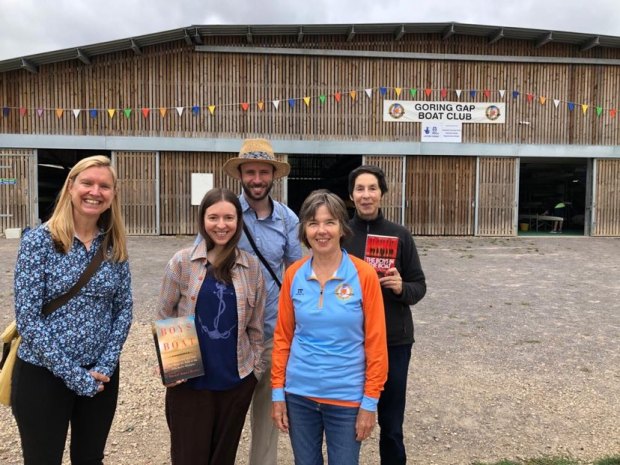
(After reading the book, some of us went on a fieldtrip to see the boating club where the woman who recommended the book rows as an amateur. It wasn’t until I saw the rowers out on the Thames that I realized that only the coxswain – the one who sits at the back of the boat and calls out the orders – faces forward, while all the other rowers are facing backwards. That feels metaphorically significant, like you have to trust where the journey is taking you all together rather than relying on your own sight.)
All along, Brown subtly weaves in the historical background: Depression-era Seattle with its shantytowns, and the rise of Hitler in Germany. Joseph Goebbels and Leni Riefenstahl were key propagandists, whitewashing the city in advance of the Olympics to make a good impression on foreign visitors. Some atrocities had already been committed, and purification policies were in place, yet the Nazis fooled many with a façade of efficiency and cleanliness.
I have deep admiration for books, fiction or non-, that can maintain suspense even though you know the outcome. The pacing really works here. Most of the action is pre-Berlin, which keeps the tension high. (The only times when my attention waned was in the blow-by-blow accounts of preliminary races.) There were so many mishaps associated with the Olympic race that it truly is amazing that the U.S. team pulled through to win – I’ll leave the specifics for future readers to discover. But there are a couple ‘stranger than fiction’ details of the book that I do want to pull out: Joe’s father and brother each married one sister from a set of twins; and actor Hugh Laurie’s father was on the Great Britain rowing team at the 1936 Olympics.
The fires and heatwave of 1936 felt familiar, as did the hairstyles and fashions in the black-and-white photos (but the ‘boys’ themselves look more like 35-year-olds than modern college students). In some ways it seemed that little has changed, but then other facts feel impossibly outdated – e.g., sperm whale oil was used to oil the boats.
This might seem like a ‘dad book’ – indeed, several of us passed the book on to our fathers/-in-law after reading – but in fact it has very broad appeal and is one I’d be likely to recommend to any big readers, even if they’re not keen on nonfiction. It’s one of my most memorable reads of the year so far. And whether you fancy reading the book or not, you may want to look out for the George Clooney-directed film, coming out next year. (Secondhand purchase) 
#1920Club Classics of the Month: Agatha Christie and F. Scott Fitzgerald
I’m sneaking in a couple of quick reviews on the final day to join in with Simon and Karen’s latest reading week, The 1920 Club. Speaking of books that were published a century ago, I happened to review Chéri by Colette as one of my monthly classics last year, and I’m currently reading The Age of Innocence by Edith Wharton in advance of our May book club meeting.

The Mysterious Affair at Styles by Agatha Christie
 I don’t think I’ve read an Agatha Christie mystery since I was about … 13? (It was And Then There Were None.) But over the years I’ve watched countless Poirot and Miss Marple cases on TV with my mother. This was Poirot’s first outing, and it’s narrated by Hastings, the slightly dim Watson to the Belgian detective’s Sherlock Holmes.
One July, invalided home from the war at age 30, Hastings goes to visit old family friends at Styles, their Essex manor house: brothers John and Lawrence Cavendish and their elderly stepmother, who has recently (and somewhat shockingly) remarried. When old Mrs. Cavendish is found dead of strychnine poisoning, Poirot is brought in to sort through the potential suspects. Coffee and cocoa cups, a fragment of a charred will, a fake beard, a candle wax stain and a bolted door will be among his major clues.
Like Hastings, we as readers are quick to point to the obvious: hey, that foreigner who happens to be an expert on poisons, it’s him, right?! But as Poirot carefully explains, again and again, “If the fact will not fit the theory, let the theory go. … Real evidence is usually vague and unsatisfactory. It has to be examined, sifted. But here the whole thing is cut and dried.”
I rarely pick up a mystery novel, though when I can get stuck in I do tend to enjoy them. This was a super-quick read and I found myself turning to it more often than to other books on my stack that felt weightier in subject matter. In the end I find crime novels inconsequential, so can’t imagine needing to try another Poirot or Marple for another 20 years or so. But if you’re struggling to read in a time of anxiety, you could certainly do worse than a Christie novel.
My rating: 
This Side of Paradise by F. Scott Fitzgerald
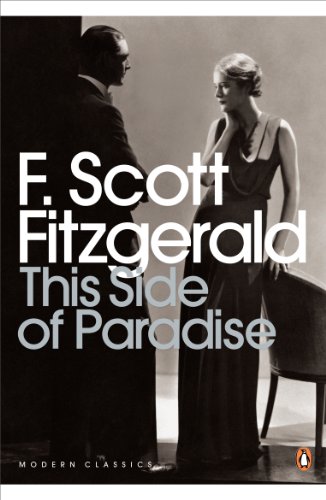 Fitzgerald has long been one of my literary blind spots. The Great Gatsby is a masterpiece, sure: I studied it in school and have read it another couple of times since, as well as lots of background nonfiction and some contemporary novels that riff on the story line. But everything else of his that I’ve tried (Tender Is the Night was the other one) has felt aimless and more stylish than substantive.
Amory Blaine is a wealthy Midwesterner who goes from boarding school to Princeton and has literary ambitions and various love affairs. He’s convinced he’s a “boy marked for glory.” But Monsignor Darcy, his guru, encourages the young man to focus on developing his character more than his dashing personality.
Hugely popular at its first release, this debut novel won Fitzgerald his literary reputation – as well as Zelda Sayre’s hand in marriage. What with the slang (“Oh my Lord, I’m going to cast a kitten”), it felt very much like a period piece to me, most impressive for its experimentation with structure: parts are written like a film script or Q&A, and there are also some poems and lists. This novelty may well be a result of the author cobbling together drafts and unpublished odds and ends, but still struck me as daring.
In a strange way, though, the novel is deliberately ahistorical in that it glosses over world events with a flippancy that I find typical of Fitzgerald. Even though Amory is called up to serve, his general reaction to the First World War is dispatched in a paragraph; Prohibition doesn’t get much more of a look-in.
I understand that the book is fairly autobiographical and in its original form was written in the first person, which I might have preferred if it led to greater sincerity. I could admire some of the witty banter and the general coming-of-age arc, but mostly felt indifferent to this one.
My rating: 
 Bookish Beck = Rebecca Foster. American transplant to England. Freelance proofreader and book reviewer.
 Bookish Beck