Rearranging and Culling My Library
I’m a thrill-seeker, me; when life gets boring, it’s time to engage in the extreme sport of rearranging my home library. My goal this month has been to shake things up and trick myself into being lured by my own books. After all, I was attracted enough to acquire them all. But at some point it’s as if I stop seeing the individual books and they collectively become a sort of wallpaper.
And as I’ve mentioned to some of you, I’ve been disappointed that attempts to highlight segments of my collection – e.g. shelves devoted to BIPOC authors and Women’s Prize nominees – failed: these books seemed more likely to sit unread for years. It must be something to do with creating a feeling of obligation. Even my piles of foodie reads and medical memoirs, two of my favourite subgenres, have gotten ignored.
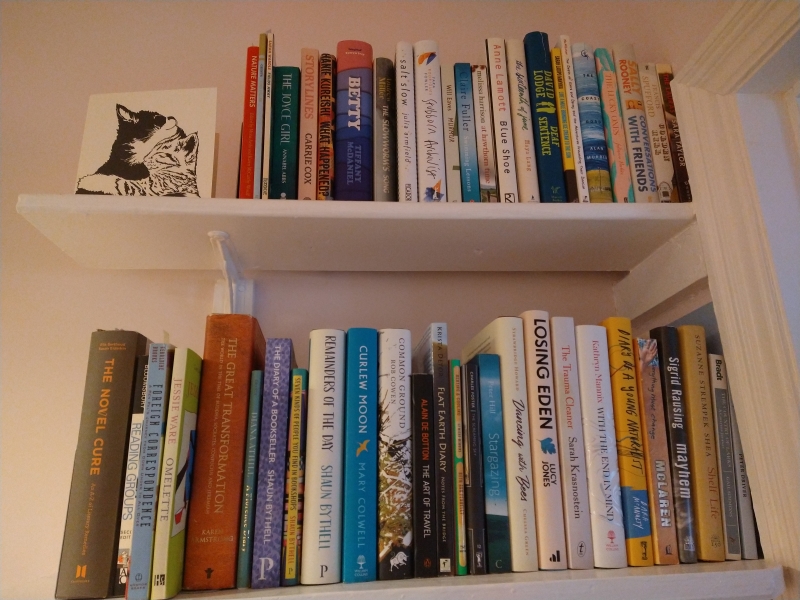
Signed copies shelves: fiction; nonfiction
Setting up special-interest sections backfired, so what next? First, I switched up locations in the upstairs; second, I adjusted the classifications. The one hard and fast rule in my collection is that I separate read from unread books. I don’t currently have room to display read paperbacks, which are in boxes upstairs awaiting built-in shelving in our lounge. I only have one bookcase for read hardbacks, and it’s at capacity; I’ll soon have to reconsider how I display them (and double-stack in the meantime).
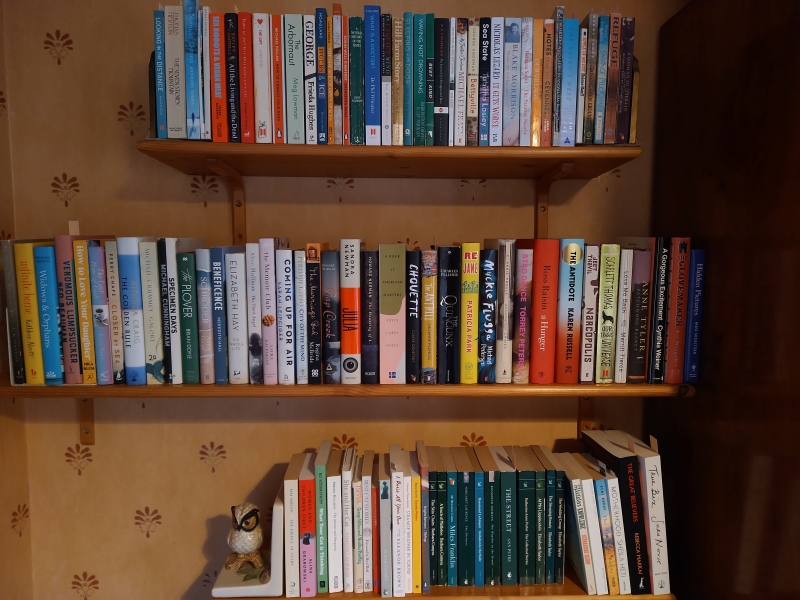
Nonfiction priority; hardback fiction; upcoming challenges and miscellaneous
For my fiction TBR, I interfiled everything into one sequence. Previously, I had kept story collections and novellas separate, but the latter are easy to spot. I’m a librarian at heart and could never eradicate alphabetical order. But, as Jan Morris observed in A Writer’s House in Wales, “I am … stymied in my methodical ordering of this library by the matter of size. Books can be maddeningly un-uniform, meaning that some … which should be side by side with their fellows, are too tall to get on the proper shelves.” Thus a separate shelf for hardbacks and oversize paperbacks.
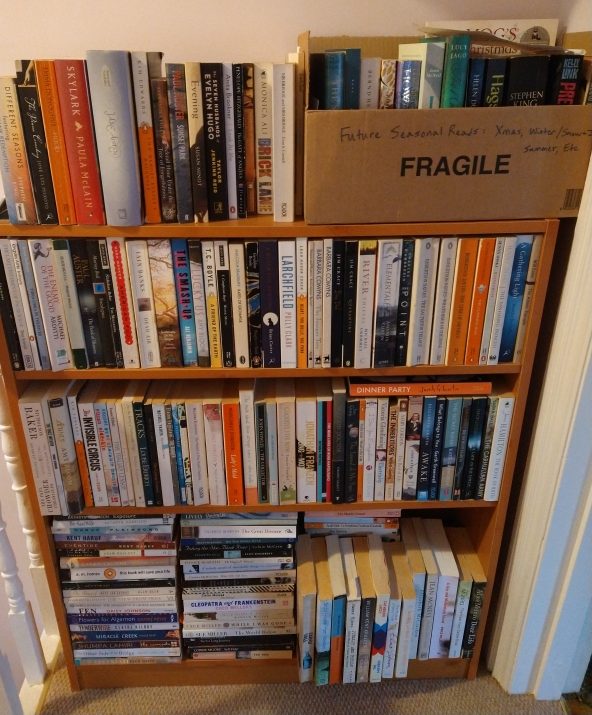
Upcoming and seasonal reads; first half of Fiction A-Z
Then, on a whim, I decided to mix it up by creating a rainbow bookcase on the landing. (To make it more of a challenge, I told myself I could use no Penguins for orange. And I put all the green Viragos together on a different shelf for visual impact.) This made me appreciate just how many books have blue spines, and dull white or black ones! I’m rather pleased with the result, but I will have to be loose about the contents: books will come and go as I read and pass them on, and add others in. In fact, I slotted three in yesterday – two green and a pink – after a trip to our local indie bookstore for my friend’s belated 70th birthday treat.
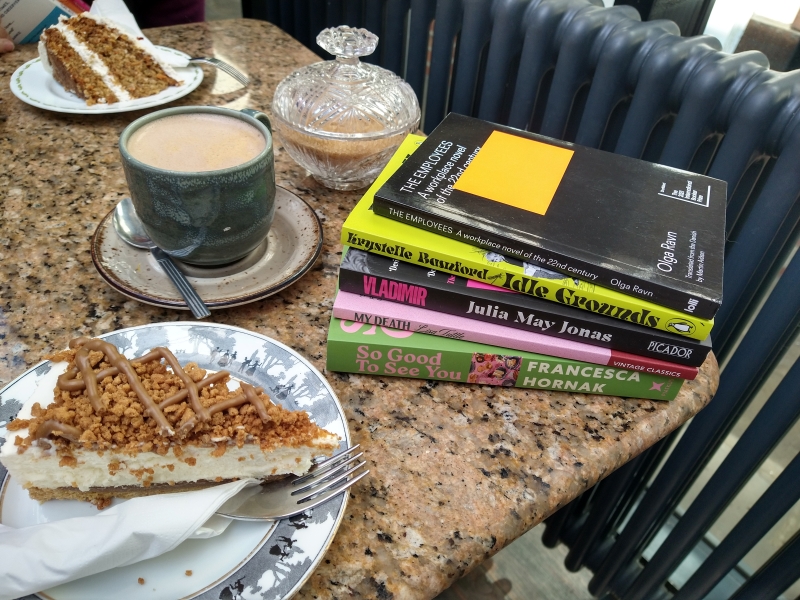
Other areas I’ve created:
- Priority shelves for time-sensitive books (to be reviewed at publication or for challenges)
- Nonfiction priority – two shelves, one in approximated Dewey order; another that includes review copies and some part-read
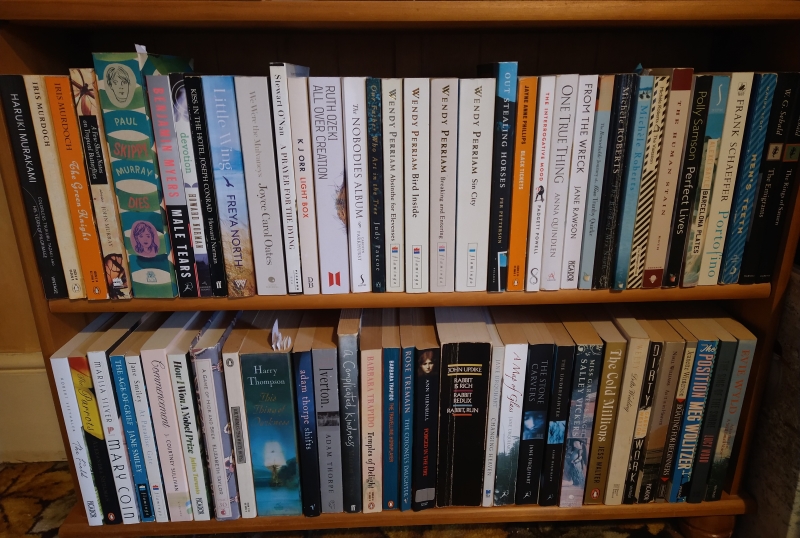
Fiction A-Z, part II
Plus some I’ve maintained:
- Priority to reread
- Seasonal books, in a box
- Signed copies – fiction and nonfiction separate; the handful of unread ones are offset
All through this process, I kept an eye out for books I was no longer keen to read. I ended up jettisoning another 81 (after the 90–100 I culled last year during our hallway redecoration), 17 of which I’ll sell; the rest will be donated to charity or the Little Free Library or given to book club friends as part of the book swap game we do for our holiday social each year.
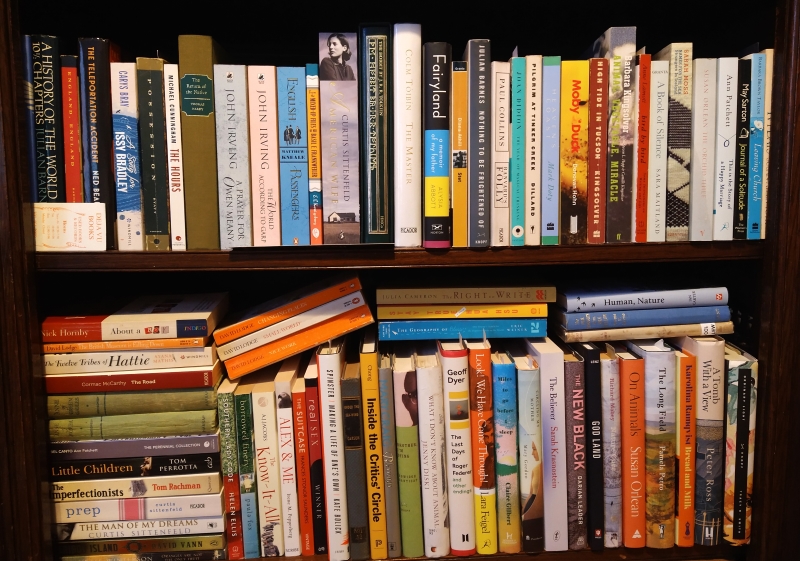
To reread (top shelf and bottom left stack); nonfiction priority
My criteria for getting rid of books were, as I’ve expounded in several posts before.
- Is it a duplicate copy? I used to keep two copies of certain books, thinking I’d do buddy reads with my husband. I have to face facts, though: buddy reads don’t work for us. He tends to read one book at a time and races ahead, while I falter or give up entirely (ahem, Cloud Atlas). I’ve only kept multiple copies where I think it’s a book we might consider setting for book club.
- Is the condition too poor? I’m not usually overly picky about this, but I did ditch four books whose spines were so faded that the title was no longer legible.
- Am I really going to read it? This is a difficult one. I like the idea of certain books but forget that I have random pet peeves, and only so much space – and time. If unsure, I checked the Goodreads page. Ratings and reviews from my friends, but also from randoms whose taste I’ve come to know, can be very helpful in telling me if something is likely to be for me. Some examples of books I decided against keeping, and the reasons:
- Peculiar Ground by Lucy Hughes-Hallett: A doorstopper of a saga that starts in the 17th century, one of my last choices of historical period to read about.
- The Mammoth Cheese by Sheri Holman: Shortlisted for the Orange Prize, but it’s over 400 pages and has great potential to be hokey.
- Eothen by Alexander Kinglake: I had two copies and rid myself of both, even though Jan Morris called it one of the best travel books of all time, because I can’t bear straight travelogues, especially antiquated ones.
- The Mars Room by Rachel Kushner: I DNFed her previous novel and decided against reading her latest; why would the one in between suit me any better?
- The Men Who Stare at Goats and Them by Jon Ronson: I enjoyed two of his books pre-pandemic, but when I look at these now, they just seem dated.
- Pharmakon by Dirk Wittenborn: Bought at The Works in Whitby in 2016 and kept all these years because I was amused by the sales stickers layering up from £2 to £1 to 50p to 25p to 10p. Yes, I bought it for 10 pence. But after a decade, I accepted that I was never going to read this 400+-page novel about an invented drug that induces happiness but then leads to a murder.
As I was going through my groaning set-aside shelf, especially, I had to be honest with myself. Sometimes I misjudge and request a review copy, then for years feel guilty about not reading something that turned out not to be for me. Or I might have liked something enough to get 50–100 pages, or more, into it but then ran out of steam. My choices for these (80+) books were: resume it right away; shelve it with the TBR, either with my progress marked with a slip of paper, or with the intention of starting over at the beginning; or call it unfinished and get rid of it.
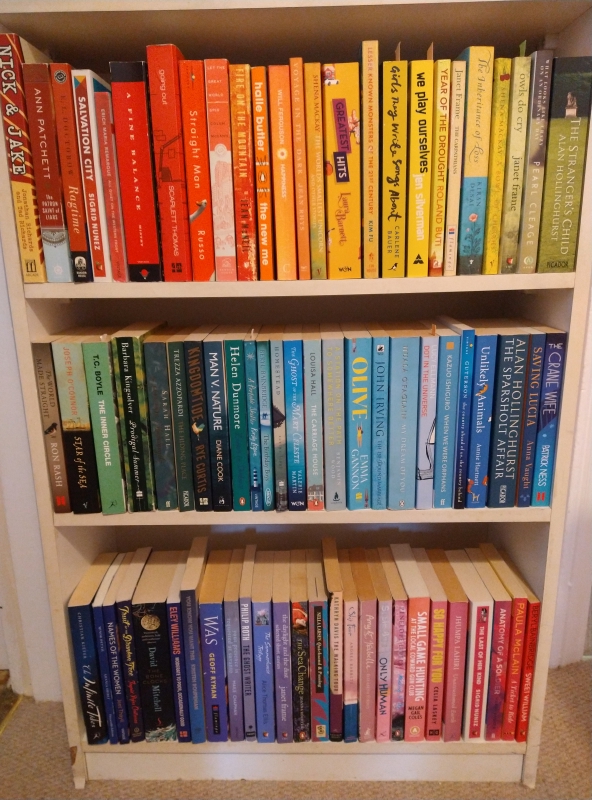
The rainbow bookcase! Have you ever made one of these?
This will be an ongoing task and an evolving system, especially if I ship the remainder of my books over from the USA in June. They’ve been in boxes in my sister’s basement – before that, my dad’s storage unit; before that, my parents’ garage – for far too long. It’s time for a final prune and a reunion with the rest of their family across the pond.
Whether all this honing and rearranging of my collection has been successful, time will tell: my end-of-year stats will reveal whether I’ve managed to read more from my own shelves. I reckon I’ll enjoy the mental athletics of remembering where I’ve moved a book and finding something to fit a seasonal challenge or personal goal. Now that the books have new neighbours, I might be tempted by my long-neglected Four in a Row project again. And for 20 Books of Summer, the only parameter will be that they must be from my own shelves.
How have you kept your TBR under control recently? Do you also have to ‘trick’ yourself into reading your own books?
A Short Trip to Sedbergh, England’s Book Town
We’ve finally completed the ‘Triple Crown’ of British book towns: Hay-on-Wye in Wales is one of our favourite places and we’ve visited seven or more times over the years (the latest); inspired by Shaun Bythell’s memoirs, we then made the pilgrimage to Wigtown in Scotland in 2018. But we hadn’t made it to Sedbergh, England’s book town, until this past week. A short conference my husband was due to attend in the northwest of the country was the excuse we needed – though a medical emergency with our cat (fine now; just had to have an infected tooth out) shortened our trip and kept him from participating in the symposium at Lancaster.
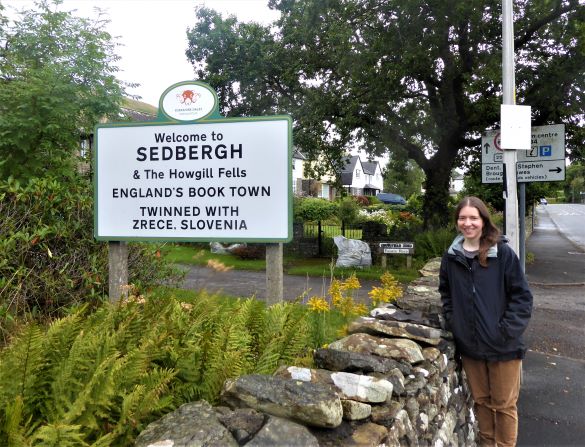
Sedbergh is technically in Cumbria but falls within the Yorkshire Dales National Park. The book town initiative was part of a drive to re-invigorate the local economy after the 2001 foot and mouth disease outbreak. It’s a very sleepy town, more so than Hay or Wigtown, and only has two dedicated bookshops. The flagship store is Westwood Books, which was based in Hay until 2006 and occupies a former cinema / factory building. It is indeed reminiscent of Hay’s Cinema Bookshop, and is similar in size and stock to the largest of the Hay shops.
The only other shop in town that only sells books is Clutterbooks charity bookshop, where we started our book hunting after we left the car at our Airbnb flat on the Wednesday. With everything priced at £1 or £1.50, it tempted me into my first six purchases. Next up was Westwood, which opens until 5, an hour later than some other places. I bought a couple more books (delighted with the pristine secondhand copy of Julian Hoffman’s first nature book) but also resold them a small box of antiquarian and signed books for more than I could ever have hoped for – covering all my book purchases for the trip, as well as our meals and snacks out. On the Thursday we had a quiet drink in a cosy local pub to toast Her Majesty’s memory.


Various main street eateries and shops have a shelf or two of books for sale. We perused these, and the Little Free Library in the old bus shelter, on the Wednesday afternoon and first thing Friday morning. I added one more purchase to my stack – a paperback copy of Fire on the Mountain by Jean McNeil for £1 – just before we left town. In general, there weren’t as many bookshops as expected, and lots of places opened later or closed earlier than advertised, presumably because it was off season and rather rainy. So, it was a little underwhelming as book town experiences go, and I can’t imagine Sedbergh ever drawing us back.
However, we enjoyed exploring the area in general, with stops at Little Moreton Hall, and Sizergh Castle and Chester, respectively, on the way up and back. As part of the conference, we joined in a walk from Grange to Cartmel that took in an interesting limestone pavement landscape. It was my first time in the Dales or Lake District in many a year, and a good chance to get back to that pocket of the world.


Painful but Necessary: Culling Books, Etc.
I’ve been somewhat cagey about the purpose for my trip back to the States. Yes, it was about helping my parents move, but the backstory to that is that they’re divorcing after 44 years of marriage and so their home of 13 years, one of three family homes I’ve known, is being sold. It was pretty overwhelming to see all the stacks of stuff in the garage. I was reminded of these jolting lines from Nausheen Eusuf’s lush poem about her late parents’ house, “Musée des Beaux Morts”: “Well, there you have it, folks, the crap / one collects over a lifetime.”


On the 7th I moved my mom into her new retirement community, and in my two brief spells back at the house I was busy dealing with the many, many boxes I’ve stored there for years. In the weeks leading up to my trip I’d looked into shipping everything back across the ocean, but the cost would have been in the thousands of dollars and just wasn’t worth it. Although my dad is renting a storage unit, so I’m able to leave a fair bit behind with him, I knew that a lot still had to go. Even (or maybe especially) books.
Had I had more time at my disposal, I might have looked into eBay and other ways to maximize profits, but with just a few weeks and limited time in the house itself, I had to go for the quickest and easiest options. I’m a pretty sentimental person, but I tried to approach the process rationally to minimize my emotional overload. I spent about 24 hours going through all of my boxes of books, plus the hundreds of books and DVDs my parents had set aside for sale, and figuring out the best way to dispose of everything. Maybe these steps will help you prepare for a future move.

The Great Book Sort-Out in progress.
When culling books, I asked myself:
- Do I have duplicate copies? This was often the case for works by Dickens, Eliot and Hardy. I kept the most readable copy and put the others aside for sale.
- Have I read it and rated it 3 stars or below? I don’t need to keep the Ayn Rand paperback just to prove to myself that I got through all 1000+ pages. If I’m not going to reread Jane Smiley’s A Thousand Acres, better to put it in the local Little Free Library so someone else can enjoy it for the first time.
- Can I see myself referring to this again? My college philosophy textbook had good explanations and examples, but I can access pithy statements of philosophers’ beliefs on the Internet instead. I’d like to keep up conversational French, sure, but I doubt I’ll ever open up a handbook of unusual verb conjugations.
- Am I really going to read this? I used to amass classics with the best intention of inhaling them and becoming some mythically well-read person, but many have hung around for up to two decades without making it onto my reading stack. So it was farewell to everything by Joseph Fielding and Sinclair Lewis; to obscure titles by D.H. Lawrence and Anthony Trollope; and to impossible dreams like Don Quixote. If I have a change of heart in the future, these are the kinds of books I can find in a university library or download from Project Gutenberg.
My first port of call for reselling books was Bookscouter.com (the closest equivalents in the UK are WeBuyBooks and Ziffit). This is an American site that compares buyback offers from 30 secondhand booksellers. There’s a minimum number of books / minimum value you have to meet before you can complete a trade-in. You print off a free shipping label and then drop off the box at your nearest UPS depot or arrange for a free USPS pickup. I ended up sending boxes to Powell’s Books, TextbookRush and Sellbackyourbook and making nearly a dollar per book. Powell’s bought about 18 of my paperback fiction titles, while the other two sites took a bizarre selection of around 30 books each.
Some books that were in rather poor condition or laughably outdated got shunted directly into piles for the Little Free Library or a Salvation Army donation. Many of my mom’s older Christian living books and my dad’s diet and fitness books I sorted into categories to be sold by the box in an online auction after the house sells.
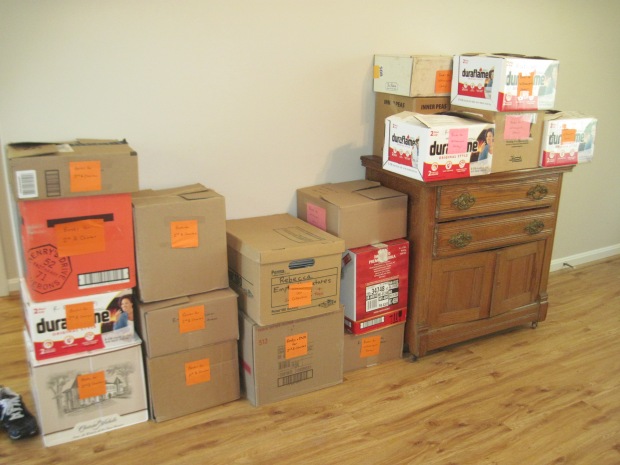
The final set of books awaiting sale.
All this still left about 18 boxes worth of rejects. For the non-antiquarian material I first tried 2nd & Charles, a new and secondhand bookstore chain that offers cash or store credit on select books. I planned to take the rest, including the antiquarian stuff, to an Abebooks seller in my mom’s new town, but I never managed to connect with him. So, the remaining boxes went to Wonder Book and Video, a multi-branch store I worked for during my final year of college. The great thing about them (though maybe not so great when you work there and have to sort through boxes full of dross) is that they accept absolutely everything when they make a cash offer. Although I felt silly selling back lots of literary titles I bought there over the years, at a massive loss, it was certainly an efficient way of offloading unwanted books.
As to everything else…
- I sent off 42.5 pounds (19.3 kilograms) of electronic waste to GreenDisk for recycling. That’s 75 VHS tapes, 63 CDs, 38 cassette tapes, 11 DVDs, five floppy disks, two dead cables, and one dead cell phone I saved from landfill, even if I did have to pay for the privilege.
- I donated all but a few of my jigsaw puzzles to my mom’s retirement community.
- I gave my mom my remaining framed artworks to display at her new place.
- I gave some children’s books, stuffed animals, games and craft supplies away to my nieces and nephews or friends’ kids.
- I let my step-nephew (if that’s a word) take whatever he wanted from my coin collection, and then sold that and most of my stamp collection back to a coin store.
- Most of my other collections – miniature tea sets, unicorn figurines, classic film memorabilia – all went onto the auction pile.
- My remaining furniture, a gorgeous rolltop desk plus a few bookcases, will also be part of the auction.
- You can tell I was in a mood to scale back: I finally agreed to throw out two pairs of worn-out shoes with holes in them, long after my mother had started nagging me about them.


Mementos and schoolwork have been the most difficult items for me to decide what to do with. Ultimately, I ran out of time and had to store most of the boxes as they were. But with the few that I did start to go through I tried to get in a habit of appreciating, photographing and then disposing. So I kept a handful of favorite essays and drawings, but threw out my retainers, recycled the science fair projects, and put the hand-knit baby clothes on the auction pile. (My mom kept the craziest things, like 12 inches of my hair from a major haircut I had in seventh grade – this I threw out at the edge of the woods for something to nest with.)


 All this work and somehow I was still left with 29 smallish boxes to store with my dad’s stuff. Fourteen of these are full of books, with another four boxes of books stored in my mom’s spare room closet to select reading material from on future visits. So to an extent I’ve just put off the really hard work of culling until some years down the road – unless we ever move to the States, of course, in which case the intense downsizing would start over here.
At any rate, in the end it’s all just stuff. What I’m really mourning, I know, is not what I had to get rid of, or even the house, but the end of our happy family life there. I didn’t know how to say goodbye to that, or to my hometown. I’ve got the photos and the memories, and those will have to suffice.
 Bookish Beck = Rebecca Foster. American transplant to England. Freelance proofreader and book reviewer.
 Bookish Beck