Spring Reading 2021: Birdsong, Cherry Blossom & More
It’s been a gorgeously sunny spring here – how about where you are? Although there have still been some frosty nights troubling the gardeners among us, it’s been warm in the daytime and the flowers and blossom are coming on apace.
Recently I’ve read a couple of books reflecting on the spring of 2020, specifically the opportunities it offered to reconnect with local nature at a time when we were isolated and couldn’t travel.
I’ve also been feeling nostalgic for Washington, D.C. and the Maryland suburbs, where I grew up. It’s been two years since my last trip back, but I’m holding out hope that I can make it over in June for a family wedding.
Rounding out my selection of “Spring” titles is an offbeat Japanese novella.
Looking back to the coronavirus spring:
On Thursday evening I watched “The Act of Nature Watching,” a special Earth Day Zoom talk for West Berkshire Libraries by local nature writer Nicola Chester, whose memoir is coming out in the autumn. The UK is one of the most nature-depleted countries, she lamented. We are hardwired to watch and love nature, she noted, yet have never been more alienated from it. Reading from her columns and anthology contributions (as well as the Lovatt, below) and giving tips on recognizing birdsong and mammal signs, she spoke of nature-watching as a form of mindfulness – an approach that chimed with the first three books I feature here.
Birdsong in a Time of Silence: An Awakening by Steven Lovatt (2021)
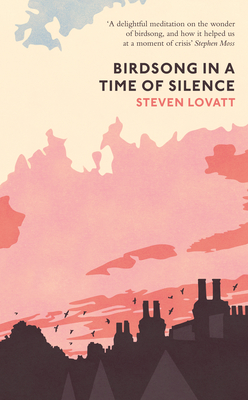 During the UK’s first lockdown, with planes grounded and cars stationary, many remarked on the quiet. All the better to hear birds going about their usual spring activities. For Lovatt, from Birmingham and now based in South Wales, it was the excuse he needed to return to his childhood birdwatching hobby. In between accounts of his spring walks, he tells lively stories of common birds’ anatomy, diet, lifecycle, migration routes, and vocalizations. (He even gives step-by-step instructions for sounding like a magpie.) Birdsong takes him back to childhood, but feels deeper than that: a cultural memory that enters into our poetry and will be lost forever if we allow our declining bird species to continue on the same trajectory.
Mentions of current events are sparse and subtle, so the spring feels timeless, as it should. I worried there might be too much overlap with A Sweet, Wild Note by Richard Smyth, but there’s room for both on your shelf. Lovatt’s writing is introspective and poetic, delighting in metaphors for sounds: “The song of a turtle dove is like the aural equivalent of a heat-haze, the gentlest corrugation of air, always just on the edge of your hearing.” 
Skylarks with Rosie: A Somerset Spring by Stephen Moss (2021)
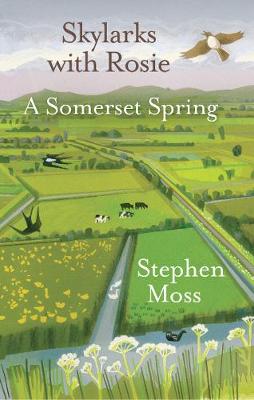 Lovatt must have been a pupil of Moss’s on the Bath Spa University MA degree in Travel and Nature Writing. The prolific Moss’s latest also reflects on the spring of 2020, but in a more overt diary format. Devoting one chapter to each of the 13 weeks of the first lockdown, he traces the season’s development alongside his family’s experiences and the national news. With four of his children at home, along with one of their partners and a convalescing friend, it’s a pleasingly full house. There are daily cycles or walks around “the loop,” a three-mile circuit from their front door, often with Rosie the Labrador; there are also jaunts to corners of the nearby Avalon Marshes. Nature also comes to him, with songbirds in the garden hedges and various birds of prey flying over during their 11:00 coffee breaks.
His speaking engagements and trips cancelled, Moss turns to online events instead. Twitter serves as a place for sharing outrage over UK politics and world events like George Floyd’s murder, but also as a welcoming community for sharing nature sightings. As the lockdown come to a close, he realizes that this time has had unexpected benefits: “Having to press the pause button … has made me rethink my life, in a good way.” He feels that, for once, he has truly appreciated the spring, “rediscovering the joys of wildlife-watching close to home”. This made for perfect reading in Somerset last week. 
Also recommended: The Consolation of Nature by Marren, McCarthy and Mynott
Remembering springs back home:
Spring in Washington by Louis J. Halle (1947)
“The discovery of spring each year, after the winter’s hibernation, is like a rediscovery of the universe … knowledge of spring gives me the freedom of the world.”
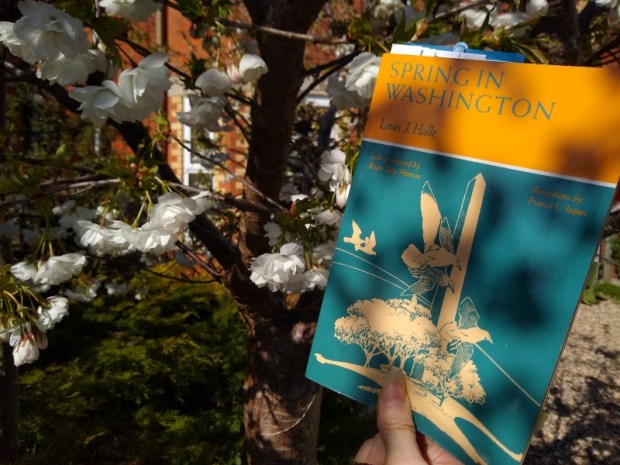 For Halle, who worked in the State Department, nature was an antidote to hours spent shuffling papers behind a desk. In this spring of 1945, there was plenty of wildfowl to see in central D.C. itself, but he also took long early morning bike rides along the Potomac or the C&O Canal, or in Rock Creek Park. From first migrant in February to last in June, he traces the spring mostly through the birds that he sees. More so than the specific observations of familiar places, though, I valued the philosophical outlook that makes Halle a forerunner of writers like Barry Lopez and Peter Matthiessen. He notes that those caught up in the rat race adapt the world to their comfort and convenience, prizing technology and manmade tidiness over natural wonders. By contrast, he feels he sees more clearly – literally as well as metaphorically – when he takes the long view of a landscape.
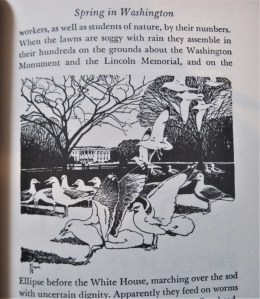 I marked so many passages of beautiful description. Halle had mastered the art of noticing. But he also sounds a premonitory note, one that was ahead of its time in the 1940s and needs heeding now more than ever: “When I see men able to pass by such a shining and miraculous thing as this Cape May warbler, the very distillate of life, and then marvel at the internal-combustion engine, I think we had all better make ourselves ready for another Flood.”
This was a lucky find at Hay Cinema Bookshop back in September. For me it was the ideal combination of thoughtful prose and vicarious travel, though I imagine it might not mean as much to those without a local connection. The black-and-white in-text illustrations by Francis L. Jaques are a particularly nice addition. 
Pussy cat, pussy cat, where have you been? I’ve been to Washington, and guess what I’ve seen… by Russell Punter and Dan Taylor (2019)
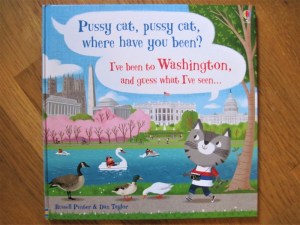 More cherry blossoms over tourist landmarks! This is part of a children’s series inspired by the 1805 English rhyme about London; other volumes visit New York City, Paris, and Rome. In rhyming couplets, he takes us from the White House to the Lincoln Memorial via all the other key sights of the Mall and further afield: museums and monuments, the Library of Congress, the National Cathedral, Arlington Cemetery, even somewhere I’ve never been – Theodore Roosevelt Island. Realism and whimsy (a kid-sized cat) together; lots of diversity in the crowd scenes. What’s not to like? (Titled Kitty cat, kitty cat… in the USA.)
And, as a bonus, some fiction in translation:
Spring Garden by Tomoka Shibasaki (2014; 2017)
[Translated from the Japanese by Polly Barton]
 Like a Murakami protagonist, Taro is a divorced man in his thirties, mildly interested in the sometimes peculiar goings-on in his vicinity. Rumor has it that his Tokyo apartment complex will be torn down soon, but for now the PR manager is happy enough here. “Avoiding bother was Taro’s governing principle.” But bother comes to find him in the form of a neighbor, Nishi, who is obsessed with a nearby house that was the backdrop for the art book Spring Garden, a collection of photographs of a married couple’s life. Her enthusiasm gradually draws Taro into the depicted existence of the TV commercial director and actress who lived there 25 years ago, as well as the young family who live there now. This Akutagawa Prize winner failed to hold my interest – like The Guest Cat, it’s oddly preoccupied with architectural detail, a Japanese fascination that doesn’t translate so well.
Have you been reading anything particularly appropriate for spring this year?
Spring Reading 2020, Part II
According to the Sámi reindeer herders, there are actually eight seasons; we’d now be in “Spring-summer” (gidágiesse), which runs from May to June.
In recent weeks I’ve read some more books that engage with the spring and/or its metaphors of planting and resurrection. (The first installment was here.) Two fiction and two nonfiction selections this time.
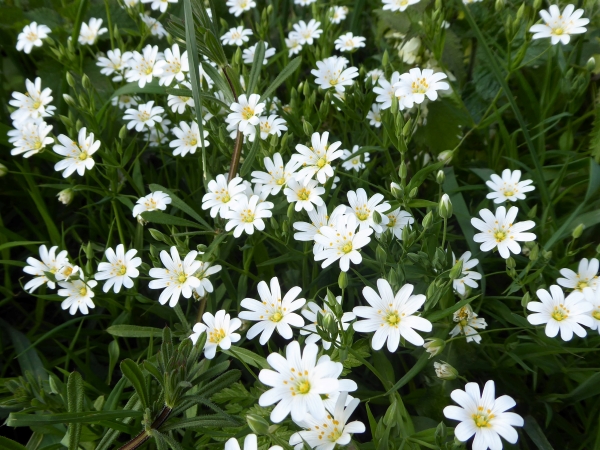
Stitchwort beside a nearby lane. Photo by Chris Foster.
The White Garden: A Novel of Virginia Woolf by Stephanie Barron (2009)
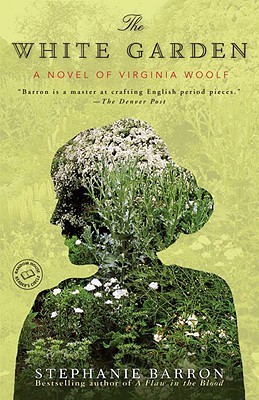 Barron is best known for her Jane Austen Mysteries series. Here she takes up the relationship between Virginia Woolf and Vita Sackville-West and crafts a conspiracy theory / alternative history in which Virginia did not commit suicide upon her disappearance in March 1941 but hid with Vita at Sissinghurst, her Kent home with the famous gardens. Investigating this in the autumn of 2008 are Jo Bellamy, an American garden designer who has been tasked with recreating Sackville-West’s famous White Garden at her wealthy client’s upstate New York estate, and Peter Llewelyn, a Sotheby’s employee who helps Jo authenticate a journal she finds hidden in a gardener’s shed at Sissinghurst.
Jo has a secret connection: her grandfather, Jock, who recently committed suicide, was a gardener here at the time of Woolf’s visit, and she believes the notebook may shed light on Virginia’s true fate and what led Jock to kill himself. Romantic complications ensue. This is fun escapism for Americans after an armchair trip to England (including Oxford and Cambridge for research), but so obviously written by an outsider. I had to correct what felt like dozens of errors (e.g. the indoor smoking ban came into effect in July 2007, so the hotel dining room wouldn’t have been filled with cigarette smoke; “pulling a few” is not slang for having a few drinks – rather, “pulling” has the connotation of making a romantic conquest).
I’ve visited Sissinghurst and Knole and had enough of an interest in the historical figures involved to keep me going through a slightly silly, frothy novel. 
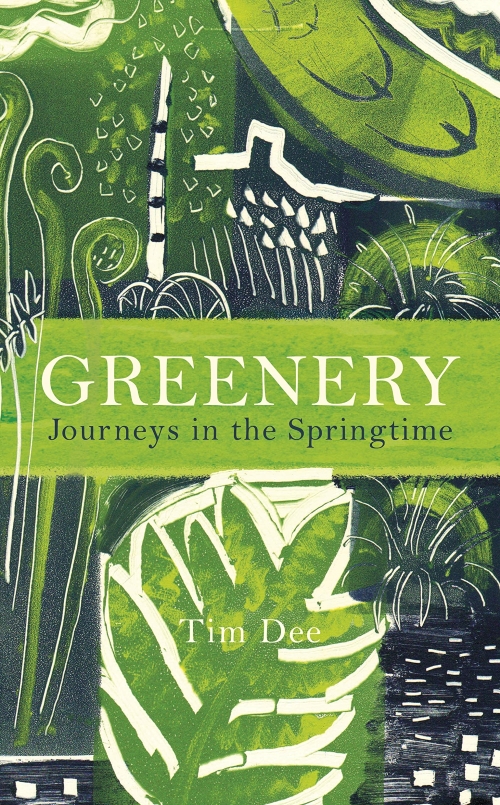
Greenery: Journeys in Springtime by Tim Dee (2020)
From the Cape of Good Hope to the Arctic Circle, Dee tracks the spring as it travels north. From first glimpse to last gasp, moving between his homes in two hemispheres, he makes the season last nearly half the year. His harbingers are chiefly migrating birds – starting with swallows. Here’s how he states his aim:
Knowing those annually recurring gifts of nature, and registering them alongside our own one-way journey through life, why not try to travel with the season and be in springtime for as long as possible, why not try to start where the season starts, and then to keep up with it, in step, walking a moving green room, travelling under the sun, like swallows out of Africa?
Starting in February in the Sahara Desert, he sees an abundance of the songbirds and raptors he’s used to finding in Europe, as well as more exotic species endemic to Africa. Any fear that this will turn out to be some plodding ‘I went here and saw this, then there and saw that’ nature/travel narrative dissipates instantly; although the book has a strong geographical and chronological through line, it flits between times and places as effortlessly as any bird, with the poetic quality of Dee’s observations lifting mundane moments into sharp focus. For instance, at their Ethiopian hotel, a wedding photography mecca, “a waiting wedding dress collapsed on a black cane chair, like an ostrich suicide.” A nightjar startled in the New Forest is “a bandaged balsa-wood model: a great moth’s head with the wings of a dark dragonfly.”
Dee’s wanderings take him from Scandinavia to central Europe and back. Wherever he happens to be, he is fully present, alive to a place and to all its echoes in memory and literature. He recalls a lonely year spent in Budapest studying Hungarian poetry in the 1980s, and how the sight and sound of birds like black woodpeckers and eagle owls revived him. Visits to migration hotspots like Gibraltar and Heligoland alternate with everyday jaunts in Ireland or the Bristol and Cambridgeshire environs he knows best.
Each vignette is headed with a place name and latitude, but many are undated, recalling springs from decades past or from the work of admired writers. Some of his walking companions and mentioned friends are celebrated nature or travel writers in their own right (like Julia Blackburn, Mark Cocker, Patrick McGuinness and Adam Nicolson; there’s also his cousin, fiction writer Tessa Hadley), while Samuel Taylor Coleridge, Seamus Heaney, D. H. Lawrence and Gilbert White are some of the book’s presiding spirits.
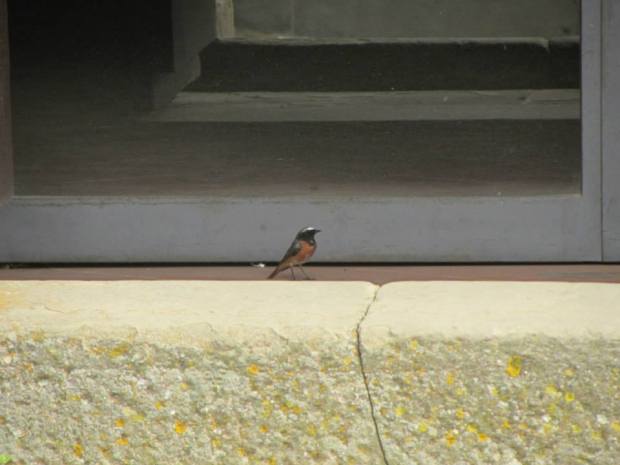
A redstart on some church steps in Tuscany, April 2014. Not the best view, but this is Dee’s favourite bird. Photo by Chris Foster.
Greenery is steeped in allusions and profound thinking about deep time and what it means to be alive in an era when nature’s rhythms are becoming distorted. It is so gorgeously literary, so far from nature and travel writing as usual, that it should attract readers who wouldn’t normally dip into those genres. While Dee’s writing reminds me somewhat of Barry Lopez’s, closer comparisons could be made with Helen Macdonald’s H Is for Hawk and Peter Matthiessen’s The Snow Leopard: quest narratives that nestle their nature writing within a substrate of memoir and philosophy. The last few pages, in which Dee, now in his late fifties, loses a close friend (Greg Poole, who painted the book’s cover) and receives a diagnosis of Parkinson’s disease but also learns he is to become a father again, are achingly beautiful.
I find I’ve written more about this book than I intended to in a reviews roundup, but it’s so extraordinary it deserves this much and more. It’s not just one of the few best nonfiction books of the year, but a fresh, masterful model of how to write about nature. 
In the Springtime of the Year by Susan Hill (1975)
 This is my favorite of the six books I’ve now read by Hill. Early one spring, Ruth Bryce’s husband, Ben, dies in a forestry accident. They had been only married a year and now here she is, aged 20 and a widow. Ben’s little brother, 14-year-old Jo, is a faithful visitor, but after the funeral many simply leave Ruth alone. Ben’s death is a “stone cast into still water,” whose ripples spread out beyond his immediate family.
There is little plot as such, yet this is a lovely, quiet meditation on grief and solitude amid the rhythms of country life. Ruth vacillates between suicidal despair and epiphanies of exaltation at how all of life is connected. Religious imagery coinciding with Easter describes a cycle of death and renewal. Very late on in the book, as winter comes round again, she has the chance to be of help to another local family that has suffered a loss, and to a member of Ben’s remaining family.
It took me two whole springs to read this. For those who think of Hill as a writer of crime novels (the Simon Serrailler series) and compact thrillers (The Woman in Black et al.), this may seem very low on action in comparison, but there is something hypnotic about the oddly punctuated prose and the ebb and flow of emotions. 
Plant Dreaming Deep by May Sarton (1968)
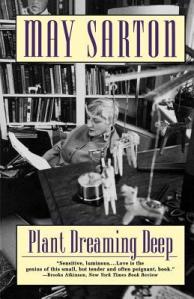 This serves as a prelude to the eight journals for which Sarton would become famous. It’s a low-key memoir about setting up home in the tiny town of Nelson, New Hampshire, making a garden and meeting the salt-of-the-earth locals who provided her support system and are immortalized in fictional form in the novel she published two years later, Kinds of Love. At the time of publication, she’d been in Nelson for 10 years; she would live there for 15 years in all, and (after seeing out her days in a rented house by the coast in Maine) be buried there.
Sarton was nearing 50 by the time she bought this, her first home, and for her it represented many things: a retreat from the world; a place for silence and solitude; and somewhere she could bring together the many aspects of herself, even if just by displaying her parents’ furniture, long in storage, and the souvenirs from her travels – “all the threads I hold in my hands have at last been woven together into a whole—the threads of the English and Belgian families from which I spring … the threads of my own wanderings”.
Nelson feels like a place outside of time. It holds annual Town Meetings, as it has for nearly two centuries. Her man-of-all-work, Perley Cole, still cuts the meadow with a scythe. After years of drought, she has to have water-drillers come and find her a new source. An ancient maple tree has to be cut down, reminding her of other deaths close to home. Through it all, her beloved garden is a reminder that new life floods back every year and the routines of hard work will be rewarded.
Some favorite lines:
“Experience is the fuel; I would live my life burning it up as I go along, so that at the end nothing is left unused, so that every piece of it has been consumed in the work.”
“gardening is one of the late joys, for youth is too impatient, too self-absorbed, and usually not rooted deeply enough to create a garden. Gardening is one of the rewards of middle age, when one is ready for an impersonal passion, a passion that demands patience, acute awareness of a world outside oneself, and the power to keep on growing through all the times of drought, through the cold snows, toward those moments of pure joy when all failures are forgotten and the plum tree flowers.”
Note: I discovered I’ve always misunderstood this title, thinking it whimsically imagined a plant having dreams; instead, “plant” is an imperative verb, as in Sarton’s adaptation of Joachim du Bellay: “Happy the man who can long roaming reap, / Like old Ulysses when he shaped his course / Homeward at last toward the native source, / Seasoned and stretched to plant his dreaming deep.” It’s about a place where one can root one’s work and intentions.
Have you been reading anything springlike this year?
Spring Reading 2020, Part I
What a beautiful spring we’ve been having here. And, as usual, I’ve been reading with the seasons: some nature books about birdsong, flowers, etc., as well as a few books with “Spring” in the title. I have several more on the go that I’ll write up next month.
A Cold Spring by Elizabeth Bishop (1955)
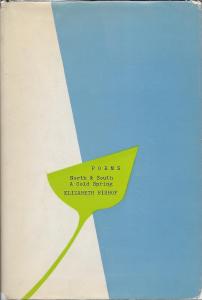 The second of Bishop’s four published collections, this mostly dwells on contrasts between city (e.g. “View of the Capitol from the Library of Congress,” “Varick Street” and “Letter to N.Y.”) and coastal locations (e.g. “The Bight,” “At the Fishhouses” and “Cape Breton”). The three most memorable poems for me were the title one, which opens the book; “The Prodigal,” a retelling of the Prodigal Son parable; and “Invitation to Miss Marianne Moore” (“From Brooklyn, over the Brooklyn Bridge, on this fine morning, please come flying,” with those last three words recurring at the end of each successive stanza; also note the sandpipers – one of her most famous poems was “Sandpiper,” from 1965’s Questions of Travel). I find that I love particular lines or images from Bishop’s poetry but not her overall style.
Favorite lines:
A cold spring:
the violet was flawed on the lawn.
For two weeks or more the trees hesitated;
the little leaves waited
(from “A Cold Spring”)
Spring: A Folio Anthology, edited by Sue Bradbury (2017)
 As a seasonal anthology, this falls short by comparison to the Wildlife Trust’s Spring. There are too many letters or journal entries that only happen to be set in March to May and don’t in any way evoke the season. The selection of poems and passages is fairly predictable, and closing with an ominous extract from Rachel Carson’s Silent Spring (see below) makes for rather a downbeat conclusion. Highlights: the preface by Paul Evans, Parson Woodforde’s pigs getting drunk on the dregs of some beer (1778), Elizabeth David rhapsodizing about a wild asparagus risotto she had in Italy, and Angus Buchanan coming upon an idyllic setting in Wildlife in Canada. The gorgeous cover, the slightly ornate font that liaises s or c with t, and the three two-page green-dominated illustrations somewhat make up for the lackluster contents.
Silent Spring by Rachel Carson (1962)
 When I saw Lucy Jones speak at an event in Hungerford in support of her new book, Losing Eden, early last month, I was intrigued to hear her say that her work was consciously patterned on Silent Spring – right down to the same number of chapters. This prompted me to finally pick up the copy of Carson’s classic that I got free during a cull at the library where I used to work and have a skim through.
Both books are forthright explications of the environmental problems we face, backed up by volumes of irrefutable evidence, and suggest some potential solutions. Both open, though, with a dystopian scene: Carson’s first chapter imagines an American town where things die because nature stops working as it should. Her main target was insecticides that were known to kill birds and had presumed negative effects on human health through the food chain and environmental exposure. Although the details may feel dated, the literary style and the general cautions against submitting nature to a “chemical barrage” remain potent.
A Country Year: Living the Questions by Sue Hubbell (1986)
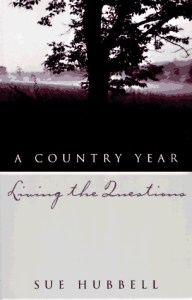 A seasonal diary that runs from one spring to the next, this is a peaceful book about living alone yet finding community with wildlife and fellow country folk. I took nine months over reading it, keeping it as a bedside book.
At her farm in southern Missouri’s Ozark Mountains, Hubbell had a small beekeeping and honey production business, “a shaky, marginal sort of affair that never quite leaves me free of money worries but which allows me to live in these hills that I love.” After her 30-year marriage ended, she found herself alone in “the afternoon of my life,” facing “the work of building a new kind of order, a structure on which a fifty-year-old woman can live”. In few-page essays she reflects on the weather, her interactions with wildlife (from bats and black rat snakes to a fawn caught in a fence), and country events like a hog roast.
I love introspective books like this one that balance solitude with nature and company and that showcase older women’s wisdom (Joan Anderson, May Sarton and Barbara J. Scot also write/wrote in this vein). Hubbell, who died at age 83 in late 2018, wrote broader scientific narratives about evolution and genetic engineering, as well as detailed books about bees and other insects. I’ll look out for more of her work.
A Sweet, Wild Note: What We Hear when the Birds Sing by Richard Smyth (2017)
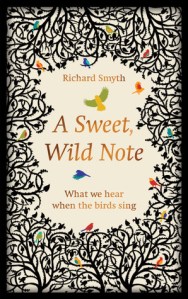 Despite being a birdwatcher since childhood, Smyth had always been ambivalent about birdsong. He certainly wasn’t one of those whizzes who can identify any bird by its call; in fact, he needed convincing that bird vocalizations are inherently beautiful. So he set off to answer a few questions: Why do birds sing? How can we recognize them by their songs? And how have these songs played into the human‒bird relationship throughout history? Ranging from bird anatomy to poetry, his historical survey is lighthearted reading that was perfect for the early days of spring. There are also chapters on captive birds, the use of birdsong in classical music, and the contribution birds make to the British soundscape. A final section, more subdued and premonitory in the vein of Silent Spring, imagines a world without birdsong and “the diminution that we all suffer. … Our lives become less rich.” (The title phrase is how Gilbert White described the blackcap’s song, Smyth’s favorite.)
Favorite lines:
when everything around you seems to be moving at a gallop, a bird’s song reminds you that some things stay the same … that you really can go home again.
in many ways the whole point of birdsong is that it’s beyond our grasp. It’s fleeting, evanescent; you might as well try to take a fistful of morning mist. But that hasn’t stopped us trying.
Have you been reading anything particularly appropriate for spring this year?
A Bouquet of Spring Reading
In March through May I often try to read a few gardening-themed books and/or ones with “spring” in the title. Here are some of the ones that I have on the go as occasional reading:
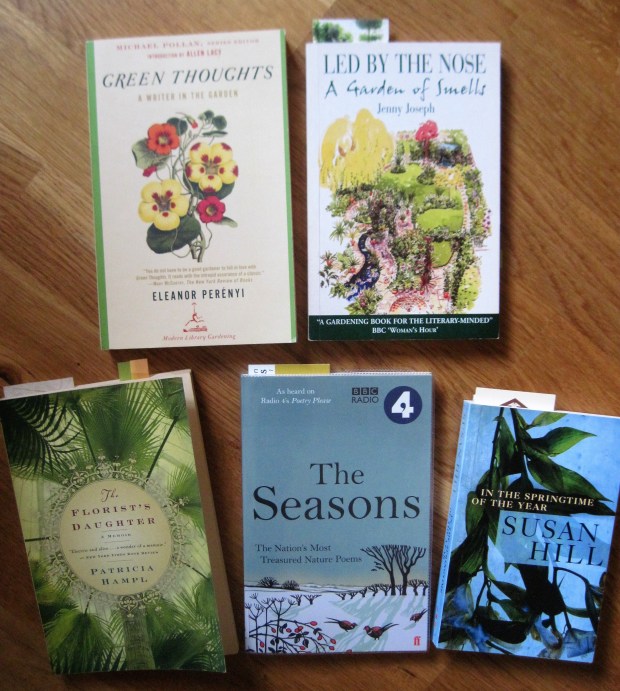
Flowers and gardens
The Florist’s Daughter by Patricia Hampl: Her mother’s final illness led Hampl to reflect on her upbringing in St. Paul, Minnesota as the daughter of an Irish Catholic library clerk and a Czech florist. I love how she writes about small-town life and helping out in her father’s flower shop:
“These apparently ordinary people in our ordinary town, living faultlessly ordinary lives … why do I persist in thinking—knowing—they weren’t ordinary at all? … Nostalgia is really a kind of loyalty”
“it was my father’s domain, but it was also marvelously other, this place heavy with the drowsy scent of velvet-petaled roses and Provençal freesias in the middle of winter, the damp-earth spring fragrance of just-watered azaleas and cyclamen”
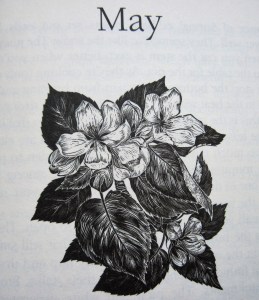 Led by the Nose: A Garden of Smells by Jenny Joseph: Joseph’s name might not sound familiar, but she was the author of the famous poem “Warning: When I Am an Old Woman I Shall Wear Purple” and died early last year. This is a pleasant set of short pieces about what you might see and sense in your garden month by month. “Gardeners do indeed look before and after, at the same time living, as no one else, in the now of the nose,” she maintains. I’m particularly fascinated by the sense of smell and how a writer can describe odors, so I was delighted to find this in a charity shop in Edinburgh last year and have been reading it a few pages at a time as a bedside book. I especially like the wood engravings by Yvonne Skargon that head each chapter.
Green Thoughts: A Writer in the Garden by Eleanor Perényi: A somewhat dense collection of few-page essays, arranged in alphabetical order, on particular plants, tools and techniques. I tried reading it straight through last year and only made it as far as “Beans.” My new strategy is to keep it on my bedside shelves and dip into whichever pieces catch my attention. I don’t have particularly green fingers, so it’s not a surprise that my eye recently alighted on the essay “Failure,” which opens, “Sooner or later every gardener must face the fact that certain things are going to die on him. It is a temptation to be anthropomorphic about plants, to suspect that they do it to annoy.”
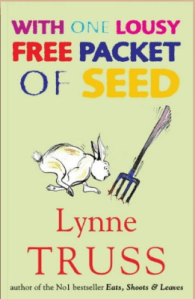 With One Lousy Free Packet of Seed by Lynne Truss (DNF at page 131 out of 210): A faltering gardening magazine is about to be closed down, but Osborne only finds out when he’s already down in Devon doing the research for his regular “Me and My Shed” column with a TV actress. Hijinks were promised as the rest of the put-out staff descend on Honiton, but by nearly the two-thirds point it all still felt like preamble, laying out the characters and their backstories, connections and motivations. My favorite minor character was Makepeace, a pugnacious book reviewer: “he used his great capacities as a professional know-all as a perfectly acceptable substitute for either insight or style.”
Spring
The Seasons, a Faber & Faber / BBC Radio 4 poetry anthology: From Chaucer and other Old English poets to Seamus Heaney (“Death of a Naturalist”) and Philip Larkin (“The Trees”), the spring section offers a good mixture of recent and traditional, familiar and new. A favorite passage was “May come up with fiddle-bows, / May come up with blossom, / May come up the same again, / The same again but different” (from “Nuts in May” by Louis MacNeice). Once we’re back from America I’ll pick up with the summer selections.
In the Springtime of the Year by Susan Hill: Early one spring, Ruth Bryce’s husband, Ben, dies in a forestry accident. They had only been married a year and here she is, aged twenty-one and a widow. Ben’s little brother, 14-year-old Jo, is a faithful visitor, but after the funeral many simply leave Ruth alone. I’m 100 pages in and still waiting for there to be a plot as such; so far it’s a lovely, quiet meditation on grief and solitude amid the rhythms of country life. Ben’s death is described as a “stone cast into still water,” and here at nearly the halfway point we’re seeing how some of the ripples spread out beyond his immediate family. I’m enjoying the writing more than in the three other Hill books I’ve read.
 Absent in the Spring by Mary Westmacott: (The title doesn’t actually have anything to do with the season; it’s a quotation from Shakespeare’s Sonnet 98: “From you have I been absent in the spring.”) From 1944, this is the third of six novels Agatha Christie published under the alias Mary Westmacott. Joan Scudamore, traveling back to London from Baghdad after a visit to her adult daughter, encounters bad weather and misses her train, which leaves her stranded in the desert for days that feel more like weeks. We’re led back through scenes from Joan’s earlier life and realize that she’s utterly clueless about what those closest to her want and think. Rather like Olive Kitteridge, Joan is difficult in ways she doesn’t fully acknowledge. Like a desert mirage, the truth of who she’s been and what she’s done is hazy, and her realization feels a little drawn out and obvious. Once she gets back to London, will she act on what she’s discovered about herself and reform her life, or just slip back into her old habits? This is a short and immersive book, and a cautionary tale to boot. It examines the interplay between duty and happiness, and the temptation of living vicariously through one’s children.
Have you been reading anything particularly appropriate for spring this year?
Dubiously Thematic Easter Reading
In 2015 and 2017 I came up with some appropriately theological reading recommendations for Easter. This year I’m going for a more tongue-in-cheek approach, as befits the unfortunate conjunction of Easter with April Fools’ Day.
Currently reading or reviewing:
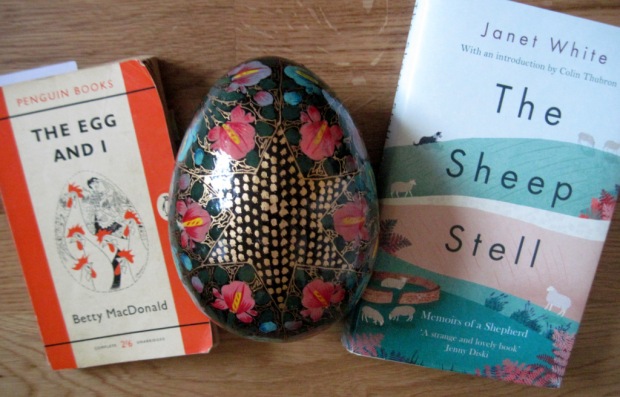
The Egg and I by Betty MacDonald
I bought this on a whim from a local charity shop, based on the title, cover and blurb. I’m about one-third of the way through so far. MacDonald and her husband started a chicken farm in a mountainous area of the Pacific Northwest in the 1940s. Her account of her failure to become the perfect farm wife is rather hilarious. My only hesitation is about her terrible snobbishness towards rednecks and “Indians.”


A representative passage: “Gathering eggs would be like one continual Easter morning if the hens would just be obliging and get off the nests. Co-operation, however, is not a chickenly characteristic and so at egg-gathering time every nest was overflowing with hen, feet planted, and a shoot-if-you-must-this-old-grey-head look in her eye.”
The Sheep Stell by Janet White
 I’m reviewing this reissued memoir for the TLS. It’s a delightful story of finding contentment in the countryside, whether on her own or with family. White, now in her eighties, has been a shepherd for six decades in the British Isles and in New Zealand. While there’s some darker material here about being stalked by a spurned suitor, the tone is mostly lighthearted. I’d recommend it to anyone who’s enjoyed books by Gerald Durrell, James Herriot and Doreen Tovey.
Representative passages: “Shepherding is a strange mixture of tremendous physical work alternating with periods of calm, quiet indolence.” & “A dare, a dream and a challenge. I could have hunted the whole world over and never in a lifetime found anywhere so right: warm, high, pastoral and severed by the sea.”
Read recently:
The Trouble with Goats and Sheep by Joanna Cannon
 Mrs. Creasy disappears one Monday in June 1976, and ten-year-old Grace Bennett and her friend Tilly are determined to figure out what happened. I have a weakness for precocious child detectives (from Harriet the Spy to Flavia de Luce), so I enjoyed Grace’s first-person sections, but it always feels like cheating to me when an author realizes they can’t reveal everything from a child’s perspective so add in third-person narration and flashbacks. These fill in the various neighbors’ sad stories and tell of a rather shocking act of vigilante justice they together undertook nine years ago.
Sheep are a metaphor here for herd behavior and a sense of belonging, but also for good versus evil. Grace and Tilly become obsessed with a Bible passage the vicar reads about Jesus separating the sheep from the goats. But how can he, or they, know who’s truly righteous? As Grace says, “I think that’s the trouble, it’s not always that easy to tell the difference.” It’s a simplistic message about acknowledging the complexity of other lives and situations rather than being judgmental, and matches the undemanding prose.
Reminiscent of Rachel Joyce, but not as good.
My rating:
Vita Nova by Louise Glück
 My first collection from the prolific Pulitzer winner. Some of the poems are built around self-interrogation, with a question and answer format; several reflect on the myth of Orpheus and Eurydice. The first and last poems are both entitled “Vita Nova,” while another in the middle is called “The New Life.” I enjoyed the language of spring in the first “Vita Nova” and in “The Nest,” but I was unconvinced by much of what Glück writes about love and self-knowledge, some of it very clichéd indeed, e.g. “I found the years of the climb upward / difficult, filled with anxiety” (from “Descent to the Valley”) and “My life took me many places, / many of them very dark” (from “The Mystery”).
Best lines about spring:
“The spring of the year; young men buying tickets for the ferryboats. / Laughter, because the air is full of apple blossoms.” (from “Vita Nova”)
“Spring / descended. Or should one say / rose? … yellow-green of forsythia, the Commons / planted with new grass— // the new / protected always” (from “Ellsworth Avenue”)
My rating:
Plucked off the shelf for their dubious thematic significance!

To Rise Again at a Decent Hour by Joshua Ferris
Animal, Vegetable, Miracle by Barbara Kingsolver
Wise Blood by Flannery O’Connor
So You’ve Been Publicly Shamed by Jon Ronson
The Resurrection of Joan Ashby by Cherise Wolas
Happy Easter to all those who mark it, and have a good week. I have a few review-based posts scheduled for while we’re in Wigtown, a trip I hope to report on next Monday, when I will also attempt to catch up on blogs and comments.
Midwinter Cedes to Spring
I’ve marked the turn of the seasons by following a ‘Midwinter’ book with a ‘Spring’ one.
Moominland Midwinter by Tove Jansson
 My third and favorite Moomins book (so far).
Moomins are supposed to sleep through the winter, but this year young Moomintroll awakens and finds himself in a “strange and dangerous” world transformed by snowdrifts. He can’t get his parents to wake up so is effectively a temporary orphan, surrounded by peculiar creatures from Jansson’s menagerie, this time including a dim-witted squirrel, invisible shrews, a glum little dog who wishes he could run with wolves, and the Dweller Under the Sink (with its exceptionally bushy eyebrows).
While Moomintroll searches for totems of familiarity—
He looked at the cupboard in the corner and thought of how nice it was to know that his own old bath-gown was hanging inside it. That something certain and cosy still remained in the middle of all the new and worrying things.
—Too-ticky has the opposite mindset: “All things are so very uncertain, and that’s exactly what makes me feel reassured.” She goes fishing under the ice, builds a life-size horse out of snow, and assembles tree trunks and old furniture for the midwinter ritual of a huge bonfire.
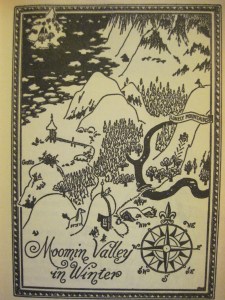 When they receive a visit from the Hemulen, who’s keen on skiing and declares the indoors too stuffy in winter, the creatures quickly tire of his energetic optimism. The truth is that they like sitting around being miserable. “I’m cold! I’m lonely! I want the sun back again!” Moomintroll pouts, but even he is too affable to make the Hemulen leave.
Of course the spring finally arrives, as it does every year, but it’s depressingly long in coming and for Moomintroll becomes a matter of faith. I love the strangeness of Jansson’s imagination, the balance of melancholy and comedy, and the little philosophical nuggets buried along the way – children and adult readers alike will get a lot out of this. It doesn’t talk down to children with a rosy message about everything being alright.
My rating: 
Spring: An anthology for the changing seasons, edited by Melissa Harrison
Although this was the first of the Wildlife Trusts anthologies published in 2016, I got a late start last year so am reading this as the final of four. In common with the other volumes, it’s a terrific mix of contemporary and historical writing, big names and newcomers, observation and reflection. Compared with the other books, it seems to have more about WT sites in particular, with a few pieces from current volunteers or former employees. I also noticed that there’s a bit more of a focus on birds – with essays on the chiffchaff, the birds encountered on the Cley Marshes, cuckoo festivals, young dippers, and a tawny owl chick.
 That said, there’s still plenty of variety here, with everything from spring flora* to adders fueling the generally two- to three-page essays. I especially liked Kate Long’s piece on filming hedgehogs at night and Vijay Medtia’s on how people of color living in cities have little access to nature; he recalls spotting a magpie with a twig in its beak at a train station and having to ask someone what it was called. Of the previously published authors, I enjoyed hearing more from Rob Cowen and Miriam Darlington and laughed at Will Cohu’s ice cream and underwear metaphors applied to varieties of cherry trees.
You can’t beat George Orwell on toad sex, and it’s fun to encounter excerpts from classic novels in the context of a nature book: The Wind in the Willows, Lorna Doone, and Jane Eyre (which, shamefully, I didn’t recognize until Lowood was mentioned in the last paragraph). I think my favorite piece of all, though, was Jo Sinclair’s about watching spring’s arrival after a major operation and noting nature’s inscrutable jumble of beauty and brutality.
And my favorite passage:
Year after year all this loveliness for eye and ear recurs: in early days, in youth, it was anticipated with confidence; in later years, as the season approaches, experience and age qualify the confidence with apprehension lest clouds of war or civil strife, or some emergency of work, or declining health, or some other form of human ill may destroy the pleasure or even the sight of it: and when once again it has been enjoyed we have a sense of gratitude greater than in the days of confident and thoughtless youth. Perhaps the memory of those days, having become part of our being, helps us in later life to enjoy each passing season.
(from Sir Edward Grey’s The Charm of Birds, 1927)
This passage from Reverend Francis Kilvert’s diary (April 14, 1871) makes me look forward to our trip to nearby Hay-on-Wye next month: “The village is in a blaze of fruit blossom. Clyro is at its loveliest. What more can be said?” Simply that these anthologies are an essential companion to the seasons.
*Like my husband’s piece, positioned right before the R.D. Blackmore extract.
(See also my reviews of Summer, Autumn and Winter.)
My rating:
In the Past Week…
It truly felt like spring was on the way. Temperatures were in the mid-fifties (I’ve never really gotten to grips with Centigrade) and the daffodils in our back garden were trying their best to join the snowdrops decorating the churchyard in town. I started reading this pair of books to look to the seasons ahead instead of dreading that winter might return in earnest:
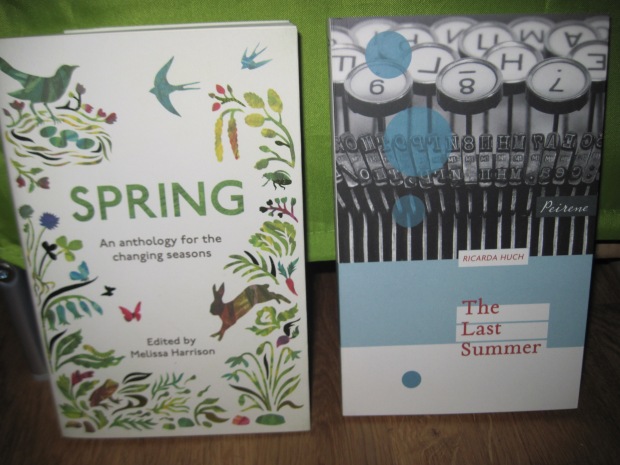
Some lovely things have happened in the past week.
- I’ve delighted from afar as my sister, a widow for just over two years, precipitously falls in love with a pastor she met through a dating website.
- I had my second yoga class and, after the one other participant had to leave early, got what was essentially a private lesson. Many of the poses feel right at the edge of what my flexibility and balance will allow, which is surely a sign that the exercise is doing me good.
- (This one’s not so much lovely as annoying yet amusing.) The cat, already a connoisseur of cereal milk, discovered the illicit pleasure of melted butter in a dish we unthinkingly left on the counter, and now will not rest in his search for it. This is bad news as he’s already quite the butterball. He’s also ramped up his efforts to access all of the house’s secret spaces, including the airing cupboard, the under-stairs cupboard, and the crawlspace under the bath. [Stay tuned for tomorrow’s mini-reviews of yet more cat books, including one about some very mischievous Siamese cats.]
- On Friday I got an e-mail out of the blue asking me to review a book for the Times Literary Supplement. It was October 2015 when I first wrote for them, but that ended poorly: they ran out space in the magazine for my review and paid me a “kill fee” instead, but it made me doubt myself – was that code for them not thinking my writing was good enough to publish? So hearing back from them five months after I’d last gotten in touch asking for work was a great surprise. And I get to read History of Wolves, which I’ve heard marvelous things about.
- We went to a brilliant gig by folk artists Phillip Henry and Hannah Martin in a hole-in-the-wall venue 10 minutes from our house. It was doubtless the first time I’d seen beatboxing and a classical Indian sitar/guitar used in folk music, and Henry’s harmonica skills were literally unbelievable. You had to have been there. I was impressed anew at how folk, arising as it does from liberal working-class traditions, is unafraid to tackle social issues. They had songs about his cotton mill-working grandfather, the war in Syria, immigration, and a detention center in the Midlands. My favorite, though, was “Landlocked,” about a real woman from the eighteenth century who went to sea with her naval husband but ended up right back where she started: selling fish at Exmouth harbor. I loved Martin’s deep, rich voice and the complex interplay of guitar, banjo, pedal steel and fiddle in many of their songs.
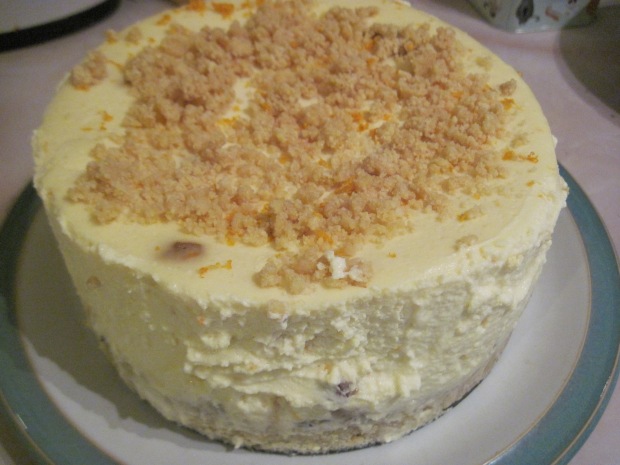
- With one of our leftover jars of homemade mincemeat we made a decadent mincemeat cheesecake from this Nigel Slater recipe. What with the shortbread crust and crumbs and the orange zest in the topping, it was very much like having mince pies – but also cheesecake. Yum.
- This morning we attended a service led by a former archbishop. We knew that George Carey was a parishioner at the Berkshire church we’ve been frequenting since December, but hadn’t seen him at the pulpit yet. He’s one of various retired and lay clergy who have been filling in while the church seeks to appoint a new vicar. Carey gave a damn fine sermon (I guess he’s had plenty of practice) on the enormous topic of why bad things happen to good people, refuting the prosperity gospel and telling the tragically fascinating story behind the hymn “It Is Well with My Soul.”
And, of course, I’ve been reading some brilliant books. This week’s ongoing reading has included three terrific novels: Homegoing by Yaa Gyasi, Spaceman of Bohemia by Jaroslav Kalfař, and Narcissism for Beginners by Martine McDonagh.
 Bookish Beck = Rebecca Foster. American transplant to England. Freelance proofreader and book reviewer.
 Bookish Beck