The Booker Dark Horse: Elmet by Fiona Mozley
The dark horse in this year’s Man Booker Prize race is Elmet, a brilliant, twisted fable about the clash of the land-owning and serf classes in contemporary England. I’d love to see this win the Booker, or make the shortlist at the very least. You’d hardly believe it’s a debut novel, or that it’s by a 29-year-old PhD candidate in medieval history. The epigraph from Ted Hughes defines “Elmet” as an ancient Celtic kingdom encompassing what is now West Yorkshire. The word still appears in a few Yorkshire place names today. Metaphorically, Hughes notes, the region was a “‘badlands’, a sanctuary for refugees from the law.” That’s an apt setting for Mozley’s central characters: a family living on the edge of poverty and respectability – off-grid and not quite legal.
 Daniel and Cathy Oliver – 14 and 15, respectively – live with their father, John Smythe, in a simple house he built with his own hands in a copse. They mostly eat whatever they can hunt. Daddy is a renowned pugilist not above beating people up when they owe his friends money. Feisty Cathy is bullied by boys at school; when teachers don’t believe her, she has no choice but to hit back. There’s a strong us-against-the-world ethos to the novel, but underneath that defensiveness there’s a sense of unease: Daniel, the narrator, isn’t a fighter like his father and sister. He’s a sensitive soul who’s happiest cooking and playing with his dogs.
Like the reader, Daniel watches in grim fascination as Mr. Price, a powerful local landlord, starts issuing threats. Price warns Daddy that his family is trespassing. If they don’t leave he’ll make life difficult for them. A group of tenants, many of them just out of prison and barely getting by, bands together to take revenge on Price, planning to withhold rent and farm labor until conditions improve. No longer will they accept £20 payments for 10-hour work days. At first it seems their fight for rights might be successful, but Price and his goons retrench. Things come to a head when Price promises to sign their plot of land over to Daniel – if Daddy agrees to call off the strike and fight one last climactic match in the woods.
The final 70 pages of Elmet blew me away: a crescendo of fateful violence that reaches Shakespearean proportions. This knocks all those Hogarth remakes (which generally, with the exception of Hag-Seed, adhere too slavishly to the plots and so fail to channel the spirit) into a cocked hat. Though oddly similar to two other novels on the Booker longlist that unearth disturbing doings in a superficially pastoral England – Reservoir 13 by Jon McGregor and Autumn by Ali Smith – Elmet achieves the better balance between lush nature writing and Hardyesque pessimism. Mozley’s countryside is no idyll but a fallen edgeland:
And if the hare was made of myths then so too was the land at which she scratched. Now pocked with clutches of trees, once the whole county had been woodland and the ghosts of the ancient forest could be marked when the wind blew. The soil was alive with ruptured stories that cascaded and rotted then found form once more and pushed up through the undergrowth and back into our lives.
The characters usually speak in Yorkshire dialect, but where many authors would render the definite article as “t’,” Mozley simply elides it. For instance, here’s John shaking his head over the injustice of land ownership:
It’s idea a person can write summat on a bit of paper about a piece of land that lives and breathes, and changes and quakes and floods and dries, and that that person can use it as he will, or not at all, and that he can keep others off it, all because of a piece of paper. That’s part which means nowt to me.
The author is not entirely consistent with the transcription of dialect, though, and sometimes her use of spoken language is off: too ornate to be believable in certain characters’ mouths, like Cathy or a man who comes to the door to deliver bad news late on. These are such minor lapses of authorial control that I barely think them worth mentioning, but take it as proof that Mozley will only get better in the years to come. This is a gorgeous, timeless tale of the determination to overcome helplessness by facing down those who might harm the body but cannot destroy the spirit.
My rating: 
Elmet was published in the UK by JM Originals on August 10th. With thanks to Yassine Belkacemi and Katherine Burdon at John Murray Press for the free review copy.
Blog Tour: Foxes Unearthed by Lucy Jones
Cold, delicately as the dark snow
A fox’s nose touches twig, leaf;
[…]
Across clearings, an eye,
A widening deepening greenness,
Brilliantly, concentratedly,
Coming about its own business
~Ted Hughes, “The Thought-Fox” (1957)
Foxes Unearthed, freelance journalist Lucy Jones’s first book, won a Society of Authors’ Roger Deakin Award for nature writing. If you’re familiar with Patrick Barkham’s Badgerlands, you’ll recognize this as a book with a comparable breadth and a similar aim: clearing the reputation of an often unfairly reviled British mammal. Jones ranges from history to science and from mythology to children’s literature in her search for the truth about foxes. Given the media’s obsession with fox attacks, this is a noble and worthwhile undertaking.
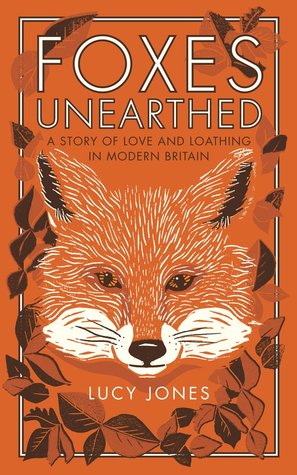 The book proper opens with a visit to Roald Dahl’s house, now a Buckinghamshire museum, where he wrote Fantastic Mr. Fox. Still one of the best-known representations of foxes in British literature, Dahl’s Mr. Fox is a Robin Hood-like hero, outsmarting a trio of mean-spirited farmers to provide a feast for his family. Foxes’ seemingly innate wiliness prompts ambivalent reactions, though; we admire it, but we also view it as a threat or an annoyance. As Jones puts it, the fox of fables and traditional stories is “a villain we cheer for.”
Not everyone cheers, of course. Under Henry VIII, the Vermin Acts of 1532 (not repealed until the 1750s) promised a reward to anyone who killed foxes, then considered a nuisance animal. Fox hunting and the cruel sport of “tossing” have a long history that eventually came up against the movement towards animal welfare, starting with Jeremy Bentham in the 1740s and codified by the 1911 Protection of Animals Act. Meanwhile, Jones notes, children’s books advocating compassion for animals, such as Anna Sewell’s Black Beauty (1877), ensured that the message made it out of the legislative chamber and into everyday life.
The second chapter is a useful survey of fox behavior. Foxes are omnivores, and in recent decades have started to move into Britain’s cities, where they find plenty of food to scavenge. In rural settings, foxes are still the subject of farmers’ loathing even though they rarely take lambs and actually help keep rabbit numbers in check. Still, the stereotype of foxes killing for fun instead of for hunger persists, whereas they in fact cache their surplus food. Chapter 3 asks whether fox numbers have reached pest status and considers various control strategies, from straightforward culling to the non-lethal methods supported by conservationists.
I enjoyed Jones’s meetings with figures from both sides of the debate. She goes along on a fox hunt, but also meets or quotes animal rights activists, academics, and high-profile nature promoters like Chris Packham. All told, though, I felt the book could have been closer to 200 pages than 300. Most chapters are very long, and some could easily be combined and/or shortened. For instance, Chapter 1 relays the amount of information about fox hunting that most readers will be prepared to absorb, yet it’s then the subject of two more chapters.

At the British Wildlife Centre in Surrey. Photo by Chris Foster.
This is an important book for correcting misconceptions, but your enjoyment of it may be in proportion to your personal interest in the subject. In terms of fonts and cover design, though, you’re unlikely to come across a more gorgeous book this year.
Foxes Unearthed was published in paperback by Elliott & Thompson on March 16th. Thanks to Alison Menzies for arranging my free copy for review.
To encounter foxes in fiction, try the following:
- Glow by Ned Beauman
- The Many Selves of Katherine North by Emma Geen
- Midwinter by Fiona Melrose
- The Soho Leopard by Ruth Padel (a poetry book with a sequence on urban foxes)
& the forthcoming How to Be Human by Paula Cocozza (April 6th).
Marginalia, Bookmarks, Etc. Found in Books
 In two of the books I currently have on the go, items found in books are a key element. First there’s Swimming Lessons in Claire Fuller, in which one strand of the narrative is told via a series of letters Ingrid hid in various thematically relevant books from her husband’s overflowing collection before she disappeared 12 years ago.
I’ve also been skimming Reading Allowed, novelist Chris Paling’s book of mildly amusing anecdotes from his time working in a public library. As little interludes he records the items he’s found being used as bookmarks in library volumes: a postcard, a shopping list, a meal plan, a CV, and so on.
In my years working in bookshops and libraries I found lots of proper bookmarks left behind in books; this photo shows the ones I’ve kept (others I’ve given away, recycled or donated to the library basket).

This doesn’t account for all the train tickets, receipts, newspaper clippings, etc. that were serving as makeshift bookmarks. The strangest thing I think I ever found in a book was an old-fashioned faux pearl-topped hatpin marking a place in a copy of Elizabeth Barrett Browning’s collected poems.
And then there are the written messages I’ve found in books: other people’s bookplates (I especially like the one that appears in the front of each volume of my 1919 Chapman & Hall set of the complete works of Dickens – such an enviable reward for good attendance!);


a heartfelt message of friendship in the copy of May Sarton’s The Fur Person I got free from Book Thing of Baltimore;

a young lady’s thoughts strewn across the selected poems of Ted Hughes;

and a dead-simple recipe for a tropical fruit drink pencilled on the back cover of Patricia Volk’s memoir, Stuffed.

For me, the random objects and messages you might find are all part of the fun of buying secondhand books.
What’s the strangest thing you’ve ever found in a secondhand book?
Literary Power Couples: An Inventory
With Valentine’s Day on the way, I’ve been reading a bunch of books with “Love” in the title to round up in a mini-reviews post next week. One of them was What I Loved by Siri Hustvedt – my second taste of her brilliant fiction after The Blazing World. Yet I’ve not tried a one of her husband Paul Auster’s books. There’s no particular reason for that; I’ve even had his New York Trilogy out from the library in the past, but never got around to reading it.
How about some other literary power couples? Here’s some that came to mind, along with an inventory of what I’ve read from each half. It’s pretty even for the first two couples, but in most of the other cases there’s a clear winner.
Zadie Smith: 5
Nick Laird: 5 (= ALL)
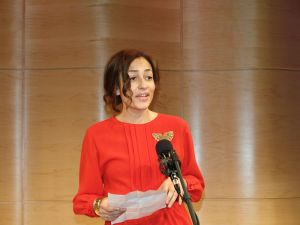
Zadie Smith in 2011. By David Shankbone (CC BY 3.0 (http://creativecommons.org/licenses/by/3.0) via Wikimedia Commons.
I’ve read all of Zadie Smith’s work apart from NW; I only got a few pages into it when it first came out, but I’m determined to try again someday. To my surprise, I’ve read everything her husband Nick Laird has ever published, which includes three poetry collections and two fairly undistinguished ‘lad lit’ novels. I’m pleased to see that his new novel Modern Gods, coming out on June 27th, is about two sisters and looks like a stab at proper literary fiction.
Jonathan Safran Foer: 4 (= ALL)
Nicole Krauss: 3 (= ALL)
Alas, they’re now an ex-couple. In any case, they’re both on the fairly short list of authors I’d read anything by. Foer has published three novels and the nonfiction polemic Eating Animals. Krauss, too, has three novels to her name, but a new one is long overdue after the slight disappointment of 2010’s Great House.
Margaret Drabble: 5
Michael Holroyd: 0
Michael Holroyd is a biographer and general nonfiction dabbler. I have a few of his books on my TBR but don’t feel much compulsion to seek them out. By contrast, I’ve read four novels and a memoir by Margaret Drabble and am likely to devour more of her fiction in the future.

Margaret Drabble in 2011. By summonedbyfells [CC BY 2.0 (http://creativecommons.org/licenses/by/2.0)%5D via Wikimedia Commons.
Claire Tomalin: 2
Michael Frayn: 1
Claire Tomalin’s masterful biographies of Charles Dickens and Thomas Hardy are pillars of my nonfiction collection, and I have her books on Nelly Ternan and Samuel Pepys on the shelf to read as well. From her husband, celebrated playwright Michael Frayn, however, I’ve only read the comic novel Skios. It is very funny indeed, though, about a case of mistaken identity at an academic conference on a Greek island.
Plus a few I only recently found out about:
Ian McEwan: 7 (+ an 8th in progress)
Annalena McAfee: 1 (I’ll be reviewing her novel Hame here on Thursday)
Katie Kitamura: 1 (I just finished A Separation yesterday)
Hari Kunzru: 0
Madeleine Thien: 1 (Do Not Say We Have Nothing)
Rawi Hage: 0
Afterwards I consulted the lists of literary power couples on Flavorwire and The Huffington Post and came up with a few more that had slipped my mind:
Michael Chabon: 1
Ayelet Waldman: 0
I loved Moonglow and am keen to try Michael Chabon’s other novels, but I also have a couple of his wife Ayelet Waldman’s books on my TBR.
Dave Eggers: 5
Vendela Vida: 0
I’ve read a decent proportion of Dave Eggers’s books, fiction and nonfiction, but don’t know anything by his wife and The Believer co-founder Vendela Vida.
David Foster Wallace: 2
Mary Karr: 1
I didn’t even know they were briefly a couple. From Wallace I’ve read the essay collection Consider the Lobster and the commencement address This Is Water. I’ve definitely got to get hold of Karr’s memoirs, having so far only read her book about memoir (The Art of Memoir).
And some classics:
Ted Hughes: 1 (Crow)
Sylvia Plath: 0
F. Scott Fitzgerald: 2 (The Great Gatsby and Tender Is the Night)
Zelda Fitzgerald: 0
![F. Scott and Zelda Fitzgerald in 1921. By Kenneth Melvin Wright (Minnesota Historical Society) [Public domain], via Wikimedia Commons.](https://bookishbeck.com/wp-content/uploads/2017/02/f_scott_fitzgerald_and_wife_zelda_september_1921.jpg?w=208&h=300)
F. Scott and Zelda Fitzgerald in 1921. By Kenneth Melvin Wright (Minnesota Historical Society) [Public domain], via Wikimedia Commons.
How have you fared with these or other literary power couples? Do you generally gravitate towards one or the other from a pair?
 Bookish Beck = Rebecca Foster. American transplant to England. Freelance proofreader and book reviewer.
