Wellcome Book Prize Shadow Panel Decision
It’s been a whirlwind five weeks as we on the shadow panel have made our way through the six books shortlisted for the Wellcome Book Prize 2017. The list is strong and varied: an account of the AIDS crisis, a posthumous memoir by a neurosurgeon, a thorough history of genetics, an introduction to the microbial world, and novels about a donor heart and an ordinary family’s encounter with unexpected illness. All have been well worth engaging with, but when it came to decision time we had a pretty clear winner: When Breath Becomes Air by Paul Kalanithi. (With Sarah Moss’s The Tidal Zone a fairly close second.)


“I realized that the questions intersecting life, death, and meaning, questions that all people face at some point, usually arise in a medical context.” ~Paul Kalanithi
I first read this book a year and a half ago; when I picked it back up on Friday, I thought I’d give it just a quick skim to remind myself why I loved it. Before I knew it I’d read 50 pages, and I finished it last night in the car on the way back from a family party, clutching my dinky phone as a flashlight, awash in tears once again. (To put this in perspective: I almost never reread books. My last rereading was of several Dickens novels for my master’s in 2005–6.)
What struck me most on my second reading is how Kalanithi, even in his brief life, saw both sides of the medical experience (as the U.K. book cover portrays so well). He was the harried neurosurgery resident making life and death decisions and marveling at the workings of the brain; in a trice he was the patient with terminal lung cancer wondering how to make the most of his remaining time with his family.

Yet in both roles his question was always “What makes human life meaningful?” – a quest that kept him shuttling between science, literature and religion. In eloquent prose and with frequent scriptural allusions, this short, technically unfinished book narrates Kalanithi’s past (his growing-up years and medical training), present (undergoing cancer treatment but ultimately facing death) and future (the legacy he leaves behind, including his daughter).
Looking back once again at the guidelines for the Wellcome Book Prize (“At some point, medicine touches all our lives. Books that find stories in those brushes with medicine are ones that add new meaning to what it means to be human”), When Breath Becomes Air stands out as a perfect exemplar. In her blog review, Ruby writes, “This book looks death right in the eye and doesn’t seek to rationalise it, explain it, avoid it. It deals with it head on.” In his Nudge review Paul calls the book “equally heart breaking and full of love … a painfully honest account of a short, but intense life.”
My thanks, once again, to the other members of the shadow panel: Paul Cheney, GrrlScientist, Ruby Jhita and Amy Pirt.
Tomorrow evening the winner of the Wellcome Book Prize 2017 will be announced at an awards ceremony at the Wellcome Collection in London. As thanks for my participation in the blog tour, I’ve been invited to attend. Small talk and networking are very much outside of my comfort zone, but I couldn’t pass up this opportunity and hope to at the very least meet one or two fellow bloggers. I’ll post very quickly when I get home from the ceremony tomorrow night to announce the winner, and promise a longer write-up of the event sometime on Tuesday.
Polishing off the Wellcome Prize Shortlist: How to Survive a Plague
Spanning from the summer of 1981, when the New York Times first broke the story about a rare cancer observed in homosexuals, to 1996, when protease inhibitors came onto the market and offered HIV sufferers a new lease on life, How to Survive a Plague is a comprehensive history of the AIDS crisis. Especially in its early chapters, it reads like a fascinating medical mystery – though we already know the answers, the book skillfully captures the ignorance and terror that reigned for so many years as people sought to understand what Gay-Related Immune Deficiency (GRID, the original name for AIDS) was and how it was transmitted.
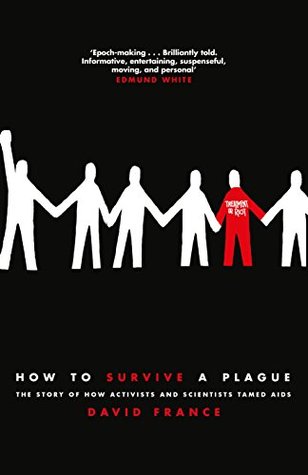 As a journalist and a gay man, David France was right in the thick of the crisis when he moved to Manhattan in 1981. He lost friends and lovers to AIDS, and had his own health scares, too – once, on assignment in war-torn Central America, he developed what he thought was a Kaposi’s sarcoma lesion but turned out to be a sign of amoebic infection.
Throughout the 1980s the number of HIV cases roughly doubled each year; media coverage was intense but often alarmist. Undertakers refused to deal with AIDS victims, and Jerry Falwell and his ilk spoke of a gay conspiracy taking over America. Far too slowly, research advanced to cope with the crisis. France gives details of the medical trials and presidential commissions that kept AIDS at the forefront of the national conscience, generally thanks to patient advocacy groups like ACT UP (AIDS Coalition to Unleash Power) and PWA (People with AIDS – more proactive terminology than victims or patients).
The book reminds me most of Sheri Fink’s Five Days in Memorial, another social history with a vast scope and a large cast of characters; here there are about 25 doctors, researchers and activists, many of them based in New York City, who keep recurring. For instance, there’s Joe Sonnabend, an infectious diseases expert who specialized in treating gay men for venereal diseases; Larry Kramer, who wrote an angry novel about fellow homosexuals yet tried to lead the response; and Richard Berkowitz, a former sex worker who co-wrote How to Have Sex in an Epidemic, a safe sex guide that encouraged a surge in condom use.
I rather underestimated the reading load the Wellcome shortlist would create for me; I ended up getting bogged down in this 500+-page book’s level of detail and only succeeded in skimming it. I think that for someone without a personal stake in the story of AIDS, watching the 2012 documentary film of the same title that spawned the book would be an easier way to absorb copious information and keep track of all the individuals and organizations involved.
Nonetheless, I can certainly affirm the importance of a landmark book like this one. When I surveyed critical opinion on it for Bookmarks magazine, I noticed many comparisons to Randy Shilts’s 1987 And the Band Played On, but while that book was written in medias res and deliberately vilified a French-Canadian flight attendant named Gaëtan Dugas who was linked with multiple AIDS cases in North America, How to Survive a Plague benefits from two decades of hindsight and reflects a mixture of journalistic objectivity and personal grief.
It’s sobering to remember the scale of the AIDS epidemic: 100,000 Americans had died of it by 1991. As one HIV-positive ACT UP activist cried out to Bill Clinton, then a Democratic candidate, at a campaign event, “Bill, we’re dying of neglect!” France’s book really brings home how traumatic these years were for a whole country, but especially for homosexuals. He describes the relief of knowing that effective medical treatment was finally in the pipeline, but also the lingering effects of shame, bitterness, and fear.
Nobody left those years uncorrupted by what they’d witnessed, not only the mass deaths—100,000 lost in New York City alone, snatched from tightly drawn social circles—but also the foul truths that a microscopic virus had revealed about American culture: politicians who welcomed the plague as proof of God’s will, doctors who refused the victims medical care, clergymen and often even parents themselves who withheld all but a shiver of grief. Such betrayal would be impossible to forget in the subsequent years.
My rating: 
My gut feeling: France has written a definitive history of the AIDS crisis in the United States. It’s a cautionary tale that must not be forgotten. While not among my personal favorites from the shortlist, it would be a worthy winner.
More reviews:
Clare’s at A Little Blog of Books
Stay tuned for our shadow panel winner, which I will announce here tomorrow morning!
Wellcome Prize Shortlist, Pt. 2: The Tidal Zone by Sarah Moss
This is Sarah Moss’s third consecutive appearance on the Wellcome Book Prize shortlist, after Bodies of Light in 2015 and Signs for Lost Children in 2016, a pair of linked novels about a female doctor in the nineteenth century. The Tidal Zone, on the other hand, is a contemporary story of how a sudden, strange illness shakes up one middle-class family.
It’s a clichéd image from television and films: new parents tiptoe into their baby’s room every night to make sure he or she is still breathing. But 15 years later, narrator Adam Goldschmidt starts doing the same thing for his teenage daughter, Miriam, after she collapses on her school’s sports field and stops breathing for a few minutes. Thanks to a teacher’s quick thinking, CPR and paramedics soon see her stable again, but for Adam and his wife Emma, herself a GP, this is like a biblical loss of innocence: for the first time they realize that something calamitous could happen to Miriam or their eight-year-old, Rose, at any moment. Adam feels himself part of a global web of suffering parents, including those whose children are bombed in the Middle East or shot by police in America. All he sees are potential Pietàs.
It comforts me to think that most parents in most of time and most of the world have lived with this fear as a matter of course. It comforts me to think that while I have little fellowship in my fear with the parents at the school gate, the massed ghosts of England and the majority of parents living in the world now are with me. Although it turns out, of course, once people have a reason to tell you, that more of the school-gate parents than you used to imagine live in the overlap between ordinary life and tragedy.
Miriam is a delightfully sarcastic kid, lefty and socially engaged. I love her banter with the rest of the family. She was never going to be a meek angel in a hospital bed. Still, she’s ready to resume regular life long before Adam and Emma are ready to let her out of their sight for more than an hour or two. Meanwhile, Adam has to keep things ticking over at home. A stay-at-home dad in Coventry, he teaches the occasional art history class at the local university and is slowly writing a book about Coventry Cathedral, which was bombed to destruction during World War II and later rebuilt. Occasional chapters about the cathedral’s history make the narrative arc even clearer: this is all about catastrophe and reconstruction. How does a family, or a city, bounce back from what looked like the end?
Eventually a diagnosis and suggested treatment arrive, but the mystery remains of what caused Miriam’s cardiac arrest in the first place. What combination of factors – what she’d eaten, how much she’d exercised, what was in the air – could account for a failure to keep breathing? And could there be a genetic aspect to this condition that could link back to Adam’s mother’s unexpected death when he was nine?
It’s from Adam’s early memories of his mother that the title comes: when he was a boy they explored the tidal zone at the Cornwall coast, looking for creatures in the rock pools. Just as tidal pools mark the boundary between the land and the sea, this novel probes the liminal space between survival and death. But it also recognizes that even in that crucial gap, daily activities continue: hanging up the laundry, emptying the dishwasher, fielding pleas for a cat, and carping about NHS and university bureaucracy. Moss writes so well about normal life – something I also noticed in Night Waking, the other novel of hers that I’ve read, which is narrated by a mother of young children (and a character who’s briefly mentioned here, as Adam’s friend) – she lends correct weight to the everyday without overlooking epiphanies and moments of timelessness.

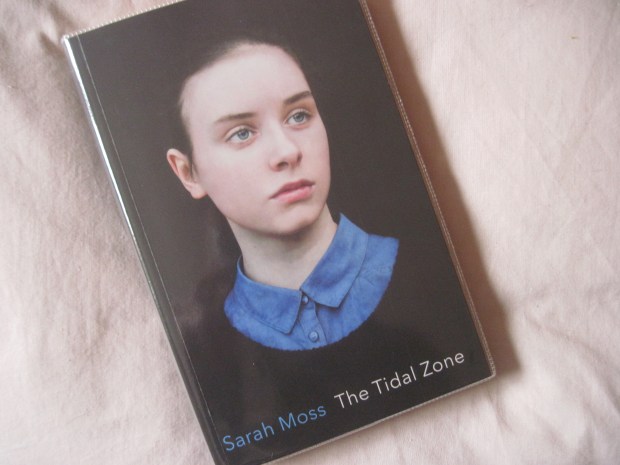
I love this striking cover: Eliza (2015) by Michael Gaskell. It’s an acrylic portrait on board of his niece and won second prize in that year’s BP Portrait Awards – but it’s so amazingly crisp I would have sworn it was a photograph!
I admired many things about the novel, particularly how easily Moss writes from a male viewpoint and the ways in which she reflects on the storytelling impulse. The extraordinary first chapter opens with “Once upon a time” and narrates the quotidian miracles of conception, pregnancy, birth and child development before making this personal, proceeding from “the girl” to “you” and finally to “I” in the second chapter. On several (perhaps one too many) occasions Moss repeats that fairytale opener to tell about Miriam’s medical journey or explain how Adam’s mother and American-born father met at a commune. This emphasizes the way we construct narratives around everything from our origins to our health.
A plan is a story about the future … a diagnosis is a story, brings a story’s promise of safe conduct through time and place to an anticipated ending.
I felt a bit too much time was spent on Adam’s father, and in the back of my mind was the niggling thought that this First World family is never facing true disaster because they have all kinds of safety nets in place; Moss’s is a very middle-class vision. I also think some readers could struggle with the slight aimlessness of the plot, though by the end you do get the sense that the characters are looking to the future in simple ways.
However, I don’t think those small complaints detract from the novel’s power. It’s a sobering but ultimately reassuring story with a simple message: we are all fragile, and we must appreciate life and health while we can.
You can’t go round not loving things because they’ll die.
May we forget. It is a pity that the things we learn in crisis are all to be found on fridge magnets and greetings cards: seize the day, savour the moment, tell your love—May we live long enough to despise the clichés again, may we heal enough to take for granted sky and water and light, because the state of blind gratitude for breath and blood is not a position of intelligence.
My rating: 
My gut feeling: Moss’s fiction shows true commitment to probing issues of health and medicine, and she’s an underrated author in general. Glancing back at the description of the books the Wellcome Prize panel is looking for (“At some point, medicine touches all our lives. … The subjects these books grapple with might include birth and beginnings, illness and loss, pain, memory, and identity”), I think this novel is a very strong contender indeed.
More reviews:
Clare’s at A Little Blog of Books
Eleanor’s at Elle Thinks
Eric’s at Lonesome Reader
Shortlist strategy:
Currently reading: I Contain Multitudes, Ed Yong’s (surprisingly?) enjoyable book about microbial life – I’m nearly halfway through and have taken it with me on our mini-holiday. Also The Gene by Siddhartha Mukherjee, a daunting 500+-page history of genetics, but I’ve loved this author’s work before (The Emperor of All Maladies).
I’m away in Hay-on-Wye through Thursday the 6th but will be back and responding to comments on Friday the 7th.
Making Plans for April & a Return to Hay-on-Wye
In April I’ll be busy with the last three books on the Wellcome Book Prize shortlist. I’m nearing halfway in Ed Yong’s I Contain Multitudes, have just started Siddhartha Mukherjee’s dauntingly dense The Gene, and am still awaiting my library hold on David France’s How to Survive a Plague. With the shadow panel’s decision due by the 23rd, it’s going to be something of a struggle! If push comes to shove, I’ll have to leave Dickens aside for next month and call Mukherjee and/or France my doorstopper for April.
As to other planned posts for the month…
- I read my second Margaret Laurence novel a little while back and just need to find time to write it up.
- I’m taking part in a nonfiction blog tour for a bereavement memoir on the 11th.
- I’m working on four review books, including two offered directly by the authors.
- I’ll try to round up a few recent or upcoming theology titles for an Easter post.
- If I get a chance, I’ll preview two or more recommended May releases.
Luckily, it’s a quieter month for me in terms of work deadlines. I’ve been working like a fiend to get ready for our short break to Hay-on-Wye, leaving Monday and returning Thursday evening. Tomorrow I’ll be submitting four completed reviews and scheduling a Wellcome Prize post for while we’re away, and then I’ll be able to breathe a big sigh of relief and allow myself some time off – always a difficult thing for freelancers to manage.
This will be our sixth trip to Hay-on-Wye, the Book Town in Wales. Our other visits clustered between 2004 and 2011; I can hardly believe it’s nearly six years since we’ve been back to one of our favorite places! Yet it’s a bittersweet return. On four of our previous trips, we stayed in the same B&B, a gorgeous eighteenth-century house with extensive gardens. It’s where we got engaged in 2006. It also served the finest breakfast known to man: organic Full English PLUS homemade cereals and jam to go with warm croissants; local single-variety apple juice PLUS all-you-can-drink tea. Around 2013 we toyed with the idea of going back, but didn’t make a serious enquiry until 2014. Alas, they’d closed temporarily while the hostess underwent breast cancer treatment. We wished them well, hoping we’d get a message when they reopened for business. Instead, we found her obituary in the Guardian last year.
So, although Hay is still our special place, we’re sad the experience won’t be quite the same. We also noticed that more shops have closed since last we visited, but there are still about 12, a lot for a town of its size. Some of these are top-class, like Booth’s, the Cinema Bookshop and Addyman’s. There will certainly be no dearth of tempting shopping opportunities. I’m not going with much of a plan in mind. Our general strategy is to start with the cheapest shops/bargain basements and then move on to more expensive and specialist ones.
Hay is better for browsing than for concerted searching for particular titles – for that you’re better off going online (many of the shops do Internet sales). It’s also not a place to go for cheap paperbacks – for that you’re better off at your local charity shop. So although I’m taking an updated list of books that are priorities to find, I don’t expect to make much of a dent in it. I’ll just wander and see what catches my eye. We’ll also visit Llanthony Priory and Clyro Church, go for a good country walk, and have lunch with a friend in the Brecon area.
Taking books to Hay is rather like taking coal to Newcastle, but it must be done. I’ve picked four topical reads to sample while I’m there: a selection from Reverend Francis Kilvert’s diary – he was the curate of Clyro from 1865 to 1872; Bruce Chatwin’s 1982 debut novel On the Black Hill, set on the England–Wales border; the obscure classic The Rebecca Rioter, about the Rebecca Riots against tolls in rural Wales in 1839–43; and a Kindle copy of The Airbnb Story, since we’re renting an Airbnb property this time.
But that’s not all. I need to make progress in at least some of the books I currently have on the go, too, so I will be loading up a book-themed tote bag with the following:
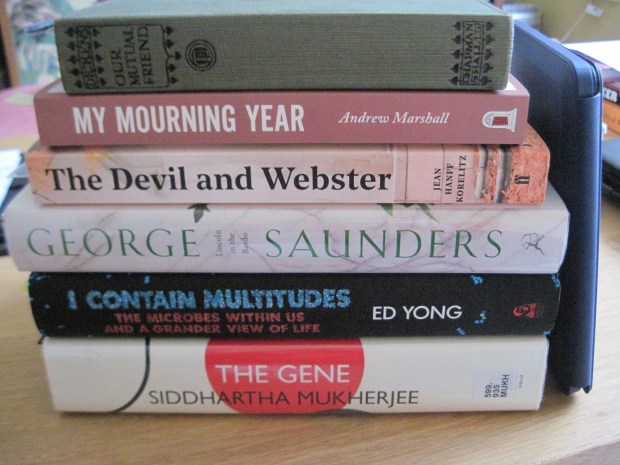
I call this my Hay-stack. Geddit? In progress on the Kindle are a poetry book and two religion books.
Now, the last thing I needed just before a trip to Hay was an influx of secondhand books, but I couldn’t help myself. This afternoon a local green initiative ran a swap shop where you bring things you don’t want anymore and go home with things you do want. I donated a couple of household items and a few books … but came away with 13 books. Good travel and literature finds. I’m particularly pleased with Elizabeth Bishop’s Complete Poems and a Dave Eggers novel I’ve not read. It’s fun to think of the journeys these books have been on: John Sutherland’s How to Read a Novel (which I have already read, but would like to have around for reference) is an ex-library book all the way from Westborough, Massachusetts! I left my details so I can get involved with future local greening activities, too.
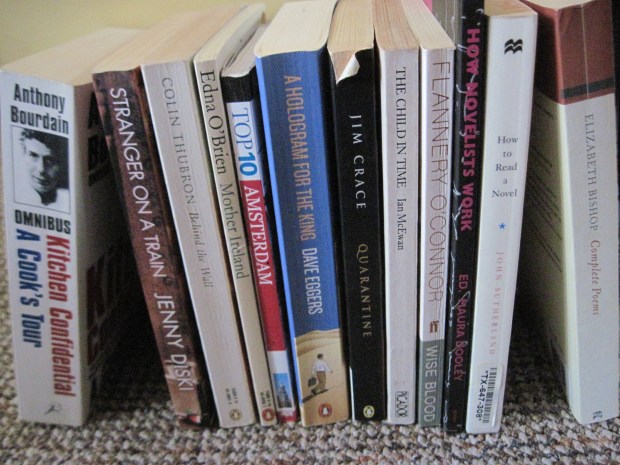
The one not pictured will be a gift.
I know a number of my readers are Hay regulars, or have at least made the trek once. If you have any up-to-date recommendations for us in terms of shopping or eating out in the area, do let me know (by tomorrow night if you can – we’re away from Monday morning).
See also: My review of Hay local interest book Under the Tump by Oliver Balch.
Enjoy my Sarah Moss review while I’m away, and I’ll see you back here on Friday!
Wellcome Prize Shortlist, Part 1: de Kerangal and Kalanithi
I’m delighted to announce the final members of our Wellcome Book Prize 2017 shadow panel:
Ruby blogs at My Booking Great Blog.
GrrlScientist is an ornithologist and science journalist who was on the judging panel for the 2016 Royal Society Insight Investment Science Book Prize.
Along with Paul and Amy, this brings us up to five people – the same number as the official judging panel.
Luckily, I’ve already read two of the shortlisted titles, one quite recently and one nearly a year and a half ago. Here are the reviews I published on Goodreads at the time. I’ll be getting both books back out of the library soon to have another look before we choose our winner.
Mend the Living by Maylis de Kerangal
(translated from the French by Jessica Moore; published in the USA as The Heart)
[This is the French author’s second novel to be translated into English. It has been made into a film and won the Prix Orange du Livre and the Grand prix RTL du livre. It was also recently shortlisted for the Albertine Prize, an American readers’ choice award for contemporary French fiction. If you’re based in the States, feel free to vote by April 30th!]
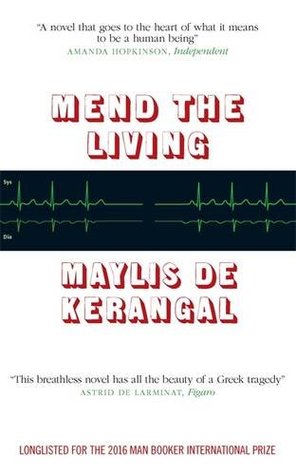 Nineteen-year-old Simon Limbeau is declared brain dead in a French hospital after a car accident, but his heart lives on: metaphorically through the love of his parents, sister, friends, and girlfriend; but also literally, in the recipient of his organ donation. Again and again de Kerangal makes a distinction between the physical reality of organs and what they represent: “Simon’s eyes are not just his nervous retina, his taffeta iris, his pupil of pure black in front of the crystalline – they are also his gaze; his skin isn’t just the threaded mesh of his epidermis, his porous cavities – it’s his light and his touch, the living sensors of his body.”
The novel spends time with Simon’s family, especially his mother, but also with the transplant coordinator, the surgeons, the nurse, and so on. I was reminded of ER as well as the French TV show The Returned – this would work really well on screen, and would be a way of avoiding the more off-putting aspects of the author’s style. She writes long, run-on sentences: sometimes half a page, sometimes even stretching to two pages, and stuffs her prose with abstruse vocabulary (or at least that’s how the translator has rendered it), a lot of it medical but some of it simply inaccessible: “emollient conjugality” plus at least a dozen English words I’d never encountered (e.g. abulic, tumid, atony, claudicant, auscultation, precellence, torticollis, naevi, scialytic).
The worst example of the unnecessary opacity is “the digitigrade gait of the sardana dancer when he’s nearing a quintal, the corpulence of an ex-obese man calibrating him in thickness, in fullness, but without visible excrescence” – in plain English, the guy is stocky.
Read in November 2016.
My rating: 
My gut feeling: The novel gives a vivid sense of the fragility of life and imbues parts of the body with metaphorical meaning. However, I think the style makes it too inaccessible and I can’t see its appeal ever being more than niche.
More reviews:
Annabel’s at Shiny New Books
Carolyn’s at Rosemary and Reading Glasses
When Breath Becomes Air by Paul Kalanithi
[The first posthumous nominee for the Wellcome Book Prize. I’ll be interested to see what I make of this one when I revisit it.]
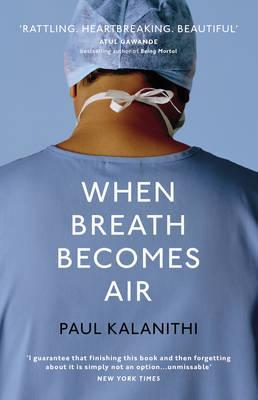 Paul Kalanithi was 36 and just completing his neurosurgery residency in Stanford, California when he was diagnosed with advanced lung cancer that did not respond well to treatment. It came as a complete surprise to this non-smoker, and set his life on a new course. He and his coterie of doctors managed his symptoms so he could operate for as long as possible, but when the time came he knew he wanted to devote his last year to writing this memoir. In addition, he would get a brief, sweet taste of fatherhood: he and his wife Lucy, also in the medical field, decided to have a child, a daughter named Cady.
Kalanithi grew up the son of Indian immigrants in Arizona. “I was driven less by achievement than by trying to understand, in earnest: What makes human life meaningful?” he recalls. Degrees in English literature and human biology were disparate attempts to find an answer. Like Henry Marsh (Do No Harm), he has a surgeon’s knowledge of the anatomy of reasoning, but realizes that does not provide the full picture. He recognizes the responsibility of holding others’ lives in the balance, and regrets occasional failures of empathy.
Those burdens are what make medicine holy and wholly impossible: in taking up another’s cross, one must sometimes get crushed by the weight.
It’s intriguing to see religious language in that statement – indeed, Kalanithi saw his work as a calling, and one with moral connotations. Christian imagery shows up repeatedly:
Instead of being the pastoral figure aiding a life transition, I found myself the sheep, lost and confused.
Openness to human relationality does not mean revealing grand truths from the apse; it means meeting patients where they are, in the narthex or nave, and bringing them as far as you can.
When’s the last time you encountered the word “narthex”?! The vocabulary is striking throughout, as in another favorite passage: “A tureen of tragedy was best allotted by the spoonful. Only a few patients demanded the whole at once; most needed time to digest.”
Kalanithi died in March 2015. In addition to the foreword by Abraham Verghese, there’s a lovely epilogue from his widow, who’s more than competent to carry on his legacy.
I appreciate stories lived on the knife edge of life and death, but I would recommend this to those who don’t normally choose to read illness narratives, simply for the beauty of its prose – a fine blend of literature and medicine – and the wholehearted picture of a life cut short.
Read in October 2015 (Random House were looking for early readers via NetGalley).
My rating: 
My gut feeling: I suspect this is by far the most popular and best-selling title on this year’s shortlist. So many people have taken it to their hearts. It will take a truly special book to knock it from the top spot.
More reviews:
Shadow panelist Paul’s at Nudge
Shadow panelist Ruby’s at My Booking Great Blog
Susan’s at A life in books
Shortlist strategy:
Currently reading: The Tidal Zone by Sarah Moss – about halfway through.
Up next: Whichever of the remaining nonfiction titles turns up to the library for me first!
I’ve also sent off an emergency e-mail to Bodley Head asking for a copy of Ed Yong’s I Contain Multitudes; it’s on loan through my library system until April 19th, which gives me no time to read it even if it comes back on time.
Wellcome Book Prize 2017 Shadow Panel
Newsflash! I’ve started a shadow panel of readers who will make our way through the six medical-themed titles shortlisted for the Wellcome Book Prize and deliberate to choose our own winner before the official prize announcement on Monday, April 24th. I hope to get the panel up to five – I’ve been in contact with a couple of science journalists via Twitter – but for now we are three, including:
Paul Cheney: blogs at Halfman, Halfbook and writes for Nudge’s Book Life section.
Amy Pirt: blogs at This Little Bag of Dreams and writes for Mookychick and g3 magazine.
The Wellcome Book Prize is an annual award sponsored by the Wellcome Trust, a global charitable foundation founded by Sir Henry Wellcome in 1936 and dedicated to improving health. The current incarnation of the prize has been running since 2009 and the winner gets a whopping £30,000. Books are nominated by their publishers, and for the 2017 award cycle they must have been issued in the UK between January 1, 2016 and December 31, 2016.
One thing that’s unique about the Wellcome Prize is that both fiction and nonfiction books are eligible. Here’s how the website describes the aim of the prize:
To be eligible for entry, a book should have a central theme that engages with some aspect of medicine, health or illness. At some point, medicine touches all our lives. Books that find stories in those brushes with medicine are ones that add new meaning to what it means to be human. The subjects these books grapple with might include birth and beginnings, illness and loss, pain, memory, and identity. In keeping with its vision and goals, the Wellcome Book Prize aims to excite public interest and encourage debate around these topics.
So as we’re reading (or looking back at) the six shortlisted books, those are the criteria we’ll be keeping in mind.
Here’s the full 2017 shortlist:
- How to Survive a Plague by David France: a history of the AIDS crisis.
- When Breath Becomes Air* by Paul Kalanithi: a posthumous memoir by a neurosurgeon.
- Mend the Living* by Maylis de Kerangal (trans. Jessica Moore): a novel about a donor heart [published in the USA as The Heart].
- The Tidal Zone by Sarah Moss: a novel about a child who suddenly falls ill.
- The Gene by Siddhartha Mukherjee: a thorough history of genetics.
- I Contain Multitudes by Ed Yong: a survey of the human body’s microbes.

* = the two I’ve already read and reviewed on Goodreads. I’ll get these reviews together for my first shortlist post on Thursday. Next up for me is The Tidal Zone, which I plan to start today. I have the three other nonfiction titles on request from the public library and hope they’ll come in soon – each one is well over 300 pages, so I’ll need plenty of time with them!
For more on this year’s nominees and the official judging panel, see this Guardian article.
What interests you from the Wellcome Book Prize shortlist? Are there some titles you’ve already read? If you’ve reviewed any of these, let me know and I’d be happy to link to your reviews when I post mine.
Also, if you’d like to read any of the shortlisted books along with us over the next five weeks, I’d love to know that you’re taking part and will help share your reviews, so do get in touch!
(A huge thanks to Naomi of The Writes of Woman for advice on running a shadow panel.)
Two Books about Mind–Body Medicine
Two of my library reads from this month were about different aspects of mind–body medicine. I expected them to overlap more than they did, actually, and hoped that the second might serve as a sort of well-written rebuttal to the first, but in the end they stayed in different camps: the first is about psychosomatic illness and psychiatric treatment, while the second is about the placebo effect and how alternative and holistic treatment strategies might be complementary to orthodox medical approaches. Both gave me a lot to think about.
It’s All in Your Head: Stories from the Frontline of Psychosomatic Illness
By Suzanne O’Sullivan
 O’Sullivan is a UK-based neurology consultant. I picked this up on a whim because I knew it had won the Wellcome Book Prize, as well as the Royal Society of Biology General Book Prize. The conditions she writes about go by many names: psychosomatic illnesses, conversion disorders, or functional conditions. In every case the patients have normal neurological test results – they do not have epilepsy or nerve damage, for instance – but still suffer from seizures or lose the use of limb(s). Their symptoms have an emotional origin instead. Many of her patients are outraged by referral to a psychiatrist, as if they’re being told they’re making it all up, but it’s actually a holistic approach: acknowledging the influence the mind has on how we feel.
Along with cases from her own career, the author writes about early doctors who developed the science of conversion disorders, including Jean-Martin Charcot and Sigmund Freud. I read the book very quickly, almost compulsively; these are fascinating stories for anyone who’s interested in medical mysteries. That’s in spite of the fact that O’Sullivan does not strike me as a natural storyteller: her accounts of patients’ cases are often no more than just one thing after another, and in reports of her own conversations with patients she comes across as robotic and not always very compassionate. Ultimately I believe she does empathize with those with psychosomatic illnesses – otherwise she wouldn’t have written a whole book to illuminate their plight – but it would have taken the writing skill of someone like Atul Gawande for this to be a better book. I’m somewhat surprised it won a major prize.
Note: Chapter 7 tackles CFS/ME/fibromyalgia. These are controversial fatigue disorders, and O’Sullivan is aware that even mentioning them in a book about psychosomatic illnesses is “foolhardy to say the least.” I don’t think what she actually has to say about these conditions is offensive, though (and I say that as someone whose mother struggled with fibromyalgia for years). She allows that there may be physical triggers, but that emotional wellbeing and traumatic experiences or regular stress cannot be overlooked.
Chew on this: “More than seventy per cent of patients with dissociative seizures and chronic fatigue syndrome are women.” The author’s best guess as to why this is? “On the face of it, women turn their distress inward and men turn it outward.”
My rating: 
Cure: A Journey into the Science of Mind over Body
By Jo Marchant
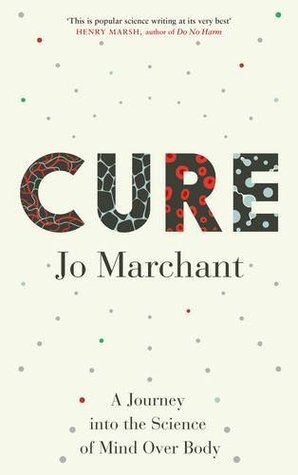 In this absorbing and well-written work of popular science, Marchant, a journalist with a PhD in genetics and medical microbiology, investigates instances where the mind seems to contribute to medical improvement: the use of placebos in transplant recipients, hypnosis for IBS patients, virtual reality to help burn victims manage pain, and the remarkable differences that social connection, a sense of purpose, meditation and empathic conversation all make. On the other hand, she shows how stress and trauma in early life can set (usually poor) people up for ill health in later years. She also travels everywhere from Boston to Lourdes to meet patients and medical practitioners, and even occasionally proffers herself as a guinea pig.
A relentless scientist, Marchant is skeptical of any claims for which there is no hard evidence, so when she acknowledges that there’s something to these unusual treatments, you know you can believe her. As Jeremy Howick of the Centre for Evidence-Based Medicine, Oxford puts it, “I think it’s more important to know that something works, than how it works.” I finished the book feeling intrigued and hopeful about what this might all mean for the future of medicine. The problem, though, is that most medical trials are funded by big pharmaceutical companies, which won’t be supportive of non-traditional methods or holistic approaches.
My rating: 
Do these books appeal to you? Do you have any experience of psychosomatic illness or mind–body medicine?
In Praise of Literary Prizes
I like a spot of competition. Whether watching Olympic figure skating, playing board games like Scrabble and Boggle, entering a low-key Oscars pool, or rooting for my favorites in American Idol seasons and Miss America pageants, I’ve always loved trying to pick the best. This means that literary prizes are hugely exciting for me, and I follow the races closely.
I’m particularly devoted to the Man Booker Prize. I was delighted to see Hanya Yanagihara’s A Little Life on the recent longlist (catch up on it here), a truly interesting set of books, diverse in terms of their genres and authors’ nationalities and nicely balanced between male and female writers (6:7). I’ve read four of the longlisted titles so far:
 The Fishermen, Chigozie Obioma (full review in May 2015 issue of Third Way): From a young Nigerian debut novelist comes a haunting tale of sibling rivalry and revenge. With sectarian riots afoot, the four oldest Agwu boys decide to make money by skipping school and fishing in the Omi-Ala River. Things get more complicated when Abulu, the local madman, issues a prophecy that seems bound to divide the brothers. The first quarter of the novel, especially, is drenched in foreshadowing (not always subtle, nor do the plot turns often rise above the predictable). Rich with prophecy and allusions, this owes much to biblical narratives and tragedies from Shakespeare to Chinua Achebe.
- Lila, Marilynne Robinson – reviewed at For Books’ Sake
- A Spool of Blue Thread, Anne Tyler – also reviewed at For Books’ Sake
- A Little Life, Hanya Yanagihara – reviewed at Shiny New Books

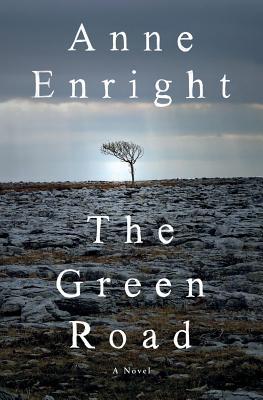 Next up: I’m reviewing The Green Road by Anne Enright for the November 2015 issue of Third Way. The Booker Prize shortlist will be announced on September 15th and the winner on October 13th.
Beyond the Booker, here are some of the other prizes I follow throughout the year, listed in vague chronological order:
 The Not the Booker Prize run by the Guardian. On this year’s shortlist is Shame by Melanie Finn, a book I loved when I reviewed it for Third Way’s April 2015 issue. It’s a powerful story of regret and the search for redemption. Though it has elements of a straightforward psychological thriller, the daring structure and moral complexities are more akin to Graham Greene. In alternating chapters, Pilgrim Jones contrasts flashbacks to her car accident and the subsequent investigation back in Switzerland with her present-tense African odyssey. This is Conrad’s Africa, a continent characterized by darkness and suffering. The question of culpability remains murky, yet the possibility of salvation shines through. [Voting will take place in October.]

- The Guardian First Book Award (open to both fiction and nonfiction): the shortlist will be announced this Friday, August 14th. One entry, Spill Simmer Falter Wither by Sara Baume, has already been chosen by readers, and the other nine are selected from publishers’ submissions. [Winner announced in late November.]
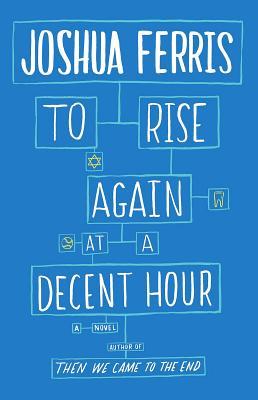
 The Dylan Thomas Prize for young writers (under 39) went to Joshua Ferris for To Rise Again at a Decent Hour last year. [Longlist in September, shortlist in October and winner announced in November.]
- The Costa Book Awards give separate prizes for fiction, debut fiction, biography, poetry, and children’s books, and also choose one overall winner. [Category shortlists in late November, category winners in early January and overall winner on January 26, 2016.]
- The Folio Prize, only two years old, considers any work of fiction published in English; before the Booker expanded to include American entries last year, it was the most Catholic of the fiction prizes. Now it risks being considered redundant; especially since it lost its Folio Society sponsorship, it’s unclear whether it will continue. [Shortlist in February and winner announced in March.]
 The Wellcome Book Prize is for medical-themed literature, fiction or nonfiction. Last year’s winner, The Iceberg by Marion Coutts, meant a lot to me for personal reasons but was also one of the most unusual and impressive memoirs I’ve ever read. I reviewed it for The Bookbag here. [Shortlist in March and winner announced in April.]

- The Pulitzer Prize is America’s premier literary award. I confess I often feel a little out of touch with the winners and don’t necessarily make a conscious effort to seek out the nominated books. I’d like to be more familiar with Pulitzer winners. Next year marks the prize’s centennial, so there’s no better time! [Winners announced in April.]
- The Independent Foreign Fiction Prize is for any book that has been translated into English and published in the UK in the previous year. I’ve found some great offbeat reads by browsing through previous longlists. As of next year, the prize is merging with the Man Booker International award, which previously recognized the life work of a foreign author every other year. [Longlist in March, shortlist in April and winner announced in May.]
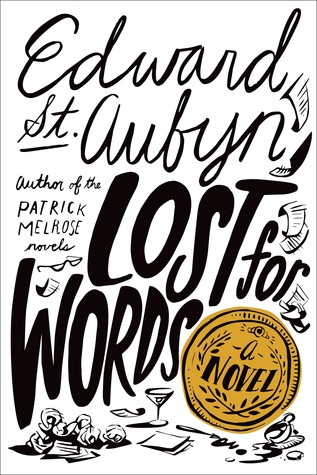
 The Bollinger Everyman Wodehouse Prize, the UK’s prize for comic literature, has run since 2000. Among the past winners are Paul Torday, Howard Jacobson, Terry Pratchett, Geoff Dyer, Gary Shteyngart, and (surprise!) Ian McEwan. I’ve read five of the winners, including Lost for Words by Edward St. Aubyn. [Shortlist in March and winner announced in May.]
- The Baileys Women’s Prize for Fiction (formerly known as the Orange Prize). Ali Smith won the 2015 award for How to Be Both. [Longlist in March; shortlist and winner announced in June.]
Do you follow literary prize races? Do you make a point of reading the winner and/or the shortlisted books? All comments welcome!
 Bookish Beck = Rebecca Foster. American transplant to England. Freelance proofreader and book reviewer.
 Bookish Beck