This comes a few days later than I intended, but better late than never. I’ve been focusing on short stories in September for the last eight years. In September 2021 I read 12 short story collections; last year it was 11.5; this year I finished 11, so pretty much par for the course, and pushing my year-to-date total to 30 story collections – not bad going for someone who feels like she hardly ever reads stories and doesn’t seek them out. This year’s reviews are here, here and here.
Hateship, Friendship, Courtship, Loveship, Marriage by Alice Munro (2001)
I always think I’ve never read Munro before, but that’s not the case. A decade or more ago I read Lives of Girls and Women. The ironic thing is that I chose it because I thought it was the odd one out in her oeuvre, being a novel rather than short stories. In fact, it’s a linked story collection, and really they might as well be discrete stories. That book left no impression, but I’d happened to accumulate several more Munro collections over the years and, especially after she won the Nobel, felt delinquent for not reading her.
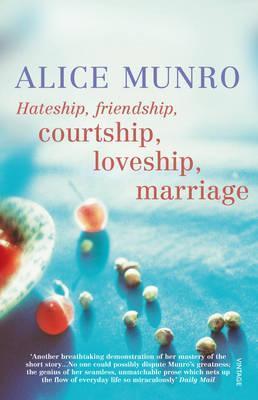 There are nine stories in the 320-page volume, so the average story here is 30–35 pages – a little longer than I tend to like, but it allows Munro to fill in enough character detail that these feel like miniature novels; they certainly have all the emotional complexity. Her material is small-town Ontario and the shifts and surprises in marriages and dysfunctional families.
More commonly, she employs an omniscient third person to allow her to move between minds, yet I found that the three first-person stories were among the most memorable: in “Family Furnishings,” a woman recalls the encounter with her father’s cousin that made her resolve to be a writer; in “Nettles,” childhood friends meet again in midlife and a potential affair is quashed by the report of a tragedy; in “Queenie,” a young woman spends a short time living with her older stepsister and her husband, her music teacher she ran off with. This last one reminded me of Tessa Hadley’s stories – no doubt Munro has been an influence on many.
For instance, the title story, which opens the collection, gave me strong Elizabeth Hay and Mary Lawson vibes. A housekeeper sets off on the train to start a new life, encouraged by a romantic correspondence fabricated by her adolescent charge, Sabitha, and her friend. Munro pays close attention to domestic minutiae like furniture and clothing. Illness and death are frequent seeds of a story: cancer in “Floating Bridge,” the suicide of an ALS patient in “Comfort,” and dementia in the oft-anthologized “The Bear Came Over the Mountain.”
Individual plots are less likely to stay with me than the quality of the prose, the compassionate eye, and the feeling of being immersed in a novel-length narrative when really I was only halfway through a few dozen pages. I’ll certainly read more Munro collections. (Free from a neighbour) 
Close Company: Stories of Mothers and Daughters, ed. Christine Park and Caroline Heaton (1987)
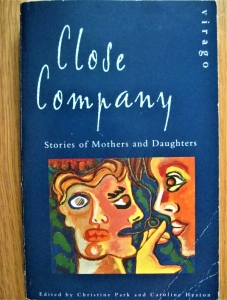 Back in 2021, I read 14 of these 25 stories (reviewed here) and set the book aside. At that time I noted the repeated theme of women’s expectations of their daughters, and that was true of the remainder as well. The editors quote Simone de Beauvoir in the introduction, “the daughter is for the mother at once her double and another person.” So in Emily Prager’s “A Visit from the Footbinder,” Lady Guo Guo subjects her spirited daughter to the same painful procedure she underwent as a child. The cultural detail was overpowering in this one, like the author felt she had to prove she’d done her research on China. The father–daughter relationship struck me more in Judith Chernaik’s Jewish Brooklyn-set “Honor Thy Father and Thy Mother.”
From this batch, two stood out the most: in “Children’s Liberation” by Jan Clausen, Lisa rebels against her lesbian mother’s bohemian lifestyle by idolizing heterosexual love stories; and in Zhang Jie’s “Love Must Not Be Forgotten,” a daughter comes to understand her mother by reading her diary about her doomed romance. My overall favourites, though, were still the stories by Jane Gardam, Janet Frame, Alice Walker and Charlotte Perkins Gilman. (Free mall bookshop) 
Small, Burning Things by Cathy Ulrich (2023)
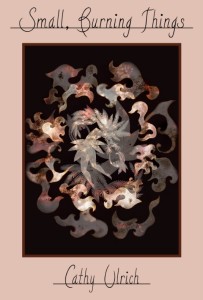 Ulrich’s second collection contains 50 flash fiction pieces, most of which were first published in literary magazines. She often uses the first-person plural and especially the second person; both “we” and “you” are effective ways of implicating the reader in the action. Her work is on a speculative spectrum ranging from magic realism to horror. Some of the situations are simply bizarre – teenagers fall from the sky like rain; a woman falls in love with a giraffe; the mad scientist next door replaces a girl’s body parts with robotic ones – while others are close enough to the real world to be terrifying. The dialogue is all in italics. Some images recur later in the collection: metamorphoses, spontaneous combustion. Adolescent girls and animals are omnipresent. At a certain point this started to feel repetitive and overlong, but in general I appreciated the inventiveness.
Published on 2 July by Okay Donkey Press. With thanks to publicist Lori Hettler for the free e-copy for review.
 I also read the first two stories in The Best Short Stories 2023: The O. Henry Prize Winners, edited by Lauren Groff. If these selections by Ling Ma and Catherine Lacey are anything to go by, Groff’s taste is for gently magical stories where hints of the absurd or explained enter into everyday life. Ma’s “Office Hours” has academics passing through closet doors into a dream space; the title of Lacey’s “Man Mountain” is literal. I’ll try to remember to occasionally open the book on my e-reader to get through the rest.
 Bookish Beck = Rebecca Foster. American transplant to England. Freelance proofreader and book reviewer.
 Bookish Beck
Well done! I’ve read that Virago compilation: I still have the 50th birthday one to read and was hoping to get it done this year!
LikeLiked by 1 person
I’ve been meaning to read that Furies one.
LikeLike
It sounds like at least two of the stories were in Munro’s larger collection, Family Furnishings, the title story was definitely in there, because I remember the plot, not so much the title, and so was “Family Furnishings.” although in that case I remember the title, not the plot. Of course, maybe Family Furnishings, which is quite a big book, incorporates several of her other collections.
LikeLiked by 1 person
Oh, okay; maybe her collections were assembled in different ways for the UK vs. US markets as well.
LikeLiked by 1 person
Penguin has reissued different compilations that are confusing even for Munro aficionados who followed her book-by-book in her career; but, I suppose, these anthologies bring new readers to her work, which is a good thing.
LikeLiked by 1 person
That may very well be true. I think I remember that Family Furnishings also had some stories that appeared in other collections I’d read. I think maybe that was her big collection of most of her stories.
LikeLike
I can see where these three make sense to nestle together in your month’s worth of reading stories.
That’s true, one does tend to feel as though her story must be well underway and, then, you check and see that you’ve read like a third of it and, then, at the end you think, well, that could have gone on a little further after all but now it’s done. Amazing.
The story behind her Flo and Rose stories is, if I remember correctly, that she was instructed (or urged, or encouraged, or nudged) to write a novel and that was the best she could offer.
That O’Henry collection is on order here; I’ve placed a hold and will let you know when it arrives. (No predictions.) Maybe you’ll be not-so-far that we can’t read along together.
LikeLiked by 1 person
I think Flo and Rose are in The Beggar Maid? I have a copy of that one. But maybe they’re similarly linked stories.
The first story in this volume featured a Mr. McCauley!
Sure, I’ve still only read the first two stories in the O. Henry collection, so whenever the book arrives for you we can do a readalong of the rest.
LikeLike
That’s the one, I can never remember which country had which title (it’s Who Do You Think You Are? in Canada, then). It does feel much like The Lives of Girls and Women.
Funny! Last year I read Marcie Rendon’s mysteries and got a chuckle out of that. So weird to type my own name into a review. (But, thereafter, of course she was referred to by her last.)
If it doesn’t hold you up. I can just jump in where you’re at too and then begin at the beginning again afterwards.
LikeLike
No problem at all. As I’m sure you can imagine, I have dozens of books to keep me busy until then!
LikeLike
Well done! I just finished reading Claire Keegan’s collection of short stories, Walk the Blue Fields, but I’ll only publish my review next week or so…
LikeLiked by 1 person
I need to read her brand new story collection/novella.
LikeLiked by 1 person
Oh, it was excellent!
LikeLike
I love reading the Best Canadian Stories every year when it comes out. Part of what makes it interesting is that there’s a different editor each year, so every volume has a unique ‘flavour’.
It’s been a while since I’ve read Alice Munro, but i can remember each story As you briefly describe it from that collection.
LikeLiked by 1 person
It’s fun reading an anthology and discovering new authors. And you’re right, you do get a different selection each year that reflects the editor’s taste.
I was so pleased to finally get to one of her collections. There are many more for me to discover now.
LikeLiked by 1 person