I don’t have anything especially insightful to say about these authors’ reasons for being cancelled, although in my review of the Clanchy I’ve noted the textual examples that have been cited as problematic. Alexie is among the legion of male public figures to have been accused of sexual misconduct in recent years. I’m not saying those aren’t serious allegations, but as Claire Dederer wrestled with in Monsters, our judgement of a person can be separate from our response to their work. So that’s the good news: I thought these were both fantastic books. They share a theme of education.
The Absolutely True Diary of a Part-Time Indian by Sherman Alexie (illus. Ellen Forney) (2007)
 Alexie is to be lauded for his contributions to the flourishing of both Indigenous literature and YA literature. This was my first of his books and I don’t know a thing about him or the rest of his work. But I feel like this must have groundbreaking for its time (or maybe a throwback to Adrian Mole et al.), and I suspect it’s more than a little autobiographical.
It reads exactly like a horny 14-year-old boy’s diary, but “Junior” (Arnold Spirit, Jr.) is also self-deprecating and sweetly vulnerable; Alexie’s tone is spot on. Junior has had a tough life on a Spokane reservation in Washington, being bullied for his poor eyesight and speech impediments that resulted from brain damage at birth and ongoing seizures. Poverty, alcoholism, casinos: they don’t feel like clichés of Indian reservations here because Alexie writes from experience and presents them matter-of-factly. Junior’s parents never got to pursue their dreams and his sister has run away to Montana, but he has a chance to change the trajectory. A rez teacher says his only hope for a bright future is to transfer to the elite high school in Reardan. So he does, even though it often requires hitch-hiking or walking miles.
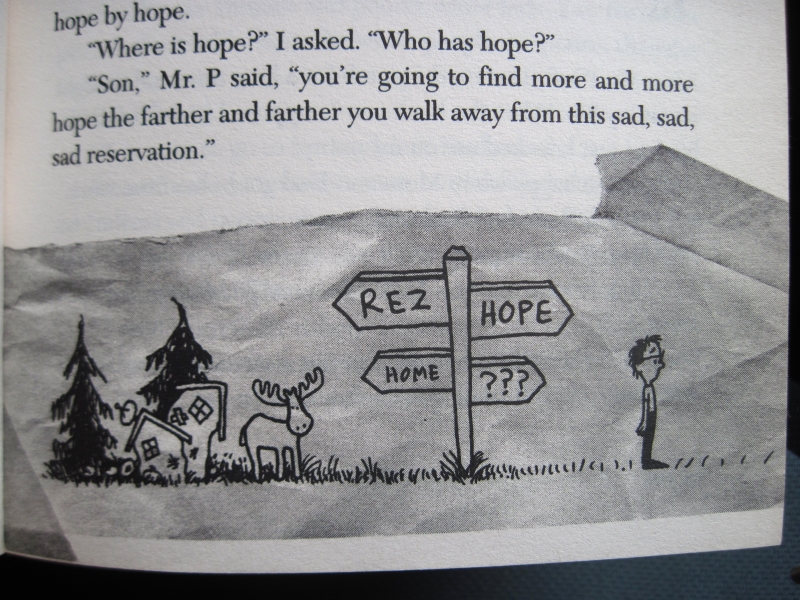
Junior soon becomes adept at code-switching: “Traveling between Reardan and Wellpinit, between the little white town and the reservation, I always felt like a stranger. I was half Indian in one place and half white in the other.” He gets a white girlfriend, Penelope, but has to work hard to conceal how impoverished he is. His best friend, Rowdy, is furious with him for abandoning his people. That resentment builds all the way to a climactic basketball match between Reardan and Wellpinit that also functions as a symbolic battle between the parts of Junior’s identity. Along the way, there are multiple tragic deaths in which alcohol, inevitably, plays a role. “I’m fourteen years old and I’ve been to forty-two funerals,” he confides. “Jeez, what a sucky life. … I kept trying to find the little pieces of joy in my life. That’s the only way I managed to make it through all of that death and change.”
One of those joys, for him, is cartooning. Describing his cartoons to his new white friend, Gordy, he says, “I use them to understand the world.”

Forney’s black-and-white illustrations make the cartoons look like found objects – creased scraps of notebook paper sellotaped into a diary. This isn’t a graphic novel, but most of the short chapters include several illustrations. There’s a casual intimacy to the whole book that feels absolutely authentic. Bridging the particular and universal, it’s a heartfelt gem, and not just for teens. (University library) 
Some Kids I Taught and What They Taught Me by Kate Clanchy (2019)
If your Twitter sphere and mine overlap, you may remember the controversy over the racialized descriptions in this Orwell Prize-winning memoir of 30 years of teaching – and the fact that, rather than issuing a humbled apology, Clanchy, at least initially, doubled down and refuted all objections, even when they came from BIPOC. It wasn’t a good look. Nor was it the first time I’ve found Clanchy to be prickly. (She is what, in another time, might have been called a formidable woman.) Anyway, I waited a few years for the furore to die down before trying this for myself.
I know vanishingly little about the British education system because I don’t have children and only experienced uni here at a distance, through my junior year abroad. So there may be class-based nuances I missed – for instance, in the chapter about selecting a school for her oldest son and comparing it with the underprivileged Essex school where she taught. But it’s clear that a lot of her students posed serious challenges. Many were refugees or immigrants, and she worked for a time on an “Inclusion Unit,” which seems to be more in the business of exclusion in that it’s for students who have been removed from regular classrooms. They came from bad family situations and were more likely to end up in prison or pregnant. To get any of them to connect with Shakespeare, or write their own poetry, was a minor miracle.

Clanchy is also a poet and novelist – I’ve read one of her novels, and her Selected Poems – and did much to encourage her students to develop a voice and the confidence to have their work published (she’s produced anthologies of student work). In many cases, she gave them strategies for giving literary shape to traumatic memories. The book’s engaging vignettes have all had the identifying details removed, and are collected under thematic headings that address the second part of the title: “About Love, Sex, and the Limits of Embarrassment” and “About Nations, Papers, and Where We Belong” are two example chapters. She doesn’t avoid contentious topics, either: the hijab, religion, mental illness and so on.
You get the feeling that she was a friend and mentor to her students, not just their teacher, and that they could talk to her about anything and rely on her support. Watching them grow in self-expression is heart-warming; we come to care for these young people, too, because of how sincerely they have been created from amalgams. Indeed, Clanchy writes in the introduction that “I have included nobody, teacher or pupil, about whom I could not write with love.”
And that is, I think, why she was so hurt and disbelieving when people pointed out racism in her characterization:
I was baffled when a boy with jet-black hair and eyes and a fine Ashkenazi nose named David Marks refused any Jewish heritage
her furry eyebrows, her slanting, sparking black eyes, her general, Mongolian ferocity. [but she’s Afghan??]
(of girls in hijabs) I never saw their (Asian/silky/curly?) hair in eight years.
They’re a funny pair: Izzat so small and square and Afghan with his big nose and premature moustache; Mo so rounded and mellow and Pakistani with his long-lashed eyes and soft glossy hair.
There are a few other ill-advised passages. She admits she can’t tell the difference between Kenyan and Somali faces; she ponders whether being a Scot in England gave her some taste of the prejudice refugees experience. And there’s this passage about sexuality:
Are we all ‘fluid’ now? Perhaps. It is commonplace to proclaim oneself transsexual. And to actually be gay, especially if you are as pretty as Kristen Stewart, is positively fashionable. A couple of kids have even changed gender, a decision … deliciously of the moment
My take: Clanchy wanted to craft affectionate pen portraits that celebrated children’s uniqueness, but had to make them anonymous, so resorted to generalizations. Doing this on a country or ethnicity basis was the mistake. Journalistic realism doesn’t require a focus on appearances (I would hope that, if I were ever profiled, someone could find more interesting things to say about me than that I am short and have a large nose). She could have just introduced the students with ‘facts,’ e.g., “Shakila, from Afghanistan, wore a hijab and was feisty and outspoken.” Note to self: white people can be clueless, and we need to listen and learn. The book was reissued in 2022 by independent publisher Swift Press, with offending passages removed (see here for more info). I’d be keen to see the result and hope that the book will find more readers because, truly, it is lovely. (Little Free Library) 
 Bookish Beck = Rebecca Foster. American transplant to England. Freelance proofreader and book reviewer.
 Bookish Beck
The Kate Clanchy story is interesting. Without informed feedback, it can be difficult as a writer to see how one’s own mental habits and ingrained language choices can be hurtful. If there was value in other parts of the book, and real care for her students and willingness to learn, it seems a positive step that she was able to hear criticism and revise accordingly.
LikeLiked by 1 person
Her long-time publisher, Picador, dumped her — too much bad publicity, I guess. But yes, I think it’s a good thing that another publisher was willing to reissue the book with minor modifications.
LikeLike
Publishers/editors are implicated in these situations too. It’s easy to blame a writer as the name on the book, but it goes through a lot of other hands. Anyway, I admire anyone who is willing to change in needed ways. Shaming people without giving them any path to reform is not helpful.
LikeLiked by 1 person
It’s baffling to think how many eyes must have on the book even before publication, and not one person thought to query her descriptions. (Was everyone at the publisher white?) I’m sure they’ve wised up now by hiring sensitivity readers.
LikeLike
This raises the question for me, how is canceling an author any different from banning books? I personally think that many aspects of this cancel culture are keeping people from being exposed to other’s outlooks and ideas, for example when campuses cancel a speaker because of student protests. I didn’t know that Sherman Alexie had been accused of sexual misconduct, but he is a fantastic writer.
LikeLike
Well indeed, Alexie’s novel has also made it onto ‘top 10 banned books’ lists, for profanity and mild sexual content. I would say that people should always be able to read a book for themselves and make up their own mind about it. And don’t dismiss any author because of something unpleasant from their personal life — we’re all flawed humans. But also don’t ignore serious issues that need to be addressed.
LikeLiked by 1 person
Right.
LikeLike
Alexie’s really does sound like something both I and my 14 yo boys would enjoy. As for the Clanchy, it must be good if a new publisher took the book on after all that! I have a good friend in the English school system, in London for many years before moving to the north. Her stories are often harrowing. Her own kid getting his head bashed in on the first day of school for simply being new. Why did I always think of English schools as fancy (posh) where all the kids were polite and retreating mini Hugh Grants?
LikeLiked by 1 person
I hope you and your teen boys will enjoy it! Maybe it won’t seem as edgy now as it did in 2007.
Ah, you’re thinking of Eton and all those other posh schools that prime ministers and MPs go to! In the rest of the country, it will really vary based on economic situation and demographics. I have extremely limited experience being in schools here. Back in 2014 I led a few book reviewing sessions at high schools in south London and the classrooms were very diverse and very well behaved and respectful.
LikeLiked by 1 person
The Clanchy was such a good book, and at the time one of her pupils who was described by her racial characteristics in the book and went on to win a top poetry prize, wrote a very strong piece in Sunday broadsheets in her defence. I understand her mental health was severely affected by the lambasting she got. Her mistake perhaps was to react back so strongly. Having met her twice before all the furore began, she was lovely, but indeed feisty!
LikeLiked by 1 person
It must have been an awful time for her, feeling so hated and misunderstood. I hope her reputation can recover quickly.
LikeLike
Intersecting post.
LikeLike
I’m guessing you mean “Interesting” — in which case, thank you 🙂
LikeLike
lol I can’t proof-read anything! I’ve sent resumes with typos in my phone number! lol
LikeLike
I tried to read the Alexie a few years ago as it should be exactly my thing but I think it was a bit too 14yo boy somehow. I should try it again.
Re the other one, I was surprised when a really bad racial stereotype made it into a novel I read through NetGalley. I fed back about it in an email to the publisher (as they’d emailed me to offer it to me) and got really good responses incl from a senior editor who said they’d put some training in place, but honestly do they edit light romances at all because it leapt out!
LikeLiked by 1 person
Good for you! The whole Clanchy scandal arose because of some Goodreads reviewers pointing out the problematic passages.
LikeLike
I love Alexie’s book – I think it’s a masterpiece and not just for teens, as you say. He’s a very talented writer. I was very sad when the news of his behavior came out. He is (was?) friends with Jess Walter and they had a wonderful podcast together years ago that was so funny and interesting. Anyway, I’m still going to read him. I’ve read a couple of others and think they’re also very good.
LikeLiked by 1 person
Oh, and I want to read that Monsters book too.
LikeLiked by 1 person
Which ones would you recommend?
LikeLike
Lone Ranger and Tonto Fistfight In Heaven and Reservation Blues. I would still like to read more of his work in the future. I think he writes on Substack now too.
LikeLiked by 1 person
I read the Alexis books years ago, before any controversy, and was so impressed by it. I remember being so disappointed when the allegations came to light. It’s hard to know when and how to separate an artist from their art.
LikeLiked by 1 person
He was far from the only one to be in a similar situation, alas. I do recommend Claire Dederer’s Monsters for thinking through the issues.
LikeLiked by 1 person
I read Monsters earlier this year and really enjoyed it! Definitely a book I’ve kept thinking about.
LikeLiked by 1 person
The first situation I’ve followed quite closely and the second I’m barely acquainted with. Alexie is on my MRE list and I wonder if you’re thought about reading his memoir (seems a natural pick for you). It’s one I bought in hard cover and have kept on the shelf even though those thick volumes often have to be “sacrificed” with long-distance moves. His short stories are fab, too: compassionate, funny, and often moving.
LikeLiked by 1 person
I spotted him on your MRE list. I will certainly try his stories, likely in September, and I’m drawn to his memoir as well.
LikeLike
[…] on the Spokane Indian Reservation.” I couldn’t help but think of it as a so-so rehearsal for The Absolutely True Diary of a Part-Time Indian because a similar cast of drunks, jokers, relatives and basketball players populates the stories […]
LikeLike
[…] The Absolutely True Diary of a Part-Time Indian by Sherman Alexie: Groundbreaking for both Indigenous literature and YA literature, this reads exactly like a horny 14-year-old boy’s diary, but “Junior” (Arnold Spirit, Jr.) is also self-deprecating and sweetly vulnerable. Poverty, alcoholism, casinos: they don’t feel like clichés of Indian reservations because Alexie writes from experience and presents them matter-of-factly. Junior moves to a white high school and soon becomes adept at code-switching (and cartooning). Heartfelt; spot on. […]
LikeLike
[…] books that hit the laughing-and-crying-at-the-same-time sweet spot: The Absolutely True Diary of a Part-Time Indian by Sherman Alexie and I’m Glad My Mom Died by Jennette […]
LikeLike