When I heard that Little Toller were reissuing their edition of Edward Thomas’s In Pursuit of Spring, I couldn’t resist pairing it with Edwin Way Teale’s book about the progress of the season up the United States, North with the Spring. These spring journeys, documented by authors delighting in nature’s bounty and responding with poetry, inspired mixed feelings in me: vicarious nostalgia, but also sadness for all that has been lost since they set out in the 1910s and 1950s, respectively.
It’s hard to live joyfully when evidence of the destruction of nature is overwhelming. Enjoying what still exists doesn’t seem like enough. But it’s a start. So this year I’ve been careful to note every phenological landmark: the first swift, the first hearing of a cuckoo, a rare sighting of a live hedgehog. One day in late April I stood on the towpath for hours watching a cloud of swallows and martins swooping for insects. I’ve also enjoyed watching from my office window as sparrows come and go from a nest box.
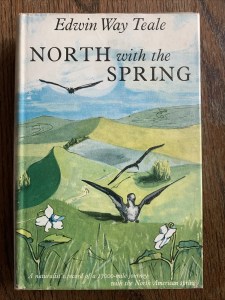
North with the Spring by Edwin Way Teale (1951)
I’ve previously reviewed Teale’s Autumn Across America and Springtime in Britain and consider him one of the classic – and most underrated – American nature writers. I was delighted to find a copy of this first seasonal volume on our trip to Northumberland a few years ago. As in the autumn book, he and his wife Nellie undertake a road trip, this time travelling from Florida up to New England, a total of 17,000 miles. Their journey lasted 130 days because instead of waiting for 21 March they started weeks before; spring comes early to the Gulf coast. Their time in Florida feels endless, constituting over a third of the book. Although it’s true that there are (were?) many peerless ecosystems there between the scrub and swamp, I grew impatient to move on to other states. The meet-up with Marjorie Kinnan Rawlings, who took them on a picnic to ‘The Yearling country,’ was a highlight.
 They travel alongside the spring warblers; past river deltas and barrier islands, by mountain meadows and forests. Other stops include Monticello and New Jersey’s pine barrens. A stopover in New York City dramatizes the difference between civilization and relative wilderness. I particularly enjoyed a pair of chapters set in Tennessee: first the wonder of Nickajack Cave, then the horror of the deforested and poisoned Ducktown Desert. Teale seems ahead of his time in decrying people’s wilful ignorance – one man they met denied the fact of migration, insisting the birds were always around – and failure to consider nature. His scenes and conversations feel fully natural; he’s as interested in people as in wildlife, and that humanism comes across in his writing.
“We longed for a thousand springs on the road instead of this one. For spring is like life. You never grasp it entire; you touch it here, there; you know it only in parts and fragments.”
(Secondhand – Barter Books, Alnwick)
In Pursuit of Spring by Edward Thomas (1914)
On Good Friday, 21 March 1913, Edward Thomas set off on his bicycle from his parents’ home in South London. He was bound southwest, toward Somerset and the height of spring. At cycling and walking pace, he would truly experience the development of the season, whereas
“Many days in London have no weather. We are aware only that it is hot or cold, dry or wet; that we are in or out of doors; that we are at ease or not.”
He prepares himself for hardship and slog:
“Spring would come, of course – nothing, I supposed, could prevent it – and I should have to make up my mind how to go westward. Whatever I did, Salisbury Plain was to be crossed”
 It’s remarkable both how much and how little has changed in the intervening century and more. The place names, plant and bird species, and alternation of town and countryside are all familiar, but the difference is stark when you see Thomas’s black-and-white photographs that illustrate the text. These dirt roads are empty. You’d have to search high and low today to find the kind of unspoiled fields, rivers, churchyards, hedgerows and stone walls that he memorializes.
Everything he sees drives him back to poetry, with long passages quoted from authors who have fallen somewhat out of fashion, such as George Herbert and Alexander Pope. I loved the scene where he buys a book at a secondhand furniture shop (for two pence, mind you) and then ignores it to eavesdrop on fellow diners at a restaurant. He has words of high praise for W.H. Hudson:
“Were men to disappear they might be reconstructed from the Bible and the Russian novelists; … Hudson so writes of birds that if ever … they should cease to exist, and should leave us to ourselves on a benighted planet, we should have to learn from him what birds were.”
Thomas also mentions William Cobbett, whose Rural Rides this reminded me of strongly. Both are slow-paced journeys around a rural England that no longer exists. Today Thomas is better remembered as a poet; he would be one of the fallen in a First World War battle just four years after this expedition. It was great to have a chance to read his nature writing, too.
With thanks to Little Toller for the free copy for review.
We’re off to rural France on Wednesday for eight days of relaxation and nature-watching; it’s not a sight-seeing or foodie trip like our time in Paris back in December. Ironically, it seems that it may be cold and rainy for much of the holiday, having been gorgeous in both countries this past week. We will hope for some sun and warmth, but have packed plenty of books and board games (and will acquire much wine) for when the weather is to be avoided inside.
What signs of the spring have you been seeing?
 Bookish Beck = Rebecca Foster. American transplant to England. Freelance proofreader and book reviewer.
 Bookish Beck
Hope you have a lovely time in France! My favourite sign of spring is always an absolute forest of flowering wild garlic.
LikeLiked by 1 person
We didn’t pick any wild garlic this year, alas. We did get one batch in our veg box, though, and put it in risotto.
LikeLiked by 1 person
I just appreciate its beauty 🙂
LikeLike
Have a lovely time in France, Rebecca, whatever the weather. Is the tower on the cover of In Pursuit of Spring identified?
LikeLiked by 1 person
Yes, it’s Turner’s Tower, Hemington, Radstock, Somerset. There’s more on the photos here: https://www.bbc.co.uk/news/in-pictures-35727382
LikeLiked by 1 person
That’s great! Thanks for that. I must have seen it; it’s so close to home.
LikeLike
I’m glad to hear the Thomas is being reissued – I read it not that long ago and loved it. So evocative…
LikeLiked by 1 person
For me it’s lighter evenings that make it feel really springy—that and the appearance of blossom.
LikeLiked by 1 person
What a lovely post to read! And I hope you are having a wonderful time on your holiday!
LikeLiked by 1 person
(Still in the UK for now; we sail tomorrow morning.)
LikeLike
So you must be sailing now: what fun! Eeeeek.
LikeLike
Tomorrow still (silly time difference!). I’ve stocked up on seasickness pills and have all the other remedies to hand, so it should be fine.
LikeLike
It’s amazing how the simple things like lighter evenings and the blooming of blossoms can instantly infuse a sense of springtime freshness into our days. There’s a unique magic in witnessing nature’s colorful transformation as it awakens from its winter slumber. The longer daylight hours seem to breathe new energy into everything around us, inviting us to embrace the season’s warmth and vitality.
LikeLiked by 1 person
Appetising choices! Enjoy your rural break.
LikeLiked by 1 person
Very behind on posts… hope you are having a fun vacation!
LikeLiked by 1 person
Colder and rainier than we expected from southwest France, but we’re making the best of it! (Back to England on Thursday.)
LikeLiked by 1 person
What lovely books! I do like Little Toller so much: must get more of theirs! Hope you’ve had a super trip even if it’s been a bit dull. I got a lifer, as far as I know, last week: a little grebe on the local lake, finally spotted as Matthew’s been seeing it intermittently for a week or so but I’ve managed to miss it.
LikeLike
[…] I recently encountered spring (if only in name) through these three books, a truly mixed bag: a novelty poetry book memorable more for the illustrations than for the words, a fascinating popular account of the science of ageing, and a typically depressing (if you know the author, anyway) novel about failing marriages and families. Part I of my Spring Reading was here. […]
LikeLike
[…] North with the Spring by Edwin Way Teale […]
LikeLike