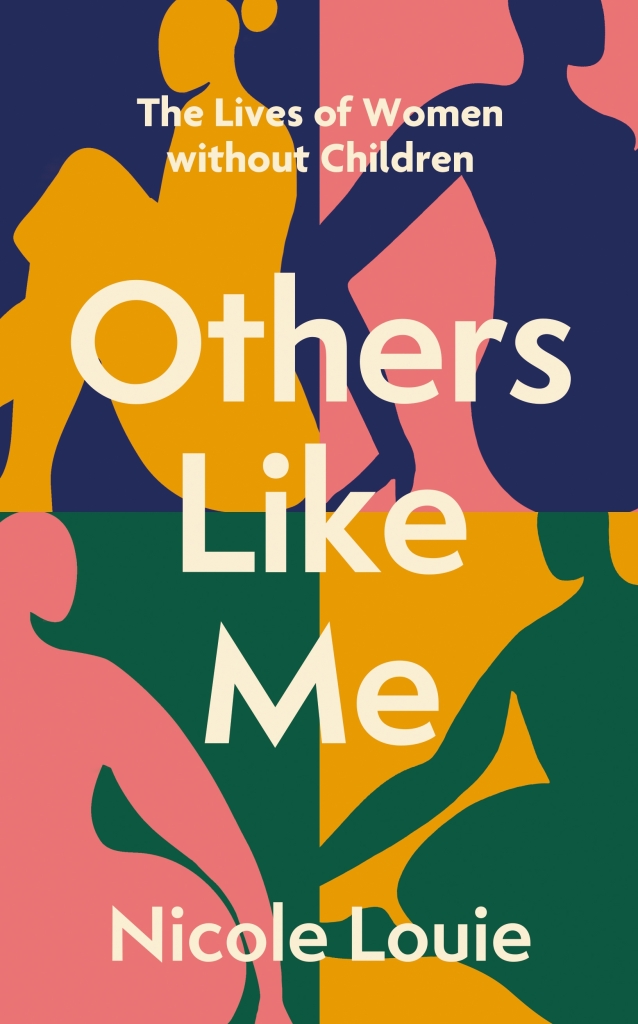
I’ve read quite a lot about matrescence and motherhood so far this year, and I value these women authors’ perspectives on their experiences. There is much that resonates with me as I look back to my relationships with my parents and observe how my sister, brother-in-law and friends are raising their children. Yet as I read of the joys and struggles of parenthood, I do sometimes think, what about the rest of us? That’s the question that drove Nicole Louie to write this impassioned book, which combines the strengths of an oral history, a group biography and a fragmented memoir. Like me, she was in search of role models, and found plenty of them – first on the library shelves and then in daily life by interviewing women she encountered through work or via social media.
The 14 Q&As, shaped into first-person narratives, are interspersed with Louie’s own story, creating a chorus of voices advocating for women’s freedom. The particulars of their situations vary widely. A Venezuelan graphic designer with MS doesn’t want to have a baby to try to fill a perceived lack. A blind Canadian writer hopes for children but knows it may be too complicated on her own. A Ghanaian asexual woman confronts her culture’s traditional expectations of woman. A British nurse in her sixties is philosophical about not having a long-term relationship at the right time, and focuses instead on the thousands of people she’s been able to care for.
The subjects come from Iceland, Peru, the Isle of Man; they are undecided, living with illness or disability, longing but unpartnered, or utterly convinced that motherhood is not for them. Their reasons are logical, psychological, personal and/or environmental, and so many of their conclusions rang true for me:
I just want to make the most of what’s here now instead of always having to long for something else I don’t already have.
I have this strong core intent to be useful to society. To channel as much energy into it as I would put into raising two children … You can’t experience everything available to you in life. So you make choices, and you decide which paths to take and which ones to leave behind without trying. And that’s okay. What’s important is to move forward with intent.
Louie herself has an interesting background: she’s Brazilian but has lived in Sweden, the UK and Ireland. Her work as a copywriter and translator has taken her behind the scenes in training AI. She first had to give serious thought to the question of becoming a mother in 2009, when it became an issue in her first marriage. But, really, she’d known for a long time that it didn’t appeal to her – at age six she was given a doll whose tummy opened to reveal a baby and quickly exchanged that toy for another. A late diagnosis of PCOS and a complicated relationship with her own mother only reinforced a clear conviction.
Other works that I’ve encountered on childlessness, such as Childless Voices by Lorna Gibb (2019) and No One Talks about This Stuff: Twenty-Two Stories of Almost Parenthood, ed. Kat Brown (2024), are heavily weighted towards infertility. Here the spotlight is much more on being childfree, although the blurb is inclusive, speaking of “women who are not mothers by choice, infertility, circumstance or ambivalence.” (I love the inclusion of that final word.)
“Motherhood as the epicentre of women’s lives was all I’d ever witnessed” via her mother and grandmother, Louie writes, so finding examples of women living differently was key for her. As readers, then, we have the honour of watching her life, her thinking and the book all take shape simultaneously in the narrative. A lovely point to mention is that Molly Peacock (The Analyst and A Friend Sails in on a Poem) mentored her throughout the composition process.
Intimate and empathetic, Others Like Me is also elegantly structured, with layers of stories that reflect diversity and the intersectionality of challenges. This auto/biographical collage of life without children will be reassuring for many, and a learning opportunity for others. I’m so glad it exists.
With thanks to Nicole Louie and Dialogue Books for the proof copy for review.
Buy Others Like Me from Bookshop.org in the UK [affiliate link]
 Bookish Beck = Rebecca Foster. American transplant to England. Freelance proofreader and book reviewer.
 Bookish Beck
This looks so interesting. It looks like the narrative is not wholly “childfree by choice” so doesn’t preclude those of us who were infertile from finding it useful (I didn’t try very hard to overcome that so there’s a choice element). I loved that point of throwing the energy you would have put into children into helping others as that’s probably what I’ve done over my life so far.
LikeLiked by 1 person
It does lean more heavily towards the childfree side because of Louie’s story, but there are also women who had miscarriages or were hampered by illness or disability. No One Talks about This Stuff (Unbound publication) has more on the infertility stuff and is a great intersectional essay collection if you felt drawn to read more on the topic.
Absolutely, I can tell you’ve put lots of energy into your community and hobbies through volunteering. Running is a big thing for you and I think of other women without children who have challenged themselves physically: my aunt who got very into tennis, my next-door neighbour who is a champion kayaker, and a friend who became a mountain guide.
LikeLike
Thank you. I think the two books together would provide a good balance. And thank you for the acknowledgement, yes, indeed, as a slower runner I could never have had the training time if I’d had children. I was never hung up on having biological children but the whole adoption landscape is very different now and I didn’t feel equal to supporting someone very damaged, so have concentrated on helping a lot of people a little, if that makes sense.
LikeLiked by 1 person
I know what you mean. Taking on a severely disabled or psychologically damaged child is a daunting prospect. My stepsister, just a few weeks older than me, is considering adoption and just dipping a toe into the process.
LikeLike
I already have this on my list for obvious reasons. I’m interested to see how other women arrived at their choice and how it affected their subsequent lives. I went from certainty to ambivalence and back to certainty again.
LikeLiked by 1 person
There’s such a variety of circumstance and opinion here. I saw myself in many of the stories even though our particular situations are so different. I grew up and married fully convinced that I’d have two kids like everyone else, but gradually that vision left me. Luckily, my husband and I have the same feeling. For some of the women in the book, a disagreement ends a relationship.
LikeLiked by 1 person
While I do have children, I adopted an too many people act like that is not “real” motherhood. [Don’t get me started]. Regardless, this sounds very interesting.
LikeLiked by 1 person
It’s definitely not an “us vs. them” thing but a “me too” — wanting to be considered equal no matter our situation. I’m so sorry you have been thought less-than for being an adoptive mother.
LikeLiked by 1 person
We’ve been a family since 2003–water under the bridge until you see things like this book (which I really want to read, by the way!)
LikeLiked by 1 person
This sounds so good and, like you, I’m really attracted by the range of stories covered and the inclusion of ‘ambivalence’, as I don’t personally identify with being either childless or childfree. I’ll definitely be picking it up.
LikeLiked by 1 person
Several of the subjects express that very sentiment: this is just one aspect of their very full and particular lives, and they don’t like being defined by it. One drew a comparison with her atheism: it is a fact about her, but not one that she thinks much about on a daily basis. I’m coming to sympathize more with the childfree camp. There are some great resources in the back of the book, including about a dozen books I want to get hold of, a couple of Instagram accounts I followed, and an annual conference in Chester that I would consider attending.
LikeLike
[…] the forms differ, a common theme – as in the other June releases I’ve reviewed, Sandwich and Others Like Me – is grappling with what a woman’s life should be, especially for those who have taken an […]
LikeLike
This book sounds great! I’m glad it exists. All women should be able to see their own choices (or ambivalence) reflected in books and art. The first quotation you shared also felt relevant to me, a woman with “only” one child. It just didn’t work out for us to have another and for a while I was very sad. But my focus over the years has shifted to celebrating what is right here in front of me.
LikeLiked by 1 person
Being content with the shape of one’s life is a big thing. It takes time!
LikeLiked by 1 person
[…] Others Like Me: The Lives of Women without Children by Nicole Louie: This impassioned auto/biographical collage combines the strengths of oral history, group biography and a fragmented memoir. “Motherhood as the epicentre of women’s lives was all I’d ever witnessed” via her mother and grandmother, Louie writes, so finding examples of women living differently was key. As readers, we watch her life, her thinking and the book all take shape. It’s intimate and empathetic, with layers of stories that reflect diversity of experience. […]
LikeLike
An essential volume to be sure. Glad you found so much worthwhile in it, glad it’s out there in the world for others to discover too.
I’ve finished Coleman Hill, btw, and I really loved it too. A lot of interesting situations on the theme of mothering there. It’s hard to believe that there will be another book that so perfectly suits me in the remaining books on my CSP reading list. (But I remember you and Laura both enjoyed Dances quite a bit and that’s an ILL for me, which won’t be in processing until my copy of Coleman Hill comes off that roster. Maybe I’ll enjoy that one a lot as well.)
LikeLiked by 1 person
Coleman Hill was my clear favourite from the CSP list, with Land of Milk and Honey in second. Too bad neither of those could win (and that the CSP and WP had to double up, though I’m sure you think they chose a worthy winner).
LikeLike
I thought Brotherless Nights was a remarkable narrative, but I would have liked to have seen different books claim those two prizes.
I’ve given up on my hold on Zhang’s book (on order since 2023) and have ILLed it instead, and it arrived fairly quickly, so that’s my current CSP read. But I did not love her first novel as much as many readers (you too?) did.
LikeLiked by 1 person
We’d read Zhang’s first novel in book club the year before and I thought it was alright, but her second is a cut above. Glad you eventually got hold of it.
LikeLike
[…] Others Like Me: The Lives of Women without Children by Nicole Louie: This impassioned auto/biographical collage combines the strengths of oral history, group biography and a fragmented memoir. “Motherhood as the epicentre of women’s lives was all I’d ever witnessed” via her mother and grandmother, Louie writes, so finding examples of women living differently was key. As readers, we watch her life, her thinking and the book all take shape. It’s warm and empathetic, with layers of stories that reflect diversity of experience. […]
LikeLike