Hard to believe, but it’s my seventh year participating in the annual Margaret Atwood Reading Month (#MARM) hosted by indomitable Canadian blogger Marcie of Buried in Print. In previous years, I’ve read Surfacing and The Edible Woman, The Robber Bride and Moral Disorder, Wilderness Tips, The Door, and Bodily Harm and Stone Mattress; and reread The Blind Assassin. I’m wishing a happy belated birthday to Atwood, who turned 85 earlier this month. Novembers are my excuse to catch up on her extensive back catalogue. In recent years, I’ve scoured the university library holdings to find works by her that I often had never heard of, as was the case with this early novel and mid-career poetry collection.
Life before Man (1979)
 Atwood’s fourth novel is from three rotating third-person POVs: Toronto museum curator Elizabeth, her toy-making husband Nate, and Lesje (pronounced “Lashia,” according to a note at the front), Elizabeth’s paleontologist colleague. The dated chapters span nearly two years, October 1976 to August 1978; often we visit with two or three protagonists on the same day. Elizabeth and Nate, parents to two daughters, have each had a string of lovers. Elizabeth’s most recent, Chris, has died by suicide. Nate disposes of his latest mistress, Martha, and replaces her with Lesje, who is initially confused by his interest in her. She’s more attracted to rocks and dinosaurs than to people, in a way that could be interpreted as consistent with neurodivergence.
It was neat to follow along seasonally with Halloween and Remembrance Day and so on, and see the Quebec independence movement simmering away in the background. To start with, I was engrossed in the characters’ perspectives and taken with Atwood’s witty descriptions and dialogue: “[Nate]’s heard Unitarianism called a featherbed for falling Christians” and (Lesje:) “Elizabeth needs support like a nun needs tits.” My favourite passage encapsulates a previous relationship of Lesje’s perfectly, in just the sort of no-nonsense language she would use:
The geologist had been fine; they could compromise on rock strata. They went on hikes with their little picks and kits, and chipped samples off cliffs; then they ate jelly sandwiches and copulated in a friendly way behind clumps of goldenrod and thistles. She found this pleasurable but not extremely so. She still has a collection of rock chips left over from this relationship; looking at it does not fill her with bitterness. He was a nice boy but she wasn’t in love with him.
Elizabeth’s formidable Auntie Muriel is a terrific secondary presence. But this really is just a novel about (repeated) adultery and its aftermath. The first line has Elizabeth thinking “I don’t know how I should live,” and after some complications, all three characters are trapped in a similar stasis by the end. By the halfway point I’d mostly lost interest and started skimming. The grief motif and museum setting weren’t the draws I’d expected them to be. Lesje is a promising character but, disappointingly, gets snared in clichéd circumstances. No doubt that is part of the point; “life before man” would have been better for her. (University library) 
This prophetic passage from Life before Man leads nicely into the themes of Interlunar:
The real question is: Does [Lesje] care whether the human race survives or not? She doesn’t know. The dinosaurs didn’t survive and it wasn’t the end of the world. In her bleaker moments, … she feels the human race has it coming. Nature will think up something else. Or not, as the case may be.
The posthuman prospect is echoed in Interlunar in the lines: “Which is the sound / the earth will make for itself / without us. A stone echoing a stone.”
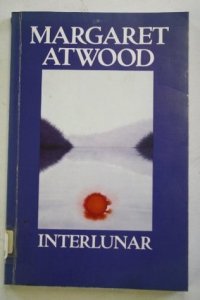
Interlunar (1984)
Some familiar Atwood elements in this volume, including death, mythology, nature, and stays at a lake house; you’ll even recognize a couple of her other works in poem titles “The Robber Bridegroom” and “The Burned House.” The opening set of “Snake Poems” got me the “green” and “scales” squares on Marcie’s Bingo card (in addition to various other scattered ones, I’m gonna say I’ve filled the whole right-hand column thanks to these two books).
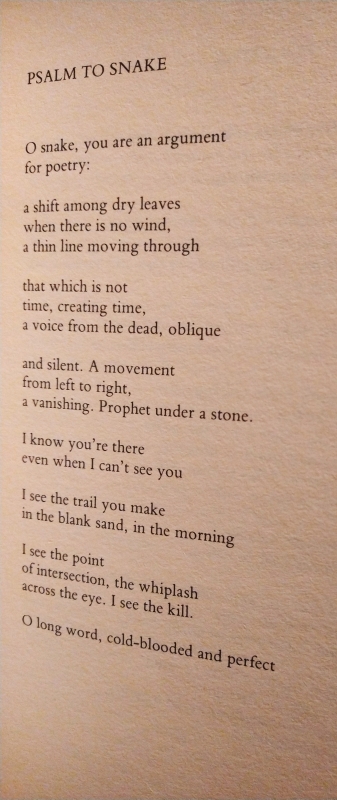
This one brilliantly likens the creature to the sinuous ways of language:
 “A Holiday” imagines a mother–daughter camping vacation presaging a postapocalyptic struggle for survival: “This could be where we / end up, learning the minimal / with maybe no tree, no rain, / no shelter, no roast carcasses / of animals to renew us … So far we do it / for fun.” As in her later collection The Door, portals and thresholds are of key importance. “Doorway” intones, “November is the month of entrance, / month of descent. Which has passed easily, / which has been lenient with me this year. / Nobody’s blood on the floor.” There are menace and melancholy here. But as “Orpheus (2)” suggests at its close, art can be an ongoing act of resistance: “To sing is either praise / or defiance. Praise is defiance.” I do recommend Atwood’s poetry if you haven’t tried it before, even if you’re not typically a poetry reader. Her poems are concrete and forceful, driven by imagery and voice; not as abstract as you might fear. Alas, I wasn’t sent a review copy of her collected poems, Paper Boat, as I’d hoped, but I will continue to enjoy encountering them piecemeal. (University library)
 Bookish Beck = Rebecca Foster. American transplant to England. Freelance proofreader and book reviewer.
 Bookish Beck
I have read Life Before Man but it was so long ago I don’t remember anything about it. My MARM experiment this year sadly didn’t turn out well – Good Bones and Simple Murders, which is essentially flash fiction, wasn’t for me. But I love that this event exists – and rereading Atwood’s novels is always an enjoyable experience! (And I still have her relatively recent essay collection yet to read.)
LikeLiked by 1 person
I’ve been enjoying seeking out some of her more obscure, older work … but it doesn’t always pan out!
LikeLiked by 1 person
I read most of Atwood’s early novels in my 20s so of course I can recall little about them. So you’re rather nudging me into wanting to re-read them!
LikeLiked by 1 person
I’m sure you don’t have to wait until next November, though that tends to be the nudge I need.
LikeLiked by 1 person
“I do recommend Atwood’s poetry if you haven’t tried it before, even if you’re not typically a poetry reader.”
I second this, with excitement. Her poems are so accessible, and as you say, perhaps not at all what people would expect.
I read the Snake poems in Interlunar because I knew you were reading it this November and wholly enjoyed them. The one you chose to share really does feel perfect, like its last line. (Overall, I thought I’d read more poems, but I think maybe I’ll read Paper Boat next year, gradually, throughout 2025.)
IIRC, I enjoyed my more-recent reread of Life before Man more than I’d enjoyed it previously, but I did consistently want more of the museum too. As I mentioned to Bill, who also read it this year, I am going to try to locate the photos I took (of it and the planetarium) with that reread. The quotations you’ve selected do whet my appetite though. Nicely done. And lovely to have you participate in what I know is a very full (and tricky) month for you. It’s quite possible that you hold the MARM record over these seven years!
LikeLiked by 1 person
I will humbly accept my medal 😉
LikeLike
[…] Bookish Beck on Life Before Man and Interlunar […]
LikeLike
I’ve been using MARM to read Atwood’s earlier novels (and Cats Eye) which reflect her experience of that period, rather than the later, big, story telling novels. This year, like you, I read Life Before Man (I keep writing Life After Man, which is where your final quote goes too). I agree, they don’t get much joy out of all their adultery, do they.
LikeLiked by 1 person
That’s quite a coincidence that we picked the same obscure older novel to read this year.
LikeLike
The essay I read from Burning Questions also had the theme of humans dying off and nature continuing on… she’s been thinking about this idea for a long time!
Whenever I read an MA quotation, I have her voice in my head which makes it that much more fun to read. Such a distinctive voice.
LikeLiked by 1 person
She’s a prophetess for sure. We’re lucky to have her.
LikeLiked by 1 person
Well done for keeping going with the Month so consistently! I don’t fancy Life Before Man but that’s the handy thing about the Month, I read a couple of reviews so now know to avoid it!
LikeLiked by 1 person
My book club is interested in doing something by her but it’s so hard to decide on the right one. It can’t be too long; and not too popular or too obscure.
LikeLiked by 1 person
[…] The Robber Bride and Moral Disorder, Wilderness Tips, The Door, Bodily Harm and Stone Mattress, and Life Before Man and Interlunar; and reread The Blind Assassin. Novembers are my excuse to catch up on the […]
LikeLike