Swedish author Elin Cullhed won the August Prize and was a finalist for the Strega European Prize with this first novel for adults. Euphoria is a recreation of Sylvia Plath’s state of mind in the last year of her life. It opens on 7 December 1962 in Devon with a list headed “7 REASONS NOT TO DIE,” most of which centre on her children, Frieda and Nick. She enumerates the pleasures of being in a physical body and enjoying coastal scenery. But she also doesn’t want to give her husband, poet Ted Hughes, the satisfaction of having his prophecies about her mental illness come true.
 Flash back to the year before, when Plath is heavily pregnant with Nick during a cold winter and trying to steal moments to devote to writing. She feels gawky and out of place in encounters with the vicar and shopkeeper of their English village. “Who was I, who had let everything become a compromise between Ted’s Celtic chill and my grandiose American bluster?” She and Hughes have an intensely physical bond, but jealousy of each other’s talents and opportunities – as well as his serial adultery and mean and controlling nature – erodes their relationship. The book ends in possibility, with Plath just starting to glimpse success as The Bell Jar readies for publication and a collection of poems advances. Readers are left with that dramatic irony.
Cullhed seems to hew to biographical detail, though I’m not particularly familiar with the Hughes–Plath marriage. Scenes of their interactions with neighbours, Plath’s mother, and Ted’s lover Assia Wevill make their dynamic clear. The prose grows more nonstandard; run-on sentences and all-caps phrases indicate increasing mania. There are also lovely passages that seem apt for a poet: “Ted’s crystalline sly little mint lozenge eyes. Narrow foxish. Thin hard. His eyes, so embittered.” The use of language is effective at revealing Plath’s maternal ambivalence and shaky mental health. Somehow, though, I found this quite tedious by the end. Not among my favourite biographical novels, but surely a must-read for Plath fans. 
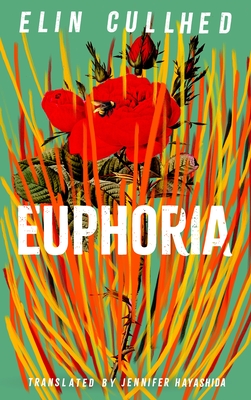
Translated from the Swedish by Jennifer Hayashida in 2022 – our first read in translation, I think? And what a brilliant cover.
With thanks to Canongate for the free copy for review.
The main question we ask about the books we read for Literary Wives is:
What does this book say about wives or about the experience of being a wife?
Marriage is claustrophobic here, as in so many of the books we read. Much as she loves her children, Plath finds the whole wifehood–motherhood complex to be oppressive and in direct conflict with her ambitions as an author. Sharing a vocation with her husband, far from helping him understand her, only makes her more bitter that he gets the time and exposure she so longs for. More than 60 years later, Plath’s death still echoes, a tragic loss to literature.
See Kate’s, Kay’s and Naomi’s reviews, too!
Coming up next, in March: Lessons in Chemistry by Bonnie Garmus – I’ve read this before but will plan to skim back through a copy from the library.
 Bookish Beck = Rebecca Foster. American transplant to England. Freelance proofreader and book reviewer.
 Bookish Beck
I was a real Plath obsessive in my youth (although not gone as far as defacing the Hughes name on her gravestone) and have continued reading everything I can lay my hands on by and about her. But this wasn’t necessarily my favourite read – I didn’t feel it added much to our knowledge or impression of Plath or her marriage, but I did feel it had some universal points to make about the clash between two creative personalities and huge artistic egos.
LikeLiked by 1 person
A fair assessment, I think. I’m glad you know this novel.
LikeLike
It makes me think more about what Sarah Manguso said about her novel Liars: that motherhood can be inextricable from patriarchy but marriage never is. There’s so much historical/social contingency at work when you think about the oppression of a marriage—the professional rivalry that Hughes and Plath experienced might manifest differently now, or not at all, whereas it was obviously very gendered in their era. Does that make that sense of stifling or claustrophobia inherent to marriage, or inherent to the conditions of marriage at different points in history? And does it even matter, when the end result for so many generations was the stifling?
LikeLiked by 1 person
Ah yes, well remembered with the Manguso quote. I don’t think there was a way to do motherhood differently at that time, unless (a bit later) you joined a commune, perhaps. I do wonder if it’s unique to heterosexual marriage; we haven’t yet read a novel with a same-sex partnership.
LikeLike
Oh, now, that would be interesting. Eva Baltasar’s Boulder, perhaps?
LikeLiked by 1 person
I hated her Mammoth, so I’m wary to try again. But it would be good to do something that pictures a lesbian marriage (and even though “wives” is in the title, I’m sure we could stretch to an all-male couple, too).
LikeLike
I usually fictionalized accounts of real life figures so will keep an eye out for this one.
LikeLiked by 1 person
I also like novels about authors, in particular. But this one might have meant more to me if I’d read more by or about Plath beforehand.
LikeLiked by 1 person
[…] Rebecca’s, Kay’s and Naomi’s reviews, […]
LikeLike
I think the fact that we both pulled out different quotes is testament to Cullhed’s writing.
I didn’t know lots about the Plath-Hughes marriage but the book prompted some further reading (eg. I didn’t know about defacing the headstone before my further reading, so was interested to see that mentioned in one of the other comments).
LikeLiked by 1 person
I didn’t know anything about Assia and her daughter… That whole story is also hugely tragic. Do we not hear more about it because Assia was not a writer or well-known in any other way?
LikeLiked by 1 person
I imagine Assia deserves a novel of her own! Hughes really seems to have cursed every relationship he touched.
On a happier note, I have a memoir by their daughter Frieda to read, and it looks to be a sweet story of how she adopted a pet magpie (George).
LikeLiked by 1 person
I watched a short video about Frieda, because I was curious to know more about her – she seems to have come through okay.
I was thinking the same thing about Ted. Was he drawn to depressive women? Were they drawn to him? Or did he drive them to it? Hopefully not the latter!
LikeLike
I’ve still never finished The Bell Jar, so I need to get back into that. I also have a biography of Plath and a copy of her poetry collection Ariel on the shelf.
LikeLike
I’m glad you mention how the book ends. If the reader knew nothing of Sylvia’s story, the ending could be interpreted as hopeful.
I would argue that she finds motherhood oppressive and in conflict with her ambitions because she has no support. Maybe with support this would still be the case, but we have no way of knowing.
LikeLiked by 1 person
At times I think she found motherhood oppressive, but I think she committed suicide over Ted and her loneliness.
LikeLiked by 2 people
The novel gave me the impression that Plath was bipolar, but the tiny bit of research I did suggests she just had depression.
LikeLiked by 1 person
I thought bipolar, too, although the title, Euphoria, didn’t really seem to apply to much of it. She was depressed most of the time.
LikeLike
I agree – it wasn’t about the kids.
LikeLiked by 1 person
I liked the scene of her mother visiting: Sylvia was so anxious about impressing her that it didn’t seem like she let her mother help her very much. And she didn’t appear to have friends in the community.
LikeLiked by 1 person
I didn’t realize this was a translation. Thanks for pointing that out, because I have to add it to my Translators page! I also loved the cover.
I realized that Ted was jealous of Sylvia’s fame, but now that I’m a month away from the book, I can’t remember thinking that Sylvia was jealous of Ted’s. Certainly she was jealous of the time he had to work, time that she hardly had any of.
It wasn’t my favorite, either, although I’m not sure why. I don’t think I have a poetic mind. I had trouble following her thought processes and reactions at times.
LikeLiked by 1 person
Can you think of another translated book LW has done before, or was this the first?
You’re probably right that time and responsibility were the main points of conflict. There was that scene where Ted left the baby to her own devices so that he could write and Sylvia was appalled when she got home.
LikeLiked by 1 person
I can look at the list of books we’ve done since I joined, but I don’t know about before. I think Naomi was in the club before me, but maybe I’m wrong. I’ll look. Just a sec.
LikeLike
The Happy Marriage by Tahar Ben Jelloun, which we read for April 2016, was originally in French. Ties by Domenico Sarnone, which we read for August 2019, was originally in Italian.
LikeLiked by 1 person
I believe that Ties was translated by Jhumpa Lahiri, but I could be thinking of another book.
LikeLiked by 1 person
Okay, so this was the third selection in translation. I think you’re right that Lahiri was the translator.
LikeLike
I wonder if she wrote past that point in manuscript or whether she always knew that she would end her version of the story at that juncture.
LikeLiked by 1 person
Unless she added an epilogue narrated by someone else, she wouldn’t have been able to follow through to Plath’s death. That would have been a predictable and depressing ending, though true to life.
LikeLike
[…] at age 30. What I previously knew of her life mostly came from hearsay and was reinforced by Euphoria by Elin Cullhed. For the mixture of nonfiction, fiction and poetry represented below, I’m […]
LikeLike