Like pretty much every other woman over 30 on the planet, I read Lessons in Chemistry when it first came out. I was happy for my book club to select it for a later month when I was away; it made a decent selection but I had no need to revisit it, then or now. I think it still holds the record for the longest reservation queue in my library system. I enjoyed this feel-good feminist story well enough but found certain elements hokey, such as Six-Thirty the dog’s preternatural intelligence and Elizabeth Zott’s neurodivergent-like bluntness and lack of sentimentality.
My original review: Elizabeth Zott is a scientist through and through, applying a chemist’s mindset to her every venture, including cooking, rowing and single motherhood in the 1950s. When she is fired from her job in a chemistry lab and gets a gig as a TV cooking show host instead, she sees it as her mission to treat housewives as men’s intellectual equals, but there are plenty of people who don’t care for her unusual methods and free thinking. I was reminded strongly of The Atomic Weight of Love and The Rosie Project, as well as novels by Katherine Heiny and especially John Irving with the deep dive into backstory and particular pet subjects, and the orphan history for Zott’s love interest. This was an enjoyable tragicomedy. You have to cheer for the triumphs she and other female characters win against the system of the time. However, the very precocious child (and dog) stretch belief, and the ending was too pat for me. (Public library) 
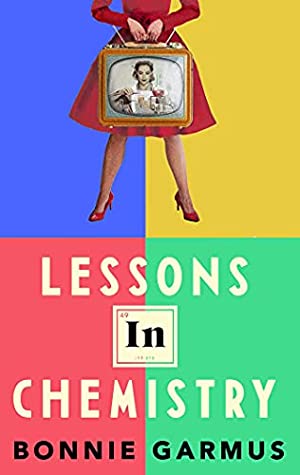
The main question we ask about the books we read for Literary Wives is:
What does this book say about wives or about the experience of being a wife?
Elizabeth is deeply in love with Calvin Evans yet refuses to be his wife. She spurns marriage because she correctly intuits that it will limit her prospects, this being the 1960s. “I’m going to be a scientist. Successful women scientists don’t marry,” she tells her mother. Forasmuch as she assumes her television audience to be traditional housewives, she rejects their situation for herself. A single mother, a minor celebrity, a scientific researcher: none of these roles would be compatible with marriage. (Though there’s another ultimate reason why she stays unmarried.)
A supporting character, her neighbour Harriet, offers a counterpoint or cautionary tale. She’s trapped in a marriage to an odious man she despises. “Because while she was stuck forever being Mrs. Sloane—she was a Catholic—she never wanted to turn into a Mr. Sloane.”
Almost all of the books we read for the club, whether contemporary or historical, present marriage in at least a somewhat negative light, or warn that there are many things that can go wrong…
See Kate’s, Kay’s and Naomi’s reviews, too!
Coming up next, in June: The Constant Wife by W. Somerset Maugham. This is the first play we’ve done and my first Maugham in a while, so I’m looking forward to it.
 Bookish Beck = Rebecca Foster. American transplant to England. Freelance proofreader and book reviewer.
 Bookish Beck
I think I am one of the only people left who hasn’t read this yet!
LikeLiked by 2 people
No, I’m with you there. I hadn’t heard of it until now. 😂
LikeLiked by 2 people
It’s an undemanding holiday read, should you so wish. But I also don’t think you’d be missing out if you chose not to read it.
LikeLiked by 1 person
Add me to this list. It’s occasionally on display at my local library branch, and I do want to watch the series, but there are so many books on the stack. (As if you don’t already know all about THAT. hehehe)
LikeLiked by 2 people
Hi Rebecca
We really liked this book. The protagonist reminded us of Kb’s mother, although she was a physicist.
The Fab Four of Cley
🙂 🙂 🙂 🙂
LikeLiked by 1 person
I’m sure she was a remarkable woman, especially for her times! It’s good to hear that the depiction here resonated for you.
LikeLiked by 1 person
My book group read this one (of course! Whose didn’t!) and I enjoyed it, but did find the total lack of attempt to make it feel accurate to the period (in terms of dialogue, particularly) quite off-putting.
LikeLiked by 1 person
How does your group tend to choose books? It’s still a fraught process for us. We gather ideas over a number of months and then vote on them, usually in two rounds. I’m sure you would have preferred to read a novel that was actually from the 1960s!
LikeLike
Ours is a bit chaotic – when our list is running low, it’s a free-for-all and people can suggest whatever they like, and pretty much everything gets added to the list (as long as it’s available in paperback and ideally under 350pp). We somehow end up with a good range of styles/periods/authors!
LikeLiked by 1 person
We could do with stricter guidelines — people keep suggesting Dickens or the like, but some struggle to read even a 300-page book per month! Availability in paperback is a good thing to keep in mind; one member decided not to take part this month because the novel wasn’t yet in paperback (though there were plenty of copies at the library, just sayin’…).
LikeLike
I didn’t really notice that all our books have shown marriage in a negative light, although some have. Hmm. Now I have to look back. Well, The Sentence didn’t, although it had a disagreement, but I thought the marriage in that book was one of its best relationships. It also didn’t really fit into our club very well, though. And looking way back, Ahab’s Wife didn’t. I frankly can’t remember the plots of many of the books, though.
Of course, the dog was a magical character. The daughter? Not so sure. Maybe a prodigy?
LikeLiked by 1 person
I’m sure it’s not all, Kay, but when I think back through a number of them they do seem negative. Naomi is right, though, that there wouldn’t be a source of conflict unless marriage was indeed challenging! In future it would be interesting to read some nonfiction and/or a novel about a homosexual marriage.
LikeLiked by 1 person
Well, we should look for that kind of thing next time. I have been putting down everything I could turn up, but that was with a search of “marriage” in Amazon. I read a book for one of my other projects that might work for a gay marriage, except it seemed more casual than that. I don’t think either character was that committed. Hmmm. Something to think about.
LikeLike
My search keyword was insufficient.
LikeLike
I created a shelf to remind myself of future possibilities. How to Sleep at Night by Elizabeth Harris and Wife by Charlotte Mendelson are both about same-sex marriages. There’s a few nonfiction books about marriage and/or divorce on there too.
https://www.goodreads.com/review/list/5875398-rebecca?shelf=literary-wives-to-consider
LikeLiked by 1 person
Nice! I have been adding ones I run across directly to the spreadsheet. I have that advantage.
LikeLike
I can’t decide how I feel about this new trend of writing neurodivergent protagonists as a way to create humorous situations. I get why it’s done, because it seems to work, but… what do others think of it?
I guess it makes sense that most of the marriages we read about are dysfunctional in some way – otherwise the conflict in the book has to come from somewhere else. I wonder, too, if it’s a sad reflection of reality.
LikeLiked by 1 person
We also did Strange Sally Diamond in my book club and its protagonist’s childhood trauma resulted in a lack of interpersonal skills that seemed a lot like stereotypes of autism. I think of it as a lazy shortcut to characterization.
That does make sense: there wouldn’t be much to write about it if every marriage was happy. (‘All happy families are alike’?)
LikeLiked by 1 person
Ugh, this is a pet peeve of mine. And it’s hard to express without sounding harsh when so many people really love some of the books built on that. On occasion I’ve been convinced to try another, and I’ve momentarily believed it could be an exception…but, then, nope.
LikeLiked by 1 person
I wonder how you will feel about it in this one…
LikeLike
We read this at our book group ages ago, and I was in the dissenting minority who didn’t like it. I found the characterisation thin, and just stereotypical in the case of the men. The only character I liked was the dog. 2.5 stars from me.
LikeLiked by 1 person
I did think it was quite thin, a feel-good girl-power story, though enjoyable as these things go.
LikeLiked by 1 person
Humph ….
LikeLike
I was so glad to read your review about this book. I have felt like a traitor to STEM women everywhere for thinking it was a good, enjoyable read, but not as amazing as most reviews tend to paint it. It very much felt like it was written in a more modern era with only the use of some 1960’s sensibilities on the part of some characters to create a foil for Elizabeth.
LikeLiked by 1 person
That makes sense to me! I liked it fine but don’t think it will stand the test of time.
LikeLike
I really liked this when I first read it but I wonder if it would stand up to a reread. I do remember really liking the dog (and I generally am not a fan of animals characters in books.) It was a HUGE hit for a long time at the library. It’s funny how some books just catch on and keep going. Right now it’s The Wedding People and The Women that are the very long holds lists books.
LikeLiked by 1 person
I guess it hit that sweet spot between women’s fiction and general fiction. And of course there was an adaptation as well.
LikeLiked by 1 person
I only read Lessons in Chemistry now and just came across your literary wives club. How interesting.
Contrary to other readers, I am not an animal person, so the dog did nothing for me. But the story itself could have been the story of my life. Without the successful tv job.
LikeLike