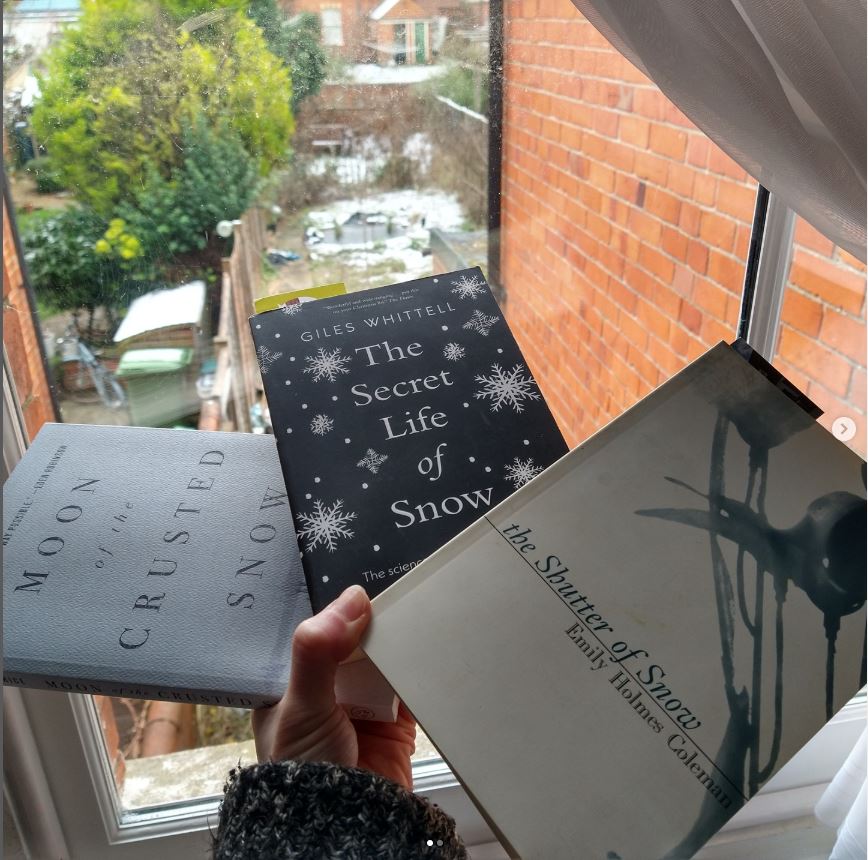
Here I am squeaking in on the day before the spring equinox – when it’s predicted to be warmer than Ibiza here in southern England, as headlines have it – with a few snowy reads that have been on my stack for much of the winter. I started reading this trio when we got a dusting back in January, in case (as proved to be true) it was our only snow of the year. I have an arresting work of autofiction that recreates a period of postpartum psychosis, a mildly dystopian novel by a First Nations Canadian, and a snow-lover’s compendium of science and trivia.
 As it happens, I’ll be starting the spring in the middle of We Do Not Part by Han Kang, which is austerely beautiful and eerily snowy: its narrator traverses a blizzard to rescue her friend’s pet bird; and the friend’s mother recalls a village massacre that left piles of snow-covered corpses. Here Kang muses on the power of snow:
Snow had an unreality to it. Was this because of its pace or its beauty? There was an accompanying clarity to snow as well, especially snow, drifting snow. What was and wasn’t important were made distinct. Certain facts became chillingly apparent. Pain, for one.
The Shutter of Snow by Emily Holmes Coleman (1930)
 Coleman (1899–1974), an expatriate American poet, was part of the Paris literary milieu in the 1920s and then the London scene of the 1930s. (She worked with T.S. Eliot on editing Djuna Barnes’s Nightwood, for instance.) This novella, her only published work of fiction, was based on her experience of giving birth to her son in 1924, suffering from puerperal fever and a mental breakdown, and being incarcerated in Rochester State Hospital. Although the portrait of Marthe Gail is in the omniscient third person, the stream-of-consciousness style – no speech marks or apostrophes, minimal punctuation – recalls unreliable first-person narration. Marthe believes she is Jesus Christ. Her husband Christopher visits occasionally, hoping she’ll soon be well enough to come home to their baby. It’s hard to believe this was written a century ago; I could imagine it being published tomorrow. It is absolutely worth rediscovering. While I admired the weird lyrical prose (“in his heart was growing a stern and ruddy pear … He would make of his heart a stolen marrow bone and clutch snow crystals in the night to his liking”; “This earth is made of tar and every morsel is stuck upon it to wither … there were orange peelings lying in the snow”), the interactions between patients, nurses and doctors got tedious. (Secondhand – Community Furniture Project, Newbury)
Moon of the Crusted Snow by Waubgeshig Rice (2018)
 A mysterious total power outage heralds not just the onset of winter or a temporary crisis but the coming of a new era. For this Anishinaabe community, it will require a return to ancient nomadic, hunter-gatherer ways. I was expecting a sinister dystopian; while there are rumours of a more widespread collapse, the focus is on adaptation versus despair, internal resilience versus external threats. Rice reiterates that Indigenous peoples have often had to rebuild their worlds: “Survival had always been an integral part of their culture. It was their history. The skills they needed to persevere in this northern terrain … were proud knowledge held close through the decades of imposed adversity.” As an elder remarks, apocalypse is nothing new. I was more interested in these ideas than in how they played out in the plot. Evan works snow-ploughs until, with food running short and many falling ill, he assumes the grim task of an undertaker. I was a little disappointed that it’s a white interloper breaks their taboos, but it is interesting how he is compared to the mythical windigo in a dream sequence. As short as this novel is, I found it plodding, especially in the first half. It does pick up from that point (and there is a sequel). I was reminded somewhat of Sherman Alexie. It was probably my first book by an Indigenous Canadian, which was reason enough to read it, though I wonder if I would warm more to his short stories. (Birthday gift from my wish list last year)
The Secret Life of Snow: The science and the stories behind nature’s greatest wonder by Giles Whittell (2018)
 This is so much like The Snow Tourist by Charlie English it was almost uncanny. Whittell, an English journalist who has written history and travel books, is a snow obsessive and hates that, while he may see a few more major snow events in his lifetime, his children probably won’t experience any in their adulthood. Topics in the chatty chapters include historical research into snowflakes, meteorological knowledge then and now and the ongoing challenge of forecasting winter storms, record-breaking snowfalls and the places still most likely to have snow cover, and the depiction of snow in medieval paintings (like English, he zeroes in on Bruegel) and Bond films. There’s a bit too much on skiing for my liking: it keeps popping up in segments on the Olympics, avalanches, and how famous snow spots are reckoning with their uncertain economic future. It’s a fun and accessible book with many an eye-popping statistic, but, coming as it did a decade after English’s, does sound the alarm more shrilly about the future of snow. As in, we’ll get maybe 15 more years (until 2040), before overall warming means it will only fall as rain. “That idea, like death, is hard to think about without losing your bearings, which is why, aware of my cowardice and moral abdication, I prefer to think of the snowy present and recent past rather than of the uncertain future.” (Secondhand – Community Furniture Project, Newbury)
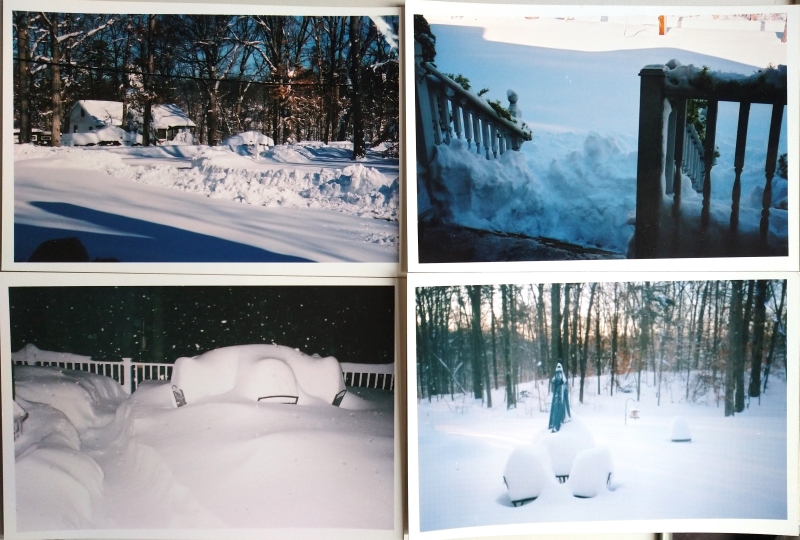
Whittell’s mention of the U.S. East Coast “Snowmaggedon” of February 2010 had me digging out photos my mother sent me of the aftermath at our family home of the time.
Any wintry reading (or weather) for you lately? Or is it looking like spring?
 Bookish Beck = Rebecca Foster. American transplant to England. Freelance proofreader and book reviewer.
 Bookish Beck
Well with titles like Birding, Nesting and Amma, I think my current reading is pretty springlike at the moment.
LikeLiked by 1 person
Indeed! I can tell you’re following the Women’s Prize this year. Birding has appealed to me ever since I saw that kitschy cover, but I haven’t figured out how to access it yet.
LikeLiked by 1 person
I’m reading the ebook version, the cover is great and the town/locations descriptions vivid and feel seventies-like to me, as if suspended in time.
LikeLike
Too bad, Rice’s book sounded promising.
This is the usual yoyo weather season in Northen Illinois: 75 one day, 40 the next, with of course thunderstorms in between
LikeLiked by 1 person
There are lots of Canadian fans of the Rice and I wouldn’t want to put anyone off, but it didn’t capture me.
That sounds like a typical Maryland winter to me. (Where I grew up.) One of my closest friends bought a faux-fur cape for her January 6th wedding … and it ended up being nearly 70 degrees instead.
LikeLiked by 1 person
Moon of the Crusted Snow seemed promising, but not if it is plodding. I thought the same about The Shutter of Snow, that it seemed to apply to now. It reminded me of The Yellow Wallpaper.
LikeLiked by 1 person
The good news about the Rice is that it is only 210 pages; if you read it devotedly (whereas I put it down for ages or only read tiny bits at a time), you might be able to sustain some momentum.
Yes, that’s a good comparison for the Coleman. I’m not sure I’ve ever actually read The Yellow Wallpaper but I know the premise.
LikeLiked by 1 person
It’s a good one, and a short story, at that. I realized later I should have put it in quotes instead of italics.
LikeLike
The Rice has been on my radar for a long time, but I might give it a miss on the basis of your report. Jesus—only fifteen more years of snow? Is that everywhere, or just in non-Arctic/far Northern regions?
LikeLiked by 2 people
The Rice is thoroughly readable but not unmissable imo.
Whittell made it sound more general, but I guess he’s mostly talking about the UK. There will no doubt be outliers and little pockets all over that still get some snow, but we will probably have a vanishingly small chance of seeing it in southern England in the future.
LikeLike
That sounds about right. God.
LikeLike
Moon of the Crusted Snow definitely had pacing problems (and so does the sequel) but I appreciated the sort of no-nonsense approach to apocalypse – rather than focus on figuring out “what happened” it’s just time to survive.
The no snow after 2040 thing freaked me out, so I googled it – looks like that applies to the UK and/or the “mountain west” region in the states. Probably not here. Plenty of snow on the ground for the first day of spring, which is normal. Does it freak you out? Did you really only get one dusting of snow this year and is that normal?
LikeLiked by 1 person
Yes, it was refreshing that he didn’t feel the need to create an elaborate backstory for what went wrong down south.
I’m now used to getting no snow or just one very small covering per winter here in the south of England. The only ‘big’ snow (maybe a foot) I experienced here was in 2009. I really miss the snows of my childhood.
LikeLike
Ah, I love snow, and that fact about English snow makes me so sad. We had frost here yesterday though, so hopefully it will linger a bit longer up north (though we almost never get any snow where I live even now because we’re too near to the coast). The “Snowmaggedon” photos are fantastic. My dad has similar from his home in Nenthead, the highest village in England. I loved the Han Kang, so look forward to hearing your fuller thoughts.
LikeLiked by 1 person
I really miss getting proper snow! In years to come we may have to go on quests to find it in the UK or further afield. I’d not heard of Nenthead; that’s a good record to hold.
LikeLiked by 1 person
The Giles Whittel is the one I’d go for here. Though I’m not in the mood for snow just now.
LikeLiked by 1 person
It sure feels like spring (or summer) today!
LikeLiked by 1 person
😊
LikeLike
I’ve not heard of any of these books! I’m in the States and where I’m at, it’s much colder today. We’ve had a stretch of really nice warmer weather, but today it’s in the low 40s fahrenheit. So much for spring weather for the spring equinox! LOL
LikeLiked by 1 person
We’re at a balmy 65 degrees today with beautiful blue skies and sunshine. It’s a welcome change and made up for the day’s sad task of burying our cat’s ashes in the backyard.
LikeLike
I’m so sorry for your loss. 😦 *hugs*
LikeLiked by 1 person
Love that the Han Kang story so perfectly meshed with your other seasonal selections! I didn’t think of Moon of the Crusted Snow as a dystopian novel; I read it expecting a lot of reflection on what community means and how people work together (and don’t). So I wasn’t surprised that it had a very slow start (and, in contrast, ends almost urgently), but I can see how, if one was expecting a dystopian story, it wouldn’t fit the bill (and the marketing has leaned that way, it seems). My review was here, if you’re curious, but I bet Naomi’s enthusiasm inspired your choice. Just recently I snapped a photo of the gridline of electrical towers that the guys follow to return up north from Toronto; I loved coming across them on a backroad unexpectedly. (The towers, not the characters! lol) FWIW, I don’t think it’s so much that we are meant to view that single character as the villainous interloper, as sometimes happens in other stories (hello, R.F. Kuang’s Babel!), but that he is a deliberate representative of a dominant culture that has been supporting/feeding the windigo for a long, long time, just one of many ruled by greed and avarice, who have turned their backs on reciprocity and cooperation. You might like Richard van Camp’s linked short stories set in the north-far from here, but it might not seem that way viewed from England-and he has a fabulous and very succinct windigo story.
LikeLiked by 1 person
Very apt! I am stolidly un-apt, as ever, though I did read “Stories for Mothers and Daughters” and “A Mother’s Recompense” around Mother’s Day, didn’t I!
LikeLiked by 1 person
The Rice novel is on my TBR. The library system only has a couple of copies and they always seem to be checked out, which is why I haven’t yet gotten to it. Well, one reason.
LikeLiked by 1 person
It seems to have a cult following! I’ll hope you enjoy it more than I did.
LikeLiked by 1 person
[…] was an enduringly relevant and absorbing read, a classic to sit alongside Emily Holmes Coleman’s The Shutter of Snow and Janet Frame’s Faces in the […]
LikeLike