With all the roses in full bloom and the swifts back and nesting in the corner of our eaves, it’s been feeling more like summer than high spring as we approach the end of May. I didn’t amass many spring-themed books this year, but managed to piece together the below trio of library books. They feel quite England- (and Scotland-) specific; I wonder how well these authors are known outside the UK. All: 
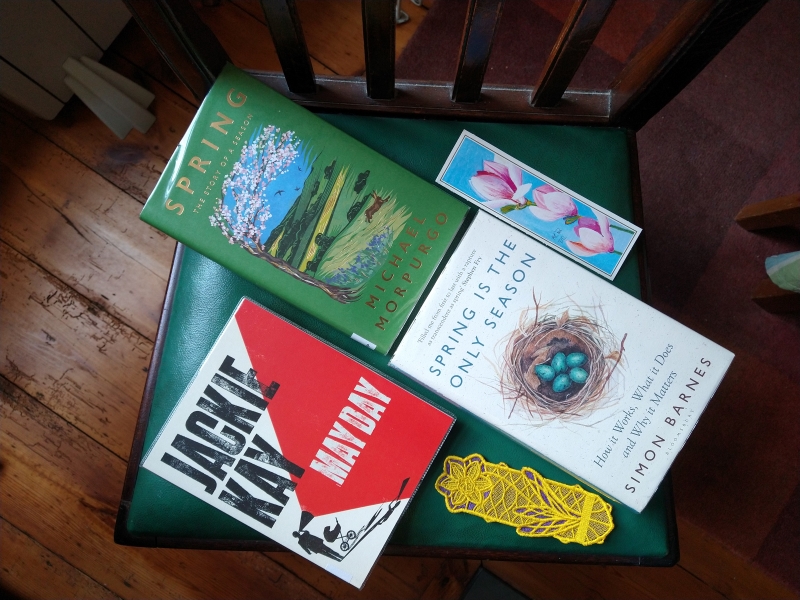
May Day by Jackie Kay (2024)
 May Day is a traditional celebration for the first day of May, but it’s also a distress signal – as the megaphone and stark font on the cover reflect. Aptly, there are joyful verses as well as calls to arms here. Kay devotes poems to several of her role models, such as Harry Belafonte, Paul Robeson, Peggy Seeger and Nina Simone. But the real heroes of the book are her late parents, who were very politically active, standing up for workers’ rights and socialist values. Kay followed in their footsteps as a staunch attendee of protests. Her mother’s death during the Covid pandemic looms large. There is a touching triptych set on Mother’s Day in three consecutive years; even though her mum is gone for the last two, Kay still talks to her. Certain birds and songs will always remind her of her mum, and “Grief as Protest” links past and future. The bereavement theme resonated with me, but much of the rest made no mark (especially not the poems in dialect) and I don’t find much to admire poetically. I love Kay’s memoir, Red Dust Road, which has been among our most popular book club reads so far, but I’ve not particularly warmed to her poetry despite having read four collections now.
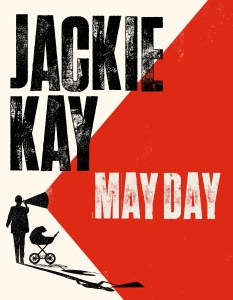
Spring: The Story of a Season by Michael Morpurgo (2025)
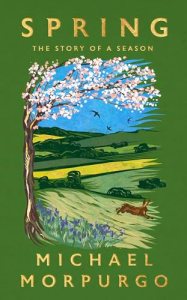 I’d not read Morpurgo before. He’s known primarily as a children’s author; if you’ve heard of one of his works, it will likely be War Horse, which became a play and then a film. This is a small hardback, scarcely 150 pages and with not many words to a page, plus woodcut illustrations interspersed. As revered English nature authors such as John Lewis-Stempel and Richard Mabey have also done, he depicts a typical season through a diary of several months of life on his land. For nearly 50 years, his Devon farm has hosted the Farms for City Children charity he founded. He believes urban living cuts people off from the rhythm of the seasons and from nature generally; “For so many reasons, for our wellbeing, for the planet, we need to revive that connection.” Now in his eighties, he lives with his wife in a small cottage and leaves much of the day-to-day work like lambing to others. But he still loves observing farm tasks and spotting wildlife (notably, an otter and a kingfisher) on his walks. This is a pleasant but inconsequential book. I most appreciated how it captures the feeling of seasonal anticipation – wondering when the weather will turn, when that first swallow will return.
And a skim:
Spring Is the Only Season: How It Works, What It Does, and Why It Matters by Simon Barnes (2025)
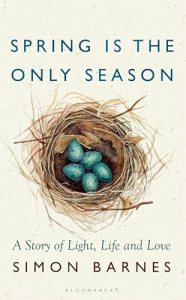 This 400+-page tome has an impressive scope. Like Mark Cocker does in One Midsummer’s Day, Barnes retreats all the way back to the Big Bang and then slowly zooms in, via the evolution of plants and the phenology of birds and insects. He also covers every possible topic you could think of relating to spring: religious festivals, mythology, literature, art, farming, and so on. Had I never read another book on spring, perhaps I would find this compendium satisfying, but it is rather meandering and too many of its points of reference are familiar. Moreover, the overall project is too similar to Tim Dee’s extraordinary Greenery. Alas, Barnes isn’t half the writer Dee is, so this ends up being a rather workmanlike survey. I most enjoyed the chapter-ending “Signs of Spring” lists from his Norfolk home. These more than illustrate how seasonality has gone awry due to climate change; a whole chapter wasn’t necessary to spell it out.
 Bookish Beck = Rebecca Foster. American transplant to England. Freelance proofreader and book reviewer.

Sounds like none of these quite hit the mark. I did love Morpurgo as a child (my favourites were Kensuke’s Kingdom and Private Peaceful) but this one clearly isn’t designed to be very substantial.
LikeLiked by 2 people
Oh, SAME! Kensuke’s Kingdom is absolutely enchanting. I also enjoyed King of the Cloud Forests. I do think Morpurgo is a natural children’s writer, so I’m not surprised that he’s less successful at writing for adults.
LikeLiked by 1 person
He wasn’t part of my childhood reading at all — though you grew up in the USA, do you think you were introduced to him because of your English mum? The selection of his books in the children’s section of my library is vast!
LikeLike
It was my English grandparents, aunts and uncles who gave me his books for Christmases and birthdays! (They were also the reason why I was a Harry Potter early adopter – my aunt and uncle gave me the first two books when I was six. They were available in the US but at that point still kind of a secret known only by a select few.)
LikeLiked by 1 person
You were a trendsetter even then 😉
LikeLike
I bought a lovely anniversay edition of War Horse to read aloud to the (step) kids, but I cried too much while I was reading it to myself, so they never heard it after all. heh It’s a beautiful story, best read in a single sitting. I can’t remember where I had heard of him, so that the anniversary edition stood out to me in the bookshop…maybe the 1001 Children’s Books included him? But all three of these appeal to me. My spring reading has been all over the place, but all fiction and short stories I think. Really must get my post finished too, as you mentioned in another comment, the beginning of June feels summery, reducing the inclination to “talk spring”.
LikeLiked by 1 person
Your blog, your rules; you can write about spring whenever you want! I imagine it will feel spring-like for longer there than it does here. I’ll be keen to hear about what seasonal fiction you’ve been reading.
I failed to read a “May” Sarton this month, but thought I might try to get to one for the 30th anniversary of her death in July.
LikeLike
If I wait just a few more months, it would be spring on the other side of the world! It really does feel like the most extended spring ever here. All the flowering trees are very very flowery indeed.
I’ve been reading one of her journals at night, one of the later ones (pulled at random from a nearby shelf, not deliberately). What a lovely idea to read one for that lossiversary. Hmmmm.
LikeLike
I’ve tried Kay’s poetry too and not been overly impressed. Her memoir could be interesting though.
LikeLiked by 1 person
The memoir is really beautiful, it’s about her growing up with an adoptive Scottish couple and going back to Nigeria to meet her father.
LikeLiked by 1 person
It’s a shame the Simon Barnes is a bit … messy? as I have loved the books I’ve read by him before. Good attempt at Spring, though: I have nothing!
LikeLiked by 1 person
I’ve never actually read him before, though I think my husband has (the Bad Birdwatcher/Botanist ones). I remember his Times columns often seemed quite repetitive. At least once per article we’d expect to see him describe something as “rum”!
LikeLiked by 1 person
That’s definitely seasonal readig!
Greenery does sound fascinating! Thanks
LikeLiked by 1 person
[…] didn’t realize that Michael Morpurgo’s Spring was the launch of a series of short nonfiction books on the seasons. McDermid writes a book a year, […]
LikeLike