As far as I know, this is the first play we’ve chosen for the club. While I’m a Maugham fan, I haven’t read him in a while and I’ve never explored his work for the theatre. The Constant Wife is a straightforward three-act play with one setting: a large parlour in the Middletons’ home in Harley Street, London. A true drawing room comedy, then, with very simple staging.
{SPOILERS IN THE REMAINDER}
Rumours are circulating that surgeon John Middleton has been having an affair with his wife Constance’s best friend, Marie-Louise. It’s news to Mrs. Culver and Martha, Constance’s mother and sister – but not to Constance herself. Mrs. Culver, the traditional voice of a previous generation, opines that men are wont to stray and so long as the wife doesn’t find out, what harm can it do? Women, on the other hand, are “naturally faithful creatures and we’re faithful because we have no particular inclination to be anything else,” she says.
Other characters enter in twos and threes for gossip and repartee and the occasional confrontation. Marie-Louise’s husband, Mortimer Durham, shows up fuming because he’s found John’s cigarette-case under her pillow and assumes it can only mean one thing. Constance is in the odd position of defending her husband’s and best friend’s honour, even though she knows full well that they’re guilty. With her white lies, she does them the kindness of keeping their indiscretion quiet – and gives herself the moral upper hand.
Constance is matter of fact about the fading of romance. She is grateful to have had a blissful first five years of marriage; how convenient that both she and John then fell out of love with each other at the same time. The decade since has been about practicalities. Thanks to John, she has a home, respectability, and fine belongings (also a child, only mentioned in passing); why give all that up? She’s still fond of John, anyway, and his infidelity has only bruised her vanity. However, she wants more from life, and a sheepish John is inclined to give her whatever she asks. So she agrees to join an acquaintance’s interior decorating business.
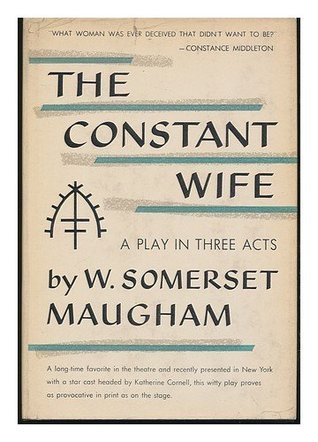
The early reappearance of her old flame Bernard Kersal, who is clearly still smitten with her, seeds her even more daring decision in the final act, set one year after the main events. Having earned £1400 of her own money, she has more than enough to cover a six-week holiday in Italy. She announces to John that she’s deposited the remainder in his account “for my year’s keep,” and slyly adds that she’ll be travelling with Bernard. This part turns out to be a bluff, but it’s her way of testing their new balance of power. “I’m not dependent on John. I’m economically independent, and therefore I claim my sexual independence,” she declares in her mother’s company.
There are some very funny moments in the play, such as when Constance tells her mother she’ll place a handkerchief on the piano as a secret sign during a conversation. Her mother then forgets what it signifies and Constance ends up pulling three hankies in a row from her handbag. I had to laugh at Mrs. Culver’s test for knowing whether you’re in love with someone: “Could you use his toothbrush?” It’s also amusing that Constance ends up being the one to break up with John for Marie-Louise, and with Marie-Louise for John.
However, there are also hidden depths of feeling meant to be brought out by the actors. At least three times in scenes between John and Constance, I noted the stage direction “Breaking down” in parentheses. The audience, therefore, is sometimes privy to the emotion that these characters can’t express to each other because of their sardonic wit and stiff upper lips.
I hardly ever experience plays, so this was interesting for a change. At only 70-some pages, it’s a quick read even if a bit old-fashioned or tedious in places. It does seem ahead of its time in questioning just what being true to a spouse might mean. A clever and iconoclastic comedy of manners, it’s a pleasant waystation between Oscar Wilde and Alan Ayckbourn.
(Free download from Internet Archive – is this legit or a copyright scam??) 
The main question we ask about the books we read for Literary Wives is:
What does this book say about wives or about the experience of being a wife?
Answered by means of quotes from Constance.
- Partnership is important, yes, but so is independence. (Money matters often crop up in the books we read for the club.)
“there is only one freedom that is really important, and that is economic freedom”
- Marriage often outlasts the initial spark of lust, and can survive one or both partners’ sexual peccadilloes. (Maugham, of course, was a closeted homosexual married to a woman.)
“I am tired of being the modern wife.” When her mother asks for clarification, she adds rather bluntly, “A prostitute who doesn’t deliver the goods.”
“I may be unfaithful, but I am constant. I always think that’s my most endearing quality.”
We have a new member joining us this month: Becky, from Australia, who blogs at Aidanvale. Welcome! Here’s the group’s page on Kay’s website.
See Becky’s, Kate’s, Kay’s and Naomi’s reviews, too!
Coming up next, in September: Novel about My Wife by Emily Perkins
 Bookish Beck = Rebecca Foster. American transplant to England. Freelance proofreader and book reviewer.
 Bookish Beck
What did you think of the notion of marriage being transactional? Isn’t that what Constance is basically boiling it down to once the love has gone?
LikeLiked by 1 person
A lot of the books we’ve discussed for the club talk about roles and finances in a transactional way. I guess Maugham plays with that idea. Constance could be considered calculating, but in John’s final estimation she’s also lovable.
LikeLiked by 1 person
Yes, but he still thinks he owns her.
LikeLike
I think this sounds like a provocative (in a good way) choice for your group (albeit unusual, as a drama)!
It might be helpful to think of the Internet Archive as the book side (indexing print) of the Wayback Machine (indexing web content). Well, I guess that’s only helpful if you know about/use The Wayback Machine. Anyway, the IA isn’t a sc*m and I suspect that some of the negative chatter about it resides with the fact that they create a historic record (including public government documents) in an era where not everyone wants there to be a record. AFAIK most of the materials are uploaded by librarians…I love seeing all the different collections when I “borrow” a book (I can’t download what I use, only sign it out by the hour with a login, but Maugham is in the public doman, I think?). It’s one of the places I try to donate to, because I often use it for work. (But I also have a long list of saved items there, which would be only for fun, too. All O/P stuff.)
LikeLiked by 1 person
Whew, I’m glad the Internet Archive isn’t something to avoid. I worried that it was a cheeky way of getting free e-books. This copy appeared to have been scanned from a library in Delhi. Would it not technically be in the public domain until 2027?
LikeLike
Delhi?! Amazing. I think I will track to see which libraries I notice while making use of their collection;! I used to think that I understood how public domain worked, but I think there are more variations (or, exceptions?) than I previously understood. But I don’t think I’ve ever seen something on IA that was downloadable that wasn’t classed as in the public domain.
LikeLike
I loved how funny this was – and also surprising, especially for its time. I wonder what sparked the idea for this play? I haven’t read any of his other work – did he often write about society’s flaws?
LikeLiked by 1 person
Oh, Maugham is great, you must try him! He often writes about marriage and social mores. The Painted Veil would be a good one to try first.
LikeLiked by 1 person
Very good review! I have never read Maugham
LikeLiked by 1 person
Thanks! I would recommend him. He’s very readable, and I say that as someone who’s fairly allergic to classics…
LikeLiked by 1 person
Ha! I’ve given up on Dickens. I’ll see if there’s a nice short Maughm to start with.
LikeLiked by 1 person
I, too, have admitted defeat with Dickens. I last tried reading him about 12 years ago.
As for Maugham, Up at the Villa is only about 100 pages and very good. The Painted Veil and The Moon and Sixpence are also pretty short.
LikeLike
IA is legit! I use it for academic stuff all the time. An absolute godsend given that nowhere else was going to be able to provide me with scans of half a dozen obscure 1790s-published novels immediately and for free.
LikeLiked by 1 person
Glad to hear it. I wish I’d known about it during my MA days! (At Leeds I once had a very obscure Victorian novel brought over from Australia on microfilm as an ILL.)
LikeLike
I loved the title and play on her name 🙂 In fact, I loved all of this play – I thought it was really funny and could absolutely imagine how it would be acted and staged as I was reading.
LikeLiked by 1 person
I agree it was very humorous and would still entertain audiences today.
LikeLike
Id forgotten that line about the toothbrush, hilarious and probably a great test of love. One thing I didn’t really reflect on was Constance response to her husbands affair in light of the fact that it was with her best friend. Her response makes more sense if it were a stranger. For it to be with a close friend like that I feel I would expect more anger, even if it was toward her friend moreso than the husband from whom she’s obviously emotionally estranged.
LikeLiked by 1 person
Few of us would be so philosophical after such a personal betrayal! But I guess without extremes of opinion or circumstance there wouldn’t be much of a plot for an author to explore. I hope you enjoyed your first read with the club 🙂
LikeLiked by 1 person
I did, it’s been ages since I had a more full exchange with someone about a book
LikeLiked by 1 person