I spotted that the 30th anniversary of May Sarton’s death was coming up, so decided to read an unread book of hers from my shelves in time to mark the occasion. Today’s the day: she died on July 16, 1995 in York, Maine. Marcie of Buried in Print joined me for a buddy read (her review). I was drawn by the title, which comes from an Emily Dickinson quote. It’s the ninth Sarton novel I’ve read and, while in general I find her nonfiction more memorable than her fiction, this impressionistic debut novel was a solid read. It was clearly inspired by Virginia Woolf’s work and based on Sarton’s memories of her time on the fringes of the Bloomsbury Group.
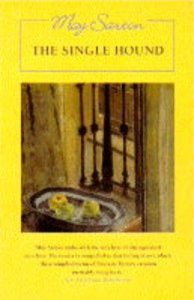 In Part I we are introduced to “the Little Owls,” three dear friends and winsome spinsters in their sixties – Doro, Annette and Claire – who teach and live above their schoolroom in Ghent, Belgium. (I couldn’t help but think of the Brontë sisters’ time in Belgium.) Doro, a poet, seems likely to be a stand-in for the author. I loved the gentle pace of this section; although the novel was published when she was only 26, Sarton was already displaying insight into friendship and ageing and appreciation of life’s small pleasures, elements that would recur in her later autobiographical work.
the three together made a complete world.
Was this life? This slow penetration of experience until nothing had been left untasted, unexplored, unused — until the whole of one’s life became a fabric, a tapestry with a pattern? She could not see the pattern yet.
tea was opium to them both, the time when the past became a soft pleasant country of the imagination, lost its bitterness, ceased to devour, and in some tea-inspired way nourished them.
Part II felt to me like a strange swerve into the story of Mark Taylor, an aspiring English writer who falls in love with a married painter named Georgia Manning. Their flirtation, as soon through the eyes of a young romantic like Mark, is monolithic, earth-shattering, but to readers is more of a clichéd subplot. In the meantime, Mark sticks to his vow of going on a pilgrimage to Belgium to meet Jean Latour, the poet whose work first inspired him. Part III brings the two strands together in an unexpected way, as Mark gains clarity about his hero and his potential future with Georgia, though cleverer readers than I may have been able to predict it – especially if they heeded the Brontë connection.
It was rewarding to spot the seeds of future Sarton themes here, such as discovering the vocation of teaching (The Small Room) and young people meeting their elder role models and soliciting words of wisdom on how to live (Mrs. Stevens Hears the Mermaids Singing). Through Doro, Sarton also expresses trust in poetry’s serendipitous power. “This is why one is a poet, so that some day, sooner or later, one can say the right thing to the right person at the right time.” I enjoyed my time with the Little Owls but mostly viewed this as a dress rehearsal for later, more mature work. (Secondhand – Awesomebooks.com) 
 Bookish Beck = Rebecca Foster. American transplant to England. Freelance proofreader and book reviewer.
 Bookish Beck
I do like the sound of this. Like you, I have preferred her non-fic, though I did really appreciate The Small Room. I hadn’t heard of this one, so glad to know more.
LikeLiked by 1 person
oh, and I remember that the heroine of The Small Room is called Lucy Winter, so Sarton definitely had Villette on the brain!
LikeLiked by 1 person
Yes, I saw that I noted that name in my review of The Small Room — no way could it be coincidental! I know you’re an admirer of Woolf, so you might like this for the unofficial homage.
LikeLike
[…] Last year, I plucked her reflections At Eighty-Two from my own collection in an evening when I’d misplaced the book I’d planned to read, and I enjoyed it so much that I’d resolved to reread her deliberately this year; when Rebecca (Bookish Beck) mentioned she was reading The Single Hound for July 16th to mark Sarton’s passing, I thought I would reread the first of Sarton’s non-fiction but, then, I couldn’t resist Rebecca’s selected novel (which she’s posted about today as well). […]
LikeLike
Funny, but I didn’t think about the Bronte connection until after I’d finished reading; at the time, I was just overwhelmed by the Little-Owls-ness of it all. LIke you, I felt like we were intended to see (at least some of) May Sarton in Doro but I also wondered whether we were intended to see her even more in Mark (because she came of age in that time when it was so much more common for men to determine from an early age that they would be prominent cultural figures…the prejudicial ideas that you describe at length in your review of MSHtMS). I didn’t expect the resolution either, and I didn’t end up writing about the way she inhabits the inner thoughts of Mark and Georgia (in parentheses) during some of their scenes, but I thought that was interesting (for 1938). I had hoped that maybe I’d find more of an emotional connection to this novel because it was her first, but all the reasons I prefer her non-fiction remain intact for me: I liked it well enough.
LikeLiked by 1 person
Thanks for joining me! I came to the same ultimate conclusion, but at least we both found it interesting for its literary pedigree and the foretaste of her themes. You’re right, the third-person narration with glimpses into characters’ inner thoughts felt ahead of its time.
LikeLike
Of Sarton’s books, I’ve only read The Magnificent Spinster, which I wasn’t that impressed with. I think it’s one of her later books, published in 1985. I should try one of her earlier ones, I guess.
LikeLiked by 1 person
That’s one of her better known ones but I haven’t actually read it yet! This was quite similar to Virginia Woolf so would definitely make an interesting counterpoint to her later stuff.
LikeLiked by 1 person
That’s interesting.
LikeLike
Interesting to read your two reviews together – they even appeared next to each other in my blog reader! I have of course seen her books but never picked one up, yet superficially they feel like they would appeal to me.
LikeLiked by 1 person
She feels a bit dated these days in her attitudes towards feminism and her own lesbianism, but there are some definite gems in her oeuvre. I prefer her journals to the novels I’ve tried thus far.
LikeLike