Simon and Kaggsy’s classics reading weeks always get me picking up older books. I found this unusual Russian novella on a giveaway pile a few years ago and it’s been on my #NovNov possibility shelf ever since, but now turned out to be the perfect time for it. This review also fits into the Hundred Years Hence challenge.

Sharik is an abused stray dog, living on scraps on the snowy streets of Moscow until Professor Philip Philipovich Preobrazhensky takes him in. The professor is a surgeon renowned for his rejuvenation procedures – implanting monkey ovaries into a middle-aged lady, for instance – and he has designs on the mutt. His new strategy is to take the pituitary gland and testicles of a just-deceased young man and transplant them into Sharik. The central chapter is composed of medical notes taken by Preobrazhensky’s assistant, Dr. Bormenthal. Gradually, a transformation is achieved: The dog’s bark becomes more of a human groan and his fur and tail fall off. Soon the new man is fully convincing: eating, dressing and conversing. Even in a matter-of-fact style, the doctor’s clinical observations are hilarious. “The dog[,] in the presence of Zina and myself, had called Prof. Preobrazhensky a ‘bloody bastard’. … Heard to ask for ‘another one, and make it a double.’” The scientists belatedly look into the history of the man whose glands they harvested and discover to their horror that he was an alcoholic petty thief who died in a bar fight. Sharikov follows suit as an inebriated boor who pesters women, wants to be known as Poligraph Poligraphovich – and still chases cats. Is it too late to reverse a Frankenstein-esque trial gone wrong?
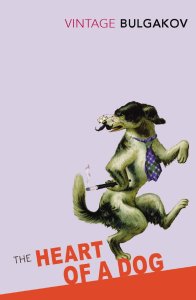 This was a fairly entertaining fable-like story, with whimsical fragments of narration from Sharik himself at the start and close. The blurb inside the jacket of my 1968 Harvill Press hardback suggests “The Heart of a Dog can be enjoyed solely as a comic story of splendid absurdity; it can also be read as a fierce parable about the Russian Revolution.” The allegorical meaning could easily have passed me by, being less overt than in Animal Farm. Reading a tiny bit of external information, I see that this has been interpreted as a satire on the nouveau riche during the Bolshevik era: Sharikov complains about how wealthy the professor is and proposes that he sacrifice some of his apartment-cum-office’s many rooms to others who have nowhere to live. But yes, I mostly stayed at the surface level and found an amusing mad-scientist cautionary tale. I’ll read more by Bulgakov – I’ve had a copy of The Master and Margarita for ages. Next year’s Reading the Meow week might be my excuse.
[Translated from Russian by Michael Glenny, 1968]
(Free from a neighbour, formerly part of Scarborough Public Library stock) 
I also intended to read An American Tragedy by Theodore Dreiser from the university library, having a dim memory of a black-and-white film version starring Montgomery Clift (A Place in the Sun). But the catalogue’s promised 400-some pages was a lie; there are two volumes in one, totaling 840 pages. So that was a nonstarter.
But here are some other famous 1925 titles that I’ve read (I’m now at 7 out of the top 15 on the Goodreads list of the most popular books published in 1925):
The Great Gatsby by F. Scott Fitzgerald
The Trial by Franz Kafka
The Painted Veil by W. Somerset Maugham
Emily Climbs by L.M. Montgomery
Carry On, Jeeves by P.G. Wodehouse
Mrs. Dalloway by Virginia Woolf
I’ve previously participated in the 1920 Club, 1956 Club, 1936 Club, 1976 Club, 1954 Club, 1929 Club, 1940 Club, 1937 Club, 1970 Club, and 1952 Club.
 Bookish Beck = Rebecca Foster. American transplant to England. Freelance proofreader and book reviewer.
 Bookish Beck
I do love the sound of this. I tried to read a different Bulgakov novel (The White Guard) for 1925 Club and came totally unstuck, so abandoned the attempt for now, but Sharik sounds very entertaining – not unlike the anthropomorphic cat Behemoth in The Master and Margarita!
LikeLiked by 1 person
Lots of his novels seem to have been published in the same year; I’m not sure why. And then they took decades to appear in English translation.
I will have to meet this cat!
LikeLike
In the case of The White Guard, at least, he started serialising it in 1925 but had to stop – it wasn’t published in full in Russian til the 60s. The Heart of a Dog and The Fatal Eggs both seem to be novellas, so maybe he was producing a lot of short work at a fast clip, or maybe they were also serialised over a period of time and 1925 just happened to be when all of them started their publication runs? It does seem like a prolific year for Bulgakov.
You’ll enjoy Behemoth!
LikeLiked by 1 person
The Heart of a Dog novella would not be of interest to me, but some of the old books on Google Books are fascinating. How authors structured their stories, what they were seeing in their environment as their protagonists lived through a story – these are the things I enjoy. The story is secondary to me, oddly. The language is often convoluted but sometimes a beautiful turn of phrase will stop me for a while.
LikeLiked by 1 person
Even at a century old this still felt pretty fresh to me. I can struggle with older classics if they’re long-winded or use archaic vocabulary and sentence structures. I’m grateful for services such as Project Gutenberg that provide free e-books.
LikeLike
Sounds like there is a nature/nurture element to the story as well with the dog inheriting the characteristics of the donor?
LikeLiked by 1 person
For sure. That belatedly reminds me of the heart transplant narrative in Jill Dawson’s The Tell-Tale Heart.
LikeLiked by 1 person
It’s a fun tale, isn’t it, yet with underlying depth I think. Not only regarding the Revolution, but also about how we treat animals and also our fellow humans. Thanks for taking part!
LikeLiked by 1 person
Sharik is a great character, more so than Sharikov. But we always knew dogs (and cats) are better than humans 😉
I’m remembering that Ned Beauman also got comic mileage out of the vogue for transplanting monkey glands in The Teleportation Accident.
LikeLiked by 1 person
This sounds like a fun read. I read An American Tragedy pre-blog and really loved it, but it is a huge book.
LikeLiked by 1 person
I didn’t have the time or fortitude to tackle something so long. But I’ll hope to make at least one contribution to Doorstopper December!
LikeLiked by 1 person
I own Master and Margarita and need to read it too!
LikeLiked by 2 people
I’m planning ahead for June!
LikeLiked by 1 person
Maybe I will join you!
LikeLiked by 1 person
[…] Foster @ Bookish Beck enjoyed the ‘Frankenstein-esque’ The Heart of a Dog by Mikhail […]
LikeLike
This seems an entertaining yet reflective book. Thanks for participating in #HYH25. I have linked up your post.
LikeLiked by 1 person
That’s a good way to summarize it. Thanks for hosting this interesting challenge! I don’t often read classics but I always find them rewarding.
LikeLike
840 pages! No thanks! The Loneliness of Sunny and Sonia was enough for me at 688! Well done, I bet you’re the only person who dug this one out of the archives!
LikeLiked by 1 person
I have a shorter Desai on the shelf to try sometime (The Inheritance of Loss).
Bulgakov seems pretty popular in general — there’s something to be said for short, readable classics!
LikeLike
Great review!
I enjoyed this one a lot: https://wordsandpeace.com/2022/11/28/novellas-in-november-2022-recap/
but The Master and Margarita is on much higher grounds. be sure to get an idea with a lt of notes, to explain all the coded language in that one.
LikeLiked by 2 people
Bulgakov is a great choice for NovNov. I’ll be looking forward to The Master and Margarita!
LikeLiked by 2 people
Ah, I see we were thinking along similar lines – I just reviewed the same book for the 1925 Club and Hundred Years Hence challenge. I enjoyed reading your thoughts on it. You’re right, the humour really does come through even in a the medium of medical notes, so that’s quite an achievement.
LikeLiked by 1 person
That’s great — I would have been surprised if I was the only one to review this book across the whole challenge! It’s reassuring that humour can translate across languages, and a century.
LikeLike
I enjoyed Andrew’s take on this one too. Not an author I know very well at all, but a longtime resident of the ‘Hopefully Someday” TBR.
LikeLiked by 1 person
Bulgakov was the same for me until now. This has given me confidence to attempt The Master and Margarita, which is significantly longer, next year (probably for Reading the Meow — Behemoth was named Penguin’s #1 cat in literature! https://www.penguin.co.uk/discover/articles/top-ten-best-cats-in-fiction-literature).
LikeLike
[…] I’ve previously participated in the 1920 Club, 1956 Club, 1936 Club, 1976 Club, 1954 Club, 1929 Club, 1940 Club, 1937 Club, 1970 Club, 1952 Club and 1925 Club. […]
LikeLike