It’s my eighth time participating in the annual Margaret Atwood Reading Month (#MARM) hosted by indomitable Canadian blogger Marcie of Buried in Print. In previous years, I’ve read Surfacing and The Edible Woman, The Robber Bride and Moral Disorder, Wilderness Tips, The Door, Bodily Harm and Stone Mattress, and Life Before Man and Interlunar; and reread The Blind Assassin. Novembers are my excuse to catch up on the soon-to-be-86-year-old’s extensive back catalogue. While awaiting a library hold of her memoir, Book of Lives, I’ve also been rereading the 1983 short story collection Bluebeard’s Egg.

Celebrating its 20th anniversary this year is The Penelopiad, Atwood’s contribution to Canongate’s The Myths series, from which I’ve also read the books by Karen Armstrong, A.S. Byatt, Ali Smith and Jeanette Winterson. I remember Armstrong’s basic point being that a myth is not a falsehood, as in common parlance, but a story that is always true even if not literally factual. Think of it as ‘these things happen’ rather than this happened. Greek mythology is every bit as brutal as the Hebrew Bible, and I find it instructive to interpret biblical stories the same way: Focus on timelessness and universality rather than on historicity.
I do the scheduling for my book club, so I cheekily set The Penelopiad as our November book so that it would count towards two blog challenges. Although it’s a feminist retelling of Homer’s The Odyssey, we concluded that it’s not essential to have prior knowledge of the Greek myths. Much of the narrative is from Penelope’s perspective, including from the afterlife. Cliché has it that she waited patiently for 20 years for her husband Odysseus to return from war, chastely warding off all her would-be suitors. But she admits to readers that both she and Odysseus are inveterate liars.
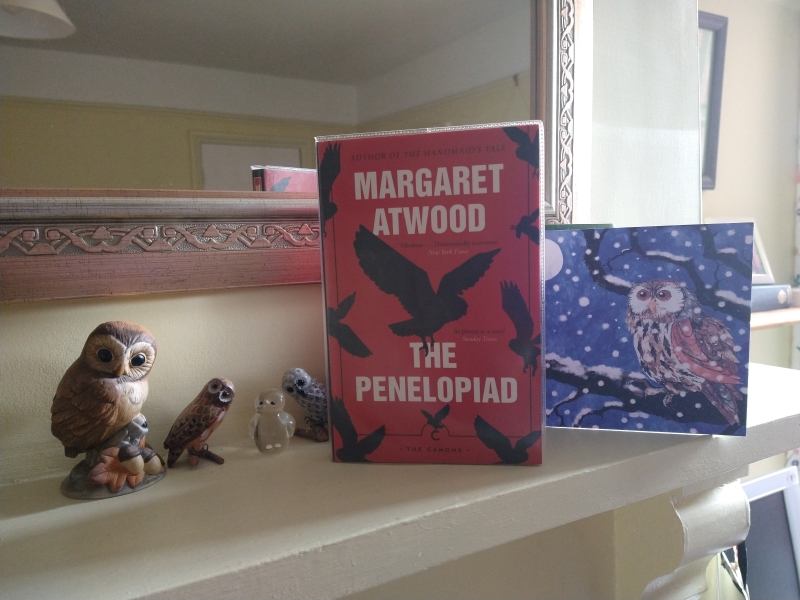
When Odysseus returned, he murdered the suitors and then Penelope’s maids – some of whom had consensual relations with the men; others of whom were raped. The focus is not on the slaughtered suitors, or on Odysseus’s triumphant return and revenge, but on the dozen maids – viz. the chapter title “Odysseus and Telemachus Snuff the Maids.” The murdered maids form a first-person plural voice (a literal Greek chorus) and speak in poetry and song, also commenting on their own plight through an anthropology lecture and a videotaped trial. They appeal to The Furies for posthumous justice, knowing they won’t get it from men (see the Virago anthology Furies). This sarcastic passage spotlights women’s suffering:
Never mind. Point being that you don’t have to get too worked up about us, dear educated minds. You don’t have to think of us as real girls, real flesh and blood, real pain, real injustice. That might be too upsetting. Just discard the sordid part. Consider us pure symbol. We’re no more real than money.
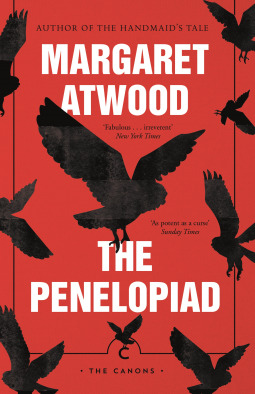
The cover of The Canons edition hints at the maids’ final transformation into legend.
 As well as The Odyssey, Atwood drew on external sources. She considers the theory that Penelope was the leader of a goddess cult. Women are certainly the most interesting characters here. Penelope’s jealousy of her cousin Helen (of Troy) and her rocky relationship with her teenage son Telemachus are additional threads. Eurycleia, Odysseus’s nurse, is a minor character, and there is mention of Penelope’s mother, a Naiad. Odysseus himself comes across not as the brave hero but as brash, selfish and somewhat absurd.
Like Atwood’s other work, then, The Penelopiad is subversive and playful. We wondered whether it set the trend for Greek myth retellings – given that those by Pat Barker, Natalie Haynes, Madeline Miller, Jennifer Saint and more emerged 5–15 years later. It wouldn’t be a surprise: she has always been wise and ahead of her time, a puckish prophetess. This fierce, funny novella isn’t among my favourites of the 30 Atwood titles I’ve now read, but it was an offbeat selection that made for a good book club discussion – and it wouldn’t be the worst introduction to her feminist viewpoint.
(Public library)
[198 pages]


 Bookish Beck = Rebecca Foster. American transplant to England. Freelance proofreader and book reviewer.

I hardly dare mention it: it’s tantamount to sacrilege. But I’m not an Atwood fan. I’ve a feeling this might be the one to change my mind, aand I’ve reserved it at the library.
LikeLiked by 1 person
She’s written in so many different genres that there’s sure to be something that works for you!
LikeLiked by 1 person
👍
LikeLike
Dear Rebecca
Thanks for this interesting review. We have this book in our library but didn’t had time to read it. You made us read it now.
The Fab Four of Cley
🙂 🙂 🙂 🙂
LikeLiked by 1 person
I’m pleased I could move it up the stack for you!
LikeLiked by 1 person
I’ve read the bulk of Atwood, but not this I think. But I obviously must!!
LikeLiked by 1 person
A curio well worth the (small amount of) time it takes to read.
LikeLiked by 1 person
I’ve yet to read anything by Atwood. I really need to remedy that! What would you recommend as a first read, or maybe what’s your favorite? Either or both. 🙂
LikeLiked by 1 person
Well, most people read The Handmaid’s Tale. I don’t actually love that one (I’m not very into dystopian fiction in general), but you might want to see what all the fuss is about. My two favorites of her novels have been Surfacing, an early and short one, and The Blind Assassin, which is long and absorbing. But she has also written short stories, nonfiction, poetry and more!
LikeLiked by 1 person
Yes, I do want to read The Handmaid’s Tale at some point for sure. I’m going to look up the two you mentioned that are favorites. Thanks!
LikeLike
I still have the idea that I’d like to read that whole series (it was an earlier reading project), but some of them were hard to find and now that’s doubly true. It sounds like you had a great discussion, not only of her surprising choices with characterisation and previously overlooked perspectives (or undervalued) but also the question of how/whether it impacted other high-profile retellings later. I’m glad MARM has been a good excuse to continue exploring her backlist: now if only someone would start a Joyce Carol Oates event. heheh Thanks for participating, despite it being a busy and challenging time of year!
LikeLiked by 1 person
I still have enough unread titles to last a few more decades 😉
Do you follow Lonesome Reader (Eric Karl Anderson)? A well-known American blogger in the UK. JCO is his favourite author and he regularly interviews her as well as reviewing her every new release. She is astonishingly prolific! The more she publishes, the more daunted I am, wondering what of hers I would start with. I have made false starts on We Were the Mulvaneys and a collection of her suspenseful stories, and that’s been it so far.
LikeLike
I think I’ve read four, beginning with Black Water, including one under her pseudonym, as well as Faith of a Writer, which I really enjoyed. I’m intrigued by the idea of a mini-project, but the earliest one locally is from 2002 and I’d like to start a little earlier. Her Wikipedia bibliography is its own page! And I knew there was a lot, but I didn’t know about the plays or that there were that many collections of stories (40ish collections? nearly as many as her novels!). Which of hers do you have? Or is she harder to find now that you’re over there? (I’ll check my shelves too.)
LikeLike
I only own We Were the Mulvaneys, and could access some random story collections plus a few of the most recent novels through the public library (I haven’t looked into the university’s holdings).
LikeLike
I checked out my second-hand options locally last week, and there are three huge stacks of her stuff (but not the Mulvaneys, weirdly). I’m sure I could cobble something together if we wanted to plan to explore. We could, even, deliberately plan to explore different books of hers! heheh
LikeLiked by 1 person
That’s sounding like a Kim and Cathy year challenge! I don’t think I’m willing to commit so much time to one author in case I’m not keen, but I’d certainly read one or two.
LikeLike
I’ve read four or five already (but long ago) and I’m STILL not sure if I’d want to commit to a year’s worth. hehe But, yeah, I’d be game for a couple, whether we choose deliberately the same books (which is where those three stacks might come in handy) or deliberately not the same (which wouldn’t be hard at all). Her birthday is in June, but shall we put a pin it it for now and see how the year goes?
LikeLiked by 1 person
Sure, let’s think about it again in the spring.
LikeLike
I love this one and the maids as a Greek chorus are fantastic, she uses their voices so cleverly.
LikeLiked by 1 person
I agree, they were my favourite thing about the book.
LikeLiked by 1 person
I loved this one when I read it.
LikeLiked by 1 person
I raced through it!
LikeLike
I read this back when it came out but it clearly didn’t make a deep impression! I wonder if I’m just not that interested in Penelope.
LikeLiked by 1 person
Ditto!
LikeLiked by 2 people
I don’t know where my aversion to Greek myths comes from. I successfully avoided all the Barker/Miller batch of updates but was willing to take a try on Atwood’s.
LikeLiked by 1 person
Ah, I preferred Miller’s Song of Achilles and Barker’s The Silence of the Girls to this one, but agree most of the others are very poor.
LikeLiked by 1 person
Well you are tempting me to give this one a try! I’m not usually much for mythology stories or retellings, but I might be able to get into Atwood’s version.
LikeLiked by 1 person
It worked for me — I hope it would for you, too!
LikeLiked by 1 person
Saw Marcie’s link to your post. Glad I came and checked it out because I thoroughly enjoyed your discussion of this book, including your introduction to Karen Armstrong’s discussion of myth. Your statement “Think of it as ‘these things happen’ rather than this happened” is a wonderful way of explaining it. (I bought this book my Armstrong but I think I moved it on in my downsize without ever reading it. Too many books.
LikeLiked by 2 people
Thank you! The Armstrong wasn’t fantastic as I recall — one to skim from a library another time, perhaps.
LikeLiked by 1 person
Thanks for that reassurance Rebecca!
LikeLike
[…] can also trace The Penelopiad (see my first post for Margaret Atwood Reading Month 2025) back to Atwood’s high school experiences with the Greek […]
LikeLike