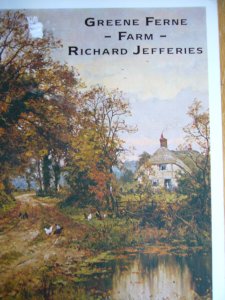
As busy as he is as a lecturer in animal ecology at the University of Reading (and a multi-instrumentalist in several folk/Americana bands), my husband, Dr Chris Foster, managed to find time to read and review (below) something for Novellas in November. This is a random, obscure Victorian novel (from 1880) that we picked up at a book sale in Kingsclere last month.
“The 19th-century author Richard Jefferies is better remembered as a nature writer than as a novelist, and in this slight early novella (albeit published only seven years before his death from tuberculosis at age 38) it is indeed his evocation of the landscapes, wildlife and weather of rural Wiltshire that stand out most.
 “Jefferies conjures atmosphere skilfully, from an uneasy night lost on chalk downland in thick fog to the lonely, dust-filled room where an avaricious old farmer looks out at the sunset from his armchair. There’s a sense of abundant nature as a backdrop for rural life that can be taken for granted, a sense of connectivity across generations – “the cuckoo came and went; the swallows sailed for the golden sands of the south; the leaves, brown and orange and crimson, dropped and died” – but also a prescient fear expressed here by a landowning squire that modern farming methods such as ‘ploughing engines’ might “suck every atom out of the soil.” The abundance of corncrakes portrayed around Greene Ferne is just one reminder for contemporary readers of how much wildlife has been lost from farmland since Jefferies was writing.
“The plot is lacklustre in comparison to the prose: a Hardyesque blend of love triangles and scenes from rural life, with no sense that the occasionally dramatic events portrayed are helping to build any narrative momentum. The portrayals of rustic village folk, complete with thick country accents, feel clichéd and idealised, especially given the decidedly un-Hardyesque happy ending, but the quality of Jefferies’ writing for much of Greene Ferne Farm is at least an encouragement to check out his other, better-known work.” [126 pages] 
 Bookish Beck = Rebecca Foster. American transplant to England. Freelance proofreader and book reviewer.
 Bookish Beck
How fascinating – I thought “Hardy” immediately! Jefferies is better known for a science fiction novel, After London, in which England reverts to wilderness after a catastrophe; it’s long been on my radar. But it sounds like his interest in rurality and nature emerged early in his work.
LikeLiked by 1 person
Wow, I had no idea about that one! It’s funny how Victorian authors renowned for Englishness and a quaint or countryside vibe also envisioned utopias (thinking of William Morris) — I wonder if they’re still worth reading today?
LikeLike
Morris is considered to have been influenced by Jefferies – I think News from Nowhere might still be worth it for a general reader, but the consensus seems to be that After London isn’t really.
LikeLiked by 1 person
It’s many many years since I’ve read any Richard Jefferies. But this review reminds me of the quality of his writing. I’ll look him out again – thanks
LikeLiked by 1 person
Anything you can recommend? I’ve not read him.
LikeLiked by 1 person
I really mean it’s years and years ago, and I was a different Reading Person then. But I do remember thinking he was a Good Writer.
LikeLiked by 1 person
I’ve never heard of Richard Jefferies, but this sounds interesting and his sci-fi book that Elle mentions – how right the squire was!
LikeLiked by 1 person
He gave his name to an English nature-writing prize. I was glad to learn about the SF book as I tend to think of him as very staid and provincial!
LikeLiked by 1 person
What fun, is this the first of a series of guest appearances Chris will make, and will all be random and obscure selections? That will be quite a presence, to be sure! (Mr BIP has been posting little MA quotes around, this November: it’s lovely to have a partner who plays along, isn’t it?)
LikeLiked by 1 person
This will be a rarity, I fear; he hasn’t updated his own blog in over two years!
LikeLike
Interesting – I thought “Hardy!” too.
LikeLiked by 1 person