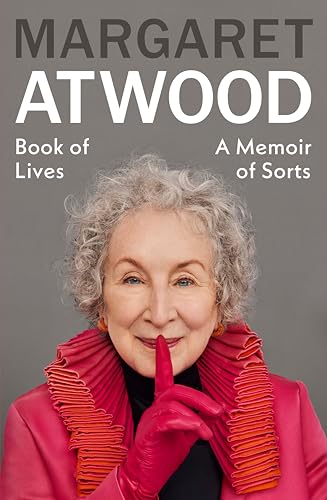
 My hold on Margaret Atwood’s memoir, Book of Lives, arrived in late November. It’ll be my first read for Doorstoppers in December. I’d also been casually rereading her 1983 short story collection Bluebeard’s Egg and managed the first two stories; I’ll return to the rest next year. A recent Guardian interview stated that Atwood had written in “every genre … except autobiography” and quoted her as saying “I’m an old-fashioned novelist. Everything in my novels came from looking at the world around. I don’t think I have much of an inner psyche.” Is this her being coy or facetious? Because, particularly among the short stories, there are many incidents taken from her life. Indeed, in the 140 pages of Book of Lives that I’ve read so far, there are frequent mentions of how people or events made their way into her fiction and poetry. Perhaps most obviously in Cat’s Eye, a novel about childhood bullying by girlfriends.
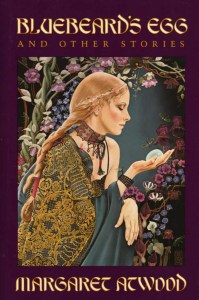 Bluebeard’s Egg opens with two Alice Munro-esque stories, “Significant Moments in the Life of My Mother” and “Hurricane Hazel,” both of which track with facts revealed in the memoir. The former draws on her mother Margaret’s Nova Scotia upbringing as the daughter of a country doctor (to avoid confusion, Atwood was nicknamed “Peggy”). Out of a welter of random stories comes the universal paradox: that she is in some ways exactly like her mother, and in others couldn’t be more different. It closes: “I had become a visitant from outer space, a time-traveller come back from the future, bearing news of a great disaster.” The latter story features a young teenage girl in a half-hearted relationship with an older, cooler boyfriend, mostly because she thinks it’s what’s expected of her. Atwood addresses it explicitly:
Let’s call this boyfriend “Buddy,” which is how he appears in a story of mine called “Hurricane Hazel.” Buddy and I broke up on the night of this famous hurricane, which flooded the Don Valley and killed eighty-one people in Toronto. Buddy wanted to go out that night, but my father, snapping out of his inattention—this was, after all, a matter of the weather, something he always kept his eye on—said it was out of the question. Didn’t Buddy know what a hurricane was? Far too dangerous!
 One can also trace The Penelopiad (see my first post for Margaret Atwood Reading Month 2025) back to Atwood’s high school experiences with the Greek classics.
Who knows when an “influence” may begin? My own 2005 book, The Penelopiad, had its origins fifty years before, when I’d been horrified by the brutal treatment dished out to Penelope’s twelve maids by Odysseus and Telemachus. After being made to clean up the blood from the suitors who’d raped them and were subsequently slaughtered by Odysseus, they were hanged in a line. “Their feet twitched, but not for very long.” A line I have always remembered.
As to Book of Lives in general, I’m finding it delightful but also dense with detail and historical context. Atwood grew up between the wilderness and the city because of her entomologist father’s seasonal fieldwork. She was called “Little Carl” due to how much she resembled her handy father, who built the cabins and houses they lived in as well as most of their furniture. With her beloved older brother, Harold, she was free to explore and later, as a camp counsellor, was known as “Peggy Nature” for her zoological expertise. She could easily have become a scientist but fell in love with crafts and the humanities, sewing her own clothes and writing an opera for Home Economics class. By the end of high school, she’d decided she was going to be a poet.
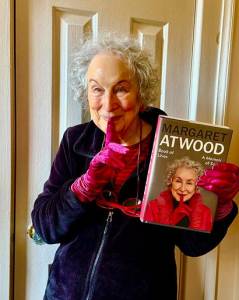
A cute pic of her from her Substack
I’m impressed by the clarity of Atwood’s memories; all I remember of my school days wouldn’t fill one chapter, let alone four. It could be argued that some of this is superfluous – a whole chapter on several summers as a counsellor at a Reform Jewish camp? But it’s her prerogative to choose the content and no doubt, always the novelist, she’s seeding important facts that will come to fruition later. As ever, her turns of phrase are amusing and her asides witty. There is a wonderful trove of photographs and artefacts for illustration. Although she effortlessly recreates her experience at any age, her perspective is salted with hindsight. I can already tell, making my way steadily through, 25 pages at a time, to return this by the deadline, that I’m going to need to read it again in the future to take it all in. Ideally, I’ll get my own copy so I can use the index to return to any scenes I want to revisit.
Bluebeard’s Egg – Little Free Library
Book of Lives – Public library
 Bookish Beck = Rebecca Foster. American transplant to England. Freelance proofreader and book reviewer.
 Bookish Beck
I’ve been looking forward to the memoir. I think I’m going to need my own copy too.
LikeLiked by 1 person
Racing through it in three weeks before the library deadline is definitely not the ideal way to read it, but lots of people are waiting for it after me!
LikeLiked by 1 person
I know I’m going to want to read or reread the fiction along with it, which will definitely take more than three weeks!
LikeLiked by 1 person
Atwood must not hold with the concept of autofiction, because I’ve definitely read stories (e.g. in Moral Disorder) that seem to be at least somewhat grounded in her own life experience!
LikeLiked by 1 person
Absolutely! Wilderness Tips, as well. I’ve found the bits of her life story most noticeable in her short stories, but the more I read this memoir the more I spot incidents in the novels, too, such as working as a census researcher (but which novel was that??). I guess she means that no full plot was ever based on what had happened to her, but smaller elements and secondary characters are rife.
LikeLiked by 1 person
It was The Edible Woman, mostly! (A short story, somewhere along the line, too, I think.)
LikeLiked by 1 person
Yes! Market research. I found that out eventually from the autobiography.
LikeLike
That’s the line from The Odyssey that I always remember too, so I’m in good company!
LikeLiked by 1 person
I do want to at least sample the memoir whenever it gets into my library system (things are very slow with the closing of Baker & Taylor and other delays.)
LikeLiked by 2 people
I’m sorry I didn’t see this before now, but I’ve added your post to the project page and I was making little cheering sounds reading your quotes from the memoir: I absolutely loved these parts of the memoir and it felt rife with them, as though she knew exactly what would most satisfy/please longtime readers! I wasn’t sure if you might have run out of reading time in Nov but, as soon as I saw the HH bit in the memoir, I knew it would fit perfectly with your original reading plans and got excited on your behalf. Maybe I will reread the bio next year because I felt like the last-quarter was even more stuffed than the first-three-quarters. Did you get to the end in some fashion before your due date?
I’ve never fully understood the concept of autofiction either, although I can see why some writers have embraced the term for their work, and it does make sense to me in the context of their work. But in my experience, there are some key truthful details but there’s a whole lot of spiralling around the edges of those, so that there is sooo much more in the end that is imagined/not true, those truthful details don’t even seem like they are details from your life either because they have been changed somehow, even though you can clearly recognise the kernel as something “real”. Anyway, I’ve heard others say similar things, but not specifically MA, and I’m sure it’s different for everyone anyhow.
LikeLiked by 1 person
I did manage to turn the final page the night before my library deadline, which felt like a feat. I’ll write it up properly tomorrow, I hope. You’re right, she identifies the kernel of experience that sparked something, but much imagination was required to get from there to the final product, which I guess is why the term autofiction is not really appropriate for any of her work.
LikeLike
[…] gave some initial thoughts about the book here to tie in with Margaret Atwood Reading Month. What I said then proved true of the book as a whole: […]
LikeLike