It’s Mothering Sunday in the UK today, so, like last year, I’m featuring three very different books about mothers and motherhood: a memoir, a novel and a poetry anthology. There are complex emotions at play in the first two due to grief, abuse and disability. The poems are cheerier (thankfully) and reflect on the experience of motherhood but also of being mothered. On that last point, I’ve added my response to a relevant short story I happened to read today.
Reading My Mother Back: A memoir in childhood animal stories by Timothy C. Baker (2022)
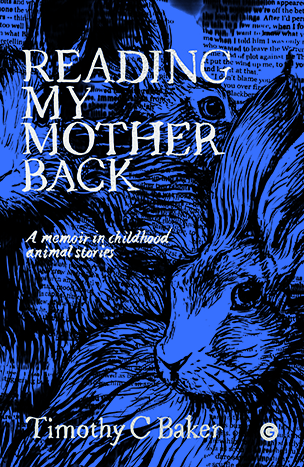 Baker is a lecturer in Scottish literature at the University of Aberdeen. His first non-academic publication is a curiously beguiling novella-length reappraisal of favourite children’s books. “To misquote Heraclitus, you cannot read the same book twice.” While he’s sheepish about including so many 19th- and early-20th-century white male authors, he can’t do otherwise as these are the texts that first taught him about death, loneliness and friendship: Charlotte’s Web, The Wind in the Willows, The Magician’s Nephew and Watership Down. (Also The Secret Garden.) Baker grew up in Maryland and Vermont, lonesome and closeted, with parents who briefly joined a cult. In his memory, his mother (who had been abused) always suffered with chronic illness and pain. In each chapter, he weaves together a discussion of a plot with stories from his early life and critical opinion on the value of rereading. It helped that I was familiar with six of the nine books Baker features (and others by Gallico, though not The Man Who Was Magic); I’d not even heard of Merle the High Flying Squirrel or The Book of the Dun Cow.
I spotted this in the Wigtown Festival Shop* on our 2023 visit to Scotland’s Book Town and could hardly believe it existed because it seemed so perfectly suited to me: I loved animal books, especially Watership Down, as a child; I’ll read any bereavement memoir going; I grew up 30 miles from Baltimore, where Baker spent his early life; he and I both had strict religious upbringings; and his mother experienced kidney failure (after eating a foxglove??), a link to my family’s history of kidney disease. There are plentiful differences, too, of course, but Baker emphasises connection. “If reading these books has taught me anything,” he concludes, “it is that all of my stories are individual, and all of them are universal. What we share is the unshareability of our grief … [but also] the joy of knowing that we have loved.” And for such a seemingly niche book (from Goldsmiths Press), I have actually found myself mentioning it to two blogger friends in recent days, so that’s proof he was right. 
[*As to how the book finally came into my possession: I added it to my wishlist and an acquaintance (a former mayor of Newbury, in fact) bought it for me for my 40th birthday. However, he forgot to bring the gift to our joint party and it took another 2+ years to extract it from him – through explicit reminders when we invited him to join us on a quiz team.]
Like Mother by Jenny Diski (1988)
I’ve enjoyed the late Jenny Diski’s travel memoirs (Skating to Antarctica and Stranger on a Train) and essays (On Trying to Keep Still). This novella was my first taste of her fiction and, while it’s dark as hell, I admired the psychological acuity and playfulness with narration. Occasional chapters introduce a dialogue between Nony and an imaginary interlocutor whose role is to listen to the story of her mother, Frances, a former dancer. That family history is the substance of the rest of the book, which is in an omniscient third person. The artificiality of the setup is blatant, though; Nony can neither think nor speak, having been born without a brain (hydranencephaly). Nony’s full name is thus Frances’s cruel joke.
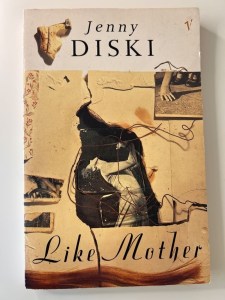
By necessity, the story stretches back to Frances’s parents, Ivy and Gerald, whose postwar optimism soon ceded to the reality of addiction, adultery and the attrition of love. A semiferal Frances escaped her unhappy home for the streets of London and engaged in sex play with Stuart on a bombsite. This went on for years. For Stuart, it blossomed into genuine love, but the numb Frances could never return his feelings and only used him. There are some really painful scenes here, such as Stuart stealing ether from the chemistry supply cupboard so she can huff herself into temporary oblivion, and a drunk Ivy molesting adolescent Frances. “Like mother, like daughter” is a bitter confirmation of inherited trauma. Nony might well be a symbolic manifestation of Frances’s desire to cultivate nothingness. To the extent that she is a literal baby – I’m really not sure – Frances does seem to love her and care for her physical needs, even as she’s grateful that the relationship will be short-lived.
Diski draws attention to the falsity of her narrative technique at the very end. It’s a disturbing yet intriguing novel that I think must be trying to make a wider point about postwar disillusionment. (Enough to make one question one’s growing antipathy towards Boomers?) I was reminded faintly of Nutshell by Ian McEwan, which is from the perspective of a fetus, and I Am Clarence by Elaine Kraf, a troubling story of a mentally ill mother and her disabled son. I have another novella plus a short story collection by Diski on the shelf, and I daresay after those I’ll have to seek out everything else she wrote. (University library) 
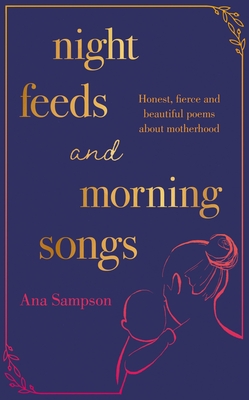
Night Feeds and Morning Songs, ed. Ana Sampson (2021)
“I crossed the border into the Republic of Motherhood
and found it a queendom, a wild queendom.”
~Liz Berry
It would have been easy to make such an anthology samey and sentimental, so kudos to Sampson for curating a solid mix of contemporary and period work. The poems are grouped into loose categories covering pregnancy, the sleepless nights of early motherhood, the power of womanly solidarity, the legacy (or absence) of one’s own mother, and the milestones of life as a child grows up and moves away. (Jackie Kay marvels that her baby boy is now a 6-foot-2 world traveller.) However, there are almost as many emotional approaches and poetic forms as there are contributors. Exhilaration meets exhaustion; guilt and grief threaten to overwhelm the good times. Sometimes the infant is addressed directly. The tone might be sombre, outraged or satirical. A few excerpts:
from “Labour Ward Prayer” by Vicky Thomas
Give us this day our daily miracle.
Exchange our offering of sweat and tears
and, most of all, of blood,
for new life, crumpled as a new leaf bud.
 from “The Visitor” by Idra Novey
…more dragon
than spaniel, more flammable
than fluid …
All wet mattress to my analysis,
he’s stayed the loudest and longest
of any houseguest
from “What My Kids Will Write about Me in Their Future Tell-All Book” by January Gill O’Neil
They will say that no was my favourite word,
More than stop, or eat, or love.
That some morning, I’d rather stay in bed,
laptop on lap, instead of making breakfast
…
They will say they have seen me naked.
Front side, back side – none of which
were my good side.
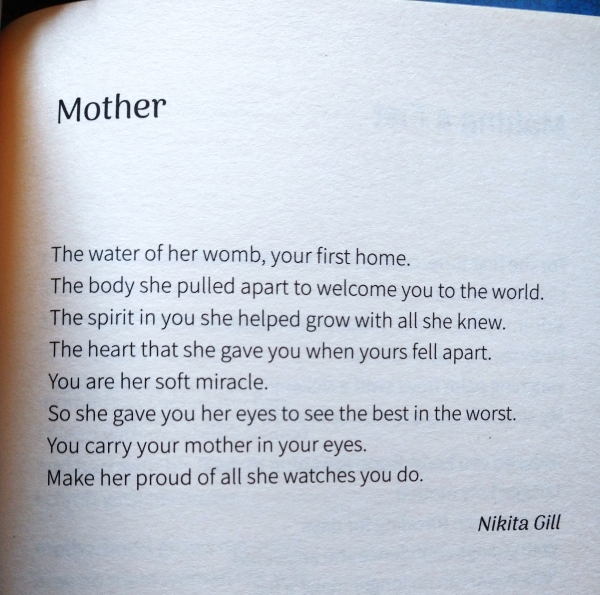
I enjoyed re-encountering work by some personal favourite poets such as Caroline Bird, though most entries were new to me. Sampson’s section introductions aren’t particularly illuminating and often reference poems that aren’t actually in the part in question. Some of the 19th-century and earlier material is quaintly twee, but I did love discovering Christina Rossetti’s “To My First Love, My Mother.” This is the poem that made me cry, though:
(Little Free Library)
And a bonus short story:
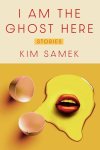 “Egg Mother” by Kim Samek (from I Am the Ghost Here): I’m two stories into Samek’s gently surreal collection. This second story combines the themes of parenting and grief prevalent above. Her openings are knockout: “At thirty-six I turn into a scrambled egg. It happens a few months after I give birth.” In therapy, the narrator discovers that she’s been repressing her grief over her mother, who died of cancer when the narrator was 13. The therapist suggests that she and her husband hold a joint ‘funeral’ for her mother and her younger self in a graveyard. But even after the ritual, she doesn’t return to herself. It’s a sobering but realistic message: some things one just doesn’t get over.
“Every story that I read becomes the story of my mother.”
~Timothy C. Baker
Last night, we saw Brooklyn expat singer-songwriter Annie Dressner (and Sean Duggan of Steady Habits) in concert at a church hall. I was mostly underwhelmed by her quirky confessional songs and little-girl voice, but a couple of songs stood out for me. One, “I Just Realized,” includes the line “And I hope that I can be just like my mother.”
Today was a more emotional day than I was expecting. I got a sweet posy from church, but having a whole service focussed on mothers and mothering was hard for me. I had to mostly switch off to get through it.
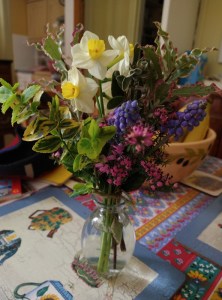
Just in my current stack, there are so many books about mothers or mothering…
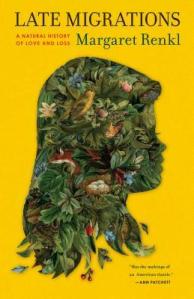 the loss of a mother (Eva Luna by Isabel Allende; The Memory of Borrowed Books by Meg Anderson; The Curious Incident of the Dog in the Night-Time by Mark Haddon; Late Migrations by Margaret Renkl; I Capture the Castle by Dodie Smith) – so common an element in novels that I have to think it’s shorthand for a character who has to pluckily rely on their own psychological resources
- mothers’ protective instinct (The Benefactors by Wendy Erskine)
- emotional distance from an unstable mother (Carrie by Stephen King; First Rain in Paradise by Gwyneth Lewis; Blonde by Joyce Carol Oates; The First Day of Spring by Nancy Tucker, which also includes the struggle to be a good mother in turn)
- mixed feelings about the inability to have a child (Mare by Emily Haworth-Booth)
- a mother’s grief at the loss of a child (Ordinary Saints by Niamh Ni Mhaoileoin)
I know it’s a subject I’ll be reading and thinking about for the rest of my life.
 Bookish Beck = Rebecca Foster. American transplant to England. Freelance proofreader and book reviewer.
 Bookish Beck
So sorry yeserday was a tough one for you. It took me a long time to get through Mother’s Day with equanimity. Very thoughtful posy from your church.
LikeLiked by 1 person
So sorry yesterday was tough for you, though I had thought you had made a positive choice for childlessness. I’m being exceptionally choosy about books I add to my TBR at present, because my number of reservations at the library is just plain ridiculous and I currently have 11 out (nothing whatsoever in your terms, I know …) . It’s beginning to feel like a Task, not a Pleasure! In other word – sorry – in these circumstances, none of your offerings today made the cut.
LikeLike
(It’s to do with the absence of my mother, who died 3.5 years ago.) Ah, that’s never good when books become an obligation. I can see how cutting down might make you feel better about things. For once I’m not at the max for either loans or reservations!
LikeLike
Ah, I see. Well, you know what they say. ‘Grief is the price we pay for love’. I’m sorry it hurts so much.
LikeLiked by 1 person
I know how you feel Rebecca, My Mum is gone 16 years and I still find Mother’s Day very tough xx
LikeLiked by 1 person
Mixed feelings for you, I’m sure. I hope your kids did something special for you?
LikeLike
They did x
LikeLike
[…] this portrait of a deprived girl who murders other children. I could have included it in my Mother’s Day post because, as in the similarly dark Like Mother (by Jenny Diski), it’s the lack of a mother’s […]
LikeLike
Liz Berry! I have met her, she’s one of the best author interviewers at bookshop events I’ve encountered! That last poem is very moving.
I have come to terms with Mother’s Day just about, but usually try to spend it quietly and away from parks and cafes. The Tuesday before, I was supporting our new runners’ group and one woman, who had been telling me how difficult her life was, said brightly, “Are you looking forward to Mother’s Day?” and I found myself saying, rather more sharply than I would have liked, “Well, I don’t have a relationship with my mother and I can’t have children, so not really, no”. She did apologise and I felt a bit bad. But please don’t assume, people!!
LikeLiked by 1 person
Oh dear, I hope that taught her not to assume that Mother’s Day is a happy day for everyone.
I didn’t get on with Berry’s The Home Child but I’ve really enjoyed other poems of hers, so I need to get hold of The Republic of Motherhood.
LikeLiked by 1 person