Happy 87th birthday* to Margaret Atwood! It’s my ninth time participating in the annual Margaret Atwood Reading Month (#MARM) hosted by indomitable Canadian blogger Marcie of Buried in Print.
(In previous years, I’ve read Surfacing and The Edible Woman, The Robber Bride and Moral Disorder, Wilderness Tips, The Door, Bodily Harm and Stone Mattress, Life Before Man and Interlunar, The Penelopiad and Book of Lives; and reread portions of Bluebeard’s Egg as well as the whole of The Blind Assassin.)
I think I’ve told this story before: when I started my Master’s in Victorian Literature at the University of Leeds in 2005, I met a graduate student who was writing a thesis on Canadian woman writers. I was flummoxed because, at the time, I could only think of one – Atwood – and hadn’t read her yet. I’ve since come to discover a number of excellent Canadian authors, including women and people of colour, but Atwood was my gateway, as she probably is for many. And while I wasn’t too impressed with The Handmaid’s Tale, Cat’s Eye and Alias Grace, my first few from her, The Blind Assassin, which I read circa 2008, made me a fan for life. Since then, I’ve kept reading her at a rate of a book or two a year.
 This year, I’ve been sampling from two long books: the essay collection Burning Questions (2022) and the new and selected poems volume Paper Boat (2024). I picked a random trio of essays based on my mood. So far, I’ve read the appreciation of Polish travel writer Ryszard Kapuściński and the piece on Anne of Green Gables at 100, in which Atwood muses on Montgomery’s enduring popularity with Japanese tourists. I’ve also read part of her 2008 appreciation for Alice Munro, which would no doubt have been approached differently today.
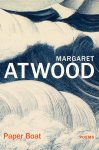 I began at the beginning in Paper Boat; I’ve also read the selected poetry volume Eating Fire, so I’m unclear on which of these poems I’ve encountered before. Mythology, animals, environmental disaster: these are familiar elements from her oeuvre as a whole. The extracts from The Animals in That Country have struck me the most thus far. Here’s a passage from “Roominghouse, Winter”:
We must resist. We must refuse
to disappear
I said, In exile
survival
is the first necessity.
After that (I say this
tentatively)
we might begin
Apart from alliteration, Atwood tends to focus more on themes than on sonic techniques or form. That, I think, makes her poetry accessible to newbies and those wary of verse.
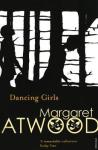 I’m also two stories into Dancing Girls and Other Stories, her 1977 collection. In “The Man from Mars,” college girl Christine has a mostly harmless stalker in the form of an exchange student from China. “Her mother volunteered that the thing about people from another culture was that you could never tell whether they were insane or not because their ways were so different.” (This reminded me so much of the Nigerian graduate student who stalked me during my year abroad!) “Betty” is about a girl’s observations of their neighbours at their summer cottage as the marriage falters; I wondered if it might have an autobiographical basis.
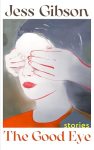 I’ve been reading MA’s daughter Jess Gibson’s debut story collection, The Good Eye, at the same time. I’m also two stories in, and will hope to finish and review both books before the end of the month. While it wouldn’t be fair to compare them in terms of prose or technical prowess, there are definitely some overlapping themes (female rivalry, men’s misdeeds, comeuppances) that make them worth discussing in parallel.
When I finish the above three, I’ll be at 34 Atwood books read! I value her as a cultural critic, outspoken political gadfly, environmental activist and puckish prophet, and I so enjoy taking the time to read her each November.
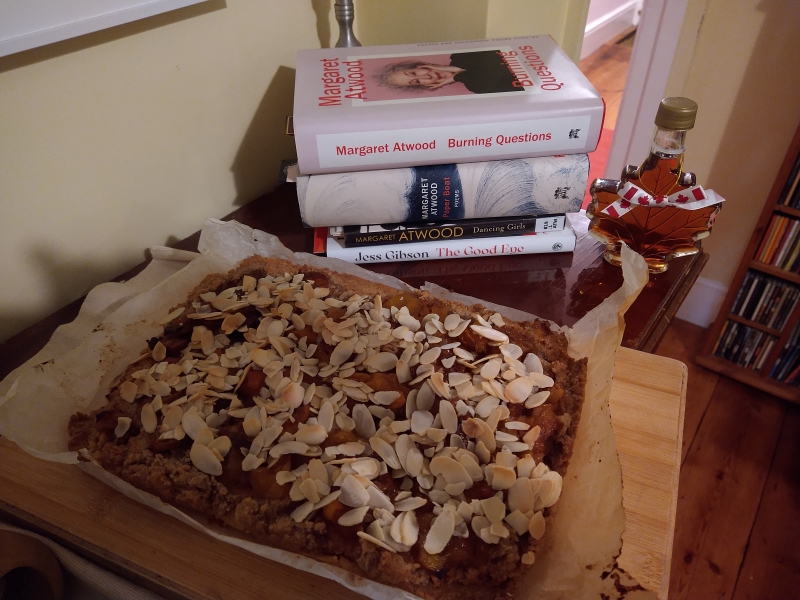
*To mark the occasion, I went trawling for maple syrup-based cake recipes and arrived at this plum and almond traybake, made with genuine Canadian maple syrup. (One of my husband’s students brought a maple leaf-shaped bottle of syrup back for him as a vacation souvenir; after we emptied it, I refilled from a supermarket bottle.) I used gluten-free flour and took it over to a book club film night watching the adaptation of another of our reads, Don’t Let’s Go to the Dogs Tonight. All the plums were foraged locally, including in my backyard, and it turned out tasty, especially when doused in more maple syrup and cream.
If only I’d seen Marcie’s reference to Atwood’s baked lemon custard cake in time, I would have made that instead, but never mind, I’ll bookmark it for next year. (Ye gods preserve her until then!)
 Bookish Beck = Rebecca Foster. American transplant to England. Freelance proofreader and book reviewer.

