Sunday Times Young Writer of the Year Award shadow panel
I’m delighted to announce that I’ve been invited to be on the official shadow panel for the Sunday Times / Peters Fraser + Dunlop Young Writer of the Year Award, in association with The University of Warwick (to give it its full and proper title). Here’s a bit of background on the prize, from its website:
The prize “is awarded annually to the best work of published or self-published fiction, non-fiction or poetry by a British or Irish author aged between 18 and 35, and has gained attention and acclaim across the publishing industry and press. £5,000 is given to the overall winner and £500 to each of the three runners-up.
“Since it began in 1991, the award has had a striking impact, boasting a stellar list of alumni that have gone on to become leading lights of contemporary literature. The 2016 Award was presented to Max Porter for his extraordinary debut, Grief Is the Thing with Feathers. Following a five-year break, the prestigious award returned with a bang in 2015, awarding debut poet Sarah Howe the top prize for her phenomenal first collection, Loop of Jade.”
Past winners include Ross Raisin, Adam Foulds, Naomi Alderman, Robert Macfarlane, William Fiennes, Zadie Smith, Sarah Waters, Francis Spufford, Simon Armitage and Helen Simpson.
This year’s official judging panel is made up of Andrew Holgate, literary editor of the Sunday Times, and writers Lucy Hughes-Hallett and Elif Shafak.

I’m joined on the shadow panel by four other book bloggers, several of whom you will recognize as long-time friends of this blog:
- Dane Cobain (SocialBookshelves)
- Eleanor Franzen (Elle Thinks)
- Annabel Gaskell (Annabookbel)
- Clare Rowland (A Little Blog of Books)
Here are some key upcoming dates:
- Sunday October 29th: shortlist announced in Sunday Times
- November 18th: book bloggers event with readings from the shortlisted authors (Groucho Club, London)
- November 27th: deadline for shadow panel winner decision
- November 29th: shadow panel winner announced on STPFD website
- December 3rd: shadow panel winner announced in Sunday Times
- December 7th: prize-giving ceremony and winner announcement (London Library)
I’m so looking forward to getting stuck into the shortlisted books and discussing them! I’ll be posting a review of each one in November.
Last-Minute Booker Prize Predictions
The Man Booker Prize 2017 will be announced this evening (roughly 22:00 GMT, in my memory). Ever since the shortlist announcement I’ve felt that George Saunders is a shoo-in for Lincoln in the Bardo. I think he will win, and should. However, I’ve still only read four out of the six on the shortlist, so my predictions are not entirely based on personal knowledge of the books. I can’t say I’m hugely enthused about trying Auster or Hamid, but I’d be more likely to do so if either won.
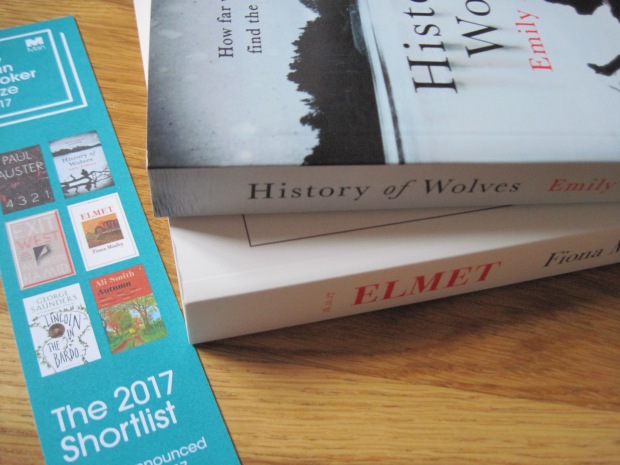
The two from the shortlist that I own + the annual bookmark, picked up from the public library.
Here, in what I predict is their descending order of likelihood to win, are the six shortlisted titles, with a pithy three words on why each one would take the prize:
Lincoln in the Bardo by George Saunders – Something actually novel.
Exit West by Mohsin Hamid – Timely re: refugees.
Autumn by Ali Smith – Timely re: Brexit.
4 3 2 1 by Paul Auster – Great American Novel.
Elmet by Fiona Mozley – Gorgeous, talented debut.
History of Wolves by Emily Fridlund – Haunting, underrated debut.
What have you managed to read from the Booker shortlist? How do your predictions match up against mine?
Final Thoughts on the Booker Longlist
On Wednesday the 13th the Man Booker Prize shortlist will be announced. I’d already reviewed six of the nominees and abandoned one; in the time since the longlist announcement I’ve only managed to read another one and a bit. That leaves four I didn’t get a chance to experience. Here’s a run-through of the 13 nominees, with my brief thoughts on each.
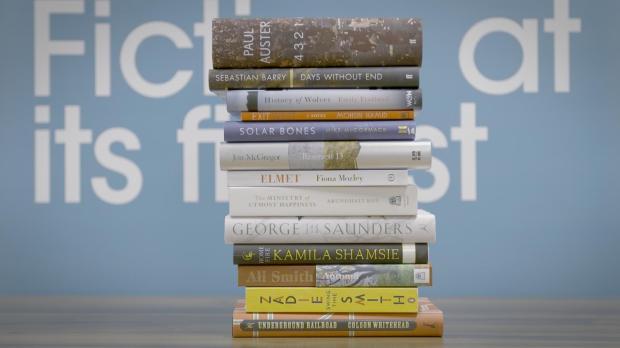
4 3 2 1 by Paul Auster (US) (Faber & Faber): I can’t see myself reading this one any time soon; I’ll choose a shorter work to be my first taste of Auster’s writing. I’ve heard mostly good reports, though.
Days Without End by Sebastian Barry (Ireland) (Faber & Faber): Read in March 2017. This is my overall favorite from the longlist so far. (See my BookBrowse review.) However, it’s already been recognized with the Costa Prize and the Walter Scott Prize for historical fiction, so if it doesn’t make the Booker shortlist I certainly won’t be crushed. 
History of Wolves by Emily Fridlund (US) (Weidenfeld & Nicolson): Read in March 2017. A slow-building coming-of-age story with a child’s untimely death at its climax. Fridlund’s melancholy picture of outsiders whose skewed thinking leads them to transgress moral boundaries recalls Lauren Groff and Marilynne Robinson. (Reviewed for the Times Literary Supplement;  )
)
Exit West by Mohsin Hamid (Pakistan-UK) (Hamish Hamilton): I don’t have much interest in reading this one at this point; I didn’t get far in the one book I tried by Hamid (The Reluctant Fundamentalist) earlier this year. I’ve encountered mixed reviews.
Solar Bones by Mike McCormack (Ireland) (Canongate): If you’ve heard anything about this, it’s probably that the entire book is composed of one sentence. Now here’s an embarrassing admission: I didn’t make it past the first page.
Reservoir 13 by Jon McGregor (UK) (4th Estate): I read the first 15% last month and set it aside. I knew what to expect – lovely descriptions of the natural world and the daily life of a small community – but I guess hadn’t fully heeded the warning that nothing much happens. I won’t rule out trying this one again in the future, but for now it couldn’t hold my interest.
Elmet by Fiona Mozley (UK) (JM Originals): Read in August 2017. Simply terrific. (See my full blog review.) Overall, this dark horse selection is in second place for me. I’d love to see it make it through to the shortlist. 
The Ministry of Utmost Happiness by Arundhati Roy (India) (Hamish Hamilton): I was never a huge fan of The God of Small Things, so this is another I’m not too keen to try.
Lincoln in the Bardo by George Saunders (US) (Bloomsbury Publishing): Read in April 2017. An entertaining and original treatment of life’s transience. I enjoyed the different registers Saunders uses for his characters, but was less convinced about snippets from historical texts. So audacious it deserves a shortlist spot; I wouldn’t mind it winning.
Home Fire by Kamila Shamsie (UK-Pakistan) (Bloomsbury Circus): This is the one book from the longlist that I most wish I’d gotten a chance to read. It’s been widely reviewed in the press as well as in the blogging world (A life in books, Elle Thinks, and Heavenali), generally very enthusiastically.
Autumn by Ali Smith (UK) (Hamish Hamilton): Read in November 2016. (See my blog review.) While some of Smith’s strengths benefit from immediacy – a nearly stream-of-consciousness style (no speech marks) and jokey dialogue – I’d prefer a more crafted narrative. In places this was repetitive, with the seasonal theme neither here nor there. 
Swing Time by Zadie Smith (UK) (Hamish Hamilton): Read in October 2016 for a BookBrowse review. The Africa material wasn’t very convincing, and the Aimee subplot and the way Tracey turns out struck me as equally clichéd. The claustrophobic narration makes this feel insular. A disappointment compared to White Teeth and On Beauty.
The Underground Railroad by Colson Whitehead (US) (Fleet): Read in July 2017. (See my blog review.) I’m surprised such a case has been made for the uniqueness of this novel based on a simple tweak of the historical record. I felt little attachment to Cora and had to force myself to keep plodding through her story. Every critic on earth seems to love it, though.
If I had to take a guess at which six books will make it through Wednesday and why, I’d say:
- 4 3 2 1 by Paul Auster – A chunkster by a well-respected literary lion.
- Exit West by Mohsin Hamid – A timely refugee theme and a touch of magic realism.
- Solar Bones by Mike McCormack – Irish stream-of-consciousness. Channel James Joyce and you’ll impress all the literary types.
- Lincoln in the Bardo by George Saunders – Effusive in tone and cutting-edge in form.
- Autumn by Ali Smith – Captures the post-Brexit moment.
- The Underground Railroad by Colson Whitehead – Though it’s won every prize going, the judges probably think they’d be churlish to pass it by.
By contrast, if I were asked for the six I would prefer to be on the shortlist, and why, it’d be:
- Days Without End by Sebastian Barry – Pretty much unforgettable.
- History of Wolves by Emily Fridlund – A haunting novel that deserves more attention.
- Reservoir 13 by Jon McGregor – Though it’s not my personal favorite, I support McGregor.
- Elmet by Fiona Mozley – A nearly flawless debut. Give the gal a chance.
- Lincoln in the Bardo by George Saunders – Show-offy, but such fun to read.
- Home Fire by Kamila Shamsie – Timely and well crafted, by all accounts.
That would be three men and three women, if not the best mix of countries. I’d be happy with that list.
What have you managed to read from the Booker longlist? How do your predictions match up against mine?
Catching Up on Prize Winners: Alderman, Grossman & Whitehead
Sometimes I love a prize winner and cheer the judges’ ruling; other times I shake my head and puzzle over how they could possibly think this was the best the year had to offer. I’m late to the party for these three recent prize-winning novels. I’m also a party pooper, I guess, because I didn’t particularly like or dislike a one of them. (Reviews are in the order in which I read the books. My rating for all three =  )
)
A Horse Walks into a Bar by David Grossman
(Winner of the Man Booker International Prize)
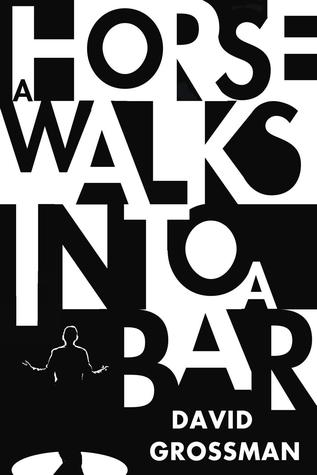 “Why the long face? Did someone die? It’s only stand-up comedy!” Except that for the comedian himself, Dovaleh Greenstein, this swan song of a show in the Israeli town of Netanya devolves into the story of the most traumatic day of his life. Grossman has made what seems to me an unusual choice of narrator: Avishai Lazar, a widower and Supreme Court justice, and Dov’s acquaintance from adolescence – they were in the same military training camp. Dov has invited him here to bear witness, and by the end we know Avishai will produce a written account of the evening.
Although it could be said that Avishai’s asides about the past, and about the increasingly restive crowd in the club, give us a rest from Dov’s claustrophobic monologue, in doing so they break the spell. This would be more hard-hitting as a play or a short story composed entirely of speech; in one of those formats, Dov’s story might keep you spellbound through a single sitting. Instead, I found that I had to force myself to read even five or 10 pages at a time. There’s no doubt Grossman can weave a clever tale about loss, and there are actually some quite funny jokes in here too, but overall I found this significantly less powerful than the author’s previous work, Falling Out of Time.
The Underground Railroad by Colson Whitehead
(Winner of the Pulitzer Prize, National Book Award and Arthur C. Clarke Award; longlisted for the Man Booker Prize)
 Following Cora on her fraught journey from her Georgia plantation through the Carolinas and Tennessee to Indiana is enjoyable enough, with the requisite atrocities like lynchings and rapes thrown in to make sure it’s not just a picaresque cat-and-mouse battle between her and Arnold Ridgeway, the villainous slavecatcher. But I’m surprised that such a case has been made for the uniqueness of this novel based on a simple tweak of the historical record: Whitehead imagines the Underground Railroad as an actual subterranean transport system. This makes less of a difference than you might expect; if anything, it renders the danger Cora faces more abstract. The same might be said for the anachronistic combination of enlightened and harsh societies she passes through: by telescoping out to show the range of threats African-Americans faced between the Civil War and the 1930s, the novel loses immediacy.
Ultimately, I felt little attachment to Cora and had to force myself to keep plodding through her story. My favorite parts were little asides giving other characters’ backstories. There’s no doubt Whitehead can shape a plot and dot in apt metaphors (I particularly liked “Ajarry died in the cotton, the bolls bobbing around her like whitecaps on the brute ocean”). However, I kept thinking, Haven’t I read this story before? (Beloved, Ruby, The Diary of Anne Frank; seen on screen in Twelve Years a Slave, Roots and the like.) This is certainly capably written, but doesn’t stand out for me compared to Homegoing, which was altogether more affecting.
The Power by Naomi Alderman
(Winner of the [Bailey’s] Women’s Prize)
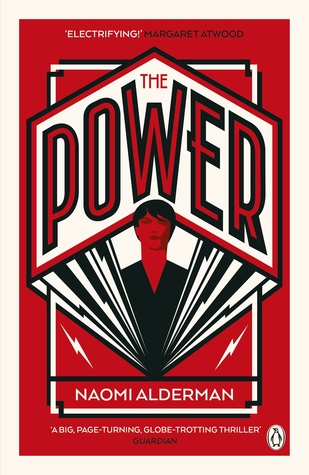 I read the first ~120 pages and skimmed the rest. Alderman imagines a parallel world in which young women realize they wield electrostatic power that can maim or kill. In an Arab Spring-type movement, they start to take back power from their oppressive societies. You’ll cheer as women caught up in sex trafficking fight back and take over. The movement is led by Allie, an abused child who starts by getting revenge on her foster father and then takes her message worldwide, becoming known as Mother Eve.
Alderman has cleverly set this up as an anthropological treatise-cum-historical novel authored by “Neil Adam Armon” (an anagram of her own name), complete with documents and drawings of artifacts. “The power to hurt is a kind of wealth,” and in this situation of gender reversal women gradually turn despotic. They are soldiers and dictators; they inflict genital mutilation and rape on men.
I enjoyed the passages mimicking the Bible, but felt a lack of connection with the characters and didn’t get a sense of years passing even though this is spread over about a decade. This is most like Margaret Atwood’s MaddAddam trilogy – Alderman’s debt to Atwood is explicit, in the dedication as well as the acknowledgments – so if you really like those books, by all means read this one. My usual response to such speculative fiction, though, even if it describes a believable situation, is: what’s the point? As with “Erewhon,” the best story in Helen Simpson’s collection Cockfosters, the points about gender roles are fairly obvious.
I’d be interested to hear if you’ve read any of these books – or plan to read them – and believe they were worthy prize winners. If so, set me straight!
The Wellcome Book Prize 2017 Awards Ceremony
Yesterday evening’s Wellcome Book Prize announcement was my first time attending a literary prize awards ceremony. Despite my nerves going in, there was quite a relaxed atmosphere (I felt almost overdressed in my H&M dress) and it was no different to any party where one struggles to make small talk – except that here all the talk was of books!
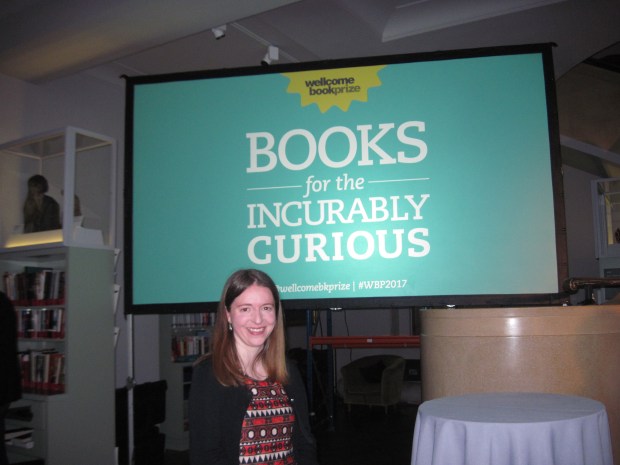
The new high-ceilinged Reading Room at the Wellcome Library (across from London’s Euston station) was a suitably swanky setting, with the unusual collection of health-themed books surrounded by an equally odd set of curios, such as death masks, paintings showing medical conditions, and a columnar red dress designed to resemble a neural tube. There was even a jazz duo playing.


It was especially lovely to meet up with Clare (A Little Blog of Books) and Ruby (My Booking Great Blog) and compare notes on book blogging while nursing a flute of prosecco and some superlative canapés. We also indulged in some subtle celebrity spotting – or, at least, the sort of authors and public figures I consider celebrities: Ned Beauman, Sarah Churchwell, A.C. Grayling, Cathy Rentzenbrink, and Suzanne O’Sullivan, last year’s Wellcome Prize winner. Three of the shortlisted authors were also present.
About 45 minutes into the event, the official proceedings began. Crime writer Val McDermid, the chair of this year’s judging panel, gave introductory remarks about the Prize and the attributes they were looking for when assessing the 140 books in the running this year. She said they were in search of books that went beyond the superficial and revealed more layers upon each rereading – as by now they’ve read the shortlisted books three times.
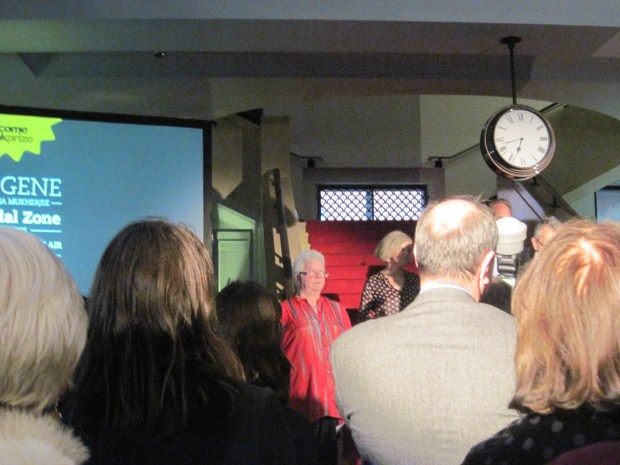
Chair of judges Val McDermid in center; fellow judge and BBC Radio books editor Di Spiers to her left.
Each of the judges then came to the podium to explain what they had all admired about a particular shortlisted book before presenting the author or author’s representative (editor, publisher or, in the case of Paul Kalanithi, his younger brother Jeevan, over from America) with flowers. When McDermid returned to the microphone to announce the winner, she started off by speaking of a book that combined two stories, the medical and the personal. Hmm, this might describe at least four or five of the books from the shortlist, I thought. Could it be When Breath Becomes Air, our shadow panel favorite? Or The Tidal Zone, our runner-up?
Within seconds the wait was over and we learned the actual winner was Mend the Living by Maylis de Kerangal. There was a pleased roar from the room, but also plenty of blinks and head shakes of surprise, I think. De Kerangal gave a few words of thanks, especially to the U.K. translator and publisher who made this edition of her book possible. This was the first work in translation to win the Wellcome Book Prize, and only the second novel (after Turn of Mind by Alice LaPlante in 2011).
Clare and I stuck around for another hour and were unexpectedly asked for book recommendations by a member of the Wellcome legal team who was kind enough to take an interest in us as book bloggers. She confessed that since uni she doesn’t read much anymore, but said that at school she enjoyed Jane Austen and she’s recently read Elena Ferrante’s books. Based on that rather thin history, we suggested she try Zadie Smith, and I also spoke up for Yaa Gyasi’s Homegoing.
On the way out we were given terrific bookish swag bags! Mine contained a paperback reissue copy of The Tidal Zone, a Wellcome Prize bookmark and commemorative booklet, and a blank notebook featuring optician’s glass eyes.

I can’t see such London events ever being frequent for me, especially given the cost of travel in from Newbury, but if a similar opportunity arises again I won’t hesitate to take advantage of it, especially if it means putting faces to names from the U.K. blogging community.
And the Winner Is…
I’m just back from London, where I saw the Wellcome Book Prize 2017 announced in the course of an awards ceremony held at the Wellcome Collection. It was an enjoyable evening; I needn’t have been so nervous. And it was lovely to meet two fellow bloggers.
 I’ll post a full write-up tomorrow, but for now I will just convey the news, to those who may not have heard yet, that the winner of this year’s Wellcome Book Prize is Mend the Living by Maylis de Kerangal. This was quite a shock to many of us in attendance. I hope it won’t sound ungracious if I say it was the collective least favorite of the shadow panel. But keep in mind that that’s relative: it was a strong set of six very different books, each worth reading.
Wellcome Book Prize Shadow Panel Decision
It’s been a whirlwind five weeks as we on the shadow panel have made our way through the six books shortlisted for the Wellcome Book Prize 2017. The list is strong and varied: an account of the AIDS crisis, a posthumous memoir by a neurosurgeon, a thorough history of genetics, an introduction to the microbial world, and novels about a donor heart and an ordinary family’s encounter with unexpected illness. All have been well worth engaging with, but when it came to decision time we had a pretty clear winner: When Breath Becomes Air by Paul Kalanithi. (With Sarah Moss’s The Tidal Zone a fairly close second.)


“I realized that the questions intersecting life, death, and meaning, questions that all people face at some point, usually arise in a medical context.” ~Paul Kalanithi
I first read this book a year and a half ago; when I picked it back up on Friday, I thought I’d give it just a quick skim to remind myself why I loved it. Before I knew it I’d read 50 pages, and I finished it last night in the car on the way back from a family party, clutching my dinky phone as a flashlight, awash in tears once again. (To put this in perspective: I almost never reread books. My last rereading was of several Dickens novels for my master’s in 2005–6.)
What struck me most on my second reading is how Kalanithi, even in his brief life, saw both sides of the medical experience (as the U.K. book cover portrays so well). He was the harried neurosurgery resident making life and death decisions and marveling at the workings of the brain; in a trice he was the patient with terminal lung cancer wondering how to make the most of his remaining time with his family.

Yet in both roles his question was always “What makes human life meaningful?” – a quest that kept him shuttling between science, literature and religion. In eloquent prose and with frequent scriptural allusions, this short, technically unfinished book narrates Kalanithi’s past (his growing-up years and medical training), present (undergoing cancer treatment but ultimately facing death) and future (the legacy he leaves behind, including his daughter).
Looking back once again at the guidelines for the Wellcome Book Prize (“At some point, medicine touches all our lives. Books that find stories in those brushes with medicine are ones that add new meaning to what it means to be human”), When Breath Becomes Air stands out as a perfect exemplar. In her blog review, Ruby writes, “This book looks death right in the eye and doesn’t seek to rationalise it, explain it, avoid it. It deals with it head on.” In his Nudge review Paul calls the book “equally heart breaking and full of love … a painfully honest account of a short, but intense life.”
My thanks, once again, to the other members of the shadow panel: Paul Cheney, GrrlScientist, Ruby Jhita and Amy Pirt.
Tomorrow evening the winner of the Wellcome Book Prize 2017 will be announced at an awards ceremony at the Wellcome Collection in London. As thanks for my participation in the blog tour, I’ve been invited to attend. Small talk and networking are very much outside of my comfort zone, but I couldn’t pass up this opportunity and hope to at the very least meet one or two fellow bloggers. I’ll post very quickly when I get home from the ceremony tomorrow night to announce the winner, and promise a longer write-up of the event sometime on Tuesday.
Polishing off the Wellcome Prize Shortlist: How to Survive a Plague
Spanning from the summer of 1981, when the New York Times first broke the story about a rare cancer observed in homosexuals, to 1996, when protease inhibitors came onto the market and offered HIV sufferers a new lease on life, How to Survive a Plague is a comprehensive history of the AIDS crisis. Especially in its early chapters, it reads like a fascinating medical mystery – though we already know the answers, the book skillfully captures the ignorance and terror that reigned for so many years as people sought to understand what Gay-Related Immune Deficiency (GRID, the original name for AIDS) was and how it was transmitted.
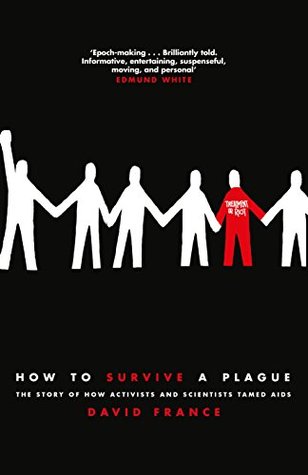 As a journalist and a gay man, David France was right in the thick of the crisis when he moved to Manhattan in 1981. He lost friends and lovers to AIDS, and had his own health scares, too – once, on assignment in war-torn Central America, he developed what he thought was a Kaposi’s sarcoma lesion but turned out to be a sign of amoebic infection.
Throughout the 1980s the number of HIV cases roughly doubled each year; media coverage was intense but often alarmist. Undertakers refused to deal with AIDS victims, and Jerry Falwell and his ilk spoke of a gay conspiracy taking over America. Far too slowly, research advanced to cope with the crisis. France gives details of the medical trials and presidential commissions that kept AIDS at the forefront of the national conscience, generally thanks to patient advocacy groups like ACT UP (AIDS Coalition to Unleash Power) and PWA (People with AIDS – more proactive terminology than victims or patients).
The book reminds me most of Sheri Fink’s Five Days in Memorial, another social history with a vast scope and a large cast of characters; here there are about 25 doctors, researchers and activists, many of them based in New York City, who keep recurring. For instance, there’s Joe Sonnabend, an infectious diseases expert who specialized in treating gay men for venereal diseases; Larry Kramer, who wrote an angry novel about fellow homosexuals yet tried to lead the response; and Richard Berkowitz, a former sex worker who co-wrote How to Have Sex in an Epidemic, a safe sex guide that encouraged a surge in condom use.
I rather underestimated the reading load the Wellcome shortlist would create for me; I ended up getting bogged down in this 500+-page book’s level of detail and only succeeded in skimming it. I think that for someone without a personal stake in the story of AIDS, watching the 2012 documentary film of the same title that spawned the book would be an easier way to absorb copious information and keep track of all the individuals and organizations involved.
Nonetheless, I can certainly affirm the importance of a landmark book like this one. When I surveyed critical opinion on it for Bookmarks magazine, I noticed many comparisons to Randy Shilts’s 1987 And the Band Played On, but while that book was written in medias res and deliberately vilified a French-Canadian flight attendant named Gaëtan Dugas who was linked with multiple AIDS cases in North America, How to Survive a Plague benefits from two decades of hindsight and reflects a mixture of journalistic objectivity and personal grief.
It’s sobering to remember the scale of the AIDS epidemic: 100,000 Americans had died of it by 1991. As one HIV-positive ACT UP activist cried out to Bill Clinton, then a Democratic candidate, at a campaign event, “Bill, we’re dying of neglect!” France’s book really brings home how traumatic these years were for a whole country, but especially for homosexuals. He describes the relief of knowing that effective medical treatment was finally in the pipeline, but also the lingering effects of shame, bitterness, and fear.
Nobody left those years uncorrupted by what they’d witnessed, not only the mass deaths—100,000 lost in New York City alone, snatched from tightly drawn social circles—but also the foul truths that a microscopic virus had revealed about American culture: politicians who welcomed the plague as proof of God’s will, doctors who refused the victims medical care, clergymen and often even parents themselves who withheld all but a shiver of grief. Such betrayal would be impossible to forget in the subsequent years.
My rating: 
My gut feeling: France has written a definitive history of the AIDS crisis in the United States. It’s a cautionary tale that must not be forgotten. While not among my personal favorites from the shortlist, it would be a worthy winner.
More reviews:
Clare’s at A Little Blog of Books
Stay tuned for our shadow panel winner, which I will announce here tomorrow morning!
Wellcome Book Prize Blog Tour: Ed Yong’s I Contain Multitudes
Ed Yong is a London-based science writer for The Atlantic and is part of National Geographic’s blogging network. I had trouble believing that I Contain Multitudes: The Microbes within Us and a Grander View of Life is his first book; it’s so fluent and engaging that it immediately draws you into the microbial world and keeps you marveling at its strange yet fascinating workings. Yong writes like a journalist rather than a scientist, and that’s a good thing: with an eye to the average reader, he uses a variety of examples and metaphors, intersperses personal anecdotes of visiting researchers at their labs or in the field, and is careful to recap important facts in a lucid way.
The book opens with a visit to San Diego Zoo (see the exclusive extract following my review), where we meet Baba the pangolin. But “Baba is not just a pangolin. He is also a teeming mass of microbes,” Yong explains. “Some of them live inside him, mostly in his gut. Others live on the surface of his face, belly, paws, claws, and scales.” Believe it or not, but we are roughly half and half human cells and microbial cells, making each of us – like all creatures – more of an ecosystem (another term is “holobiont”) than a single entity.
Microbes vary between species but also within species, so each individual’s microbiome in some ways reflects a unique mixture of genes and experiences. This is why people’s underarms smell subtly different, and how hyenas use their scent glands to convey messages. The microbiome may well be tailored to different creatures’ functions, so researchers at San Diego Zoo are testing swabs from their animals to see if there could be discernible signatures for burrowing or flying activities, or for disease. I was struck by the breadth of species considered here: not just mammals, but also invertebrates like beetles, cicadas, and squid – my entomologist husband would surely be proud. The “Us” in the subtitle is thus used very inclusively to speak of the way that microbes live in symbiosis with all living things.
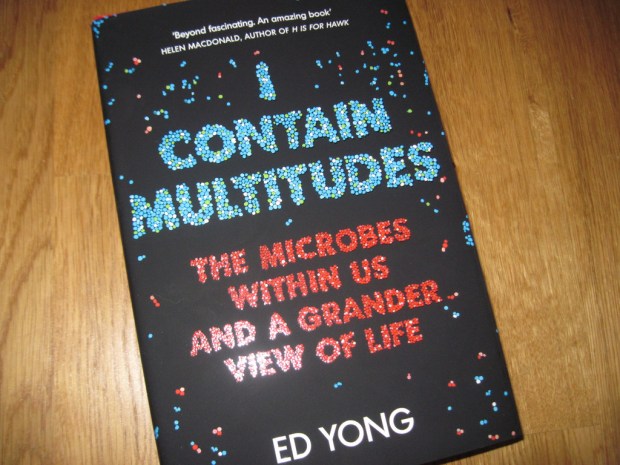
I love the textured dust jacket too.
If I were to boil down Yong’s book to one message, it’s that microbes are not simply “bad” or “good” but have different roles depending on the context and the host. You can hardly dismiss all bacteria as germs that must be eradicated when there are thousands of benign species in your gut (versus fewer than 100 kinds that cause infectious diseases). If it weren’t for the microbes passed on to us at birth, we wouldn’t be able to digest the complex sugars in our mothers’ milk. Other creatures rely on bacteria to help them develop to adulthood, like the tube worms that thrive on Navy ship hulls at Pearl Harbor.
Yet Yong feels too little attention is given to beneficial microbes, and in many cases we continue the campaign to rid ourselves of them through overuse of antibiotics and taking cleanliness to unhelpful extremes. “We have been tilting at microbes for too long, and created a world that’s hostile to the ones we need,” he asserts.
The book is full of lines like that one that combine a nice turn of phrase and a clever literary allusion. In the title alone, after all, you have references to Walt Whitman (“I contain multitudes” is from his “Song of Myself”) and Charles Darwin (“there is grandeur in this view of life” is part of the closing sentence in his On the Origin of Species). Yong also sets up helpful analogies, comparing the immune system to a thermostat and antibiotics to “shock-and-awe weapons … like nuking a city to deal with a rat.”
History and future are also brought together very effectively, with the narrative looking backwards to Leeuwenhoek’s early microscope work and Pasteur and Koch’s germ theory, but also forwards to the prospects that current research into microbes might enable: eliminating elephantiasis, protecting frogs from deadly fungi via probiotics in the soil, fecal microbiota transplants to cure C. diff infections, and so on.
The possibilities seem endless, and this is a book that will keep you shaking your head in amazement. I’d liken Yong’s style to David Quammen’s or Rebecca Skloot’s. His clear and intriguing science writing succeeds in inspiring wonder at the natural world and at the bodies that carry us through it.
With thanks to Joe Pickering at The Bodley Head for the review copy.
My rating: 
An exclusive extract from “PROLOGUE: A TRIP TO THE ZOO”
I Contain Multitudes by Ed Yong
(The Bodley Head)
All of us have an abundant microscopic menagerie, collectively known as the microbiota or microbiome.1 They live on our surface, inside our bodies, and sometimes inside our very cells. The vast majority of them are bacteria, but there are also other tiny organisms including fungi (such as yeasts) and archaea, a mysterious group that we will meet again later. There are viruses too, in unfathomable numbers – a virome that infects all the other microbes and occasionally the host’s cells. We can’t see any of these minuscule specks. But if our own cells were to mysteriously disappear, they would perhaps be detectable as a ghostly microbial shimmer, outlining a now-vanished animal core.2
In some cases, the missing cells would barely be noticeable. Sponges are among the simplest of animals, with static bodies never more than a few cells thick, and they are also home to a thriving microbiome.3 Sometimes, if you look at a sponge under a microscope, you will barely be able to see the animal for the microbes that cover it. The even simpler placozoans are little more than oozing mats of cells; they look like amoebae but they are animals like us, and they also have microbial partners. Ants live in colonies that can number in their millions, but every single ant is a colony unto itself. A polar bear, trundling solo through the Arctic, with nothing but ice in all directions, is completely surrounded. Bar-headed geese carry microbes over the Himalayas, while elephant seals take them into the deepest oceans. When Neil Armstrong and Buzz Aldrin set foot on the Moon, they were also taking giant steps for microbe-kind.
When Orson Welles said ‘We’re born alone, we live alone, we die alone’, he was mistaken. Even when we are alone, we are never alone. We exist in symbiosis – a wonderful term that refers to different organisms living together. Some animals are colonised by microbes while they are still unfertilised eggs; others pick up their first partners at the moment of birth. We then proceed through our lives in their presence. When we eat, so do they. When we travel, they come along. When we die, they consume us. Every one of us is a zoo in our own right’– a colony enclosed within a single body. A multi-species collective. An entire world.
Footnotes
- In this book, I use the terms ‘microbiota’ and ‘microbiome’ interchangeably. Some scientists will argue that microbiota means the organisms themselves, while microbiome refers to their collective genes. But one of the very first uses of microbiome, back in 1988, used the term to talk about a group of microbes living in a given place. That definition persists today – it emphasises the ‘biome’ bit, which refers to a community, rather than the ‘ome’ best, which refers to the world of genomes.
- This imagery was first used by the ecologist Clair Folsome (Folsome, 1985).
- Sponges: Thacker and Freeman, 2012; placozoans: personal communication from Nicole Dubilier and Margaret McFall-Ngai.
My gut feeling: This book is a fine example of popular science writing, and has much to teach us about the everyday workings of our bodies. It’s one of my three favorites from the shortlist.
See also: Paul’s review at Nudge
Shortlist strategy: Tomorrow I’ll post a quick response to David France’s How to Survive a Plague, and on Sunday we will announce our shadow panel winner.
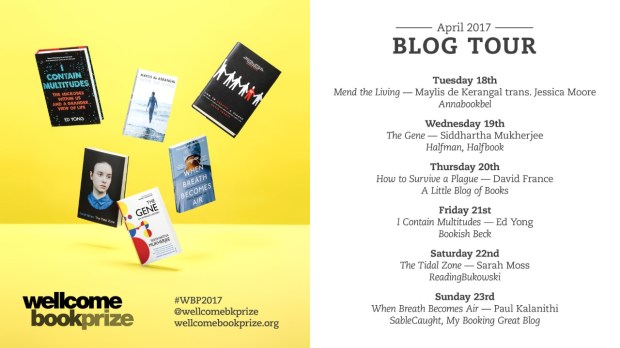
I was delighted to be asked to participate in the Wellcome Book Prize blog tour. See below for details of where other reviews and features have appeared or will be appearing soon.
And if you are within striking distance of London, please consider coming to one of the shortlist events being held this Saturday and Sunday.
Wellcome Prize Shortlist, Pt. 3: The Gene, Siddhartha Mukherjee
Siddhartha Mukherjee is an assistant professor of medicine at Columbia University, where his lab specializes in stem cells and blood cancers. His book The Emperor of All Maladies, which won a Pulitzer Prize in 2011, is among my most memorable reads of the past decade. Along with Rebecca Skloot’s The Immortal Life of Henrietta Lacks, it was one of the first books to turn me on to health-themed reading.
 So it was a disappointment to find that I could never really engage with his second full-length work, The Gene: An Intimate History. There’s no denying this book’s impressive scope: it’s a comprehensive survey of the past 150 years of genetics research, but it also stretches back to antiquity to see the different ways people have imagined that heredity works. It’s a no-holds-barred science and social history text, both chronological and thematic in approach, and it also surprises with its breadth of literary reference (as in the epigraphs from 1Q84 and The Importance of Being Earnest). However, my favorite snippets were those that constitute a mini family memoir of the schizophrenia that runs through the author’s India-based family.
Part of the problem was that a lot of the early material concerning Gregor Mendel and Charles Darwin is very familiar to me. High school genetics material has stayed fresh in my mind even though so many other subjects have faded, and I’ve done a lot of reading on Darwin for my Victorian Literature MA and on my own time. Darwin’s cousin, Francis Galton, then provides a segue into the dark side of genetics: eugenics. A lot of space is given to Nazism, but Mukherjee also hits closer to home with the case of Carrie Buck, a “feeble-minded” woman whose enforced sterilization the U.S. Supreme Court affirmed in 1927.
Other important figures in the history of genetics include Dutch botanist Hugo de Vries, Hermann Muller, Oswald Avery, Linus Pauling, and the famous English team that discovered the structure of DNA, Watson, Crick & Franklin. Parts Three and Four, which chronicle the advances in genetics that fell between the 1970s and early 2000s, struck me as particularly dull, whereas Part Five held my interest much more strongly in that it brings things up to date with the developments of the last 15 years, including epigenetics, genetic testing for breast cancer and schizophrenia, stem cell therapy and the search for a “gay gene.”
The book did leave me with a strong sense that our knowledge of genes – the least divisible unit of information about life – affects our understanding of the human identity and future:
In the early decades of the twenty-first century, we are learning to speak yet another language of cause and effect, and constructing a new epidemiology of self: we are beginning to describe illness, identity, affinity, temperament, preferences—and, ultimately, fate and choice—in terms of genes and genomes. This is not to make the absurd claim that genes are the only lenses through which fundamental aspects of our nature and destiny can be viewed. But it is to propose and to give serious consideration to one of the most provocative ideas about our history and future: that the influence of genes on our lives and beings is richer, deeper, and more unnerving than we had imagined. This idea becomes even more provocative and destabilizing as we learn to interpret, alter, and manipulate the genome intentionally, thereby acquiring the ability to alter future fates and choices.
However, at nearly 500 very dense, small-print pages, this book will, I fear, struggle to find a broad readership. Is it for science majors and graduate students? They’re likely to have their own university-approved textbooks. Is it an introduction for the general layman? Without a keen interest in science and a determination to learn the last word about genetics, readers are unlikely to persist with such a tome. I have a greater than average interest in genetic diseases, yet couldn’t manage more than a desultory skim. Unlike The Emperor of All Maladies, I can’t see this becoming a modern classic of popular science writing. For me it’s this year’s Citizen Kane: an achievement I can objectively admire but not personally warm to.
My rating:
My gut feeling: This was also shortlisted for the 2016 Royal Society Insight Investment Science Book Prize. I think it was better suited to that prize’s aims than to the Wellcome Prize’s. Keeping in mind that “the Wellcome Book Prize aims to excite public interest and encourage debate around these topics [birth and beginnings, illness and loss, pain, memory, and identity],” I unfortunately can’t see Mukherjee having the necessary universal appeal.
More reviews:
Paul’s at Nudge; he’s also on the Wellcome Book Prize blog tour for this title on Wednesday.
Shortlist strategy: I’m reviewing Ed Yong’s I Contain Multitudes for the Wellcome Book Prize blog tour on Friday. The last hurdle is David France’s How to Survive a Plague, another doorstopper I’m having to skim to get through. I plan to review it here on Saturday and on Sunday we will announce our shadow panel winner.
 Bookish Beck = Rebecca Foster. American transplant to England. Freelance proofreader and book reviewer.
 Bookish Beck