Book Triage
I feel like I have more books staring at me than ever before. I could blame free library reservations and a trip to Wigtown, but there’s one more major reason for the books stacking up: an utter lack of restraint when it comes to requesting or accepting books for review. I’ve had loads of books coming through the door in the past month or so. Some were offered to me by authors or publishers via Goodreads, Twitter or my blog’s contact form. Others I sent e-mails to request after I saw tempting reviews in the Guardian or previews on Susan’s blog.
Of course I want to read all of these books. I really want to read most of them. Otherwise I wouldn’t have gone to the trouble of requesting, borrowing or buying them. But even so, there’s only so much time. It’s not just a simple matter of picking up the book(s) from the stack that I most feel like reading at a given moment anymore. No, it’s become a triage process whereby I have to assess them by order of urgency.
So, what are my priorities? Here’s a baker’s dozen, in photos.
- Wellcome Book Prize shortlist reading. I’m on the last of six now; this is for the blog tour coming up next week.
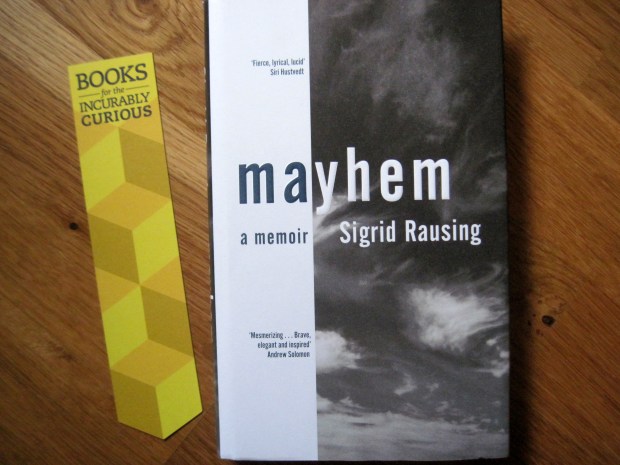
- Library books that are due in early May and requested after me.
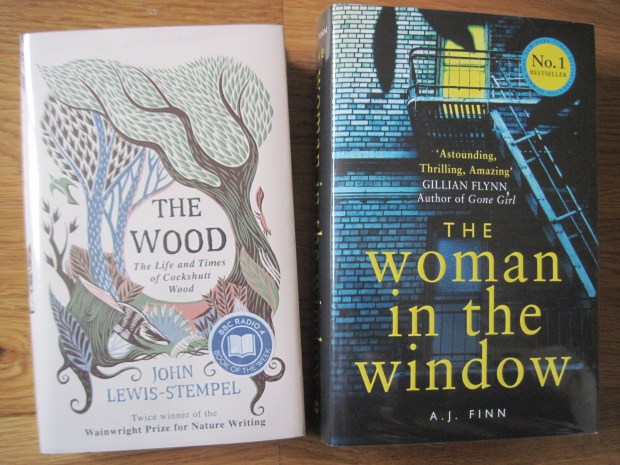
- Books I’ve requested for a blog review, in release date order. I feel so behind that you can expect some doubled-up reviews or mini-reviews in roundup form.
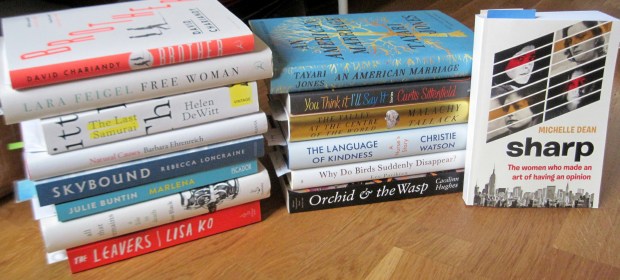
- Books I’ve agreed to review for another outlet, even if that’s just Goodreads.

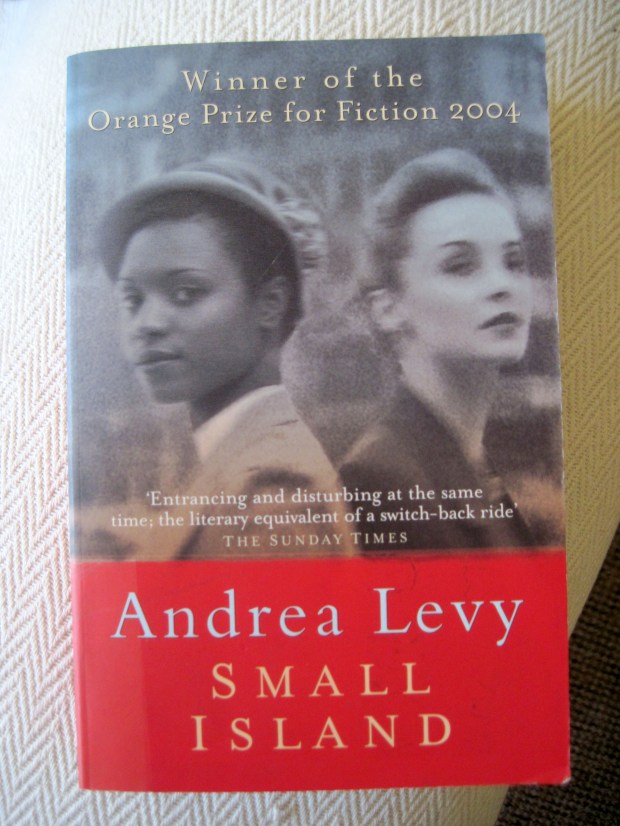
- My first-ever buddy read: Small Island with Buried in Print and Consumed by Ink, arranged months ago. Join us!
- Month- or season-specific reads.
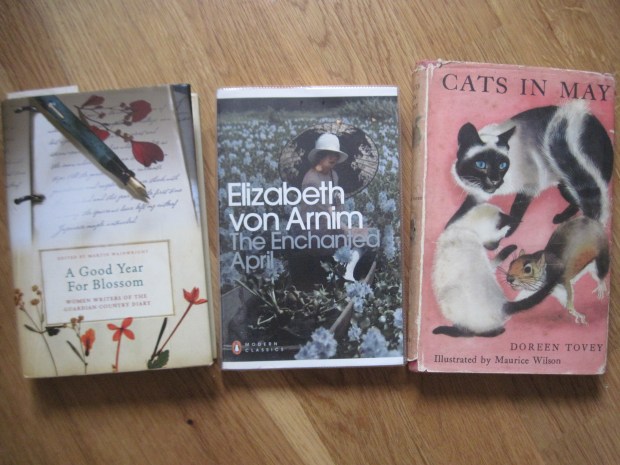
- Public library books with no current renewal issues.
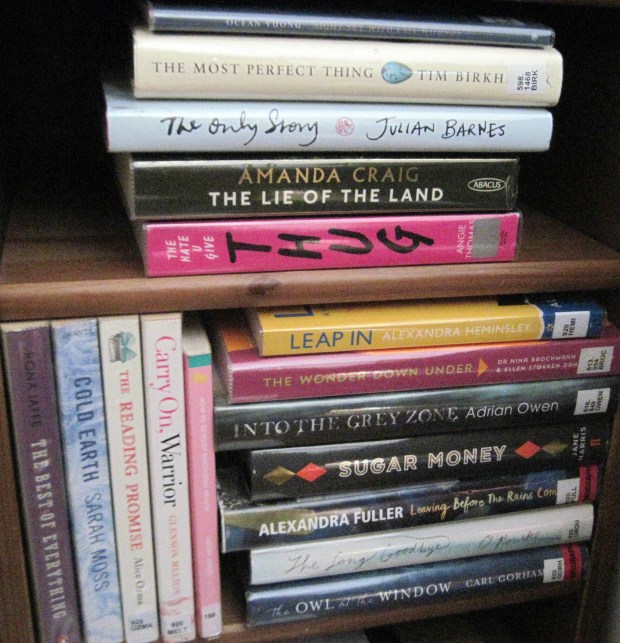
- Booker Prize winners for the 50th anniversary this summer – I’ll at least review the Coetzee for Shiny New Books, and perhaps a few more on the blog if I get the time.

- Three more Iris Murdoch novels to read as part of Liz’s #IMReadalong later on in the year, starting in June.

- Bibliotherapy prescriptions.

- Books I’ve set aside temporarily, generally because I have enthusiastically started too many at once and had to put some down to pick up more time-sensitive review books. Many of these I was enjoying very much and could see turning out to be 4- or even 5-star reads (especially Brooks, Frame and Matthiessen); others I might end up abandoning.

- University library books, which can be renewed pretty much indefinitely.

- Every other book I own, even if I had it eyed up for a particular challenge. My vague resolution to read lots of travel books and biographies has pretty much gone by the wayside so far. I also have barely managed a single classic. Sigh! There’s still two-thirds of the year left, but I certainly won’t be managing the one a month from these genres that I proposed.
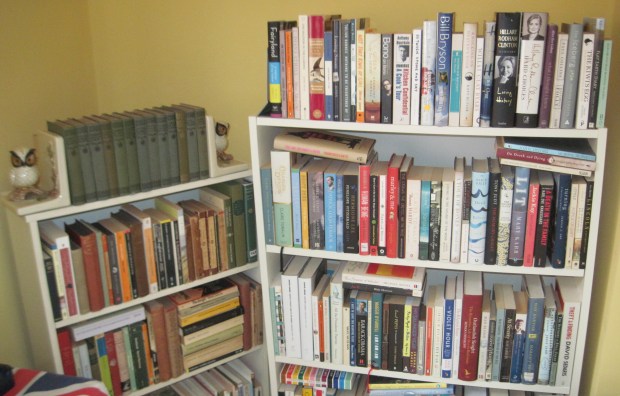
What’s your book triage situation like?
What to Look Out for in April
April will be a busy month on the blog what with four Wellcome Book Prize shortlist reviews plus posts on our shadow panel decision and the awards ceremony, three blog tours within a week, and various other review books jostling for my attention.

To be reviewed at any time.
April 5th seems to be a huge day for new releases. I own four print books that are all coming out on that day; alas, the only one I’ve been able to start is Elizabeth J. Church’s All the Beautiful Girls, for an upcoming Shiny New Books review. I’m approaching the one-quarter point. The others may well have to wait for a quieter time.
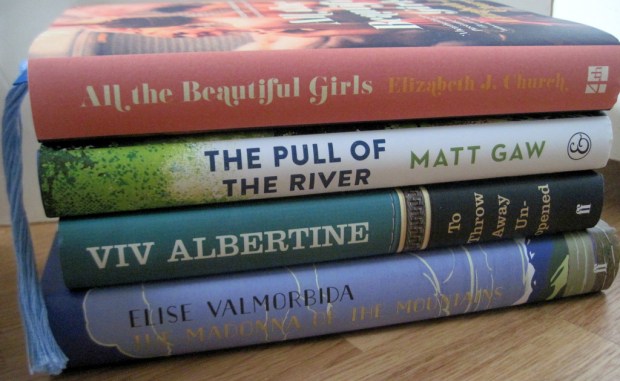
April 5th releases.
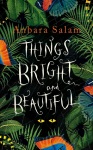 I started another April 5th release on my Kindle a couple of weeks ago, Things Bright and Beautiful by Anbara Salam. It’s about a missionary couple whose lives are disrupted by the return of an older missionary. I was thinking of abandoning it until I got to the last line of the prologue, which threw in a pretty great twist. So maybe I’ll go back to it.
For now, I can recommend the one April 5th release I actually managed to finish:
Dear Mrs. Bird by A.J. Pearce
 If you loved The Guernsey Literary and Potato Peel Pie Society, I have just the book for you: another feel-good World War II-set novel with characters you’ll cheer for. December 1940, London: Twenty-two-year-old Emmeline Lake dreams of being a Lady War Correspondent, but for now she’ll start by typing up the letters submitted to Henrietta Bird’s advice column in Woman’s Friend. All too quickly, though, the job feels too small for Emmy. Mrs. Bird refuses to print letters on Unpleasant subjects, which could include anything from an inappropriate crush to anxiety. She thinks cowardly readers bring their troubles on themselves and need to buck up instead of looking to others for help. But Emmy can’t bear to throw hurting people’s missives away. Perhaps she could send some advice of her own?
Emmy shares a flat with her best friend Bunty, and they each have a fiancé who is part of the war effort. As a volunteer for the Fire Brigade, Emmy sees the effects of Luftwaffe bombings up close. But it’s only after heartache hits home for both of these young women that they really understand how much is at stake in the war. The novel got a little melodramatic for me in its last quarter, but it’s overall a charming “Keep Calm and Carry On” and Stick It to Hitler-style story that never strays far from jollity for too long.
Other readalikes: My Salinger Year by Joanna Rakoff and The Night Watch by Sarah Waters
Some favorite lines:
“I told myself we could all get blown up by tomorrow so we might just as well enjoy ourselves.”
“Granny didn’t spend half her life chaining herself to railings for today’s woman to moon around waiting for some chap to look after her.”
My rating:
 On Monday we’re off to Wigtown, Scotland’s Book Town, for five days. Though we’ve been to Hay-on-Wye, Wales six times, we’ve never been to Wigtown despite meaning to for years. When I read Shaun Bythell’s Wigtown bookselling memoir last autumn, it felt like a sign that it was time. Did you see his The Diary of a Bookseller has been described in French as le quotidien d’un libraire misanthrope écossais (literally, “the daily life of a misanthropic Scottish bookseller”)?
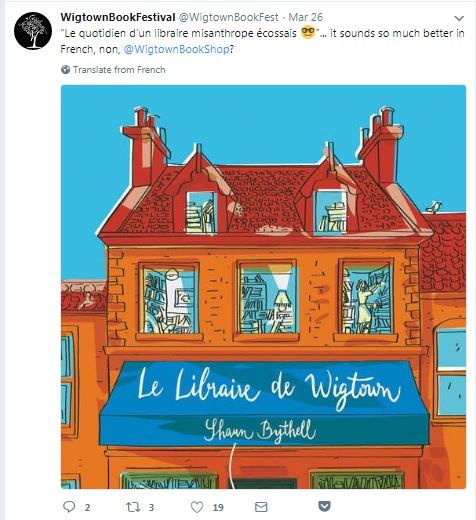
That’s too good! If only it were the official French title. I will of course be visiting his shop, and asking for a signature on my proof copy if I can pluck up the nerve. We’ll strive to be model customers lest we become the subject of a grumpy Tweet or Facebook post.
Coals to Newcastle and all that, but here’s the pile I’ve packed for Wigtown.
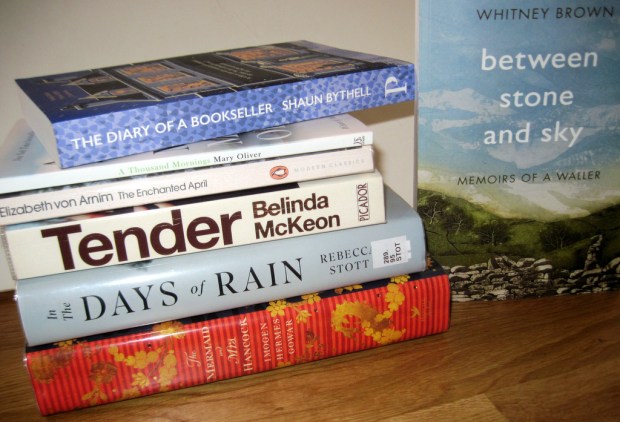
This is mostly for the six-hour car rides there and back. During the days we’ll be busy with outings to the surrounding countryside plus book shopping and café visits, but I daresay there will be some time for reading at the B&B in the afternoons and evenings.
For once I haven’t scoured my shelves for place-appropriate books; I don’t think I own any particularly Scottish reads, unless Michel Faber’s Under the Skin counts (ah wait, I also have an Ali Smith novel on the shelf).
Anyway, this time I’ve really just put together a pile of books I’ve been wanting to read for ages. The only ‘work’-related one is Between Stone and Sky, for a TLS review; otherwise I’m giving myself from Easter through the 6th off. I’m not even sure I’ll take my Kindle, except as a backup – that kind of thing could get you (or, rather, your Kindle) shot in this town. If I do, I’ll be sure to leave it behind in the B&B room or the glove box when we go into town for the day!
What are you up to in April?
Library Checkout: March 2018
Last month I rejoiced that reservations would once again be free through my library system. On the very day the policy came into effect, what did I do? Went into the online catalogue and placed 15 reservations (the maximum). And then when some of those arrived for me, I placed more to get back up to 15. And then when some of those arrived… You get the picture. Why this compulsive placing of holds when I already have massive stacks of books to read? I have nothing to say in my defense. At least books are a benign addiction, right?
This month I also resumed using a library system I haven’t used in several years. I had a few hours to kill in Reading town center before a routine hospital appointment, so decided to take advantage of the library’s stock, which seems to be particularly good on memoirs by women.
So as not to overwhelm you, and because so many books are still hanging on from previous months, I’ll only feature the new to-be-read arrivals since last month’s Library Checkout post, and in photo form. As usual, I’ve added in star ratings and links to Goodreads reviews of books I haven’t already featured on the blog.
LIBRARY BOOKS READ
- Little Women by Louisa May Alcott (a re-read for me)

- Herzog by Saul Bellow
- Harmless Like You by Rowan Hisayo Buchanan
- Mean Time by Carol Ann Duffy [poetry]
- The Book of Forgotten Authors by Christopher Fowler

- Vita Nova by Louise Glück [poetry]

- Plot 29: A Memoir by Allan Jenkins
- This Is Going to Hurt: Secret Diaries of a Junior Doctor by Adam Kay
- There Is an Anger that Moves by Kei Miller [poetry]
- Somebody I Used to Know by Wendy Mitchell with Anna Wharton
- And When Did You Last See Your Father? by Blake Morrison

- Lots of Candles, Plenty of Cake by Anna Quindlen
- Spirals in Time: The Secret Life and Curious Afterlife of Seashells by Helen Scales
- Probably Nothing: A diary of not-your-average nine months by Matilda Tristram [graphic novel]
SKIMMED ONLY
- With the End in Mind: Dying, Death and Wisdom in an Age of Denial by Kathryn Mannix – I now own a copy that I will revisit for the Wellcome Book Prize shadow panel.
CURRENTLY READING
- To the Is-Land: An Autobiography by Janet Frame
- Life in the Garden by Penelope Lively
- Never Mind by Edward St. Aubyn
- The Vaccine Race by Meredith Wadman
- Island Home: A Landscape Memoir by Tim Winton
CHECKED OUT, TO BE READ


(Cut off in middle photo: Cold Earth by Sarah Moss and The Mermaid and Mrs. Hancock by Imogen Hermes Gowar)
IN THE RESERVATION QUEUE
- The Grave’s a Fine and Private Place by Alan Bradley
- The Wonder Down Under: A User’s Guide to the Vagina by Dr. Nina Brochmann and Ellen Støkken Dahl
- Anecdotal Evidence by Wendy Cope
- The Lie of the Land by Amanda Craig
- Take Courage: Anne Brontë and the Art of Life by Samantha Ellis
- The Woman in the Window by A.J. Finn
- Other Minds: The Octopus and the Evolution of Intelligent Life by Peter Godfrey-Smith
- Leap In: A Woman, Some Waves, and the Will to Swim by Alexandra Heminsley
- Morning: How to Make Time: A Manifesto by Allan Jenkins
- The Wood: The Life and Times of Cockshutt Wood by John Lewis-Stempel
- The Executor by Blake Morrison
- To Be a Machine: Adventures among Cyborgs, Utopians, Hackers, and the Futurists Solving the Modest Problem of Death by Mark O’Connell
- Brainstorm: Detective Stories from the World of Neurology by Suzanne O’Sullivan
- Into the Gray Zone: A Neuroscientist Explores the Border between Life and Death by Adrian Owen
- Home Fire by Kamila Shamsie
- Tin Man by Sarah Winman
- Not that Kind of Love by Clare Wise and Greg Wise
RETURNED UNREAD
- Testosterone Rex: Myths of Sex, Science, and Society by Cordelia Fine – I lost interest and have plenty of other medical-themed reads on the pile thanks to the Wellcome Book Prize shortlist.
RETURNED UNFINISHED
- The Secret Life of Cows by Rosamund Young – I read the first 33 pages out of 137. I had two problems with the book: the twee anthropomorphism (“almost every day, we see daughters consulting their mothers about impending confinements, or maybe just discussing the weather”), and the fact that the author, a family farmer, can be compassionate enough to call intensive animal-rearing “iniquitous criminality” yet raises animals and lovingly observes their behavior only to see them killed.
What have you been reading from your local libraries? Does anything appeal from my stacks?
Snow-y Reads
It’s been a frigid start to March here in Europe. Even though it only amounted to a few inches in total, this is still the most snow we’ve seen in years. We were without heating for 46 hours during the coldest couple of days due to an inaccessible frozen pipe, so I’m grateful that things have now thawed and spring is looking more likely. During winter’s last gasp, though, I’ve been dipping into a few appropriately snow-themed books. I had more success with some than with others. I’ll start with the one that stood out.


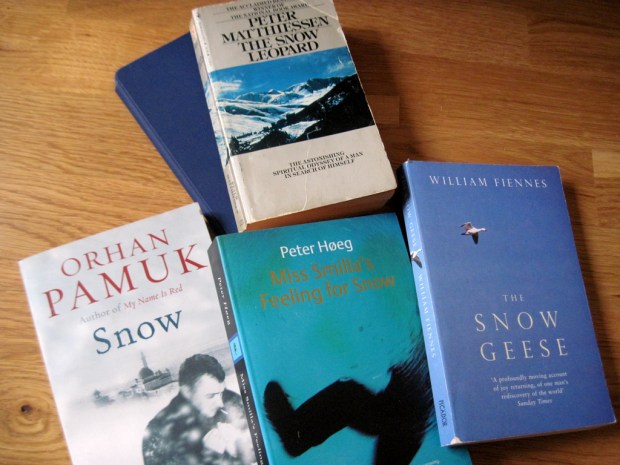
Miss Smilla’s Feeling for Snow by Peter Høeg (1992)
[trans. from the Danish by Felicity David]
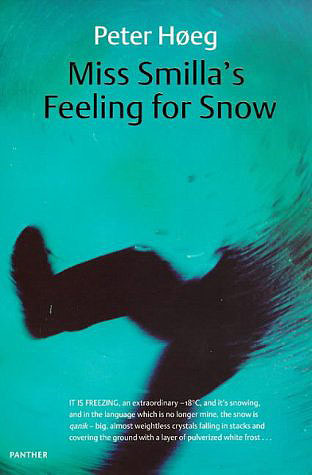 Nordic noir avant la lettre? I bought this rather by accident; had I realized it was a murder mystery, I never would have taken a chance on this international bestseller. That would have been too bad, as it’s much more interesting than your average crime thriller. The narrator/detective is Smilla Jaspersen: a 37-year-old mathematician and former Arctic navigator with a Danish father and Greenlander mother, she’s a stylish dresser and a shrewd, bold questioner who makes herself unpopular by nosing about where she doesn’t belong.
Isaiah, a little Greenlander boy, has fallen to his death from the roof of the Copenhagen apartment complex where Smilla also lives, and she’s convinced foul play was involved. In Part I she enlists the help of a mechanic neighbor (and love interest), a translator, an Arctic medicine specialist, and a mining corporation secretary to investigate Isaiah’s father’s death on a 1991 Arctic expedition and how it might be connected to Isaiah’s murder. In Part II she tests her theories by setting sail on the Greenland-bound Kronos as a stewardess. At every turn her snooping puts her in danger – there are some pretty violent scenes.
I read this fairly slowly, over the course of a month (alongside lots of other books); it’s absorbing but in a literary style, so not as pacey or full of cliffhangers as you’d expect from a suspense novel. I got myself confused over all the minor characters and the revelations about the expeditions, so made pencil notes inside the front cover to keep things straight. Setting aside the plot, which gets a bit silly towards the end, I valued this most for Smilla’s self-knowledge and insights into what it’s like to be a Greenlander in Denmark. I read this straight after Gretel Ehrlich’s travel book about Greenland, This Cold Heaven – an excellent pairing I’d recommend to anyone who wants to spend time vicariously traveling in the far north.
Favorite wintry passage:
“I’m not perfect. I think more highly of snow and ice than of love. It’s easier for me to be interested in mathematics than to have affection for my fellow human beings.”
My rating:
One that I left unfinished:
Snow by Orhan Pamuk (2002)
[trans. from the Turkish by Maureen Freely]
 This novel seems to be based around an elaborate play on words: it’s set in Kars, a Turkish town where the protagonist, a poet known by the initials Ka, becomes stranded by the snow (Kar in Turkish). After 12 years in political exile in Germany, Ka is back in Turkey for his mother’s funeral. While he’s here, he decides to investigate a recent spate of female suicides, keep tabs on the upcoming election, and see if he can win the love of divorcée Ipek, daughter of the owner of the Snow Palace Hotel, where he’s staying. There’s a hint of magic realism to the novel: the newspaper covers Ka’s reading of a poem called “Snow” before he’s even written it. He and Ipek witness the shooting of the director of the Institute of Education. The attempted assassination is revenge for him banning girls who wear headscarves from schools.
As in Elif Shafak’s Three Daughters of Eve, the emphasis is on Turkey’s split personality: a choice between fundamentalism (= East, poverty) and secularism (= West, wealth). Pamuk is pretty heavy-handed with these rival ideologies and with the symbolism of the snow. By the time I reached page 165, having skimmed maybe two chapters’ worth along the way, I couldn’t bear to keep going. However, if I get a recommendation of a shorter and subtler Pamuk novel I would give him another try. I did enjoy the various nice quotes about snow (reminiscent of Joyce’s “The Dead”) – it really was atmospheric for this time of year.
Favorite wintry passage:
“That’s why snow drew people together. It was as if snow cast a veil over hatreds, greed and wrath and made everyone feel close to one another.”
My rating:
One that I only skimmed:
The Snow Geese by William Fiennes (2002)
 Having recovered from an illness that hit at age 25 while he was studying for a doctorate, Fiennes set off to track the migration route of the snow goose, which starts in the Gulf of Mexico and goes to the Arctic territories of Canada. He was inspired by his father’s love of birdwatching and Paul Gallico’s The Snow Goose (which I haven’t read). I thought this couldn’t fail to be great, what with its themes of travel, birds, illness and identity. However, Fiennes gets bogged down in details. When he stays with friendly Americans in Texas he gives you every detail of their home décor, meals and way of speaking; when he takes a Greyhound bus ride he recounts every conversation he had with his random seatmates. This is too much about the grind of travel and not enough about the natural spectacles he was searching for. And then when he gets up to the far north he eats snow goose. So I ended up just skimming this one for the birdwatching bits. I did like Fiennes’s writing, just not what he chose to focus on, so I’ll read his other memoir, The Music Room.
My rating:
 Considered but quickly abandoned: In the Midst of Winter by Isabel Allende
Would like to read soon: The Snow Leopard by Peter Matthiessen – my husband recently rated this 5 stars and calls it a spiritual quest memoir, with elements of nature and travel writing.
What’s been your snowbound reading this year?
Library Checkout: February 2018 – A Bumper Edition!
I found a plethora of interesting books, many of them pretty recent, on my last few trips to the public library. I had somehow convinced myself that my library system doesn’t have many interesting new books in stock, but I was proven wrong.
Plus, excellent news: As of March 1st, reservations will be free again. Eleven months ago, the library system brought in a 50-pence charge for every reservation and I stopped placing holds altogether. I can only presume that this was an experiment that didn’t bring in enough revenue, or that, now that the council has reduced hours and staffed its branch libraries with volunteers only, they can afford to offer reservations for free again. It’s a sad state of affairs in general, but a boon for me: from next month I’ll be able to place holds on any Wellcome-shortlisted titles I haven’t read, and lots of other recent books I’m interested in.
For once I’ve done a good job of plowing through a bunch of my library books, including the four books that made up the Costa Prize for Poetry shortlist. As usual, I’ve added in star ratings and links to reviews of books I haven’t already featured on the blog in some way.
LIBRARY BOOKS READ
- The Travelling Cat Chronicles by Hiro Arikawa

- Women and Power: A Manifesto by Mary Beard

- Kumukanda by Kayo Chingonyi [poetry – shortlisted for Costa Prize]
- Inside the Wave by Helen Dunmore [poetry – winner of Costa Prize]
- This Cold Heaven: Seven Seasons in Greenland by Gretel Ehrlich
- Family Matters by Rohinton Mistry
- On Balance by Sinéad Morrissey [poetry – shortlisted for Costa Prize]
- Useful Verses by Richard Osmond [poetry – shortlisted for Costa Prize]
- The Man Who Mistook His Wife for a Hat by Oliver Sacks
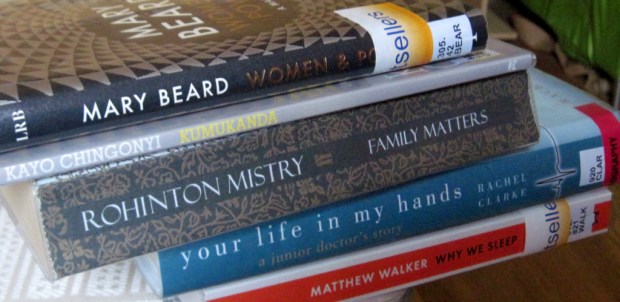
A selection of the library books I read and skimmed this past month (the others have since been returned).
SKIMMED ONLY
- Your Life in My Hands: A Junior Doctor’s Story by Rachel Clarke
- Why We Sleep: The New Science of Sleep and Dreams by Matthew Walker
CURRENTLY READING
- Little Women by Louisa May Alcott (a re-read)
- Herzog by Saul Bellow
- Harmless Like You by Rowan Hisayo Buchanan
- The Book of Forgotten Authors by Christopher Fowler
- To the Is-Land: An Autobiography by Janet Frame
- Plot 29: A Memoir by Allan Jenkins
- There Is an Anger that Moves by Kei Miller [poetry]
- And When Did You Last See Your Father? by Blake Morrison
- Spirals in Time: The Secret Life and Curious Afterlife of Seashells by Helen Scales
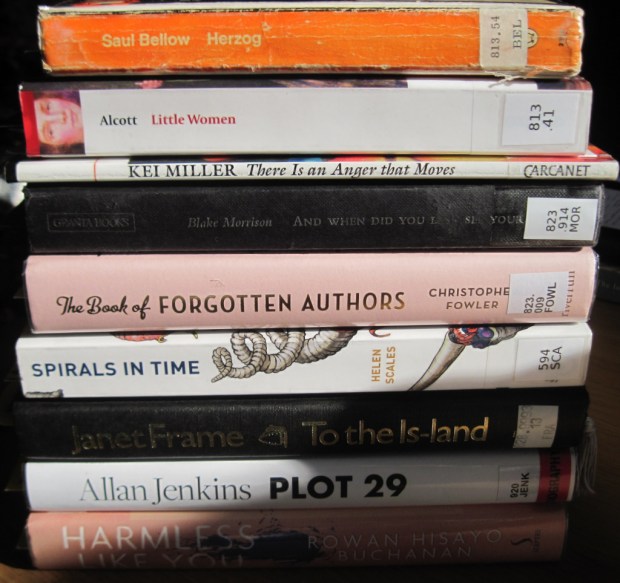
The currently reading stack.
CHECKED OUT, TO BE READ
Public library:
- The Most Perfect Thing: Inside (and Outside) a Bird’s Egg by Tim Birkhead
- Mean Time by Carol Ann Duffy [poetry]
- Testosterone Rex: Myths of Sex, Science, and Society by Cordelia Fine
- Somebody I Used to Know by Wendy Mitchell with Anna Wharton
- In the Days of Rain by Rebecca Stott
- Island Home: A Landscape Memoir by Tim Winton
- The Secret Life of Cows by Rosamund Young
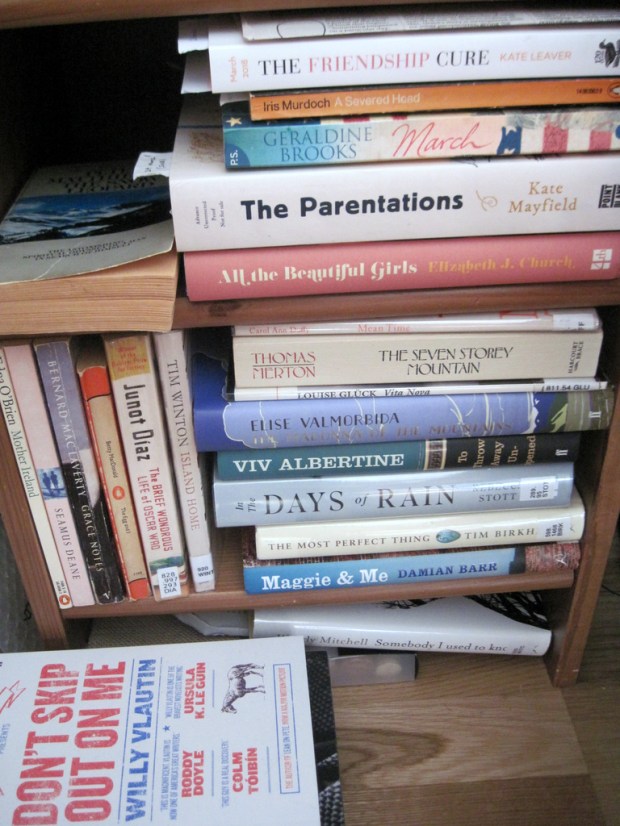
My bedside table (and environs) with its usual overwhelming selection of review books, library books, and backlist books from my own collection. And yes, it’s double-stacked!
University library:
- The Amazing Adventures of Kavalier & Clay by Michael Chabon
- The Brief Wondrous Life of Oscar Wao by Junot Díaz
- Vita Nova by Louise Glück [poetry]
- On the Road by Jack Kerouac
- The Cabaret of Plants: Botany and the Imagination by Richard Mabey
- The Sparrow by Mary Doria Russell
- The Catcher in the Rye by J.D. Salinger
- The Magnificent Spinster by May Sarton
RETURNED UNREAD
- Take Courage: Anne Brontë and the Art of Life by Samantha Ellis – This was requested by another user before I had a chance to read it. Maybe I’ll put a hold on it next month and try again.
What have you been reading from your local libraries? Does anything appeal from my stacks?
Today Is World Read Aloud Day
 An unprecedented second post in one day for me. I recently learned from Ron Charles’s article in the Washington Post that today, February 1st, is World Read Aloud Day, an annual celebration hosted by LitWorld to draw attention to ongoing literacy challenges. I mentioned in my write-up of my bibliotherapy experience that one recommendation I was given was to try reading aloud with my husband. To that end, I got hold of the three suggested books below and we’ve dipped into all of them on recent evenings. At the moment we’re managing to do a bit of reading aloud every few days, which isn’t so bad for a start.
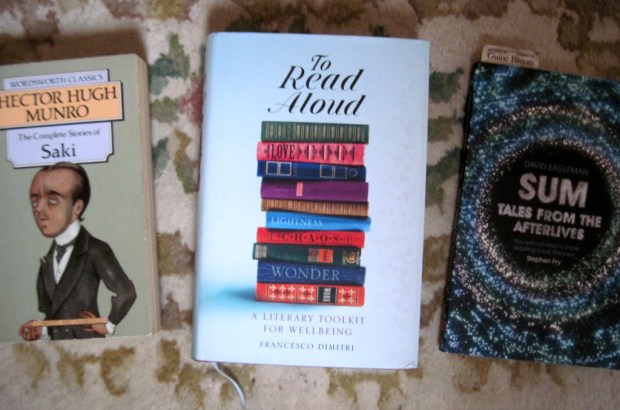
Dimitri’s book includes extracts by everyone from Neil Gaiman to Robert Macfarlane, all arranged under thematic headings. A special index at the back of the book orders the pieces according to how long they are estimated to take to read, ranging from three minutes to more like 15. So far we’ve tackled a handful of the shorter pieces; any of the longer ones we’ll probably split and each take half.
David Eagleman’s flash fiction collection is billed as being about the afterlife. The first story was a laugh-out-loud inventory of all the time the average human spends on different activities. Thirty-three hours sleeping versus 14 minutes experiencing pure joy. That kind of thing. I look forward to the rest.
Ella Berthoud particularly recommended Saki’s short story “Tobermory” since it’s about a talking cat (but is rather dark!), so we started with that one. Many of the others are only a couple of small-print pages. Have you read any Saki? What can you recommend?
Apart from classroom experiences, the last time I remember doing concerted reading aloud was with my mother when I was in my early teens. After I got home from school in the afternoons we’d convene on her bed to read Mark Twain short stories like “The Celebrated Jumping Frog of Calaveras County.”
Have you done any reading aloud lately?
Library Checkout: January 2018
Here’s what’s changed since last month:
LIBRARY BOOKS READ
- The Heart’s Invisible Furies by John Boyne
- Ali: A Life by Jonathan Eig
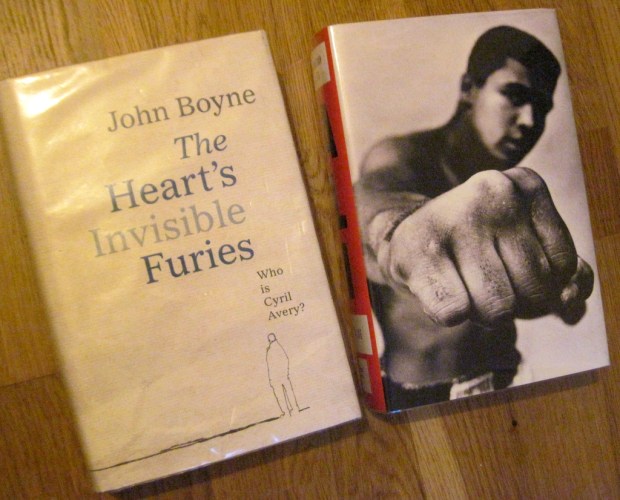
Two absolutely knock-out doorstoppers!
CURRENTLY READING
- Herzog by Saul Bellow
- This Cold Heaven: Seven Seasons in Greenland by Gretel Ehrlich
- Family Matters by Rohinton Mistry
- On Balance by Sinéad Morrissey [poetry – shortlisted for Costa Prize]
- The Man Who Mistook His Wife for a Hat by Oliver Sacks
- Spirals in Time: The Secret Life and Curious Afterlife of Seashells by Helen Scales
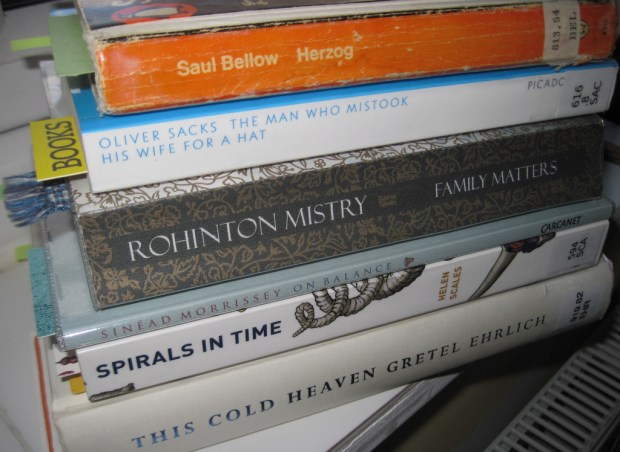
Then you’ll recognize a lot of the same titles hanging over from last month. The lack of a firm due date for the university library books (they can be renewed pretty much indefinitely) makes me put them off in favor of other, seemingly more timely, reads.
CHECKED OUT, TO BE READ
Public library:
- Harmless like You by Rowan Hisayo Buchanan
- Inside the Wave by Helen Dunmore [poetry – winner of Costa Prize]
- Useful Verses by Richard Osmond [poetry – shortlisted for Costa Prize]
University library:
- The Amazing Adventures of Kavalier & Clay by Michael Chabon
- The Brief Wondrous Life of Oscar Wao by Junot Díaz
- To the Is-land: An Autobiography by Janet Frame
- Vita Nova by Louise Glück [poetry]
- On the Road by Jack Kerouac
- The Cabaret of Plants: Botany and the Imagination by Richard Mabey
- There Is an Anger that Moves by Kei Miller [poetry]
- And When Did You Last See Your Father? by Blake Morrison
- The Sparrow by Mary Doria Russell
- The Catcher in the Rye by J.D. Salinger
- The Magnificent Spinster by May Sarton

RETURNED UNREAD
- Ghosts of Christmas Past, a story collection edited by Tim Martin – The only one I read was Neil Gaiman’s dark 100-word tale, “Nicholas Was.” When it came down to it, I realized I wasn’t actually that interested in holiday ghost stories.
- The High Places by Fiona McFarlane – Once again I borrow a short story collection with the best of intentions but return it unread. Sigh!
- NeuroTribes: The Legacy of Autism and the Future of Neurodiversity by Steve Silberman – Alas, this was requested back from the uni library by another user. I’ll have to get it out again another time.
- Bellwether by Connie Willis – My husband read it and enjoyed it well enough, but from his description it sounds silly to me. I’ll try to find another of her books to be the right follow-up to last year’s read of To Say Nothing of the Dog.
What have you been reading from your local libraries? Does anything appeal from my stacks?
Final 2017 Statistics and 2018 Goals
It’s possible that I might finish another book tomorrow, but as we now have house guests here through the 2nd, it’s probably for the best if I consider the reading year done. I even surpassed 2016’s reading total, making this my most prolific year ever:
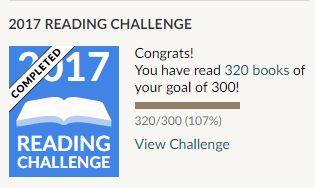
The breakdown:
Fiction: 49.3%
Nonfiction: 40.7%
Poetry: 10%
(Very similar to last year.)
Male author: 38.4%
Female author: 61.6%
(Roughly the same thing happened last year, which I find interesting because I have never consciously set out to read more books by women.)
E-books: 25.2%
Print books: 74.8%
(This really surprised me. Last year I was at one-third e-books / two-thirds print books, but this year the print books have dominated even more. I think this might be because I’m more likely to read lots of books on Kindle when traveling and we’ve done less travel overall; I’ve also scaled back on some of the reviewing gigs that only send me e-books.)
Works in translation: 8%
(I thought I’d done better than last year, but I actually read a bit less in translation. Sigh.)
Where my books came from for the whole year:
- Free print or e-copy from publisher: 28%
- Downloaded from NetGalley or Edelweiss: 22.2%
- Secondhand purchase: 18.5%
- Public library: 16.7%
- Free from giveaways (or Book Thing of Baltimore): 6.5%
- Gifts: 6.2%
- University library: 1.9%
Some interesting additional statistics courtesy of Goodreads:
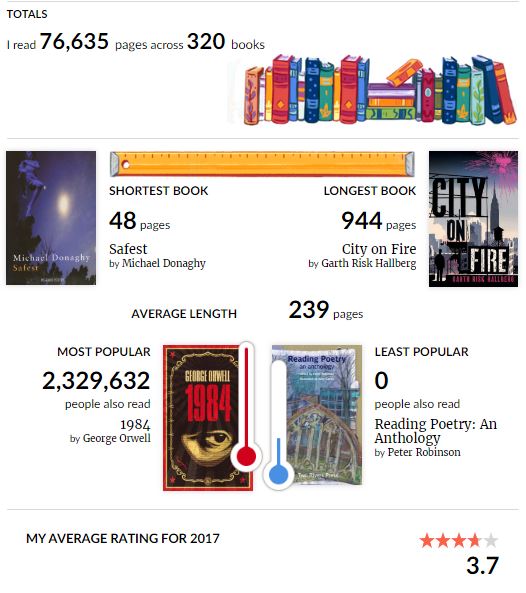
2018 Goals
Looking back at the reading goals I set for 2017, I’m pleased to see that I did indeed get involved with blog tours and prize shadow panels: I participated in eight blog tours and two shadow panels (the Wellcome Book Prize and the Sunday Times Young Writer of the Year Award – highlights of my bookish year; I’ll probably do the Wellcome again next year). I was pretty consistent about featuring at least one classic and a doorstopper per month. I doubt I’ll keep those challenges up on a monthly basis in 2018, but I might do them occasionally.
Specifically, in the next year I’d like to focus on:
- Travel classics
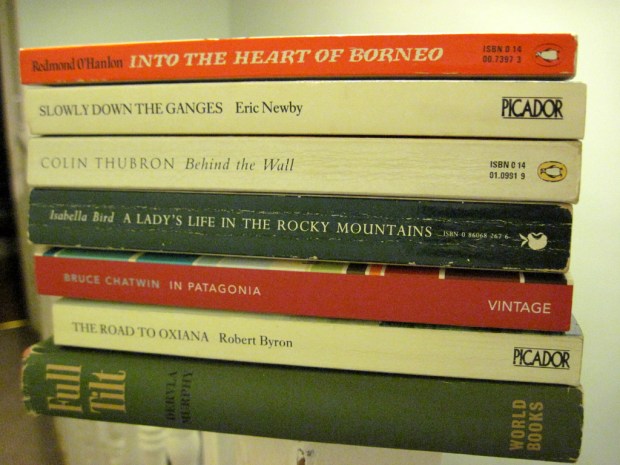
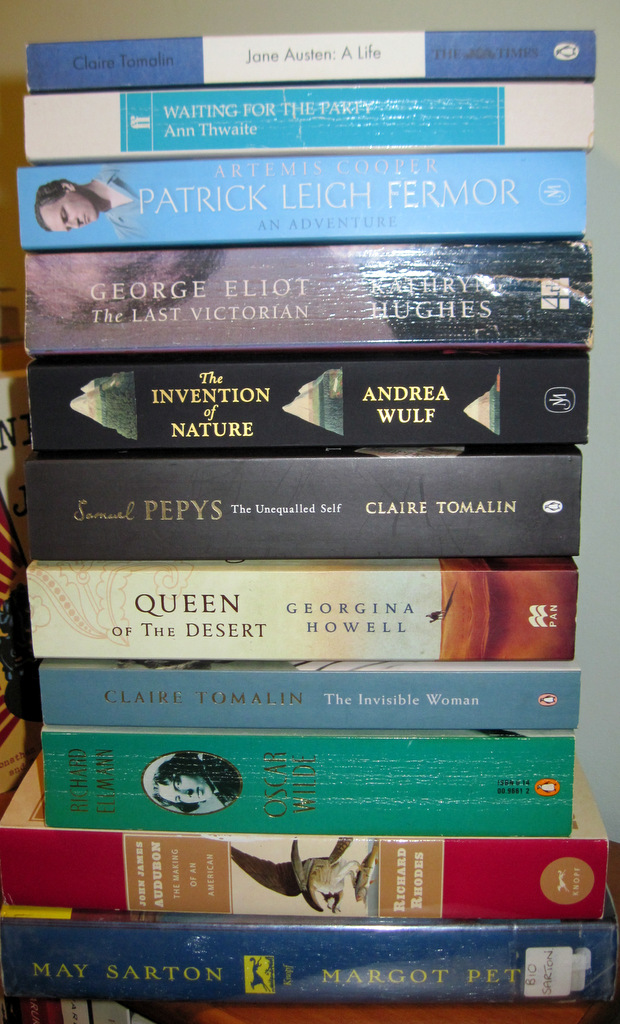
- Biographies, some of which will happen to top out at 500 pages or more.
- Literature in translation (I’d like to increase the past year’s percentage.)
- The books I own – I went around and counted 327 unread books in the house, which is more than a year’s reading. (This is opposed to 221 at this time last year; I blame a trip to Hay-on-Wye, multiple visits to Book Cycle in Exeter, free books acquired from the swap shop, and a 3-for-95 pence deal one of our local charity shops used to have.) In addition, I have nearly 350 books on my Kindle: again, over a year’s reading. To keep chipping away at the books I already own, I need to scale back on purchases and on requests from publishers (print or e-) and try to make the books from my own shelves account for at least a quarter – better, a third – of my reading in 2018.
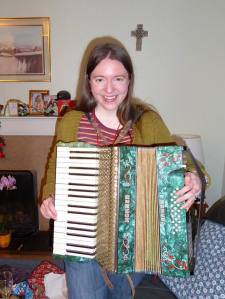 Unrelated to books … I got a vintage accordion for Christmas and need to learn a) how to read music and b) how to play an accordion. It should be a fun project!
I’ll be back at some point next week – once I’ve had time to wade through all the upcoming 2018 releases I’ve heard about via Goodreads, NetGalley, Edelweiss, Publishers Weekly, Library Journal, Twitter, Instagram, other bloggers, etc. – to preview the 25–30 coming out in the first half of the year that I’m most excited about.
Happy New Year, everyone! Thanks for your support of my blog through another year.
How did 2017 turn out for you reading-wise? What are some of your goals for 2018?
Library Checkout: December 2017
Posting early this month so that I’m not a nuisance on Christmas Day…
Most of the usual suspects from last month are still hanging around waiting to be read, though I also got (small!) fresh stacks out from both the public library and the university library.
LIBRARY BOOKS READ
- Our Endless Numbered Days by Claire Fuller
CURRENTLY READING
- Herzog by Saul Bellow
- The Heart’s Invisible Furies by John Boyne
- The Man Who Mistook His Wife for a Hat by Oliver Sacks
- Spirals in Time: The Secret Life and Curious Afterlife of Seashells by Helen Scales
CHECKED OUT, TO BE READ
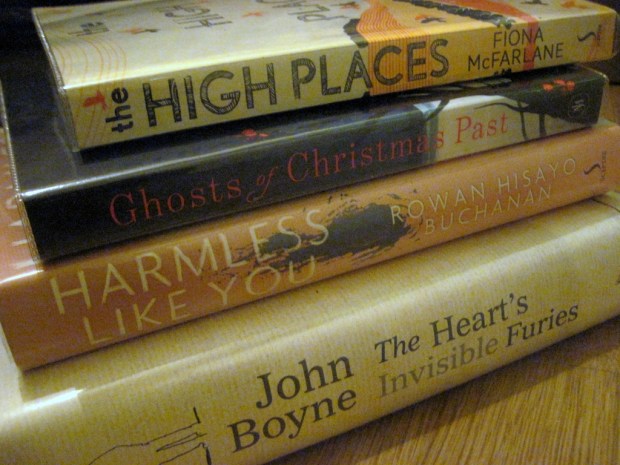
Public library

University library
Still out from the university library:
- This Cold Heaven: Seven Seasons in Greenland by Gretel Ehrlich
- To the Is-land: An Autobiography by Janet Frame
- Vita Nova [poetry] by Louise Glück
- The Cabaret of Plants: Botany and the Imagination by Richard Mabey
- There Is an Anger that Moves [poetry] by Kei Miller
- And When Did You Last See Your Father? by Blake Morrison
- The Catcher in the Rye by J.D. Salinger
- The Magnificent Spinster by May Sarton
RETURNED UNFINISHED
- The Cat Who Stayed for Christmas by Cleveland Amory
- Howl, Kaddish and Other Poems by Allen Ginsberg
RETURNED UNREAD
- Fresh Complaint: Stories by Jeffrey Eugenides – I’ve read all of his novels, so felt that I should at least try his short stories, but a glance at the table of contents made my heart sink. All of the stories are at least 20 pages long, and one is titled “The Oracular Vulva” (?!). I still have this on my Kindle, so perhaps I’ll try it another time.
What have you been reading from your local libraries? Does anything appeal from my stacks?
Merry Christmas to all!
The Rest of the Books I Abandoned in 2017, and the Year’s Disappointments
My abandoned books posts are always perversely popular, garnering nearly twice as many views as many of my reviews. This seems to be because fellow readers are secretly (and a bit guiltily) looking for permission to give up on the books they’re not enjoying. I hereby grant you my blessing! If after 25 pages or so a book is not grabbing you – even if it’s a bestseller, or a book all the critics or bloggers are raving about – have no shame about putting it down. You can always change your mind and try it another time, but ultimately you are the arbiter of your own internal library, and only you can say whether a book is for you or not.
That said, here are all the rest of the books I’ve abandoned since May’s post (not mentioning again any that might have come up through my Library Checkout or monthly preview posts). I don’t write full reviews for DNFs, just a sentence or two to remind myself of why I gave up on a book. (In chronological order of my reading.)
Dear Mr M by Herman Koch: I didn’t even make it past the first few pages. I wasn’t at all engaged, and I couldn’t now tell you a single thing about the book.
Stay with Me by Ayobami Adebayo: I started this for a potential BookBrowse review and it felt derivative of every other African-set book I’ve ever read. It was difficult to see what made it original enough to be on the shortlist for the Women’s Prize for Fiction. (DNF @ 15%)
Reservoir 13 by Jon McGregor: I feel bad about this one because so many discerning readers admire it. I thought I knew what to expect – lovely writing, much of it descriptions of the natural world and the daily life of a small community – but I guess I hadn’t fully heeded the warning that nothing happens. You hear a lot about Hardyesque locals you can’t keep straight (because what do they matter?) but never anything about what happened to the missing girl. Couldn’t hold my interest, but I won’t rule out trying it again in the future. (DNF @ 15%)
My Absolute Darling by Gabriel Tallent: I’d heard amazing things about this debut novel and was indeed impressed by the descriptive language and characterization. But if you know one thing about this book, it’s that it’s full of horrifically matter-of-fact scenes of sexual abuse. When I reached the first of these I couldn’t go on, even though I was supposed to review this for the Pittsburgh Post-Gazette. Luckily my editor was very understanding. (DNF @ 6%)
Idaho by Emily Ruskovich: I’d heard a lot of pre-publication buzz about this book, which came out in January, and always meant to get around to it. The problem is likely down to expectations and a surfeit of information. Had I come to this knowing little to nothing about it, perhaps I would have been drawn into the subtle mystery. (DNF @ 7%)
The 7th Function of Language by Laurent Binet [trans. from the French by Sam Taylor]: HHhH was brilliant, but this one’s cleverness passed me by. I could probably sustain my interest in a playful mystery about linguistics and ‘the death of the author’ for the length of a short story, but not for nearly 400 pages. (DNF after 40 pages)
Future Home of the Living God by Louise Erdrich: This starts out feeling like the simple story of Cedar meeting her biological Native American parents and coming to terms with her out-of-wedlock pregnancy. It takes a long time to start resembling the dystopian novel it’s supposed to be, and the signs that something is awry seem too little and come too late to produce even mild alarm. I’d try something else by Erdrich, but I didn’t find her take on this genre worthwhile.(DNF @ 32%)
The Picture of Dorian Gray by Oscar Wilde: I think the central problem here was that I’d seen a theatre adaptation of the novel less than a month before and the story was too fresh in my mind; there were no plot surprises awaiting me, and the scenes involving the painting itself, which I was most interested in reading for myself, felt ever so melodramatic. (DNF after 70 pages)
The Comfort Food Diaries: My Quest for the Perfect Dish to Mend a Broken Heart by Emily Nunn: After a dear brother’s suicide, a breakup from her fiancé, and a couple of spells in rehab to kick the alcohol habit that runs in her family, Nunn set off on a quest for what people across the country consider to be comfort food. She starts with a visit to a cousin in the South and some indulgence in ham biscuits and peanut brittle. Like Life from Scratch by Sasha Martin, this is too heavy on the sad backstory and not quite enough about food. (DNF @ 25%)
The Unseen by Roy Jacobsen [trans. from the Norwegian by Don Bartlett and Don Shaw]: A subtle story of a fishing/farming family carving out a life on a bleak Norwegian island and dreaming of a larger life beyond. I can’t think of anything particularly negative to say about this; it just failed to hold my interest. I read over a third while on holiday in Amsterdam – reading it by the coast at Marken felt particularly appropriate – but once we got back I got caught up in other review books and couldn’t get back into it. (DNF @ 41%)
Favorite lines: “Nobody can leave an island. An island is a cosmos in a nutshell, where the stars slumber in the grass beneath the snow. But occasionally someone tries.”
The Woman on the Stairs by Bernhard Schlink [trans. from the German by Joyce Hackett and Bradley Schmidt]: I planned to review this for German Literature Month back in November. To start with it was vaguely reminiscent of The Last Painting of Sara de Vos and Me and Kaminski, with an artist trying to micromanage the afterlife of his painting and keep hold of the wife he stole off its owner, but it quickly tailed off. The narrator, who is the lawyer representing the painter, soon declares himself in love with the portrait subject – a sudden disclosure I couldn’t quite believe. (DNF @ 23%)
Her Body and Other Parties by Carmen Maria Machado: I read 4 out of 8 stories. Machado writes bizarre, sex-saturated mash-ups of fairy tales and urban legends. My favorite was “Mothers,” about queer family-making and the abuse lurking under the surface of so many relationships. This author is absurdly good at lists, all through “Inventory” and in the shrine to queer icons in “Mothers.” But all the stories go on too long (especially the Law and Order, SVU one, which felt to me like pure filler) and would no doubt be punchier if shorter. Not a book for me, but one I’d recommend to others who’d appreciate the edgy feminist bent.
The Cat Who Stayed for Christmas by Cleveland Amory: A pointless sequel to what was already a rather lackluster story. I read the first chapter and gave the rest a quick skim. It feels like it’s been spun out of a real dearth of material for the sake of prolonging 15 minutes of fame. A whole chapter on how Polar Bear the cat doesn’t really like the trappings of celebrity? Yawn. I’m usually a cat book person, but not in Amory’s case.
Howl, Kaddish and Other Poems, by Allen Ginsberg: I was most interested in reading “Howl,” having seen the wonderful James Franco movie a few years ago and then encountered Ginsberg earlier this year as a minor character in The Nix. I read up through Part I of “Kaddish” and that felt like enough. These are such strange poems, full of startling body and food imagery and alliteration, that they made me laugh out loud in astonishment. They’re awesome in their own way, but also so unsettling I didn’t want to read too much at once.
And a few books I was really looking forward to this year but ended up disappointed with:
Manhattan Beach by Jennifer Egan: Egan focuses on interesting historical side notes such as a woman working as a diver at Brooklyn Navy Yard during WWII, but in general her insertion of period detail is not very natural. I couldn’t help but compare this with her previous novel, the highly original A Visit from the Goon Squad. By comparison, Manhattan Beach is merely serviceable historical fiction and lost my interest as it went into flashbacks or veered away to spend time with other characters. My interest was only ever in Anna. Overall not a stand-out work. (Reviewed for The Bookbag.)
Forest Dark by Nicole Krauss: Impressive in scope and structure, but rather frustrating. If you’re hoping for another History of Love, you’re likely to come away disappointed: while that book touched the heart; this one is mostly cerebral. Metafiction, the Kabbalah, and some alternative history featuring Kafka are a few of the major elements, so think about whether those topics attract or repel you. Looking a bit deeper, this is a book about Jewish self-invention and reinvention. All told, there’s a lot to think about here: more questions than answers, really. Interesting, for sure, but not the return to form I’d hoped for.
George and Lizzie by Nancy Pearl: There are some endearing characters and enjoyable scenes in this tale of an odd couple’s marriage, but in a desperate wish to avoid being boring, Pearl has too often chosen to be edgy rather than sweet, and experimental rather than thorough. I think she intended to tell an empowering parable that counters slut-shaming, but it’s so hard to like Lizzie. The writing is notably poor in the earliest sections, where the attempt at a breathless, chatty style is a distraction. Dutiful research into football hardly helps, instead making this seem like a weak imitation of John Irving.
Dunbar by Edward St. Aubyn: An underwhelming King Lear adaptation. (Didn’t Jane Smiley already give us a less caustic version of this daughters-fighting-over-the-family-business scenario?) It is Dunbar and his emotional awakening and reconciliation with Florence (Cordelia) that power the book. The other two sadistic, nymphomaniac daughters and their henchmen are too thinly drawn and purposelessly evil to be believed.
 Bookish Beck = Rebecca Foster. American transplant to England. Freelance proofreader and book reviewer.
 Bookish Beck