Doorstopper of the Month: Theft by Finding by David Sedaris
I’ve read six of David Sedaris’s humorous collections of personal essays. A college friend first recommended him to me in 2011, and I started with When You Are Engulfed in Flames – which I still think is his best book, though Me Talk Pretty One Day is also very good. Sedaris can be riotously funny, and witty and bittersweet the rest of the time. From Raleigh, North Carolina, he has lived in New York, London, Paris, Normandy and Tokyo. Many of his essays stem from minor incidents in his travels. His kooky Greek-American family members and longsuffering partner, Hugh Hamrick, are his stock characters, and his pieces delight in cultural and linguistic misunderstandings and human obstinacy versus openheartedness.
When I heard Sedaris was publishing his selected diaries, I wasn’t sure I’d read them. I knew many of his essays grow out of episodes recorded in the diary, so would the entries end up seeming redundant? I’d pretty much convinced myself that I was going to give Theft by Finding a miss – until I won a proof copy in a Goodreads giveaway. This is the first volume, covering 1977 to 2002; a second volume from 2003 onwards is planned.
 What I most liked about this book is the sense you get of the sweep of the author’s life: from living in his North Carolina hometown and doing odd construction jobs, hitchhiking and taking drugs to producing plays, going on book tours and jetting between Paris and New York City, via an interlude in Chicago (where he attended art school and taught writing). Major world events occasionally make it in – the Three Mile Island disaster, Princess Diana’s death, the Bush/Gore election, 9/11 – but for the most part this is about daily nonevents. It’s a bit of a shock to come across a serious moment, like his mother’s sudden death in 1991.
One thing that remains constant is Sedaris’s fascination with people’s quirks. For instance, nearly every night for nine years he visited his local IHOP for coffee, cigarettes and people-watching. He seems to meet an inordinately large number of homeless, hard-up and crazy types; perhaps, thanks to his own years-long penury (October 6, 1981: “I’ve paid my rent and my phone bill, leaving me with 43 cents”) and addictions (he didn’t quit alcohol and marijuana until 1999), he feels a certain connection with down-and-outs.
By the last few years of the diary, though, he’s having dinners with Mavis Gallant, Susan Sontag, and Merchant & Ivory. This isn’t obnoxious name-dropping, though; I appreciated how Sedaris maintains a kind of bemused surprise about his success rather than developing a feeling of entitlement. He acts almost guilty about his wealth and multiple properties (“I’ve fallen deeper into the luxury pit”). Time spent abroad keeps him humble about his linguistic abilities and gives him a healthy measure of doubt about the American lifestyle; I especially liked his reaction to a Missouri Walmart.
The problem with the book, though, is that the early entries are really quite dull. Things picked up a bit by the early 1980s, but it wasn’t until the late 1990s that I realized I was actually finding the entries laugh-out-loud funny like I expect from Sedaris. The book as a whole is too long and inclusive; Simon Cowell would surely call it indulgent. I tried to imagine what would have resulted if an outsider had reduced the complete diaries to a one-volume selection. A cast list and photographs of Sedaris and his family over the years would also be helpful; I’d be interested to know if any supplementary material was added to the final product that did not appear in my proof.
Ultimately I think this is only for the most die-hard of Sedaris fans. I will certainly read the second volume as I expect it to be funnier and better written overall. But if – as appears to be the case from the marketing slogans in my proof – the publishers are hoping this will introduce Sedaris to new readers, I think they’ll be let down. If you’ve not encountered him before, I suggest picking up Me Talk Pretty One Day or trying one of his radio programs.
Some favorite passages:
October 26, 1985; Chicago: In the park I bought dope. There was a bench nearby, so I sat down for a while and took in the perfect fall day. Then I came home and carved the word failure into a pumpkin.
October 5, 1992; New York: The new Pakistani cashier at the Grand Union is named Dollop.
October 5, 1997; New York: Making it worse, I had to sit through another endless preview for Titanic. Who do they think is going to see that movie?
June 18, 1999; Paris: Today I saw a one-armed dwarf carrying a skateboard. It’s been ninety days since I’ve had a drink.
October 3, 1999; Paris: I said to the clerk, in French, “Hello. Sometimes my clothes are wrinkled. I bought a machine anti-wrinkle, and now I search a table. Have you such a table?” The fellow said, “An ironing board?” “Exactly!”
My rating: 
Have you read (or heard) anything by David Sedaris? Are you a fan?
Polishing off the Wellcome Prize Shortlist: How to Survive a Plague
Spanning from the summer of 1981, when the New York Times first broke the story about a rare cancer observed in homosexuals, to 1996, when protease inhibitors came onto the market and offered HIV sufferers a new lease on life, How to Survive a Plague is a comprehensive history of the AIDS crisis. Especially in its early chapters, it reads like a fascinating medical mystery – though we already know the answers, the book skillfully captures the ignorance and terror that reigned for so many years as people sought to understand what Gay-Related Immune Deficiency (GRID, the original name for AIDS) was and how it was transmitted.
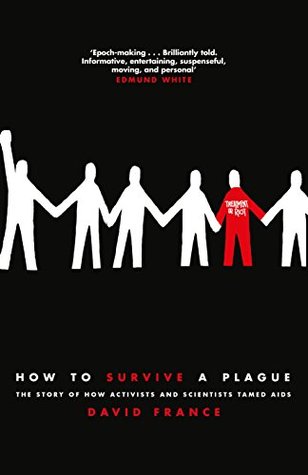 As a journalist and a gay man, David France was right in the thick of the crisis when he moved to Manhattan in 1981. He lost friends and lovers to AIDS, and had his own health scares, too – once, on assignment in war-torn Central America, he developed what he thought was a Kaposi’s sarcoma lesion but turned out to be a sign of amoebic infection.
Throughout the 1980s the number of HIV cases roughly doubled each year; media coverage was intense but often alarmist. Undertakers refused to deal with AIDS victims, and Jerry Falwell and his ilk spoke of a gay conspiracy taking over America. Far too slowly, research advanced to cope with the crisis. France gives details of the medical trials and presidential commissions that kept AIDS at the forefront of the national conscience, generally thanks to patient advocacy groups like ACT UP (AIDS Coalition to Unleash Power) and PWA (People with AIDS – more proactive terminology than victims or patients).
The book reminds me most of Sheri Fink’s Five Days in Memorial, another social history with a vast scope and a large cast of characters; here there are about 25 doctors, researchers and activists, many of them based in New York City, who keep recurring. For instance, there’s Joe Sonnabend, an infectious diseases expert who specialized in treating gay men for venereal diseases; Larry Kramer, who wrote an angry novel about fellow homosexuals yet tried to lead the response; and Richard Berkowitz, a former sex worker who co-wrote How to Have Sex in an Epidemic, a safe sex guide that encouraged a surge in condom use.
I rather underestimated the reading load the Wellcome shortlist would create for me; I ended up getting bogged down in this 500+-page book’s level of detail and only succeeded in skimming it. I think that for someone without a personal stake in the story of AIDS, watching the 2012 documentary film of the same title that spawned the book would be an easier way to absorb copious information and keep track of all the individuals and organizations involved.
Nonetheless, I can certainly affirm the importance of a landmark book like this one. When I surveyed critical opinion on it for Bookmarks magazine, I noticed many comparisons to Randy Shilts’s 1987 And the Band Played On, but while that book was written in medias res and deliberately vilified a French-Canadian flight attendant named Gaëtan Dugas who was linked with multiple AIDS cases in North America, How to Survive a Plague benefits from two decades of hindsight and reflects a mixture of journalistic objectivity and personal grief.
It’s sobering to remember the scale of the AIDS epidemic: 100,000 Americans had died of it by 1991. As one HIV-positive ACT UP activist cried out to Bill Clinton, then a Democratic candidate, at a campaign event, “Bill, we’re dying of neglect!” France’s book really brings home how traumatic these years were for a whole country, but especially for homosexuals. He describes the relief of knowing that effective medical treatment was finally in the pipeline, but also the lingering effects of shame, bitterness, and fear.
Nobody left those years uncorrupted by what they’d witnessed, not only the mass deaths—100,000 lost in New York City alone, snatched from tightly drawn social circles—but also the foul truths that a microscopic virus had revealed about American culture: politicians who welcomed the plague as proof of God’s will, doctors who refused the victims medical care, clergymen and often even parents themselves who withheld all but a shiver of grief. Such betrayal would be impossible to forget in the subsequent years.
My rating: 
My gut feeling: France has written a definitive history of the AIDS crisis in the United States. It’s a cautionary tale that must not be forgotten. While not among my personal favorites from the shortlist, it would be a worthy winner.
More reviews:
Clare’s at A Little Blog of Books
Stay tuned for our shadow panel winner, which I will announce here tomorrow morning!
First Encounter: Haruki Murakami (The Wind-Up Bird Chronicle)
I don’t know why I resisted reading Haruki Murakami for so long. I have some friends who are big fans of his work, but I always thought his fiction would be a bit too odd for me. The Wind-Up Bird Chronicle (1994), which I just finished last night, is certainly bizarre, but in the best possible way: it questions our comfort in the everyday by contorting familiar elements in the way that dreams do. This is the story of a young man who’s become lost in his own life and is looking for the way back. It’s a hero’s quest through a baffling, mystical underworld.
It all starts with a missing cat and a dirty phone call. It’s 1984. Thirty-year-old Toru Okada recently left his job as a law clerk and has been aimlessly spending days at home while his wife, Kumiko, goes out to her magazine editor job. A week ago the cat – named Noboru Wataya, after Toru’s hateful brother-in-law – disappeared, so he’s cooking himself some spaghetti and pondering his cat hunting strategy when he gets a call from what seems to be a phone sex hotline, except that the female speaker claims to know him well. And unexpected phone calls just keep coming, including from Malta Kano, a clairvoyant who foretells that he will experience “Bad things that seem good at first, and good things that seem bad at first.”

The cover on my library paperback. Yuck!
There’s a narrow alleyway behind their suburban Tokyo house that cuts between two rows of back gardens. On these hot June days, it’s an almost preternaturally still place, with the quiet broken only by the mechanical-sounding call of a creature Toru thinks of as the wind-up bird. He heads down the alley to look for the cat, but all he finds is the deserted (haunted?) Miyawaki house with a bird sculpture and an old, dry well in its yard. He also meets May Kasahara, a blunt sixteen-year-old who’s taking a year off school after a motorcycle accident.
So far, so realist (mostly). But things keep getting weirder, mainly through a series of further appearances and disappearances. The first to go is Kumiko, who says she’s been having an affair. Toru doesn’t believe, her, though. Or, rather, he doesn’t think a pattern of cheating is enough of an explanation for her leaving everything behind one morning. He knows there’s a deeper force driving this, and he’s determined to rescue his wife from it. Meanwhile, he has more encounters with and stories of pain from peculiar characters – everyone from a World War II lieutenant and a former fashion designer to Malta Kano’s ex-prostitute sister, Creta.
Rather like a Kafka antihero, Toru simply can’t grasp what’s happening to him.
I shook my head. Too many things were being left unexplained. The one thing I understood for sure was that I didn’t understand a thing. … “I’m sick of riddles. I need something concrete that I can get my hands on. Hard facts. Something I can use as a lever to pry the door open. That’s what I want.”
Yet his first-person narration anchors the book, making him an Everyman who we journey along with in his state of confusion. So even as the plot gets increasingly outlandish and somewhat taken over by other voices – via long monologues, letters, or tales stored in computer files – we always have this sympathetic protagonist to come home to. Like in Dickens’s novels, I noticed that minor characters like the Kano sisters keep turning up just when you’re in danger of forgetting them due to the weight of the intervening pages.

I prefer this, or pretty much any other, cover.
Yesterday I gave a gleeful squeal when a review copy of just 190 pages arrived. “So you love short books?” my husband asked. I do … but I also adore long ones that have a darn good reason to be that long – creating a whole world you can get lost in. That’s what I’m trying to celebrate with this year’s monthly Doorstopper series: books whose 500+ pages fly by, best consumed in big gulps. Such won’t always be the case: City on Fire and Hame both felt like a slog in places, though were ultimately worth engaging with. But my first encounter with Murakami showcased expansive storytelling at its best. I want to read more books like this.
I’m not entirely sure I comprehended all that happens at the end of The Wind-Up Bird Chronicle, but that doesn’t really matter. The novel left me mesmerized, shaking my head as if waking up from the strangest dream but hoping to someday go back to its world. And for 99.8% of it I forgot that I was reading a work in translation.
If I were to make a word cloud of important phrases from the book, it would look off the wall: lemon drops, a necktie, wells, bald men, baseball bats, birthmarks, being skinned alive, zoo animals, a hotel room, a wig factory, and so on. That list might intrigue you; equally, it might put you off in the same way that I was always daunted by the idea of Japanese magic realism. Let me assure you, this stunning novel is so much more than the sum of its parts.
My rating: 
How do you feel about Murakami? Which of his books should I read next?
Review & Giveaway: Hame by Annalena McAfee
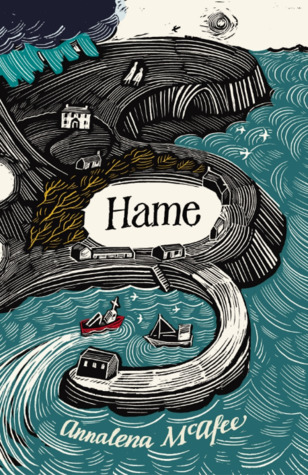 As I mentioned on Tuesday, I previously knew of Annalena McAfee only as Mrs. Ian McEwan, though she has a distinguished literary background: she founded the Guardian Review and edited it for six years, was Arts and Literary Editor of the Financial Times, and is the author of multiple children’s books and one previous novel for adults, The Spoiler (2011).
Well, anyone who reads Hame will be saying “Ian who?” as this is on such a grand scale compared to anything McEwan has ever attempted. The subtitle, “The Fascaray Archives,” gives an idea of how thorough McAfee means to be: the life of fictional poet Grigor McWatt is her way into everything that forms the Scottish identity. Her invented island of Fascaray is a carefully constructed microcosm of Scotland from ancient times to today. I loved the little glimpses of recent history, like the referendum on independence and a Donald Trump figure, billionaire “Archie Tupper,” bulldozing an environmentally sensitive area to build his new golf course (this really happened, in Aberdeenshire in 2012).
Narrator Mhairi McPhail arrives on Fascaray in August 2014, her nine-year-old daughter Agnes in tow. She’s here to oversee the opening of a new museum, edit a seven-volume edition of McWatt’s magnum opus, The Fascaray Compendium (a 70-year journal detailing the island’s history, language, flora, fauna and customs), and complete a critical biography of the poet. Over the next four months she often questions the feasibility of her multi-strand project. She also frets about her split from Marco, whom she left back in New York City after their separate infidelities. And her rootlessness – she’s Canadian via Scotland but has spent a lot of time in the States, giving her a mixed-up heritage and accent – is a constant niggle.
Mhairi’s narrative sections share space with excerpts from her biography of McWatt and extracts from McWatt’s own writing: The Fascaray Compendium, newspaper columns, letters to on-again, off-again lover Lilias Hogg, and Scots translations of famous poets from Blake to Yeats. We learn of key events from the island’s history through Mhairi’s biography and McWatt’s prose, including ongoing tension between lairds and crofters, Finnverinnity House being used as a Special Ops training school during World War II, a lifeboat lost in a gale in the 1970s, and the way the fishing industry is now ceding to hydroelectric power.
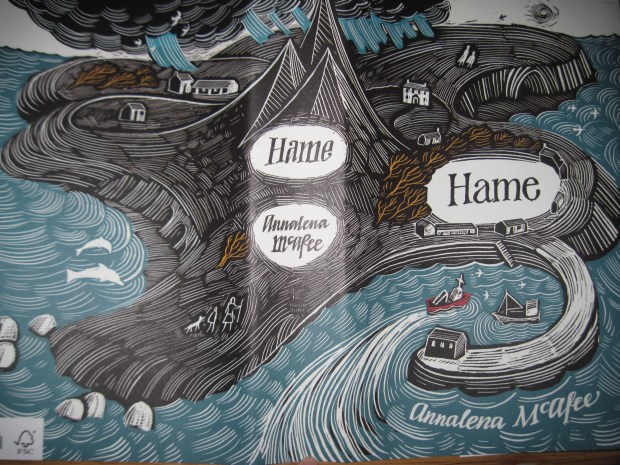
The balance between the alternating elements isn’t quite right – sections from Mhairi’s contemporary diary seem to get shorter as the novel goes along, such that it feels like there’s not enough narrative to anchor the book. Faced with yet more Scots poetry and vocabulary lists, or passages from Mhairi’s dry biography, it’s mighty tempting to skim.
That’s a shame, as the novel contains some truly lovely writing, particularly in McWatt’s nature observations:
In July and August, on rare days of startling and sustained heat, dragonflies as blue as the cloudless skies shimmer over cushions of moss by the burn while the midges, who abhor direct sunlight, are nowhere to be seen. Out to sea, somnolent groups of whales pass like cortèges of cruise ships and around them dolphins and porpoises joyously arc and dip as if stitching the ocean’s silken canopy of turquoise, gentian and cobalt.
For centuries male Fascaradians have sailed in the autumn, at the time of the ripe barley and the fruiting buckthorn, to hunt the plump young solan geese or gannets – the guga – near their nesting sites on the uninhabited rock pinnacles of Plodda and Grodda. No true Fascaradian can suffer vertigo since the scaling of these granite towers is done without the aid of mountaineers’ crampons or picks.
“Hame” means home in Scots – like in McWatt’s claim to fame, the folk-pop song “Hame tae Fascaray” – and themes of home and identity are strong here. The novel asks to what extent identity is bound up with a particular country and language, and whether we can craft our own selves. Must the place you come from always be the same as the home you choose? I could relate to Mhairi’s feeling that there’s nowhere she belongs, whether she’s in the bustle of New York or “marooned on a patch of damp peat floating in the North Sea.”
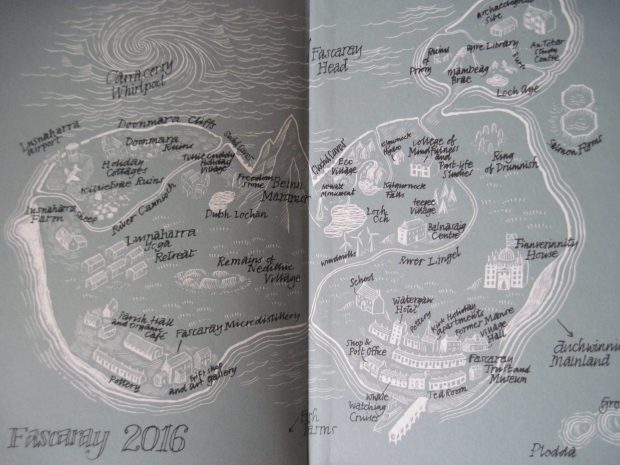
A map of the island from the inside of the back cover.
Although the blend of elements initially made me think that this would resemble A.S. Byatt’s Possession, it’s actually more like Rachel Cantor’s Good on Paper, which similarly stars a scholar who’s a single parent to a precocious daughter. In places I was also reminded of the work of Scarlett Thomas, Sara Maitland and Sarah Moss, and there’s even an echo of Robert Macfarlane’s Landmarks in the inventories of dialect words.
If you’ve done much traveling in Scotland, an added pleasure of the novel is trying to spot places you’ve been. (I thought I could see traces of Stromness, Orkney; indeed, McWatt reminded me most of Orcadian poet George Mackay Brown.) The comprehensive, archival approach didn’t completely win me over, but I was impressed by the book’s scope and its affectionate portrait of a beloved country. McAfee is of Scots-Irish parentage herself, and you can tell this is a true labor of love, and a cogent tribute.
Hame was published by Harvill Secker on February 9th. With thanks to Anna Redman for sending a free copy for review.
My rating: 
Giveaway Announcement!
I was accidentally sent two copies of Hame, so I am giving one away to a reader. Alas, this giveaway will have to be UK-only – the book is a hardback of nearly 600 pages, so would be prohibitively expensive to send abroad.
If you’re interested in winning a copy, simply leave a comment to that effect below. The competition will be open through the end of Friday the 17th and I will choose a winner at random on Saturday the 18th, to be announced via the comments and a personal e-mail.
Good luck!
Better Late than Never: City on Fire
I aim to read one book of 500+ pages in each month of 2017. My first Doorstopper of the Month is City on Fire, the 2015 debut novel from Garth Risk Hallberg. It’s common knowledge that Hallberg earned a six-figure advance for this 911-page evocation of a revolutionary time in New York City. When it was first published I didn’t think I had the fortitude to tackle it and had in mind to wait for the inevitable miniseries instead, but when I won a copy in a goodie bag from Hungerford Bookshop I decided to go for it. I started the novel just after Christmas and finished it a few days ago, so like Donna Tartt’s The Goldfinch it took me roughly a month to read because I had many other books on the go at the same time.
 Opening on Christmas Eve 1976 and peaking with the July 1977 blackout, the novel brings its diverse cast together through a shooting in Central Park. Insider traders, the aimless second generation of some of the city’s wealthiest aristocrats, anarchist punk rockers, an African-American schoolteacher, a journalist and his Vietnamese neighbor, a fireworks manufacturer, a policeman crippled by childhood polio – the characters fill in the broad canvas of the city, everywhere from Wall Street boardrooms to drug dens.
The real achievement is not how Hallberg draws each character but how he fits them all together. The closest comparison I can make is with one of Dickens’s long novels, say David Copperfield, where, especially as you approach the conclusion, you get surprising meet-ups of figures from different realms of life. The relaxed chronology reaches back to the 1950s and forward to 2003 to give hints of where these people came from and what fate holds for them.
City on Fire might sound like a crime drama – I can see a miniseries working in a manner comparable to The Wire – and the mystery of who shot Samantha Cicciaro does indeed last from about page 80 to page 800-something. But finding out who shot her and why (or why investment bankers would be funding a posse of anarchists, or who pushed a journalist into the river) is something of an anticlimax. The journey is the point, and the city is the real star, even though it’s described with a kind of affectionate disdain in the passages that follow:
The stench of the basement level reached him even here, like hot-dog water mixed with roofing tar and left in an alley to rot
The park on New Year’s Day had been a blasted whiteness, or a series of them, hemmed in by black trees like sheets snagged on barbed wire.
It seemed impossible that he’d chosen to live here, at a latitude where spring was a semantic variation on winter, in a grid whose rigid geometry only a Greek or a builder of prisons could love, in a city that made its own gravy when it rained. Taxis continued to stream toward the tunnel, like the damned toward a Boschian hellmouth. Screaming people staggered past below. Impossible, that he now footed the rent entire, two hundred bucks monthly for the privilege of pressing his cheek to the window and still not being able to see spectacular Midtown views. Impossible, that the cinderblock planter on the fire escape could ever have produced flowers.
Or wasn’t this city really the sum of every little selfishness, every ignorance, every act of laziness and mistrust and unkindness ever committed by anybody who lived there, as well as of everything she personally had loved?
Mercer Goodman, Jenny Nguyen and Richard Groskoph were my three favorite characters, and I might have liked to see more of each of them. I also felt that the book as a whole was quite baggy, and the six Interludes that separate the seven large sections, remarkable as they are (especially an entire fanzine, complete with photographs, comics and handwritten articles), weren’t strictly necessary.

It’s definitely a chunkster. For the longest while it felt like I wasn’t making a dent.
Still, I couldn’t help but be impressed by Hallberg’s ambition, and on the sentence level the novel is always well wrought and surprising, with especially lovely last lines that are like a benediction. Though it’s mostly set in the 1970s, this never feels dated; in fact, I thought it thoroughly relevant for our time: “even now they’re writing over history, finding ways to tell you what you just saw doesn’t exist. The big, bad anarchic city, people looting, ooga-booga. Better to trust the developers and the cops.”
I won’t pretend that a 900+-page book isn’t a massive undertaking, and I have some trusted bloggers and Goodreads friends who gave up on this after 250 or 450 pages. So I can’t promise you that you’ll think it’s worth the effort, though for me it was. A modern twist on the Dickensian state-of-society novel, it’s one I’d recommend to fans of Jonathan Franzen, Bill Clegg and Jennifer Egan.
My rating: 
 Bookish Beck = Rebecca Foster. American transplant to England. Freelance proofreader and book reviewer.
 Bookish Beck