Where My Books Come From
This challenge Laura (Reading in Bed) posted the other day is just too fun for me to pass up, plus it allows me to get a jump on my 2017 statistics. The idea is to look at the last 30 books you’ve read and note where you got hold of each one – whether from the publisher, the library, new or secondhand at a bookshop, etc. If you wish, you can also look at the whole year’s books and work out percentages. Leave a comment to let me know what you figure out about your own books’ provenance.

My bedside table (and environs): always a mix of secondhand, library and review copies.
Fall Down 7 Times Get Up 8: A Young Man’s Voice from the Silence of Autism, Naoki Higashida: Public library
A Girl Walks into a Book: What the Brontës Taught Me about Life, Love, and Women’s Work, Miranda K. Pennington: E-book from Edelweiss
The Great Profundo and Other Stories, Bernard MacLaverty: Secondhand copy from Book-Cycle, Exeter
Dakota: A Spiritual Geography, Kathleen Norris: Free from the Book Thing of Baltimore
Finding Myself in Britain: Our Search for Faith, Home and True Identity, Amy Boucher Pye: Christmas gift from my Amazon wish list last year
No Apparent Distress: A Doctor’s Coming-of-Age on the Front Lines of American Medicine, Rachel Pearson: PDF from publisher
At Seventy: A Journal, May Sarton: Secondhand copy from Wonder Book and Video
A Wood of One’s Own, Ruth Pavey: Free from publisher
A Sand County Almanac and Sketches Here and There, Aldo Leopold: University library
Ghost Stories of an Antiquary Vol. II, M.R. James: Free from publisher
This Little Art, Kate Briggs: Free from publisher
Reputations, Juan Gabriel Vásquez: Gift from a Goodreads friend
The Rector’s Daughter, F.M. Mayor: Secondhand copy from a charity shop
An English Guide to Birdwatching, Nicholas Royle: Gift from a Goodreads friend
The Fact of a Body: A Murder and a Memoir, Alexandria Marzano-Lesnovich: E-book from Edelweiss
Unruly Creatures: Stories, Jennifer Caloyeras: PDF from author
One Year Wiser: An Illustrated Guide to Mindfulness, Mike Medaglia: Free from publisher
A Glorious Freedom: Older Women Leading Extraordinary Lives, Lisa Congdon: PDF from publisher
Dreadful Wind and Rain: A Lyrical Fairy Tale, Diane Gilliam: Won in Twitter giveaway
As a God Might Be, Neil Griffiths: Free from publisher
Devil’s Day, Andrew Michael Hurley: E-book from NetGalley
Interlibrary Loan Sharks and Seedy Roms: Cartoons from Libraryland, Benita L. Epstein: University library
Skating at the Vertical: Stories, Jan English Leary: E-book from NetGalley
Master Georgie, Beryl Bainbridge: Free from work staff room years ago
The Immortalists, Chloe Benjamin: Free proof copy for Bookbag review
Jacob’s Room Is Full of Books, Susan Hill: Free from publisher
Slade House, David Mitchell: Public library
The Lauras, Sara Taylor: Free for Sunday Times Young Writer of the Year Award shadow panel reading
Survival Lessons, Alice Hoffman: Birthday gift from my Amazon wish list
A Field Guide to the North American Family, Garth Risk Hallberg: Free from publisher
And the statistics for 2017 so far:
- Free print or e-copy from publisher: 30.11% (Wow – how lucky am I?!)
- Downloaded from NetGalley or Edelweiss: 22.3%
- Public library: 18.22%
- Secondhand purchase: 15.24%
- Free (other) = from giveaways or Book Thing of Baltimore: 6.69%
- Gifts: 6.32%
- University library: 1.12%
Omnibuses, Built-in Bookmarks, Deckle Edge: Book Traits I Love/Loathe
My reading has tipped more towards physical books than e-books recently, and my book acquisitions have been getting rather out of hand after some cheeky charity shopping and an influx of review copies. Plus this afternoon we’re off to Bookbarn International, one of my favorite secondhand bookstores, for an evening event – and naturally, we’ll fit in some shopping beforehand. It would be rude not to after traveling all that way.
With all this tempting reading material piling up, I’ve been thinking about some of the traits I most appreciate in books…
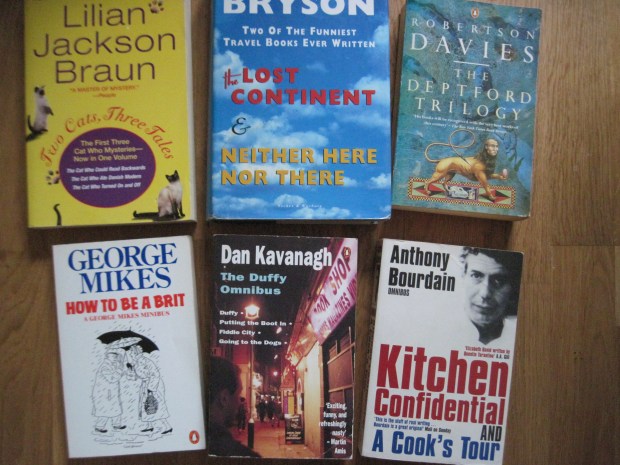
Omnibus editions: two to four books for the price of one. What could be better?
Built-in ribbon bookmarks: elegant as well as helpful. I also love how Peirene Press releases come with a matching paper bookmark for every three-book series.

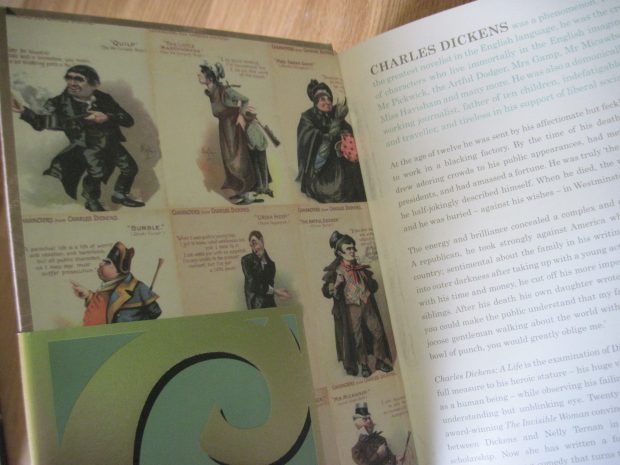
Everything about the hardback edition of Claire Tomalin’s Dickens biography is gorgeous, in fact. I especially love the vintage illustrations on the endpapers and the half-size dustjacket.
Deckle edge is one of my special loves. For the most part it’s unique to American books (over here I’ve heard it complained about as looking “unfinished”), and always makes me think nostalgically about borrowing books from the public library in my parents’ town.

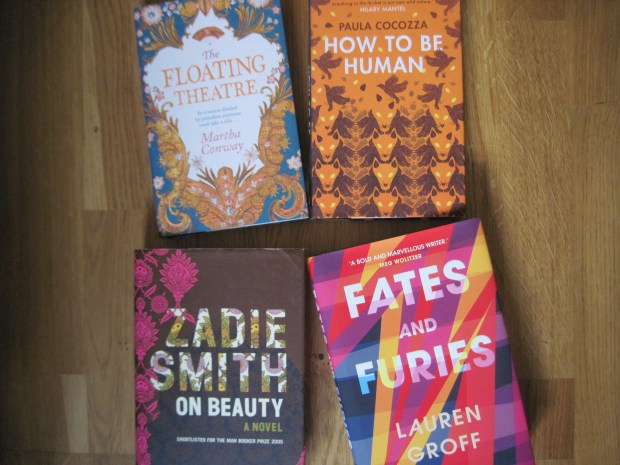
It may sound shallow, but I love these four novels almost as much for their colorful covers as for their contents. (Is it any wonder one of my favorite tags to use on Instagram is #prettycovers?) Several of these covers have raised lettering as well.
The History of Bees is one of the most attractive physical books I’ve acquired recently. The dustjacket has an embossed image; underneath it the book itself is just as striking, with a gold honeycomb pattern. There are also black-and-white bees dotted through the pages.


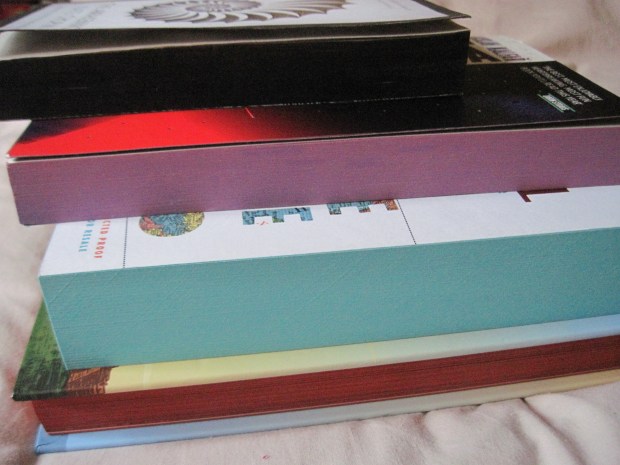
Colored text blocks (also called sprayed edges) are so unexpected and stylish.
And now for a few physical book traits I’m not as fond of. Perhaps my biggest pet peeve, impossible to photograph, is those matte covers that get permanent fingerprints on them no matter how gingerly you try to handle them.
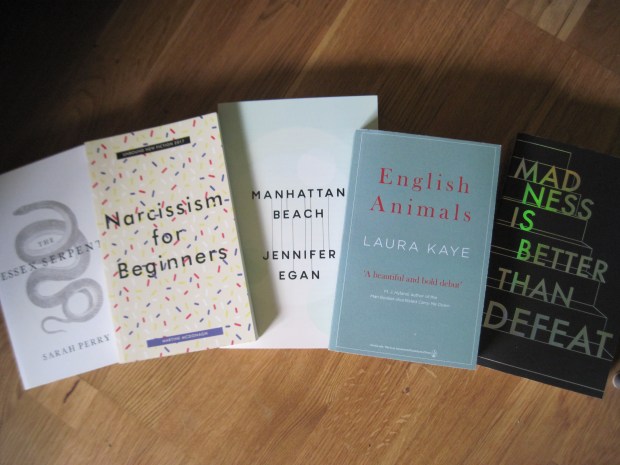
I wish proof copies didn’t often come in nondescript covers that don’t give a sense of what the finished book will look like. (No ice cream cone on Narcissism for Beginners; no leaping fox on English Animals.) However, keeping in mind that I’m lucky to be reading all these books early, I mustn’t be a greedy so-and-so.
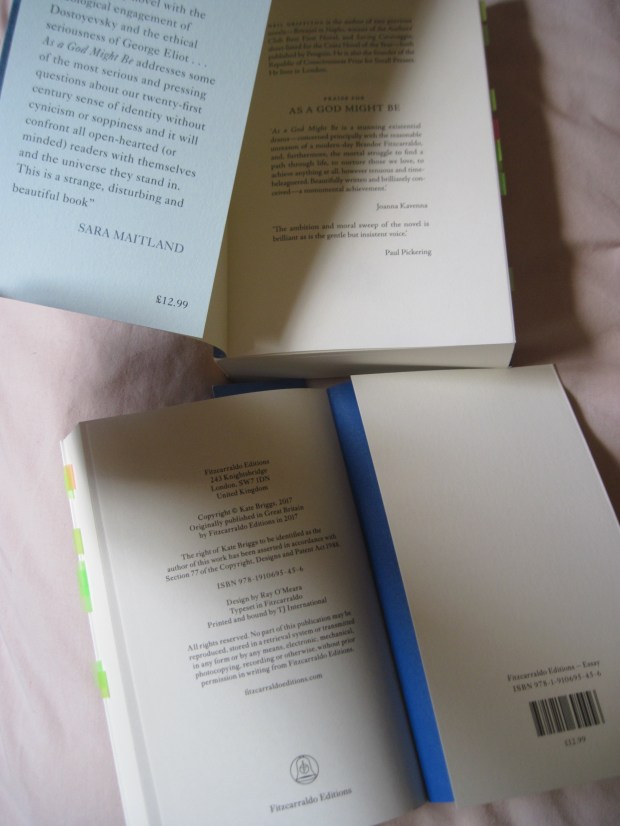
All Fitzcarraldo Editions books are paperbacks with French flaps. Another book I’m reading at the moment, As a God Might Be by Neil Griffiths (from Dodo Ink), also has French flaps. It’s not that I dislike them per se. I just wonder, what’s the point?
(See also two related posts: Books as Objects of Beauty and My (Tiny) Collection of Signed Copies.)
Okay, you opinionated book people: what are your favorite and least favorite book traits?
Am I a (Book) Hoarder?
When I was a kid my parents and sister deemed me a pack rat, and over the years I’ve been a collector of many different things: stamps, coins, figurines, tea sets, shells, fossils, feathers, anything featuring puffins or llamas, and so on. At this point my only active collection is of books, but the others are all still in evidence in my old closet. I had a few good reasons to contemplate my belongings recently: first, I read a book about decluttering; then, on my recent trip back to the States, I helped my sister pack as she prepares to move out of her home of 12 years, and co-hosted a yard sale at my parents’ house to get rid of some of ye olde stuff.
Year of No Clutter, Eve O. Schaub
 Schaub faces the possibility that she has inherited a family tendency to hoarding and tackles her house’s clutter-filled “Hell Room.” From one February to the next she enlisted her daughters’ help sorting things into piles and came up with a regular route of consignment shops, thrift stores, and libraries where she could drop off carloads of donations. Bigger projects included a photo book of 100 of her daughter’s artworks and a rag rug incorporating many beloved articles of clothing.
I enjoyed the nitty-gritty details of how this family organized and got rid of things because I like big tidying projects and putting everything in its rightful place, whether that be the recycling bin, a crate in the attic, or a charity bag. But what I most appreciated was how sensitive Schaub is to all the issues that can be tied up with our stuff, especially OCD, nostalgia, and indecision. “Although Marie Kondo disapproves, I’m not about to stop collecting my own life,” she writes. “It has been a source of pleasure for me ever since I can remember; it helps define me.” 
Helping Out
My sister is very much of the Marie Kondo school of de-cluttering. She strives for minimalism in her décor, and is constantly going back through her sons’ clothes and toys to see what she can get rid of. All the same, 12 years of living in the same house has spelled a lot of accumulation. As she did her last-minute wedding preparations in early August, I was let loose on the packing and soon got all the easy stuff – like books and decorations – boxed up. But I quickly became overwhelmed by what remained, such as the boys’ toy room, DIY supplies, and stacks upon stacks of framed art and photographs plus photo albums.
Nephew #2 “helps” with packing.
As I was packing I couldn’t keep myself from peeking into the albums and tearfully marvelling that the whole life she built with her first husband – who died of brain cancer in January 2015 – is over. Death is so simple and final, right? Yet even these many months later I have a hard time getting my head around how the huge personality and web of connections that was my brother-in-law could be gone. And this even though I couldn’t be happier that my sister has found love again and gained two terrific step-kids.
When she and her husband move into their new-build home later in the year and get all this stuff back out of storage, she’s going to have quite the job sorting through everything and deciding what of her old life to keep on display, or keep at all. How to honor the years that are gone without having them intrude on the new family that she’s made?
Making It Personal
Mementoes, including travel souvenirs and special cards and letters I’ve received, are particularly hard for me to cull. There are four or five sizable boxes full of mementoes in my closet in the States, and another couple in our attic here. Getting rid of correspondence just feels wrong to me; I’ve probably rarely deleted a personal e-mail in the last 20 years. It’s like I need that physical proof of the relationships and events that have meant the most to me.
I’m much less sentimental when it comes to most other objects. The yard sale my mom and I had last weekend was a great opportunity to get rid of things that had been sitting around for a decade or more and were just never going to join me in the UK, including lamps, cushions, a clock, a CD player, a jewelry box, a formal dress, a shoe rack, and various figurines and framed prints. I only made $37, and a lot remained to be picked up the Salvation Army (including a whole box of VHS films I found at the bottom of the closet), but it was good to shed some stuff – and I at least earned enough to cover my book and maple syrup shopping on this trip!


Now, even though there are 25–30 (smallish) boxes of books remaining in that closet, I can definitively say that I’m not as much of a book hoarder as I once was – back in high school, say. On this trip I went back through all of the boxes to consolidate them and pulled out another 50+ books to give away or resell on a future visit. I looked back with fondness through three boxes of books from my childhood, but then promptly handed them over to my mom to share with my nephews or give away, as she chooses.


Back in the UK, I keep on top of my book collection by considering carefully every time I read a book whether I want to keep it: Is it a favorite? Will I read it again, refer to it or lend it to others? If not, I might give it away to a friend, check the resale prices on Amazon, WeBuyBooks or Ziffit, or donate it to a charity shop. This keeps the review copies from piling up, and means that my shelves are always full but generally not overfull.
Are you brutal or sentimental when it comes to books and other possessions? When’s the last time you had a big clear-out?
Bloggers’ Opinions Must Not Be Bought: A Cautionary Tale
I’m leery of accepting self-published work for review. If this is prejudice on my part, it’s not unjustified: I’ve reviewed hundreds of self-published books during my four years of freelance work for Kirkus, Foreword, BlueInk, Publishers Weekly, and The Bookbag, and although I do find the very occasional gem that could hold its own in a traditional market, the overall quality is poor. When self-published authors get in touch via my blog, I usually delete their enquiries immediately. But for some reason I decided to give a second look to a request I received through Goodreads earlier this year. (All identifying details have been removed.)
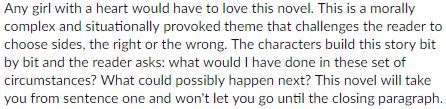
I’ll admit it: the flattery probably helped:
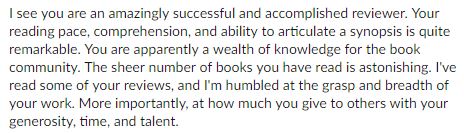
This was for a historical novel that had 4-star reviews from two Goodreads friends whose judgment I trust, so I agreed to have the author send a copy to my parents’ house in the States so that it would be waiting for me there when I arrived for my recent trip. When I opened the box, two alarm bells rang at once. First there was this. Uh oh.

Second of all: the author had taken the trouble of looking up restaurants in my parents’ area and ordered a $60 gift card from one of them to send along with the book parcel. Double uh oh.
I spent weeks wondering what in the world I was going to do about this ethical quandary. I even contacted a Goodreads friend who’d reviewed the book and asked what their experience with the author had been like. The reply was very telling:
I still feel unsettled over my interaction with [name redacted]. I’ve always made it a point not to review unsolicited books. But over a period of several weeks, [they] sent me a number of emails that ranged from flattering to fawning – and always polite and charming. Eventually, I, too, received a $60 gift card to a favorite restaurant that was within blocks of my home. I ended up, I believe, 4 starring [the] book, although the truth is that it was more of a 3-star read. Since reviewing, I have valued my independence – and honesty – and since then, have had the uncomfortable feeling of being “bought”, and for a low price at that.
I cannot tell you what to do. Obviously, I feel as if my own values were compromised. For me, it wasn’t worth what I still believe is a blot on my integrity. If you do decide to review, I’d simply encourage you to be honest because (I learned the hard way) the aftermath isn’t a good feeling.
Well, I’d promised to review the book, so I forced myself to open it, pencil in hand. After I’d corrected 10 problems of punctuation and grammar within the first six pages, I commenced skimming. There were some decent folksy metaphors and a not-half-bad dual narrative of a young woman’s odyssey and a small town’s feuds. But there were also dreadful sex scenes, melodramatic plot turns, and dialogue and slang that didn’t ring true for the time period. If I squinted pretty darn hard, I could see my way to likening the novel to the works of Ron Rash and Daniel Woodrell. But it wasn’t by any means a book I could genuinely recommend.
So when the author checked up a couple of months later to see whether I had gotten the book and what I thought of it, here’s what I replied:

I received the following abject apology, but no helpful information.

To my brief follow-up –

– I received this:
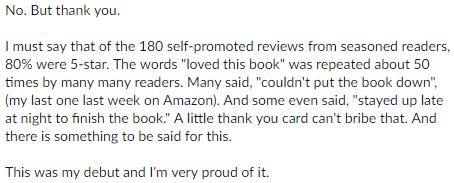
Note the phrase “self-promoted” and the meaningless repetition of “couldn’t put it down!”
And then they went on to disparage me for my age?!

I don’t believe for a minute that this person was ignorant of what they were doing in sending the gift cards. What’s saddest to me is that they have zero interest in getting an honest opinion of the work or hearing constructive criticism that could help them improve. They clearly don’t respect professionals’ estimation, either, or they’d be brave enough to pay for a review from Kirkus or another independent body. Instead, they’ve presumably been ‘paying’ $60 a pop to get fawning but utterly false 5-star reviews. Just imagine how much money they’ve spent on shipping and ‘thank-you gifts’ – easily many thousands of dollars.
And could I really have been the first in 180+ people to express misgivings about what was going on here? How worrying.
I was tempted to be generous and give the novel the briefest of 3-star reviews, perhaps as an addendum to another review on my blog, just so that I could feel justified in keeping the gift card and not have to face a confrontation with the author. But it didn’t feel right. If I want my reviews to have integrity, they have to reflect my honest opinions. As it stands, I have the gift card in an envelope, ready to be returned to the author when I’m in the States for my sister’s wedding next month; the book will most likely get dropped off at a Little Free Library.
If I was a vindictive person, I’d be going on Goodreads and Amazon and giving the book a 1-star review: as a necessary corrective to the bogus 5-star ones, and as a way of exposing this dodgy self-promotional activity. But that would in turn expose all of this person’s readers, including a valued Goodreads friend. And who knows how the author would try to retaliate.
So there you have it. My cautionary tale of a self-published author trying to buy my good opinion. What have I learned? Mostly to be even more wary of self-published work; possibly not to make any promises to review a book until I’ve seen a sample of it. But also to listen to my conscience and, when something is wrong, have the courage to speak out right away.
I’m curious: what would you have done?
Chastleton House (It Even Has a Bookshop)
I’ve been off my blogging game ever since we got back from America, but I hope to remedy that soon. I have a blog post planned for every day of the coming week, including some reviews, my monthly Library Checkout, a few recommendations for July releases, and a look back at the best books from the first half of the year.
Today I’m easing myself back into blogging with a mini profile of the National Trust historic manor we visited yesterday, Chastleton House in Oxfordshire (but it’s nearer the Gloucestershire border – very much Cotswolds country).
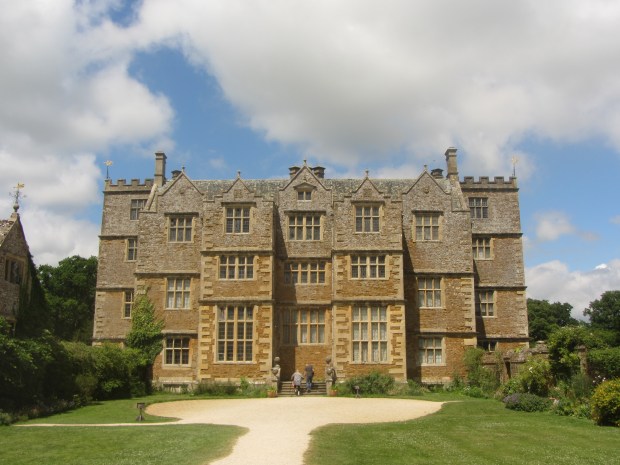
Photo by Chris Foster.
My brother-in-law sent us a voucher for free entry into any NT property, but my eye was drawn to this one in particular because I saw that there’s a secondhand bookshop in the stables. Compared to other historic houses, this one feels a lot less fusty. It’s been preserved as it was when the NT acquired it in 1991, so instead of reconstructed seventeenth-century rooms you get them as they were last used by later tenants. There are cracks in the plasterwork, cobwebs in the corners, and lots of stuff everywhere. But as a result, it seems less like part of the corporate fold; even the “Do Not Touch” signs are handwritten.


Chastleton has a literary claim to fame of which I was unaware before our visit: it was a filming location for the 2015 BBC adaptation of Hilary Mantel’s Wolf Hall. (Never mind that it was built in 1607–12, well after the Tudor history that novel is meant to portray.) Another interesting historical nugget: this is where the rules of croquet were codified in the 1860s, and there are still croquet lawns there today. Our visit happened to coincide with a special lawn games weekend, so we learned how to play croquet properly and my husband proceeded to trounce me.


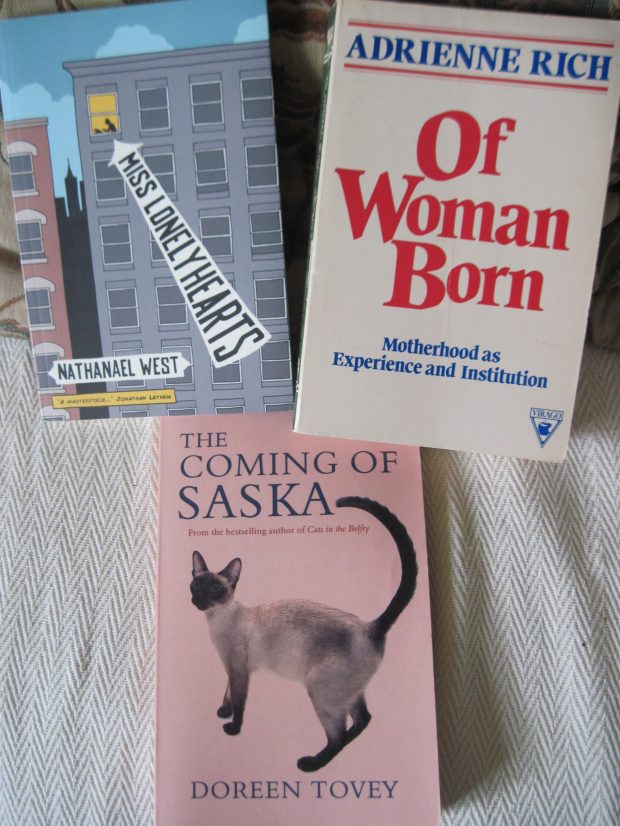
Of course, I availed myself of a few bargain books from the secondhand stall.
 We also had tea and cake from a charity sale in the next-door churchyard. After dinner back home, in the evening we decided to walk 10 minutes down the road to our local event space for a folk concert featuring The Willows, with Gareth Lee and Annie Baylis supporting. We’ve been to three gigs at this former village hall so far this year; with tickets just £10 each and the venue so close, why not?! Each time we have heard absolutely excellent live folk music, with tinges of everything from Americana to electronica.
All together, a smashing day out.
How People Found My Blog Recently
I’m always interested to find out how people who aren’t regular followers catch wind of my blog. The web searches documented in my WordPress statistics are often bizarre, but do point to what have been some of my most enduringly popular posts: reviews of The First Bad Man, The Girl Who Slept with God, and The Essex Serpent; and write-ups of events with Diana Athill and Michel Faber. I also get a fair number of searches for Ann Kidd Taylor, whose two books I’ve featured at different points.
Here are some of the more interesting results from the last six months or so. My favorite search of all may well be “underwhelmed by ferrante”! (Spelling and punctuation are unedited throughout.)
October 19: the undiscovered islands malachy tallack, the first bad man, ann kidd taylor wedding
October 21: prose/poetry about autumn
November 2: ann kidd taylor, irmina barbara yelin, the first bad man summary, diana athill on molly keane
November 6: michel faber poems, essex serpent as byatt, book summary of the girl who slept with gid byval brelinski
November 17: book cycle, james lasdun, novel the girl who slept with god
November 25: john bradshaw the lion in the living room, bibliotherapy open courses the school of life, barbara yelin irmina, 2016 best prose poem extracts
December 5: seal morning, paul evans field notes from the edge, at the existentialist café: freedom, being, and apricot cocktails with jean-paul sartre, simone de beauvoir, albert camus, marti, read how many books at once
December 23: midwinter novel melrose, underwhelmed by ferrante
January 6: charlotte bronte handwriting, hundred year old man and john irving
January 12: memorable prose on looking forward, felicity Trotman
January 24: patient memoirs, poirot graphic novel, first bad man review, he came beck why? love poems
January 26: reading discussion essex serpent, elena ferrante my brilliant friend dislike
February 3: what are chimamanda’s novels transkated to films, ann kidd taylor, shannon leone fowler, i read war and peace and liked it
February 15: “how to make a french family” “review”, book that literally changed my life, the essex serpent summary
March 13: my darling detective howard norman, the essex serpent book club questions, the first bad man summary
March 22: the doll’s alphabet, joslin linder genetic disorders
March 31: detor, louisa young michel faber
May 7: the essex serpent plot, rebecca foster writer, book about cats, gauguin the other world dori fabrizio
Personal Inscriptions, Etc. in Books
A couple of months ago we finally rescued the last boxes (we think) of our possessions out of my in-laws’ attic and storage cupboard…only five years after we moved out! As I was sorting through a box of my husband’s childhood books, I found a couple that he had won through school prizes – both of which seem to prefigure his love of British wildlife, and badgers in particular.


We also found another book he accidentally inherited from his school when the library burned down – along with the Gerald Durrell memoir and a paperback copy of Animal Farm, that makes three books that never made it back to the school even after they rebuilt. Oops!


I gave some thought to the other personal inscriptions in our book collection. Although we don’t have all that many examples in total, my mother (whom I generally call “Marm”) is the queen of inscriptions: you can count on her to write the date, the occasion, and a heartfelt message inside the front cover of any book she gives as a gift. It’s terribly sweet.


I got the Betty Crocker cookbook as a birthday present just as I was setting off for my Master’s year in Leeds – the first time I ever had to cook for myself. Over the last 11.5 years it’s gotten a lot of use, as the missing fragments of the ring binder show.


Another cookbook with some sentimental value to us is Delia Smith’s Complete Illustrated Cookery Course – a classic of English cuisine that we got as a wedding present. It’s extra special as the giver, my husband’s Auntie Joan (not actually an aunt, but a first cousin once removed or something like that), passed away earlier this year.
Do you like writing and/or receiving personal inscriptions in books?
Two Years and Counting
As of today I’ve been blogging for exactly two years.

By Joey Gannon from Pittsburgh, PA (Candles) [CC BY-SA 2.0 (http://creativecommons.org/licenses/by-sa/2.0)%5D, via Wikimedia Commons.
If I were to play the bibliotherapist and prescribe myself just one book from my Kindle backlog for today, it would be this one:

I am terrible about comparing myself to others on social media: number of likes, number of followers, level of engagement, etc. I so often think that other bloggers are involved in interesting projects or leading the way on various initiatives, whereas I’m just plodding along. It’s hard to ignore the quantitative indicators and just be content doing what I do.
Still, ideas keep coming, so I’ll roll with it.
Thank you to everyone who takes time out for my blog.
Marginalia, Bookmarks, Etc. Found in Books
 In two of the books I currently have on the go, items found in books are a key element. First there’s Swimming Lessons in Claire Fuller, in which one strand of the narrative is told via a series of letters Ingrid hid in various thematically relevant books from her husband’s overflowing collection before she disappeared 12 years ago.
I’ve also been skimming Reading Allowed, novelist Chris Paling’s book of mildly amusing anecdotes from his time working in a public library. As little interludes he records the items he’s found being used as bookmarks in library volumes: a postcard, a shopping list, a meal plan, a CV, and so on.
In my years working in bookshops and libraries I found lots of proper bookmarks left behind in books; this photo shows the ones I’ve kept (others I’ve given away, recycled or donated to the library basket).

This doesn’t account for all the train tickets, receipts, newspaper clippings, etc. that were serving as makeshift bookmarks. The strangest thing I think I ever found in a book was an old-fashioned faux pearl-topped hatpin marking a place in a copy of Elizabeth Barrett Browning’s collected poems.
And then there are the written messages I’ve found in books: other people’s bookplates (I especially like the one that appears in the front of each volume of my 1919 Chapman & Hall set of the complete works of Dickens – such an enviable reward for good attendance!);


a heartfelt message of friendship in the copy of May Sarton’s The Fur Person I got free from Book Thing of Baltimore;

a young lady’s thoughts strewn across the selected poems of Ted Hughes;

and a dead-simple recipe for a tropical fruit drink pencilled on the back cover of Patricia Volk’s memoir, Stuffed.

For me, the random objects and messages you might find are all part of the fun of buying secondhand books.
 Bookish Beck = Rebecca Foster. American transplant to England. Freelance proofreader and book reviewer.
 Bookish Beck