Polishing off the Booker Prize Shortlist
This is the second year in a row that I’ve managed to read the whole of the Man Booker Prize shortlist before the announcement of the winner. (In 2013 and 2014 I only got through four of the six titles.) Here’s my take on the final two from the shortlist (see my quick impressions of the others here and here), plus one from the longlist. I finish with thoughts about my favorites and the likely winner.
All That Man Is by David Szalay
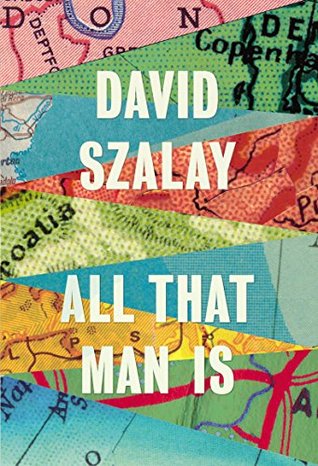 In a riff on the Ages of Man, Szalay gives nine vignettes of men trying to figure out what life is all about. His antiheroes range from age 17 to 73. Each section has several chapters and follows a similar pattern: a man from one European country travels to another European country; there are lots of scenes set at airports or otherwise in transit, and part of the overall atmosphere of dislocation is simply the effort of having to adjust to foreignness. These trips are made for various reasons: feckless French twentysomething Bérnard has been fired by his uncle so goes ahead with a vacation to Cyprus; tabloid journalist Kristian flies from Denmark to Spain to confirm rumors of a government minister’s involvement in a scandal; recently impoverished oligarch Aleksandr takes his yacht for a farewell Adriatic cruise.
Predictably, sex is a major theme: reluctant hook-ups, fantasy lovers, affairs regretted, wild oats never sown. At times I was ready to fill in the title phrase in my best Cockney accent with “All That Man Is…is a bloody wanker.” As individual stories, there’s nothing particularly wrong with these. Inevitably, though, some are more interesting than others, and they don’t quite succeed in feeding into an overarching message, unless to confirm a mood of hedonism and angst. Life is short and pointless; enjoy its moments while you can, eh? Overall, I didn’t find this to be the philosophical and elegiac experience I expected. The prose is great, though; I’d certainly read a more straightforward novel by Szalay.
Favorite lines: “How little we understand about life as it is actually happening. The moments fly past, like trackside pylons seen from a train window.”
My rating: 
Do Not Say We Have Nothing by Madeleine Thien
 “Music and stories, even in times like these, were a refuge, a passport, everywhere.” A sweeping epic of life in China in the turbulent 1960s–80s, this is the Canadian novelist’s fourth book. Narrated from the present day by Marie (or Ma-Li), who lives in Vancouver with her mother, the novel plunges into layers of flashbacks about her family’s connection to Ai-Ming and her musician father, Sparrow. With loyalty to the Communist Party (the title is a line from its anthem) considered the gold standard of behavior and Western music widely denounced as revolutionary, these characters are in a bind: will they pursue their identity as artists, or keep their heads down to avoid trouble? This theme reminded me of Julian Barnes’s fictionalized biography of the Russian composer Shostakovich, The Noise of Time, which also asks whether music can withstand political oppression.
If, like me, you know next to nothing about China’s Cultural Revolution and the transition from Chairman Mao to successive leaders, you will learn so much. There is no denying the power of this portrayal of history. In addition, I was consistently impressed by the book’s language. Thien incorporates Chinese characters and wordplay, musical bars, and snatches of poetry and folk songs. However, I didn’t find this easy reading. The flashbacks can feel endless, such that I experienced Marie’s sections as a relief and wished for more of them. I had to set daily reading targets to get through the novel before the library due date. Yet it is the sort of epic the Booker Prize loves – with echoes of Ruth Ozeki’s The Tale for the Time Being (which should have won in 2013) and Richard Flanagan’s The Narrow Road to the Deep North – and is full of wise observations about what keeps us going when life falls apart. (See my full review at Nudge.)
My rating: 
And here’s another from the longlist that I read recently:
The Many by Wyl Menmuir
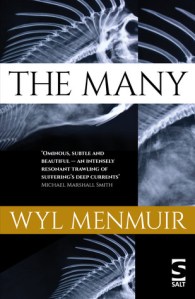 A short work of muted horror, all about atmosphere and the unexplained. Set in a Cornish fishing village, it sees newcomer Timothy Buchannan trying to figure out what happened to Perran, the man who occupied his rundown cottage until his death 10 years ago, and why everyone refuses to talk about him. Flashbacks in italics give glimpses into Timothy’s life with his wife, Lauren, who is meant to join him when he finishes the renovations; and into the fisherman Ethan’s past. I enjoyed the unsettling mood and the language used to describe the setting and Timothy’s dreams. Ultimately I’m not sure I fully understood the book, especially whether the late turns of the plot are to be viewed literally or allegorically. What I take away from it, and this is perhaps too simplistic, is an assertion that we are all joined in our losses. A quick, creepy read – you could do worse than pick it up this Halloween.
My rating: 
My two favorites from the shortlist are #1 His Bloody Project by Graeme Macrae Burnet and #2 Hot Milk by Deborah Levy. But my prediction for tomorrow’s winner is Do Not Say We Have Nothing by Madeleine Thien.
What have you managed to read from the Booker shortlist? What’s your prediction for tomorrow?
Five Reasons I Love My E-Readers
As an inveterate book sniffer and hoarder of musty paperbacks, I was always skeptical about e-readers—that is, until I got my first one three years ago. A birthday present from my husband, my Nook soon became an essential tool in my working life. A year and a bit later, I was sent a Kindle on “permanent loan” through one of my reviewing gigs, and it has quickly become one of my most prized possessions. I know some of my blog readers don’t read e-books at all, and I can sympathize with certain of your feelings. But here are five reasons I love my e-readers, followed by why they will never replace print books for me.
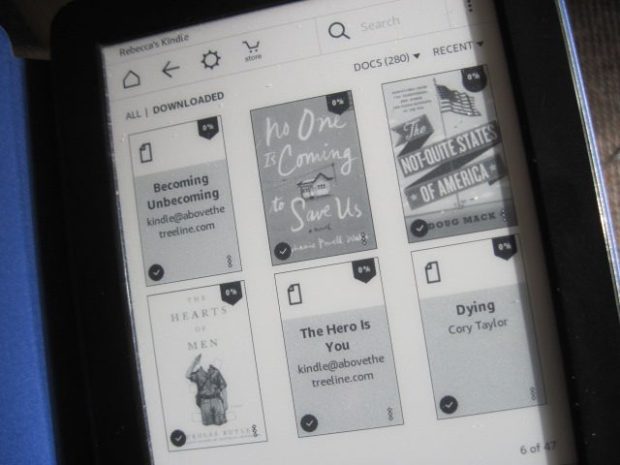
Some recent and upcoming titles I’m keen to try.
- A portable library. I often have between 250 and 300 books on my Kindle. Hundreds of books right at my fingertips, all in a slim 4 x 6 ″ rectangle! If I’m ever stuck somewhere due to delayed or broken-down transport, I’ll never be without ample choices of reading material. E-readers are perfect for cutting down on luggage when traveling (I had to cull 14 books from my suitcase on my last trip to America to stay under the weight limit) and are my usual choice for reading in the car. The Nook’s built-in light is especially useful on nighttime drives. As much as I love my print library, moving house frequently—as we have done over the past decade—always reminds you just how much weight and space books represent.
- Digital review copies. Being willing and able to read PDF and ePUB books is the only thing that has allowed me to work for lots of American companies, which is where the reviewing money seems to be. I can also request advance access to books through NetGalley and Edelweiss, particularly titles not yet published in the UK; and any Kindle downloads do not expire. When traveling I have occasionally found it useful to put other kinds of documents on my Kindle as PDFs, too, like maps and confirmation e-mails. Since I’ve never had a smartphone, this is a kind of compromise between all print and all online.
- Searching and fact-checking. My e-readers’ search function has been invaluable when writing reviews. Often I’ll need to check facts like a character’s last name, the exact city in California, when someone makes their first appearance, or how often a particular word or phrase appears. For instance, I felt that a certain quotation was overused in a memoir, so did a search for it and, indeed, found 12 occurrences!
- Moving between books. I generally have 3 or 4 Kindle books of different genres on the go at any one time, and it couldn’t be easier to move between them with a few finger taps. I’ll often switch books after every couple of chapters, or when I reach a milestone percentage.
- Perfect for certain situations. An e-reader is less obtrusive for reading in public, especially now that etiquette doesn’t seem to preclude phone and tablet use in company. It’s also easier to get one out when you’re going just a few stops on a crowded subway system. I turn to my Kindle for reading over solitary meals/snacks or any other activity that requires my hands, like using a hairdryer. When I think about the lengths I once went to in my former life as a library assistant to read print books—holding pages open with a precariously balanced apple or the edge of a plate during meal breaks; hiding books under the service desk for surreptitious reading at a quiet moment—I think how silly I was not to get an e-reader sooner!
Some of my current reading and review books.
Yet there are definitely things I don’t like about using an e-reader:
- E-books don’t feel like “real” books; I treat them as temporary and disposable and don’t do any nostalgic rebrowsing.
- Battery life can be an issue, though not as often as you might think. (During a period of average use my Kindle probably lasts two weeks, and you can charge it either via a USB cable or at a wall plug.)
- My Nook has a pretty small capacity.
- There are no page numbers on Kindle, just percentages and numerical locations.
- (A pathetic admission) I still haven’t figured out how to highlight passages on my e-readers!
- Because I’m fine with e-copies I don’t get free print books out of most of my review gigs.
- I can’t easily browse the covers/blurbs/first few pages of books to remind myself what they are and decide what I’m in the mood for—as a result, there are dozens of books on my Kindle whose titles I barely recognize.
- I sometimes wonder whether my concentration on and retention of words read on a screen are inevitably lower.
I still love books as physical objects: beautiful covers, delicious smells, the heft of them in your hand and the chance to flick through pages. I like having big stacks of them around as visible signs of progress made and challenges still to come. Arranging and rearranging my library on bookshelves is a periodic treat. So although my e-readers are extremely useful tools, using them is not an unadulterated joy; they will only ever supplement paper books for me, not replace them. I think it’s telling that when given a choice between print and electronic formats—like if I come across an available public library copy of a book I know I have on my Kindle—I’ll choose the print book every time.
How do you feel about e-readers?
More Books about Cats
Back in April I reviewed five books about cats, several of which proved to be a mite disappointing. I’m happy to report that in the meantime I have searched high and low and found some great books about cats that I would not hesitate to recommend to readers with even the slightest interest in our feline friends. I’ve got a book of trivia, a set of heart-warming autobiographical anecdotes, two books of poems, a sweet memoir, and – best of all – a wide-ranging new book that combines the science and cultural history of the domestic cat.
Fifty Nifty Cat Facts by J.M. Chapman and S.M. Davis
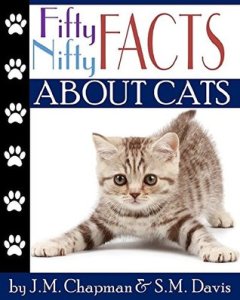 This one’s geared towards children, but I enjoyed the format: each page pairs a cute cat photo with a piece of trivia you might or might not have known. I learned a few neat things:
- a cat’s internal temperature is higher than ours (more like 101.5° F)
- cats have no sweet taste buds and have a dominant paw
- all calicos are female (orange spots being an X-linked genetic trait)
- cats could actually drink seawater – their kidneys are effective enough to process the salt
- people who say they are allergic to cat fur are actually allergic to a protein in the saliva they use to wash themselves!
My rating:
Cat Stories by James Herriot
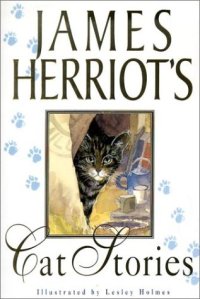 When I was a child my mother and I loved Herriot’s memoirs of life as a primarily large-animal veterinarian in Yorkshire. One story from this volume – the final, Christmas-themed one – is familiar from a picture book we brought out around the holidays. The rest are all drawn from the memoirs, though, so the fact that I don’t remember them must be a function of time; it could be as many as 22 years since I last picked up a Herriot book! In any case, these are charming tales about gentle medical mysteries and even the most aloof of stray cats becoming devoted pets. I especially liked “Alfred: The Sweet-Shop Cat” and “Oscar: The Socialite Cat,” about two endearing creatures known around the village. I also appreciated Herriot’s observation that “cats are connoisseurs of comfort.” With cute watercolor illustrations, this little book would make a great gift for any cat lover.
My rating:
I Could Pee on This: And Other Poems by Cats by Francesco Marciuliano
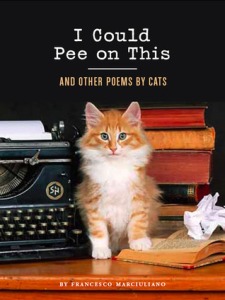 Cat owners must own a copy for the coffee table. That’s just not negotiable. You will recognize so many of the behaviors and attitudes mentioned here. This is a humor book rather than a poetry collection, so the quality of the poems (all from the point-of-view of a cat) is kind of neither here nor there. Even so, Chapter 1 is a lot better than the other three and contains most of the purely hilarious verses, like “I Lick Your Nose” and “Closed Door.” Favorite lines included “I trip you when you walk down the stairs / So you know I’m always near” and “I said I could sit on your lap forever / Don’t you even think of trying to get up / Well, you should have gone to the bathroom beforehand”. “Sushi” is a perfect haiku with a kicker of a last line: “Did you really think / That you could hide fish in rice? / Oh, the green paste burns!”
My rating:
Well-Versed Cats by Lance Percival

 A cute set of poems, most of them describing different breeds of domestic cats and a few of the big cats. There are a lot of puns and jokes along with the end rhymes, making these akin to limericks in tone if not in form. My favorite was “Skimpy the Stray?” – about a wily cat who wanders the neighborhood eliciting sympathetic snacks from various cat lovers. “The routine still goes on, so I mustn’t be too catty, / But she ought to change her name from ‘Skimpy’ into ‘Fatty’.” Our cat had a habit of stealing neighbor kitties’ food and a history of “going visiting,” as the shelter we adopted him from put it, so this particular poem rang all too true. The illustrations (by Lalla Ward, wife of Richard Dawkins) are also great fun.
My rating:
Raining Cats and Donkeys by Doreen Tovey
 Originally from 1967, this lighthearted memoir tells of Tovey’s life in a Somerset village with her husband Charles, two demanding Siamese cats named Solomon and Sheba, and Annabel the donkey. “Nobody misses anything in our village,” Tovey remarks, and along with her charming anecdotes about her pets there are plenty of amusing encounters with the human locals too. In my favorite chapter, Annabel is taken off to mate with a Shetland pony and Solomon has a tussle with a hare. I can recommend this to fans of animal books by Gerald Durrell and Jon Katz. Tovey wrote a whole series of books about her various Siamese cats and life in a 250-year-old cottage. I found a copy of Cats in the Belfry on my visit to Cambridge and will probably read it over Christmas for a cozy treat.
My rating:
The Lion in the Living Room by Abigail Tucker
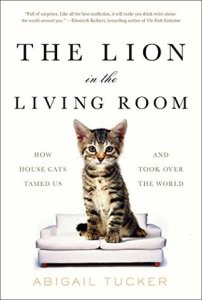 Now this is the amazing cat book I’d been looking for! It’s a fascinating interdisciplinary look at how the domestic cat has taken over the world – both literally and figuratively. A writer for Smithsonian magazine, Tucker writes engaging, accessible popular science. The closest comparison I can make, style-wise, is to Rebecca Skloot’s The Immortal Life of Henrietta Lacks, even though that has much heavier subject matter.
The book traces domestic cat evolution from the big cats of the La Brea tar pits to the modern day, explaining why cats are only built to eat flesh and retain the hunting instinct even though they rarely have to look further than their designated bowls for food nowadays. Alongside the science, though, is plenty of cultural history. You’ll learn about how cats have been an invasive species in many sensitive environments, and about the bizarre, Halloween-scary story of the Toxoplasma gondii parasite. You’ll meet the tender hearts who volunteer for trap, neuter and release campaigns to cut down on the euthanizing of strays at shelters; the enthusiasts who breed unusual varieties of cats and groom them for shows; and the oddballs who buy into the $58 billion pet industry’s novelty accessories.
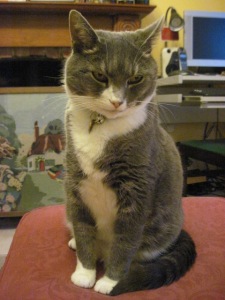
The lion in my living room.
From the earliest domestication of animals to the cat meme-dominated Internet, Tucker – a cat lady herself, as frequent mentions of her ginger tom Cheeto attest – marvels at how cats have succeeded by endearing themselves to humans and adapting as if effortlessly to any habitat in which they find themselves. A must for cat lovers for sure, but I don’t think you even have to be a pet person to find this all-embracing book pretty enthralling.
My rating:
Up next: The Church Cat, an anthology from a recent charity shop haul; The Cat Who Came for Christmas by Cleveland Amory, Cat Sense by John Bradshaw, and Talk to the Tail by Tom Cox from the public library.
Whether you consider yourself a cat lover or not, do any of these books appeal?
Birthday Happenings
One of the best things about being a home-based freelancer is that I can arrange my work schedule to suit my life. Having my birthday fall on a Friday this year was especially good because it meant I got until Monday to submit my daily editing load. My husband was working as usual, so I spent much of the day reading under the cat and charity shopping. I bought seven books, a nice mixture of England-themed nonfiction and juicy novels, plus new-to-me comfy black flats. (Total spend: £10.25.) Being short on time that evening, we lazily ordered delivery pizza for probably the first time in eight years, followed by cocktails and cake.
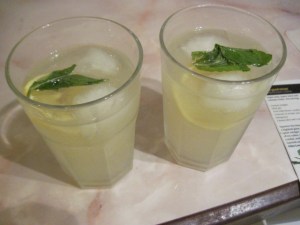 I didn’t end up using my literary cakes and cocktails books this year, but that gives me a chance to proffer my own pun names for what we did make. We tried two gin cocktails we’d found recipes for in the Guardian. The one they called “Elderflower Collins” was absolutely delicious: lemon juice, elderflower cordial and gin, topped up with San Pellegrino Limonata (lemon soda) and garnished with a lemon slice and a mint sprig. I dub it “A Visit from Mr. Collins,” as in the Bennet girls will have to down quite a few of these before…
Unfortunately, the second cocktail was not a hit. The “Miss Polly Hawkins” combines chamomile-flavored gin (I steeped two chamomile teabags in 60 mL of gin for a week), rose syrup (we didn’t have it or want to buy it so substituted our homemade rosehip syrup), plain gin and egg white. Egg white is a fairly frequent ingredient in cocktails – it adds gloss and body – but we found that it made the drink gloopy. That plus the overall floral and medicinal notes meant this was fairly hard to swallow; we had to drown it in sparkling water and ice cubes to get it down. Alas, I modify Iris Murdoch to call this “An Unappealing Rose.”
 However, my cake was an unqualified success. I usually go for chocolate or chocolate/peanut butter desserts, but decided to be different this year and requested the Italian Pear and Ginger Cheesecake from Genevieve Taylor’s cookbook A Good Egg. It was sophisticated and delicious. Running with the Italy thing, I’ll pick out a Forster title and call it “Where Angels Pear to Tread.” (It doesn’t make a whole lot of sense; then again, neither do a lot of the names in Tequila Mockingbird and Scone with the Wind!)
On Sunday the birthday fun continued with a trip to Hungerford Bookshop (our nearest independent bookshop) and a gentle country walk. I bought two secondhand books but came away with a total of four – in the basement they have a table covered in free proof copies, so my husband and I grabbed one each (how I wish I could have taken the lot!). It’s a great idea for rewarding customer loyalty and dealing with unwanted proofs; perhaps I’ll donate a stack of mine to them next time I’m there.


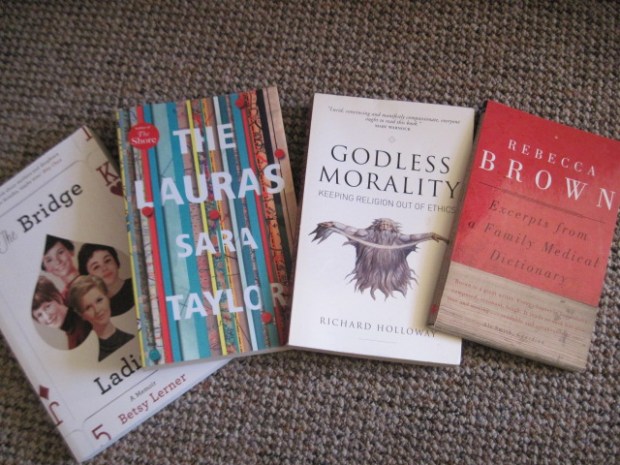
Two proofs (left) and two nonfiction purchases.
This year I got a Kindle case and two bookshop-themed memoirs as presents: The Little Bookstore of Big Stone Gap by Wendy Welch and Books, Baguettes and Bedbugs by Jeremy Mercer. I started reading the former – the story of a married couple opening a bookshop in recession-era Virginia – right away. I also got a poster frame so I can finally hang my literary map of the British Isles on the wall above my desk, and a “Shhhh, reading in progress” mug.

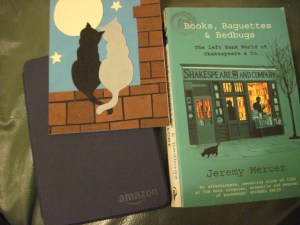

Consuming tasty food and drink + acquiring a baker’s dozen of books + getting out into the countryside = a great birthday weekend!
What are the ingredients for your perfect birthday?
Three Cancer Patient Memoirs
There can’t be many of us whose lives haven’t been touched by cancer. Siddhartha Mukherjee, author of The Emperor of All Maladies, estimates that one in three of us will have cancer at some point in life, and that figure is steadily rising to one in two. Cancer hit home for me in late 2010 with my brother-in-law’s diagnosis of a brain tumor and his subsequent death in early 2015. Since then I have been reading cancer and bereavement memoirs almost compulsively, looking for clues to how we can deal with this near-universal phenomenon. Here are three personal stories of cancer that have stuck with me lately.
This Is Cancer: Everything You Need to Know, from the Waiting Room to the Bedroom
By Laura Holmes Haddad
 A stage IV inflammatory breast cancer survivor, Laura Holmes Haddad wrote the “What to Expect” guide she wishes she could have found at the time of her diagnosis in 2012. Throughout this comprehensive, well-structured book, she uses her own experience to set out practical advice for dealing with the everyday medical and emotional realities of cancer. On the technical side, she gives an alphabetical glossary of “Cancerspeak” vocabulary, as well as explanations of different types of scans, chemo drugs, radiation treatments, methods of coping with pain, and options for reconstruction surgery. But she also goes deep into the less obvious aspects of the disease, like hidden financial costs, little-known side effects, and complications that could affect your sleep and travel. Her tips range from the dead simple—bring your own pen for filling out hundreds of pages of forms; schedule little pick-me-ups like a mini-makeover—to major issues like marriage and parenting with cancer.
“Don’t be surprised if this thing—this cancer road trip—leads to places you never could have imagined,” Holmes Haddad writes. “I’m trying to pay it forward to other patients, to help ease some angst, to comfort.” You might be surprised to learn that this is a very pleasant read. It fluidly mixes anecdote with facts and maintains an appropriate tone: forthright and reassuring yet wry, as in the ‘Devil’s Dictionary’ type translations (“DOCTOR: ‘You might feel some discomfort.’ MEANING: ‘This will hurt like hell.’”).
No cancer patient should be without this book. That statement needs no qualifying. Yes, it might be geared more towards women, specifically breast cancer patients, and there’s some U.S.-specific information about health insurance, but much of the guidance is universally applicable. Whether for yourself or to help a family member or friend, you’ll want a copy.
My thanks to publicist Eva Zimmerman for the free e-copy for review. This Is Cancer will be released by Seal Press on Tuesday.
My rating: 
Late Fragments: Everything I Want to Tell You (About This Magnificent Life)
By Kate Gross
 By the end of this charming memoir, I felt I knew Kate Gross as a friend. A high-flying British civil servant who helped Tony Blair found an NGO in Africa, she was shocked to learn in her early thirties that her occasional ‘bottom trouble’ was end-stage colon cancer with liver metastases. “I’m a golden girl, a people-pleaser, something who is used to graft and a pleasant smile being rewarded,” she writes, yet here was a situation she could not control. She died at age 36 in 2014.
In this short, clear-eyed book, she balances a brief recounting of her life with observations about terminal illness and trying to ensure a good future for her five-year-old twin sons. Memoirs by people facing death can often skirt close to cliché, but I felt Gross had fresh things to tell me about many subjects:
Cultivating “bitter gratitude”: “How strange, how brilliant it is that this awareness of wonder, this sense of the sublime, has been so closely intertwined with my illness as it has progressed.”
The value of literature: “Reading is an experience by which we connect ourselves to what we are, to this magnificent, awful life, in which the same grooves are being scored over and over again in different times and tongues.”
How to act around the dying: “we don’t expect great words of wisdom or solace. I just want this shit to be acknowledged”
Gross doesn’t believe in an afterlife beyond her children’s memory and this book—“nothingness-with-benefits.” I could sympathize with her picture of death, “me in the back of a black taxi, leaving an awesome party before the end, just when everyone else was starting to have real fun.” I wish she’d had longer at the party, but I’m glad she left these thoughts behind.
My rating:
Haematemesis: How One Man Overcame a Fear of Things Medical and Learned to Navigate His Way Around Hospital
By Henry G. Sheppard
 This is a mordantly funny account of one Australian man’s experience with recurrent cancer. In remission since 2007, Sheppard discovered in 2015 that he was once more riddled—that awful word—with leukemia. Having vowed never to go through chemo again, he learned that it had somewhat improved in the intervening years, with the drip treatments now partially replaced by tablets. This time around he ran into a lot of what he calls “Big Hospital Attitude”: scheduling issues with his bone marrow biopsy, nurses who didn’t think he could manage his own insulin treatments, and constant problems with finding veins for his many injections. Was this the much-touted “Patient-Centered Care”? Would he be better off with the “quick and relatively-painless death offered when one is mauled by a pack of wild dogs”?
“Haematemesis” means vomiting blood, and be warned: there is a lot of blood here; if you’re squeamish about needles you may struggle. There is also plenty of scatological humor. But in general I found the tone to be reminiscent of Bill Bryson in a hospital gown, especially when he’s describing squeezing his belly into a CT scanner or recounting his flatulence.
My main complaint is that at 80 pages this feels incomplete, like it’s telling just part of the story. What about his first bout with leukemia, or his earlier life (which, from a look at his Goodreads biography, seems very eventful indeed)? I understand that Sheppard wanted to get this book released while he was still able. I wish him well and hope for a sequel.
My thanks to the author for the free e-copy for review.
My rating:
The Un-Discovered Islands by Malachy Tallack
 Last summer I very much enjoyed Malachy Tallack’s first book, 60 Degrees North, a memoir cum travel book about looking for a place to call home in the midst of a nomadic life; see my Nudge review. His new book is a gorgeous art object (illustrated by Katie Scott), composed of two- or three-page mini-essays about the real and legendary islands that have disappeared and/or been disproved over the centuries. A few of the names may be familiar – Atlantis, Thule and the Isles of the Blessed, perhaps – but many of the rest are fairly obscure entries in the historical and geographical record.
It’s fascinating to see how some of these islands inhabit both mythological and real space. For instance, my favorite story is that of Hufaidh in the Southern Iraq marshes. This area where the Euphrates and Tigris Rivers meet was the ancestral home of the Ma‘dān or “Marsh Arabs,” and was known to Western visitors such as Gavin Maxwell, who came to collect his otter Mijbil (the subject of Ring of Bright Water) there, and travel writer Wilfred Thesiger. Tallack writes that Hufaidh “was part paradise and part hell, both of this world and another.” When Thesiger asked locals about the island in the 1950s, he was told that “anyone who sees Hufaidh is bewitched, and afterwards no-one can understand his words.” So Hufaidh was mythical? In a sense, Tallack acknowledges, and yet Saddam Hussein’s deliberate destruction of the marshes after the first Gulf War also obliterated Hufaidh, and even the ongoing campaign of ecological restoration can never bring it back.

“Islands of Life and Death”
I was also intrigued by the tale of the Auroras, presumed to be located between the Falkland Islands and South Georgia. They were sighted multiple times between 1762 and 1796, including by a Spanish research ship, but were never seen again after the eighteenth century. Were the sailors simply mistaken? In 1820 Captain James Weddell concluded that they must have confused the Shag Rocks, 100 miles to the east, for a new set of islands. But the mystery remained, as evidenced by Edgar Allan Poe’s 1838 novel The Narrative of Arthur Gordon Pym of Nantucket, which has a ship’s crew searching for the Auroras as well as for fur seals.
Plato almost certainly invented Atlantis for his allegories, but in reading this book you will learn that some islands are indeed suspected to have sunk, like Sarah Ann Island in the Pacific, which the USA claimed for its guano resources. And while you might think that bogus territories could not exist in the late twentieth or early twenty-first centuries, a few did: the Terra Nova Islands of the Antarctic were only removed from the map in 1989, and Bermeja, an island in the Gulf of Mexico disputed between the United States and Mexico, was only definitively proven not to exist in 2009.

“The Age of Exploration”
A few of these cases feel thin or repetitive; even with 24 islands discussed in full and another 10 listed with capsule explanations in an appendix, you sometimes get the sense that the book required a lot of barrel-scraping to craft satisfying narratives out of frustratingly incomplete stories. Still, Tallack has done an admirable job parsing fact from fiction and extracting broad lessons about the truths that might lie deeper than our atlas pages:
Absence is terrifying, and so we fill the gaps in our knowledge with invented things. These bring us comfort, but they conflict, too, with our desire for certainty and understanding.
The science of navigation has worked towards the eradication … of mystery, and to an astonishing degree it has succeeded. We can know where we are and what direction we are traveling with just the click of a button. And though that technology brings its own kind of wonder, part of us mourns what has been lost.
With its excellent color illustrations, this would make a perfect coffee table book to dip into whenever you have five or ten spare minutes to read an essay or two. I would particularly recommend it to readers who are captivated by maps, historical oddities and hoaxes.


(My review copy came wrapped in matching paper!)
The Un-Discovered Islands releases in the UK tomorrow. My thanks to Kristian Kerr of Birlinn Polygon for the free copy.
My rating:
Further reading: Two similar books I’ve read are The Ice Museum by Joanna Kavenna (about the search for Thule) and Banvard’s Folly by Paul Collins (more tangentially relevant – it’s about historical mistakes and failures). You might also try Judith Schalansky’s Atlas of Remote Islands.
Books in Brief: Five I Loved Recently
Here are mini-reviews of five books I loved recently: two I originally reviewed for other websites and three stellar library reads; three works of historical fiction and two nonfiction books.
Known and Strange Things: Essays
By Teju Cole
 This collects 55 short pieces under three headings: literature, visual arts, and travel. Alongside straightforward book reviews are essays in which Cole engages with his literary heroes. A 400-page book of disparate essays is a hard ask, and even photography aficionados may struggle through the long middle section. All the same, patience is rewarded by Part III, “Being There,” in which he deftly blends memoir and travelogue. Again and again he reflects on displacement and ambiguity. Born in Michigan but raised in Nigeria, Cole returned to the States for college. Though erudite and wide-ranging, these essays are not quite as successful as, say, Julian Barnes’s or Geoff Dyer’s in making any and every topic interesting to laymen. Still, Cole proves himself a modern Renaissance man, interweaving experience and opinion in rigorous yet conversational pieces that illuminate the arts. (See my full review on the Pittsburgh Post-Gazette website.)
Winter
By Christopher Nicholson
 A perfect novel about a few months of Thomas Hardy’s later life. On the surface it’s the story of a rather odd love triangle: the octogenarian Hardy was infatuated with Gertrude Bugler, a local Dorset actress who had agreed to play his Tess on the London stage; his neurotic second wife, Florence, got wind of his feelings and jealously decided to sabotage Gertie. Underneath, I found this to be a deeply moving book about fear – of death, but also of not having lived the way you wanted and meant to. The perspective moves between Florence and Gertie in the first person and an omniscient third-person narrator. Chapters 1, 6 and 8, in particular, are a pitch-perfect pastiche of Hardy’s style. A bleak country winter is the perfect setting for a story of personal decay and a marriage grown cold. This brought back vivid memories of my visit to Hardy’s house in 2004 and coincided with my own vision of who Hardy was.
The Complete Maus
By Art Spiegelman
 The only graphic novel to win the Pulitzer Prize, this brings the Holocaust home in a fresh way. Like Animal Farm, it uses the conceit of various animal associations: Jews are mice, Poles are pigs, Nazis are cats, and Americans are dogs. Spiegelman draws what, from a distance of decades, his father Vladek remembers about his almost unbelievable series of escapes, including time in Auschwitz. Spiegelman gives the book an extra dimension by including his 1970s/80s recording sessions with his father as a framing story for most chapters. The narration is thus in Vladek’s own broken English, and we see how exasperating Spiegelman finds him – for pinching pennies and being racist against blacks, for instance – even as he’s in awe of his story. You can see how this paved the way for comic artists like Roz Chast and Alison Bechdel. I recommend it to absolutely anyone, graphic novel fan or no.
Golden Hill
By Francis Spufford
 Bawdy, witty, vivid historical fiction; simply brilliant. You’ll never doubt for a second that you are in 1746 New York – an English colony with a heavy Dutch influence, and slavery still the standard. The novel opens suddenly as twenty-four-year-old Richard Smith arrives from London with a promissory note for £1000. He won’t explain how he came by the money or what he intends to do with it, but the order seems legitimate. This puts the merchant Mr. Lovell in rather a bind, because that kind of cash simply can’t be come by. Before he can finally get his money, Smith will fall in and out of love, fight a duel, and be arrested twice – all within the space of two months. In a book full of fantastic scenes, Smith and Septimus’ narrow escape via the rooftops on Pope Day stands out. The finest thing about the novel, though, is the authentic eighteenth-century diction. Spufford writes very good creative nonfiction, with five books to date, but with his debut novel he’s hit a home run.
Resolution
By A.N. Wilson
 From a prolific author of both fiction and nonfiction, a meticulously researched novel about George Forster, one of the naturalists on Captain Cook’s second voyage. Rather than giving a simple chronological account of the journey and its aftermath, Wilson employs a sophisticated structure that alternates vignettes from the voyage with scenes from about 10 years later, when George is unhappily married to Therese and struggling to find suitable work. This is the second novel I’ve read by Wilson, after The Potter’s Hand. I find his fiction to be thoroughly convincing as well as engaging. This reminded me most of Measuring the World by Daniel Kehlmann, another rip-roaring tale of exploration with prose emulating the more detached narrative style of the eighteenth century. Recommended to any readers of historical fiction and adventure stories. (See my full review at The Bookbag.)
Have you read any of these? Which one takes your fancy?
How People Found My Blog Recently
Back in May I surveyed a few months’ worth of the (often very odd) web searches that led people to my blog. In the past four and a half months the search terms have been more normal in that they generally relate to books or authors I’ve covered. However, I do hope I haven’t disappointed some searchers: after all, I don’t reveal the exact location of the croft in Seal Morning, instruct readers in how to pronounce ‘Athill’, or give any details about Ann Kidd Taylor’s wedding!
In any case, it’s always interesting to see what people were looking up – Oliver Balch’s Under the Tump, Michel Faber’s Undying, Sarah Perry’s The Essex Serpent and various graphic novels were popular topics – and I reckon I count among the “bookish cat people” of the first search. (Spelling and punctuation are unedited throughout this list!)
May 26: bookish cat people, oliver balch under the tump
May 31: a book review of any book about 140-160 words, in my next life i want to be a cat. to sleep 20 hours a day and wait to be fed. to sit around licking my ass., under the tump by oliver balch reviews
June 25: irmina yelin, george watsky bipolar
July 2: michel faber undying goodreads, the first bad man book miranda july plot
July 16: she’s my only father’s daughter, essex serpent, sue gee, hay on wye
July 21: the ghost of nelly burdons beck
August 5: correct pronunciation of athill in diana athill s name
August 11: the essex serpent usa release
August 24: ann kidd taylor wedding
August 25: paintings with a woman reading a book
August 29: michel faber undying review, to the bright edge of the world interview
September 8: agatha christie graphic novel, house of hawthorne
September 13: irmina by barbara yellen
September 19: paulette bates
September 21: bbc miniseris vs book war and peace
September 26: vincent van gogh graphic novel
September 28: reviews on my son my sonby howard spring
September 30: seal morning location of croft
October 3: john pritchard_something more
A Nonfiction Bonanza
For much much of the summer I was sunk deep into several very good but not particularly page-turning works of nonfiction from my shelves. I spent months reading some of them, which is very unusual for me and often a sign that I’m not enjoying something, but this time that wasn’t the case. One of these nonfiction reads – the Fermor – ended up being among my favorite books of the year so far. Below I give quick write-ups of what I’ve finished lately and recall how these books came to be in my collection.
 Lincoln: A Foreigner’s Quest by Jan Morris: Like grape jelly, the obsession with Abraham Lincoln was something about American life that world traveler Jan Morris could never understand. Here she sets out to discover the melange of history and myth that composes the 16th president. She succeeds in giving not only the salient facts of Lincoln’s life but also a fair assessment of his character, in a lighthearted and accessible book that has neither the heft nor the heavygoing tone of a standard biography. Her discussion of his rhetorical style is especially good, and in a few passages she imagines the reader into scenes. Here’s one of the best pithy observations: “Academic historians cannot allow themselves such flip idiomatic judgments, but to an outsider like me that seems about the truth of it. He was a nice man. He could be scheming, irritable, disingenuous, but he was never pompous or overbearing.” [Remainder copy bought for $3.99 at Wonder Book and Video, Frederick, Maryland.]
 The Omnivore’s Dilemma by Michael Pollan: I made the mistake of reading this a decade after its publication, which means I already knew most of its facts about industrialized farming and the insidiousness of processed foods. I found Part I to be overly detailed and one-note, constantly harping on about corn. The book gets better as it goes on, though, with Pollan doing field research at Joel Salatin’s Polyface Farm in Virginia to compare large-scale organic agriculture with more sustainable grassroots operations. Pollan’s assessment of the ethics of eating meat is not quite as thorough as Jonathan Safran Foer’s (in Eating Animals), but he does a good job of showing all sides of the issue. This would make an excellent, comprehensive introduction to where food comes from for people who have never given it much thought. But then again, the people who need it most would never pick up a dense 400+-page book by a liberal journalist. [Bought in one of the Hay-on-Wye shops for £2.]
 The Naming of the Shrew by John Wright: Wright is known in the UK as TV chef Hugh Fearnley-Whittingstall’s go-to expert on foraging, especially fungi. His enthusiasm for the arcane details of Latin naming comes through clearly in this thorough history of taxonomy. At first I thought it would be a groaningly pun-filled book of arbitrarily arranged trivia, but by Chapter 2 Wright won me over. You’ll learn all about Carl Linnaeus and the taxonomists who preceded and followed him; rules for species naming and the meaning of common Latin prefixes and suffixes; the wildly divergent sources of names, from discoverers’ names to mythology; and the endless complications of a field where species are always being lumped, split, or re-evaluated. One of my favorite facts was that aloe vera and the boa constrictor are among the few species whose English names are the same as their Latin ones. [A birthday gift from my brother-in-law last year.]
 A Time of Gifts by Patrick Leigh Fermor: A true masterwork of travel writing. Over the course of three years, starting when he was just 18, Fermor walked from Holland to Constantinople. I was particularly eager to read this because he passes through a lot of places I went on my travels this past summer, including Germany, Austria and Bratislava. This first of three volumes covers up until his entry into Hungary. His descriptions of the landscape and the people he interacted with are as fresh as if they happened yesterday, and yet he was reconstructing this journey nearly 40 years after the fact. Although he was basically traveling rough, he managed to wangle invitations into castles and aristocrats’ homes. This gives him a broad base of observation such that you feel you’re getting a complete picture of European life in the early 1930s. It’s a precious glimpse of pre-war history, but Fermor doesn’t use too heavy a hand when recalling signs of rising Nazism. Lastly, this is simply damn fine writing:
Beer, caraway seed, beeswax, coffee, pine-logs and melting snow combined with the smoke of thick, short cigars in a benign aroma across which every so often the ghost of sauerkraut would float.
The Romanesque nave was packed and an anthem of great choral splendour rose from the gothic choir stalls, while the cauliflowering incense followed the plainsong across the slopes of the sunbeams.
When no buildings were in sight, I was back in the Dark Ages. But the moment a farmhouse or a village impinged, I was in the world of Peter Brueghel.
[Bought for £1 from a secondhand bookstore in Henley-on-Thames.]
 The House by the Sea by May Sarton: This is the sixth of Sarton’s journals I’ve read. It covers 1975–6, when she was 63–4 and in her second year in Maine. Her health is not yet a worry, at least as compared to later journals, but there is a faint sense of diminished abilities and an awareness of death’s approach. Poetry has run dry for her, but in the course of writing this journal she publishes a series of biographical reflections and prepares to begin a new novel. Tamas the dog and Bramble the cat are faithful companions. Her former lover, Judy, suffers from dementia and visits with her are mostly painful reminders of what has been lost. These journals are not the place to turn if you want momentous events. Rather, read them for deep insight into a writer’s psyche, meditations on the benefits of solitude, and affirmation of the quiet joys of gardening and an ocean view. [Bought from a library book sale in America for 50 cents.]
What are some of the best nonfiction books you’ve read recently?
Literary Cakes and Cocktails
With my birthday coming up in the middle of the month, it’s time to start thinking about what treats I want to help me celebrate. Where better for a bibliophile to turn than to these two pun-filled bookish cookbooks?


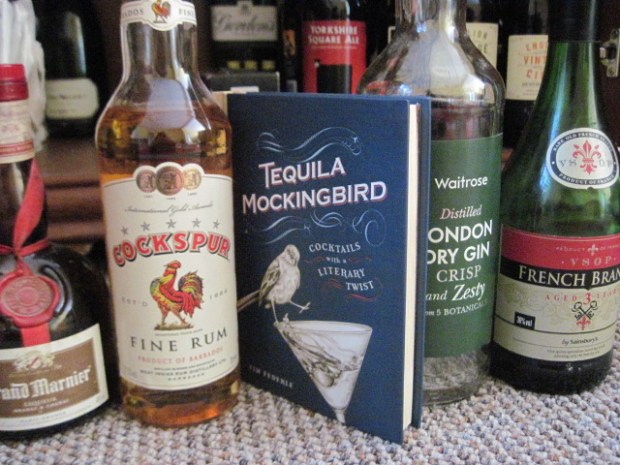
I got Scone with the Wind from my in-laws for last year’s birthday, and found Tequila Mockingbird at the Salvation Army shop in Cambridge for 70 pence the other week. There’s some mighty tempting options in both. The Woman in Black Forest Gâteau? Finnegans Cake (chocolate/stout flavored)?


And to drink, perhaps The Lime of the Ancient Mariner (gin with lime and grapefruit juices in a salted glass) or Gin Eyre (if I can find something to substitute for orange bitters)? We don’t keep a lot of spirits around, but gin and rum are always in our drinks cupboard, so that’s a good place to start.


If you can’t handle puns, look away from these books now! However, if you or someone you know likes them, these make great gift books for the coffee table. I’ll report back on my culinary trials!
 Bookish Beck = Rebecca Foster. American transplant to England. Freelance proofreader and book reviewer.
