How People Found My Blog Recently
Back in May I surveyed a few months’ worth of the (often very odd) web searches that led people to my blog. In the past four and a half months the search terms have been more normal in that they generally relate to books or authors I’ve covered. However, I do hope I haven’t disappointed some searchers: after all, I don’t reveal the exact location of the croft in Seal Morning, instruct readers in how to pronounce ‘Athill’, or give any details about Ann Kidd Taylor’s wedding!
In any case, it’s always interesting to see what people were looking up – Oliver Balch’s Under the Tump, Michel Faber’s Undying, Sarah Perry’s The Essex Serpent and various graphic novels were popular topics – and I reckon I count among the “bookish cat people” of the first search. (Spelling and punctuation are unedited throughout this list!)
May 26: bookish cat people, oliver balch under the tump
May 31: a book review of any book about 140-160 words, in my next life i want to be a cat. to sleep 20 hours a day and wait to be fed. to sit around licking my ass., under the tump by oliver balch reviews
June 25: irmina yelin, george watsky bipolar
July 2: michel faber undying goodreads, the first bad man book miranda july plot
July 16: she’s my only father’s daughter, essex serpent, sue gee, hay on wye
July 21: the ghost of nelly burdons beck
August 5: correct pronunciation of athill in diana athill s name
August 11: the essex serpent usa release
August 24: ann kidd taylor wedding
August 25: paintings with a woman reading a book
August 29: michel faber undying review, to the bright edge of the world interview
September 8: agatha christie graphic novel, house of hawthorne
September 13: irmina by barbara yellen
September 19: paulette bates
September 21: bbc miniseris vs book war and peace
September 26: vincent van gogh graphic novel
September 28: reviews on my son my sonby howard spring
September 30: seal morning location of croft
October 3: john pritchard_something more
A Nonfiction Bonanza
For much much of the summer I was sunk deep into several very good but not particularly page-turning works of nonfiction from my shelves. I spent months reading some of them, which is very unusual for me and often a sign that I’m not enjoying something, but this time that wasn’t the case. One of these nonfiction reads – the Fermor – ended up being among my favorite books of the year so far. Below I give quick write-ups of what I’ve finished lately and recall how these books came to be in my collection.
 Lincoln: A Foreigner’s Quest by Jan Morris: Like grape jelly, the obsession with Abraham Lincoln was something about American life that world traveler Jan Morris could never understand. Here she sets out to discover the melange of history and myth that composes the 16th president. She succeeds in giving not only the salient facts of Lincoln’s life but also a fair assessment of his character, in a lighthearted and accessible book that has neither the heft nor the heavygoing tone of a standard biography. Her discussion of his rhetorical style is especially good, and in a few passages she imagines the reader into scenes. Here’s one of the best pithy observations: “Academic historians cannot allow themselves such flip idiomatic judgments, but to an outsider like me that seems about the truth of it. He was a nice man. He could be scheming, irritable, disingenuous, but he was never pompous or overbearing.” [Remainder copy bought for $3.99 at Wonder Book and Video, Frederick, Maryland.]
 The Omnivore’s Dilemma by Michael Pollan: I made the mistake of reading this a decade after its publication, which means I already knew most of its facts about industrialized farming and the insidiousness of processed foods. I found Part I to be overly detailed and one-note, constantly harping on about corn. The book gets better as it goes on, though, with Pollan doing field research at Joel Salatin’s Polyface Farm in Virginia to compare large-scale organic agriculture with more sustainable grassroots operations. Pollan’s assessment of the ethics of eating meat is not quite as thorough as Jonathan Safran Foer’s (in Eating Animals), but he does a good job of showing all sides of the issue. This would make an excellent, comprehensive introduction to where food comes from for people who have never given it much thought. But then again, the people who need it most would never pick up a dense 400+-page book by a liberal journalist. [Bought in one of the Hay-on-Wye shops for £2.]
 The Naming of the Shrew by John Wright: Wright is known in the UK as TV chef Hugh Fearnley-Whittingstall’s go-to expert on foraging, especially fungi. His enthusiasm for the arcane details of Latin naming comes through clearly in this thorough history of taxonomy. At first I thought it would be a groaningly pun-filled book of arbitrarily arranged trivia, but by Chapter 2 Wright won me over. You’ll learn all about Carl Linnaeus and the taxonomists who preceded and followed him; rules for species naming and the meaning of common Latin prefixes and suffixes; the wildly divergent sources of names, from discoverers’ names to mythology; and the endless complications of a field where species are always being lumped, split, or re-evaluated. One of my favorite facts was that aloe vera and the boa constrictor are among the few species whose English names are the same as their Latin ones. [A birthday gift from my brother-in-law last year.]
 A Time of Gifts by Patrick Leigh Fermor: A true masterwork of travel writing. Over the course of three years, starting when he was just 18, Fermor walked from Holland to Constantinople. I was particularly eager to read this because he passes through a lot of places I went on my travels this past summer, including Germany, Austria and Bratislava. This first of three volumes covers up until his entry into Hungary. His descriptions of the landscape and the people he interacted with are as fresh as if they happened yesterday, and yet he was reconstructing this journey nearly 40 years after the fact. Although he was basically traveling rough, he managed to wangle invitations into castles and aristocrats’ homes. This gives him a broad base of observation such that you feel you’re getting a complete picture of European life in the early 1930s. It’s a precious glimpse of pre-war history, but Fermor doesn’t use too heavy a hand when recalling signs of rising Nazism. Lastly, this is simply damn fine writing:
Beer, caraway seed, beeswax, coffee, pine-logs and melting snow combined with the smoke of thick, short cigars in a benign aroma across which every so often the ghost of sauerkraut would float.
The Romanesque nave was packed and an anthem of great choral splendour rose from the gothic choir stalls, while the cauliflowering incense followed the plainsong across the slopes of the sunbeams.
When no buildings were in sight, I was back in the Dark Ages. But the moment a farmhouse or a village impinged, I was in the world of Peter Brueghel.
[Bought for £1 from a secondhand bookstore in Henley-on-Thames.] 
 The House by the Sea by May Sarton: This is the sixth of Sarton’s journals I’ve read. It covers 1975–6, when she was 63–4 and in her second year in Maine. Her health is not yet a worry, at least as compared to later journals, but there is a faint sense of diminished abilities and an awareness of death’s approach. Poetry has run dry for her, but in the course of writing this journal she publishes a series of biographical reflections and prepares to begin a new novel. Tamas the dog and Bramble the cat are faithful companions. Her former lover, Judy, suffers from dementia and visits with her are mostly painful reminders of what has been lost. These journals are not the place to turn if you want momentous events. Rather, read them for deep insight into a writer’s psyche, meditations on the benefits of solitude, and affirmation of the quiet joys of gardening and an ocean view. [Bought from a library book sale in America for 50 cents.]
What are some of the best nonfiction books you’ve read recently?
Literary Cakes and Cocktails
With my birthday coming up in the middle of the month, it’s time to start thinking about what treats I want to help me celebrate. Where better for a bibliophile to turn than to these two pun-filled bookish cookbooks?


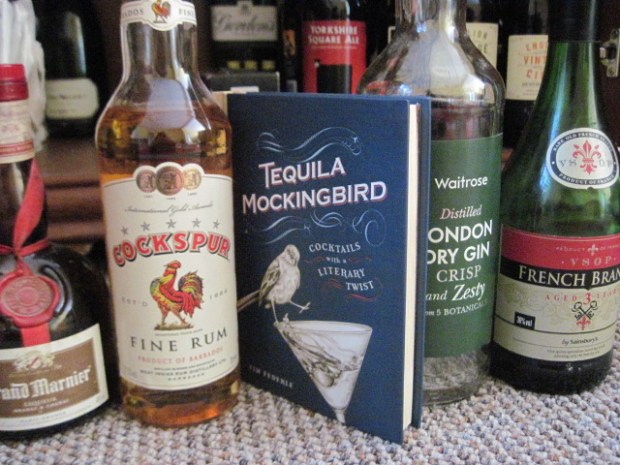
I got Scone with the Wind from my in-laws for last year’s birthday, and found Tequila Mockingbird at the Salvation Army shop in Cambridge for 70 pence the other week. There’s some mighty tempting options in both. The Woman in Black Forest Gâteau? Finnegans Cake (chocolate/stout flavored)?


And to drink, perhaps The Lime of the Ancient Mariner (gin with lime and grapefruit juices in a salted glass) or Gin Eyre (if I can find something to substitute for orange bitters)? We don’t keep a lot of spirits around, but gin and rum are always in our drinks cupboard, so that’s a good place to start.


If you can’t handle puns, look away from these books now! However, if you or someone you know likes them, these make great gift books for the coffee table. I’ll report back on my culinary trials!
Library Checkout: September 2016
I’ve been powering through the public library books, even as I keep amassing owned books – including from local charity shops and the bargain shelves at Poundland and Waterstones.
I’ve given ratings for all the books I finished, and added links to Goodreads reviews for those I managed to write about. A few of these books were truly remarkable, so I’ll probably pull them out to highlight in a future post.
The stack I currently have on loan, plus the ones on reserve, should easily see me through the autumn and into winter! (* = poetry books)
LIBRARY BOOKS READ
- Not That Kind of Girl: A Young Woman Tells You What She’s “Learned” by Lena Dunham

- The Malarkey by Helen Dunmore*
- Late Fragments: Everything I Want to Tell You (about This Magnificent Life) by Kate Gross
- The Reason I Jump: One Boy’s Voice from the Silence of Autism by Naoki Higashida
- Hot Milk by Deborah Levy
- Keeping Mum by Gwyneth Lewis*
- Winter by Christopher Nicholson
- Letter Composed during a Lull in the Fighting by Kevin Powers*
- How Snow Falls by Craig Raine*
- The Last Act of Love: The Story of My Brother and His Sister by Cathy Rentzenbrink
- The Complete Maus by Art Spiegelman
- Golden Hill by Francis Spufford

- The Wallcreeper by Nell Zink
CHECKED OUT, TO BE READ
- Ozone Journal by Peter Balakian*
- Open City by Teju Cole
- The Course of Love by Alain de Botton
- Mend the Living by Maylis de Kerangal
- The Library of Unrequited Love by Sophie Divry
- Let Me Tell You about a Man I Knew by Susan Fletcher
- The Lie Tree by Frances Hardinge
- Man Walks into a Room by Nicole Krauss
- The House at the Edge of the World by Julia Rochester

ON HOLD, TO BE PICKED UP
- Keeping an Eye Open: Essays on Art by Julian Barnes
- The Most Perfect Thing: Inside (and Outside) a Bird’s Egg by Tim Birkhead
- Thrice the Brinded Cat Hath Mew’d by Alan Bradley
- Thirteen Ways of Looking by Colum McCann
- Do Not Say We Have Nothing by Madeleine Thien
- The Painted Bridge by Wendy Wallace
IN THE RESERVATION QUEUE
- The Crime Writer by Jill Dawson
- The Man Who Wouldn’t Get Up and Other Stories by David Lodge
- Nutshell by Ian McEwan
- The Many by Wyl Menmuir
- Fingers in the Sparkle Jar by Chris Packham
- The Tobacconist by Robert Seethaler
- Autumn by Ali Smith
RETURNED UNREAD
- Aftermath: On Marriage and Separation by Rachel Cusk [I sampled the first few pages and found it flat and affectless; perhaps I’ll try her fiction instead.]
- Kid Gloves: A Voyage round My Father by Adam Mars-Jones [I decided an interest in the subject matter couldn’t overcome my frustration with the author’s style.]
(Thanks, as always, go to Shannon of River City Reading for the great blog idea and template!)
Short Stories in September
In 2014 I read 20 short story collections, but in 2015 and 2016 (at least so far) I’ve only managed 10 per year. Three of those have all clumped within the last month or so, though. I started The Pier Falls back in May but set it aside at the halfway point; luckily, when I returned to it earlier this month I devoured the rest within a few hours. I also reviewed the second annual anthology of Best Small Fictions for the Small Press Book Review, a new online venue for me, and tried out Alexandra Kleeman’s short stories after loving her debut novel last year. Mini reviews below…
Best Small Fictions 2016, edited by Stuart Dybek
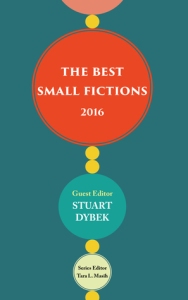 This collects 45 super-short stories that stand out for their structure, voice, and character development—all in spite of often extreme brevity. Humor and pathos provide sharp pivot points. It helps to have an unusual perspective, like that of a Venus flytrap observing a household’s upheavals (Janey Skinner’s “Carnivores”), or of potential names gathering around a baptismal font (Alberto Chimal’s “The Waterfall”). Hard as it is to choose from such a diverse bunch, I do have three favorites: Elizabeth Morton’s “Parting,” in which a divorce causes things to be literally divided; Mary-Jane Holmes’s “Trifle,” where alliteration and culinary vocabulary contrast an English summer with Middle Eastern traces; and Amir Adam’s “The Physics of Satellites,” which uses images from astronomy and a recent suicide to contrast falling, flying, and barely holding on. There are fewer highlights than in the previous volume, but this is still an excellent snapshot of contemporary flash fiction. (See my full review at the Small Press Book Review.)
The Pier Falls by Mark Haddon
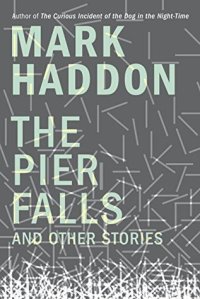 These nine stories examine what characters do in extreme, often violent situations. My three favorites were “Bunny,” reminiscent of The Fattest Man in Britain with its picture of a friendship between an obese man and a young woman who sees more in him than his size; “The Woodpecker and the Wolf,” a brilliantly suspenseful tale set in space – it reminded me of the Sandra Bullock movie Gravity; and “The Weir,” which imagines the unexpectedly lasting relationship between a lonely middle-aged man and the young woman he rescues from a near-suicide by drowning. “Wodwo” starts off as a terrific Christmas horror story but goes on far too long and loses power. I would say that about several of these stories, actually: they’re that bit too long, so that you start waiting for them to be over. I prefer sudden endings that give a bit of a kick. All in all, though, two-thirds of the stories are fairly memorable, and I’d say I liked this better than any of Haddon’s three novels.
Intimations by Alexandra Kleeman
 Kleeman’s debut novel, You Too Can Have a Body Like Mine, was a surprise favorite of mine from last year. Alas, her stories don’t pack the same punch. True, some of them employ a similar combination of surreal plot and in-your-face ideology, but only four out of the 12 stories seemed to me strong enough to stand alone. These were “Lobster Dinner,” surely inspired by David Foster Wallace’s Consider the Lobster, in which crustaceans wreak revenge on their consumers; “The Dancing-Master,” about a man who tries to introduce a nineteenth-century feral boy to culture only for wildness to come creeping back; “I May Not Be the One You Want,” in which Karen, writing a profile about a dairy farmer, avoids men’s attempts to turn her into a sexual object; and “Fake Blood,” another pseudo-horror story about a girl in a nurse costume who can’t decide whether she’s caught up in a murder mystery game or a real serial killer’s trap. Of the rest, four or five – including vignettes from Karen’s future life – are okay and a couple are pointless as well as seemingly endless (“A Brief History of Weather” and “Hylomorphosis”). Students of feminist literature, especially fans of Angela Carter, may be willing to exchange satisfying storytelling for messages about women’s bodies and anxiety about motherhood.
 On Tuesday I finished All That Man Is by David Szalay, from the Booker Prize shortlist. Whether it’s a novel or actually short stories is certainly a matter for debate! After I read Madeleine Thien’s shortlisted novel (I’ll be picking it up from the library on Friday) I’ll report back on both in advance of the prize announcement at the end of October.
 I’m also currently making my way through How Much the Heart Can Hold, a set of seven stories from the likes of Carys Bray and Donal Ryan on the theme of different types of love, and Petina Gappah’s forthcoming collection, Rotten Row. (Both are out in early November.)
Collections on my Kindle that I’m keen to read soon, maybe even before the end of this year, include We Come to Our Senses by Odie Lindsey, Music in Wartime by Rebecca Makkai, and Honeydew by Edith Pearlman.
Are you a short story fan? Read any good ones recently?
In Cambridge for “Nature Matters”
We spent a few days last week in Cambridge, England for New Networks for Nature’s interdisciplinary “Nature Matters” conference, this year on the theme of “In Touch with the Wild.” This is the fourth year my husband (a biologist with the University of Reading) has participated, and the third year in a row that I’ve attended for a day. While other years the gathering has been in the small town of Stamford, this year’s temporary move to Cambridge gave us the impetus to finally explore this world-famous city for the first time.
Arriving later than we meant to on a Thursday evening, checking into our noisy hostel and then having to dash out in time for my husband to make the first event (and making a futile attempt to find an open coffee shop where I could while away a couple hours)…this all meant our first impression of the city was not great. However, cheap, terrific Chinese street food on Friday after the conference, followed by a delicious glass of cider in a pub and a sunny day for exploring the bustling city center on Saturday created a more favorable overall feeling.
-
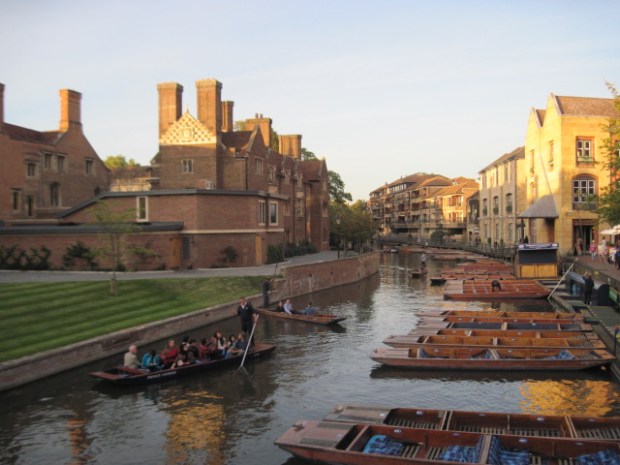
- Venice? No! Cambridge.

-
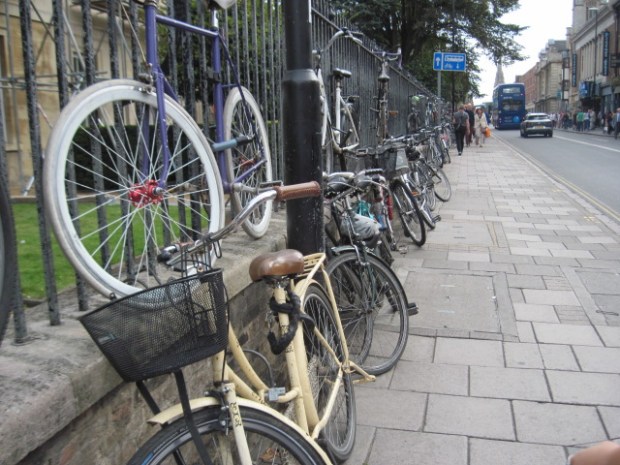
- Everyone cycles.
-

- King’s College.

-
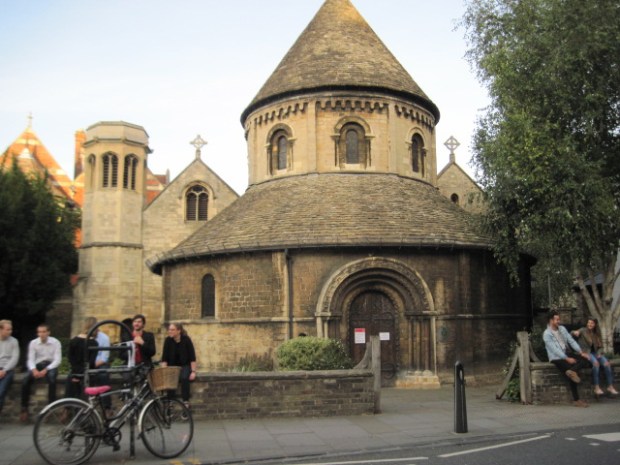
- The Church of the Holy Sepulchre, aka The Round Church.
Last year’s conference highlights for me were a debate about nature’s economic value and a panel on the purpose of nature poetry. This year’s sessions tackled personal connection with nature, rewilding (setting aside tracts of land for wilderness and reintroducing native species that have been driven out or gone locally extinct, such as wolves and wild boar), and coping with a sense of loss. With everyone from geographers to a singer and a painter involved on the day I attended, the conference succeeded in drawing in different fields from the sciences and the arts to provide commentary on ways we might reconnect with nature.
 The day’s first event brought together author William Fiennes, poet Alison Brackenbury, and Cambridge psychologist Laurie Parma. Fiennes spoke about writing an introduction to John Fowles’s long, curmudgeonly essay The Tree. Whereas Fowles denigrates Linnaeus, Fiennes thinks of him as a hero; like Adam in the Bible, Linnaeus knew the value of naming things. “In order to care about something, we first have to notice it,” Fiennes insisted; for him the noticing began when he was a child going round the garden with his father and learning plant names. Rather than thinking of names as a control mechanism, he suggested they can be a first step in “granting [a species] a place in your sensorium.”
 Brackenbury, who comes from four generations of Lincolnshire shepherds, recited from memory seven poems from her latest collection, Skies, several of which reflect on species’ extinctions or comebacks. “Look at them well before they go” is the broadly applicable piece of advice that closes “The Elms.” I especially liked one poem about a starling’s many songs.
Parma relayed the scientific evidence for green spaces mitigating stress and promoting happiness. At an event like this there’s an inevitable feeling that the speakers are preaching to the choir: we already know the personal value of time in nature, as well as the scale of environmental degradation. Still, this came home afresh in the following session as Dr. Stuart Butchart of BirdLife International spoke about the situation in Hawaii, where deforestation, non-native mosquitoes and other invasive animals are rapidly driving native birds to extinction. Photojournalist Toby Smith then questioned whether the nature photographer’s role should be to chronicle nature’s degradation or to celebrate what’s left. Many speakers acknowledged the difficult balance between mourning losses and applauding successes.
I spent most of Saturday scouring Cambridge’s charity shops and made out like a bandit, coming away with 15 books for £15.39. If you happen to find yourself in Cambridge and have seen all you need to of the colleges and the river (it doesn’t take very long), I can recommend Burleigh Street for charity shops but also Mill Road, a slightly more off-the-beaten-path student area of ethnic eateries and cheap stores. Books for Amnesty has an incredible selection; I took advantage of a couple James Lasdun books from their £1 poetry shelf. Best of all was the Salvation Army store, where all books were either 40 or 70 pence. I amassed a huge pile and then put half of it back when I remembered I would have to carry these books the mile or so back into town and then haul them around the whole rest of the day. I also did well at RSPCA’s two shops, one a dedicated bookshop on Mill Road.

Cambridge is certainly rich in secondhand book buying opportunities. Other shops I browsed but didn’t buy from included G. David Books and the tiny Sarah Key Books (also known as “The Haunted Bookshop” – I’d love to know why! – and included on a Guardian list of 10 of the best secondhand bookstores), both on St. Edward’s Passage, and the multi-floored emporium Heffers on St. John’s Street, which has a great selection of board games and gift items as well as new and used books.
As a literary destination, Cambridge left a bit to be desired, though. There weren’t any literary graves for me to find, nor any notable houses or statues. Many of the college’s famous alumni are known for work in other fields. There’s Newton, Darwin and Hawking in the sciences, for instance – they all appear in this mural in the hostel dining room. Plenty of political figures attended, as well as lots of living authors (Wikipedia has an extensive list; the hostel wall featured Zadie Smith as a fairly recent example of a literary alumna).


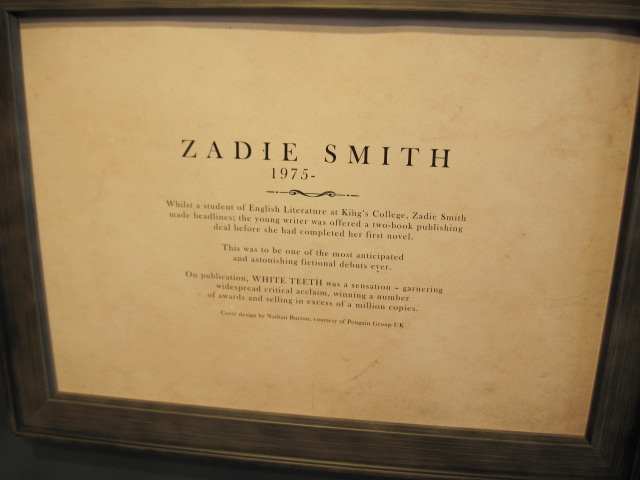
So, overall, a nice enough city for a day trip but not somewhere you need to stay much longer. Granted, it was outside of term time so King’s College wasn’t running its usual chapel services, and I never did make it out to the Fitzwilliam Museum. Still, I reckon you’ll find much more to see and do in Oxford, a city I’ve visited again and again ever since my undergraduate study abroad days took me there for weekly theology tutorials.
Your thoughts (on new cities, connecting with nature and secondhand book shopping) are always welcome!
Grief in Literature: Michel Faber and Cathy Rentzenbrink
On Tuesday night I had the chance to see Michel Faber in conversation with Cathy Rentzenbrink at Foyles bookstore in London. The topic was grief in literature, and specifically Faber’s book of poems in honor of his late wife, Undying: A Love Story (which I reviewed here in July). Faber had always written occasional poems, he said, “sort of kind of clever” stuff that he would have taken little note of if he encountered it from another author; the only really good ones, he thought, were about illness, based on his time as a nurse. So when there came this huge uprising of poems about Eva’s last illness, he felt they were a more appropriate way of commemorating her life than a novelistic narrative.

A six-floor bookshop: heaven for book lovers.
Rentzenbrink mentioned two things that particularly struck her: how Eva emerges in the fullness of her personality in the course of these poems, and the fact that the book is not angry. Faber explained that Eva herself was not angry. She did not think of multiple myeloma as her enemy and had no illusions about ‘beating’ cancer; instead, she just tried to achieve the best quality of life and the longest lifespan possible. In fact, she found cancer interesting, Faber recalled: she researched it as much as she could and followed its course with a certain curiosity. He contrasted her experience with that of an acquaintance in the Scottish Highlands who had the same disease and wanted to know nothing about it, leaving it all in the hands of her doctors. Faber believes this ignorance shortened their friend’s life unnecessarily.
Making sure that Eva came through as a real person in the poems was a struggle, Faber confessed. To start with his editors at Canongate, many of whom knew Eva, were frustrated that Undying was mercilessly medical, describing the process and aftermath of cancer treatment. A few poems, then, he wrote as a direct response to that criticism, almost as if ‘on commission’, he said, to infuse the book with more of Eva’s personality.
Only two of the poems were written while Eva was still alive, Faber noted. One was “Nipples,” written at her bedside just 10 days before her death. Eva had dealt with the pain and indignity of her illness admirably, but plasmacytomas – big purple welts all over her skin – truly broke her spirit, he revealed. His poem is a strangely erotic take on these blemishes: “Excited peaks of plasma. … Your flesh is riotous with the pleasure / of predatory cells.”

Cathy Rentzenbrink and Michel Faber
There’s irony there, and a certain dark humor in many of the rest. “There are so many absurdities when a body is breaking down spectacularly,” Faber said. And yet the last two years of Eva’s life were “incredibly intimate and tender,” as a fiercely independent woman ended up very frail and completely dependent on him as her carer. Likewise, Faber had to shift from creativity to practicality to cope with household tasks plus caregiving.
Cathy Rentzenbrink was the perfect person to interview Faber. She is the author of a bereavement memoir, The Last Act of Love, about her brother’s death after eight years in a vegetative state. Moreover, her mother survived a bout with cancer at the same age as Eva; she was heavily involved with that process through accompanying her to chemotherapy appointments. I was a bit disappointed that Rentzenbrink didn’t get to speak more about her own grief and the experience of crafting a narrative out of it. Faber said he too had envisioned more of a dialogue, but that Rentzenbrink thought it would be inappropriate for her to talk about herself and generously kept the focus on his work instead.
I also would have appreciated more context about grief literature in general, and poetry in particular. Faber did mention that there are many kinds of grief poetry. For instance, Thomas Hardy was still writing poems about his first wife decades after her death. Faber consciously avoided writing elegant, well-formed poetry like some that he’s read; instead he wanted his poems to be raw, direct, even shocking. Contrast that with the rainbows and heavenly visions of much of what’s out there. This came home to me a few weeks ago at my husband’s uncle’s funeral. Three poems were recited in the course of the ceremony, all of them heavily clichéd and unfailingly rhymed. This meant that the speakers ended up using singsong voices. In Faber’s poems, though, end rhymes are rare. I noticed them more, along with the sibilance and internal rhymes, through the emphasis he lent when reading aloud.
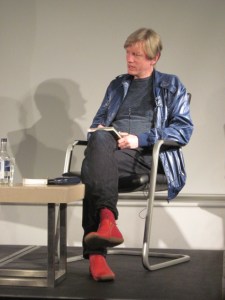 Rentzenbrink insisted there is still life to be lived for the grieving. As if to reinforce her point, Faber openly admitted to his relationship with a fellow writer who also lost a longtime partner, Louisa Young, whom he met the year after Eva’s death. He’s aware that this poses a marketing problem: he’s no longer the disconsolate soul in rumpled clothing, barely surviving without his spouse. (Indeed, he looked well put together and hip in his blue leather jacket and bright orange shoes, and his blond mop makes him appear much younger than he is.) Thinking also of a widower friend, Rentzenbrink said that her feeling was “he looked after her for so many years; he can have a little fun now!”
As to Faber’s professional future, he reiterated that he does not plan to write any more novels for adults. All of his fiction is about characters desperate to transcend, he said, and now it’s time for him to do that in his own life. He’s pondered a couple of nonfiction projects about aesthetics and music, but for now his next goal is a YA adventure novel. Whenever plaintive readers beg him for future novels, he cheekily asks whether they’ve read his whole back catalogue – including two collections of short stories, always a hard sell for novel readers. I have six more of Faber’s books to get to myself, so that’s plenty to fuel me in the years ahead. I came away from this event with a greater appreciation for the poems in Undying and a deep respect for a man aware of the seasons of his life, writing and caregiving among them.
Landmark Books from My Early Life
I initially wanted to title this post “Books that Changed My Life,” but soon realized it would probably be more accurate to speak about them as the books that have shaped my life as a keen reader and meant the most to me as the years have passed.
In making this list I was inspired by a book I recently finished, Kate Gross’s memoir Late Fragments, which finishes with a bibliography of books that influenced her during different periods of her life. Gross, who died of colon cancer at age 36 in 2014, divides her reading life into five distinct, whimsically named eras: “With my back to the radiator” (childhood), “The grub years” (adolescence), “Emerging from the cocoon” (early adulthood), “The woman in the arena” (career life) and “End of life book club.”
I’ll do a follow-up post on the key books from my twenties next month, but for now I want to focus on the books that defined my growing-up and teen years.
What Bewick’s Birds was for Jane Eyre, my parents’ book on flower arranging was for me. I couldn’t tell you the title or author, but I think this green fabric covered tome with its glossy pages and lush full-color photographs was the origin of my love of books as physical objects. I must have spent hours paging through the illustrations and breathing in the new-book aroma. I’ve been a book sniffer ever since.
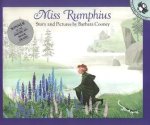 I can’t recall many of the individual picture books my mother read with me when I was little, but one that does stand out in my memory is Miss Rumphius by Barbara Cooney, about an eccentric woman who goes about planting lupines. Again, it’s a gorgeous book filled with flowers – you’d think I might have become a botanist!
 C.S. Lewis’s The Chronicles of Narnia were the first books I ever read by myself, starting at age five. It took me years to get to the allegory-heavy The Last Battle, but I read the other volumes over and over, even after the PBS television movies came out. The Silver Chair was always my favorite, but I’m sure I must have read the first three books 10 or 20 times each.
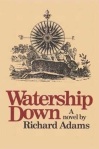 Richard Adams’s Watership Down was the first book I ever borrowed from the adult section of the public library, at age nine. Crossing the big open lobby of the Silver Spring, Maryland library from the children’s room to the imposing stacks of Adult Fiction was like a rite of passage; when I emerged clutching the fat plastic-covered hardback I felt a little bit like a rebel but mostly just pretty darn proud of myself. I inhaled the several hundred pages of this bunny epic and for years afterwards considered it my favorite book.
 Nowadays I don’t like to commit to series, but as a kid I couldn’t get enough of them: after Narnia, I devoured the Babysitter’s Club and Saddle Club books, the Anastasia Krupnik books, and so on. Whenever I found an author I loved I dutifully read everything they’d written. The Anne of Green Gables series by L.M. Montgomery, in particular, accompanied me through my early teen years. I think I saw the CBC/PBS television miniseries starring Megan Follows first and read the books afterwards. Bereft once the eight-book cycle was over, I read the much darker Emily trilogy, but it just couldn’t live up to the Anne books.
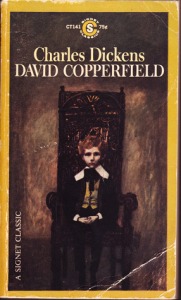 My first foray into the realm of heavy-duty classics was Charles Dickens’s David Copperfield at age 14. I bought a battered secondhand paperback from a library sale and was immediately entranced, from the first line onwards: “Whether I shall turn out to be the hero of my own life, or whether that station will be held by anybody else, these pages must show.” No doubt the idea of discovering my own potential heroism was what drew me in, but I loved everything about this novel: the rich panorama of nineteenth-century life, the vibrant secondary characters, the under-the-surface humor you had to work a little bit to understand, and the sweet second-chance romance. This was the start of my love affair with Victorian literature. I’ve read it three times since then. If ever asked for my favorite book, this is what I name.
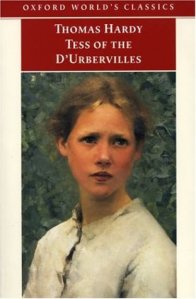 It wasn’t my first Hardy novel (that was Far from the Madding Crowd, another all-time favorite), but Tess of the D’Urbervilles is most memorable for the circumstances in which I read it. At age 19 I accompanied my sister, who’d won a singing contest on local radio, to the Season 2 finale of American Idol in Hollywood. If you were a loyal viewer, you might recall that this was the showdown between Ruben Studdard and Clay Aiken, on whom I had a hopeless crush – it later emerged that he’s gay. I read Tess on the flight to Los Angeles. Stranger pairings have been known, I’m sure, but I’ll never forget that disconnect between bleak England (where I hadn’t yet been at that point) and the sunny entertainment capital.
What are some of the books that meant the most to you in your early years?
A Perfect Book for Autumn: The City Baker’s Guide to Country Living
When Olivia Rawlings, the protagonist of pastry chef Louise Miller’s debut novel, The City Baker’s Guide to Country Living, arrives in Guthrie, Vermont one September, it’s with a weight of guilt and rumor behind her. She left Boston’s Emerson Club in ignominy after setting the place on fire with a Baked Alaska and sleeping with a married boss twice her age. Now her best friend, Hannah, is determined to help Livvy make a fresh start in a small town. She uses her clout as the local doctor’s wife to get Livvy a job as the chief baker at the Sugar Maple Inn, run by a formidable older lady named Margaret.
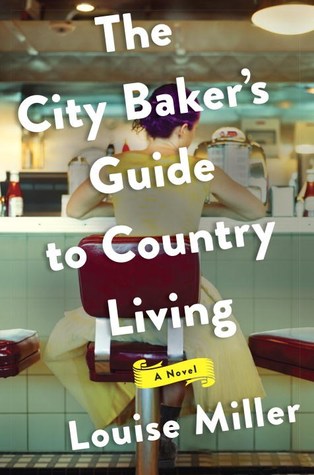 Livvy sets up in the sugar house with her Irish wolfhound, Salty, and settles into a daily routine of baking muffins, bread and cakes for the guests. She gets to know the local community by soaking up atmosphere at the Black Bear Tavern and playing banjo with the Hungry Mountaineers band at country dances. The McCrackens, in particular, become a kind of surrogate family for this lonely woman in her early thirties: Dotty is Margaret’s best friend; her husband Henry is battling colon cancer; and their youngest son Martin has temporarily given up his normal life in Seattle to help out. A love of food and music binds Livvy to the McCrackens, and Henry is like a stand-in for the father she lost as a teenager.
This is a warm, cozy read full of well-drawn secondary characters and romantic possibilities for Livvy. There’s nothing clichéd about it, though. Livvy is a sassy narrator whose hair goes from purple to orange to turquoise and whose promiscuous past matches her reputation for perfect macaroons and apple pie. I didn’t love the conflict at the three-quarters point that briefly takes Livvy back to Boston, but it all comes together in a satisfying dénouement.
I love how Miller documents the rhythms of the small-town country year, including tapping the maple trees in the early spring and a pie baking contest at the summer county fair. But I’m calling this a perfect book for autumn because of how the early chapters depict pivotal events from Livvy’s first months in Guthrie, especially the annual Harvest Festival supper (corn consommé, baby green salad with walnuts and maple vinaigrette, goat cheese on apple spice bread, prime rib or mushroom risotto, chive popovers, Vermont cheddar with quince paste, and pumpkin crème brûlée) and a boisterous Thanksgiving meal with the McCrackens.
Kitchens of the Great Midwest by J. Ryan Stradal was one of my top fiction picks of last year, and this is a worthy 2016 counterpart. Though not quite as edgy, Miller’s debut also shares the foodie theme of my favorite novel of 2016 so far, Sweetbitter by Stephanie Danler. All three of these books capture the almost theatrical magic of the restaurant meal. I’ll leave you with this extended passage describing the setup for the Harvest Festival. Though I’ve never been to New England in the fall, it makes me nostalgic for it all the same:
There is a moment after the prep is done and before the theater of the dinner service begins when I love to escape the kitchen. Dusk had fallen, and when I stepped outside, I was drawn to the light spilling from the barn, golden and inviting. I poked my head in. Margaret had outdone herself. The long tables were covered in cream linen. Squash-colored tapers stood tall in sparkling silver candelabras. Fat bouquets of sunflowers, goldenrod, and black-eyed Susans stuffed into mason jars were surrounded by tiny pumpkins and crab apples. I looked up to see a thousand white Christmas lights hanging from the rafters. The whole room glowed.
The City Baker’s Guide to Country Living was published by Pamela Dorman Books on August 9th. My electronic review copy came from NetGalley.
My rating: 
Booker Longlist Mini Reviews
Tomorrow the Man Booker Prize shortlist will be announced. I’d already read and reviewed four of the nominees (see my quick impressions here), and in the time since the longlist announcement I’ve managed to read another three and ruled out one more. Two were terrific; another was pretty good; the last I’ll never know because it’s clear to me I won’t read it.
His Bloody Project by Graeme Macrae Burnet
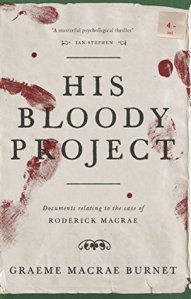 What a terrific, propulsive tale Burnet has woven out of a real-life (I think) nineteenth-century Scottish murder case. The seams between fact and fiction are so subtle you might forget you’re reading a novel, but it’s clear the author has taken great care in assembling his “documents”: witness testimonies, medical reports, a psychologist’s assessment, trial records, and – the heart of the book and the most fascinating section – a memoir written by the murderer himself. As you’re reading it you believe Roddy implicitly and feel deeply for his humiliation (the meeting with the factor and the rejection by Flora are especially agonizing scenes), but as soon as you move on to the more ‘objective’ pieces you question how he depicted things. I went back and read parts of his account two or three times, wondering how his memories squared with the facts of the case. A great one for fans of Alias Grace, though I liked this much better. This is my favorite from the Booker longlist so far.
Eileen by Ottessa Moshfegh
 “I often felt there was something wired weird in my brain, a problem so complicated only a lobotomy could solve it—I’d need a whole new mind or a whole new life.” This isn’t so much a book to enjoy as one to endure. Being in Eileen’s mind is profoundly unsettling. She’s simultaneously fascinated and disgusted by bodies; she longs for her alcoholic father’s approval even as she wonders whether she could get away with killing him. They live a life apart in their rundown home in X-ville, New England, and Eileen can’t wait to get out by whatever means necessary. When Rebecca St. John joins the staff of the boys’ prison where Eileen works, she hopes this alluring woman will be her ticket out of town.
There’s a creepy Hitchcock flavor to parts of the novel (I imagined Eileen played by Patricia Hitchcock as in Strangers on a Train, with Rebecca as Gene Tierney in Laura), and a nice late twist – but Moshfegh sure makes you wait for it. In the meantime you have to put up with the tedium and squalor of Eileen’s daily life, and there’s no escape from her mind. This is one of those rare novels I would have preferred to be in the third person: it would allow the reader to come to his/her own conclusions about Eileen’s psychology, and would have created more suspense because Eileen’s hindsight wouldn’t result in such heavy foreshadowing. I expected suspense but actually found this fairly slow and somewhat short of gripping.

Hot Milk by Deborah Levy
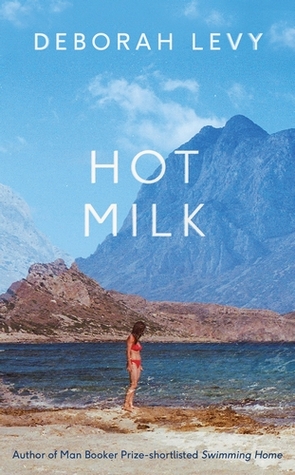 This is a most unusual mother–daughter story, set on the southern coast of Spain. Twenty-five-year-old Sofia Papastergiadis has put off her anthropology PhD to accompany her mother, Rose, on a sort of pilgrimage to Dr. Gómez’s clinic to assess what’s wrong with Rose’s legs. What I loved about this novel is the uncertainty about who each character really is. Is Rose an invalid or a first-class hypochondriac? Is Dr. Gómez a miracle worker or a quack who’s fleeced them out of 25,000 euros? As a narrator, Sofia pretends to objective anthropological observation but is just as confused by her actions as we are: she seems to deliberately court jellyfish stings, is simultaneously jealous and contemptuous of her Greek father’s young second wife, and sleeps with both Juan and Ingrid.
Levy imbues the novel’s relationships with psychological and mythological significance, especially the Medusa story. I don’t think the ending quite fits the tone, but overall this is a quick and worthwhile read. At the same time, it’s such an odd story that it will keep you thinking about the characters. A great entry I’d be happy to see make the shortlist.
[One I won’t be reading: The Schooldays of Jesus by J.M. Coetzee. I opened up the prequel, The Childhood of Jesus, and could only manage the first chapter. I quickly skimmed the rest but found it unutterably dull. It would take me a lot of secondary source reading to try to understand what was going on here allegorically, and it’s not made me look forward to trying more from Coetzee.]
 As for the rest: I have All That Man Is by David Szalay and Serious Sweet by A.L. Kennedy on my Kindle and will probably read them whether or not they’re shortlisted. The same goes for Do Not Say We Have Nothing by Madeleine Thien, for which I’m third in a library hold queue. I’d still like to get hold of The Many by Wyl Menmuir. That leaves just Hystopia by David Means, which I can’t say I have much interest in.
I rarely feel like I have enough of a base of experience to make accurate predictions, but if I had to guess which six books would make it through tomorrow, I would pick:
His Bloody Project by Graeme Macrae Burnet
The Schooldays of Jesus by J.M. Coetzee
Hot Milk by Deborah Levy
The North Water by Ian McGuire
My Name Is Lucy Barton by Elizabeth Strout
Do Not Say We Have Nothing by Madeleine Thien
That would be three men and three women, and a pretty good mix of countries and genres. I’d be happy with that list.
 Bookish Beck = Rebecca Foster. American transplant to England. Freelance proofreader and book reviewer.
