Three on a Theme for Valentine’s Day: “Love” Books by Natalie Diaz, Maile Meloy and Jane Smiley
This post is an annual tradition for me, somehow.* Love, whether erotic, romantic or familial, turns up in the titles of these three works by women writers: poems, short stories and a novella.
Postcolonial Love Poem by Natalie Diaz (2020)
Diaz, raised on a Mojave reservation in California, won a Pulitzer Prize for this honey-thick exploration of queer Native American identity. There are lustful moments aplenty here—
My lover comes to me like darkfall—long,
and through my open window. Mullion, transom. […]
I keep time on the hematite clocks of her shoulders.
(from “Like Church”)
 —but the mineral-heavy imagery (“the agate cups of your palms …the bronzed lamp of my breast”) is so weirdly archaic and the vocabulary so technical that I kept thinking of the Song of Solomon. Not that there’s anything wrong with that; it’s just not the model I expected to find.
So I ended up preferring the forthright political poems about contemporary Native American life. Police shootings, pipeline protests: it’s a fact that her people are disproportionately persecuted (see “American Arithmetic”). Her brother’s drug abuse and mental illness also form a repeating subject (e.g., “It Was the Animals”).
The collection is as much of a love poem to land as it is to a woman, with water bodies described as affectionately as female bodies. “The Colorado River is the most endangered river in the United States—also, it is a part of my body” is the opening line of “The First Water Is the Body”; see also “exhibits from the American Water Museum.”
My favourite single poem, “If I Should Come Upon Your House Lonely in the West Texas Desert,” is sexy but also, charmingly, features echoes of “Goldilocks and the Three Bears”:
I will swing my lasso of headlights
across your front porch,
let it drop like a rope of knotted light
at your feet.
While I put the car in park,
you will tie and tighten the loop
of light around your waist—
and I will be there with the other end
wrapped three times
around my hips horned with loneliness.
[…]
I will lie down in you.
Eat my meals at the red table of your heart.
Each steaming bowl will be, Just right.
I will eat it all up,
break all your chairs to pieces.
(New purchase, Awesomebooks.com) 
Half in Love by Maile Meloy (2002)
Meloy’s was a new name for me when I picked this up as part of a bargain secondhand book haul last year, but she’s actually published 10 books and is esteemed in literary circles; Ann Patchett even dedicated her latest release, These Precious Days, to her.
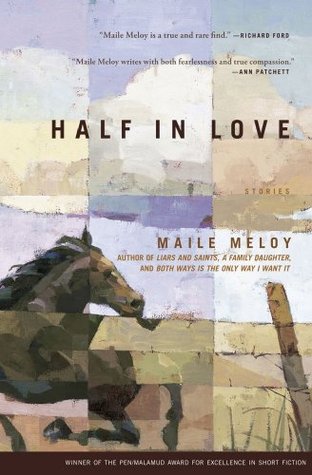 Meloy is from Montana and most of the 14 stories in this, her debut collection, are set in the contemporary American West among those who make their living from the outdoors, diving to work on hydroelectric dams or keeping cattle and horses. However, one of the more memorable stories, “Aqua Boulevard,” is set in Paris, where a geriatric father can’t tamp down his worries for his offspring.
The few historical stories have a melancholy air, with protagonists whose star has faded. There’s the brief, touching portrait of an outmoded career in “The Ice Harvester” and the secondhand reminiscences of being in late-colonial diplomatic service in the Middle East in “Last of the White Slaves”; “Red” is about an American soldier stationed in London during the Second World War.
Crime and its consequences recur. I loved the opening story, “Tome,” about a lawyer whose client wants her to keep in touch after he goes to jail. Teenage girls are the title characters in a couple of stories; “Ranch Girl” is in the second person. “Kite Whistler Aquamarine” is a heartbreaker about a filly born premature one winter. “Paint” was the standout for me: it’s pretty terrifying what a wife’s temporary attitude of neglect leads to when her luckless husband undertakes some DIY.
As is usual with a collection, a few of the stories left little impression on me. But there’s sufficient range and depth here to induce me to seek out more of Meloy’s work. I can recommend this to readers of Claire Boyles, David Guterson, Lily King, Jane Smiley (see below!) and David Vann. (Secondhand purchase, 2nd & Charles) 
Favourite passages:
“Be interesting in your twenties,” Suzy says. “Otherwise you’ll want to do it in your thirties or forties, when it wreaks all kinds of havoc, and you’ve got a husband and kids.”
Eugénie invited my husband to Greece every summer because she wanted him to publish her memoir. She had lived a remarkable life but didn’t have a remarkable book, and it dragged through slow ghostwritten revisions. Every year, at work in the hot city, I thought of blue water and white bougainvillea and forgot how exhausting it was to be her guest, to stay in favor and say the right things. So each summer we would arrive, look at the new draft, give careful suggestions that would not be taken, and find ourselves on the terrace waiting for her to trip mercifully off to bed.
Ordinary Love by Jane Smiley (1990)
 This is one of Smiley’s earlier works and feels a little generic, like she hadn’t yet developed a signature voice or themes. One summer, a 52-year-old mother of five prepares for her adult son Michael’s return from India after two years of teaching. His twin brother, Joe, will pick him up from the airport later on. Through conversations over dinner and a picnic in the park, the rest of the family try to work out how Michael has changed during his time away. “I try to accept the mystery of my children, of the inexplicable ways they diverge from parental expectations, of how, however much you know or remember of them, they don’t quite add up.” The narrator recalls her marriage-ending affair and how she coped afterwards. Michael drops a bombshell towards the end of the 91-page novella. Readable yet instantly forgettable, alas. I bought it as part of a dual volume with Good Will, which I don’t expect I’ll read. (Secondhand purchase, Bookbarn International)
If you read just one … It’s got to be Postcolonial Love Poem, the most Eros-appropriate of the three by far.
*I’m really not a Valentine’s Day person, yet this is the sixth year in a row that I’ve put together a themed post featuring books that have “Love” or a similar word in the title in the run-up to mid-February (2017, 2018, 2019, 2020, and 2021).
Read any books about love lately?
America Reading & Book Haul, Etc.
The wedding of a college friend – who I calculated I’ve known at least half my life – was the excuse we needed to book a trip back to the States for the last two weeks of May. Along with the classy nuptials in the Fell’s Point area of Baltimore, we enjoyed a day’s sightseeing in Philadelphia, a couple of outings to watch birds and other wildlife on Cape May (a migration hotspot in New Jersey), two meet-ups with other friends, and plenty of relaxation time with my mom and sister, including a Memorial Day picnic at my mom’s retirement community and a tour of Antietam Battlefield. It was much hotter than anticipated, including some days in the high 80s or even 90s, and the hayfever, ticks and mosquitoes were bad, too, but we survived.


While back in Maryland I continued the intermittent downsizing process I’ve been going through for a while now. After being on the market for nearly a year, my family home finally sold and went to closing while we were over there. So that provided a scrap of closure, but my current estrangement from my father (we don’t even know where he’s living) means there’s a lot of continuing uncertainty.
In any case, I managed to reduce the number of boxes I’m storing with my sister from 29 to 20 by recycling lots of my old schoolwork, consolidating my mementos, reselling one box of books and donating another, donating a box of figurines and decorative bottles to a thrift store, displaying some at my mom’s place, giving away a few trinkets to a friend’s kids, and packing a bunch of stuff – photo albums and decorations as well as 64 books – in our various suitcases and hand luggage to take back to the UK.


And I also acquired more books, of course! A whopping 46 of these were free: eight review copies were waiting for me at my mom’s place; three were from the outdoor free bin at 2nd & Charles, a secondhand bookstore; one was found in a Little Free Library near our friends’ place in New Jersey (Emerald City by Jennifer Egan, not pictured); and the rest were from The Book Thing of Baltimore, a legendary volunteer-run free bookshop. I mostly raided the biography section for an excellent selection of women’s life writing; the fiction is unalphabetized so harder to find anything in, but I picked up a few novels, too. My only purchases were new (remainder) copies of one novel and one memoir from Dollar Tree. Total book spending on the trip: just $2.12.
What I Read:
Two that I’d already started but finished on the plane ride over:
 The Florist’s Daughter by Patricia Hampl: (As featured in my spring reading list.) “Love and flowers, death and flowers.” Poetic writing about small-town Minnesota life, a tense relationship with her late mother, and her late father’s flower shop.
- The Girls by Lori Lansens: I love reading about sister relationships, and the Darlen girls’ situation is an extreme case of love and jealousy given that they literally can’t get away from each other. Not as good as the two other conjoined-twin novels I’ve read, Chang and Eng by Darin Strauss and Cutting for Stone by Abraham Verghese, but I would read more from Lansens, a solid Oprah Book Club sort of author.
Three review books that will be featuring here in the near future:
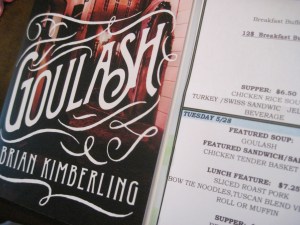
- Goulash by Brian Kimberling

- Sorry I’m Late, I Didn’t Want to Come: An Introvert’s Year of Living Dangerously by Jessica Pan
- Mother Ship by Francesca Segal
A few quick reads:
 A Certain Loneliness: A Memoir by Sandra Gail Lambert: (A proof copy passed on by an online book reviewing friend.) A memoir in 29 essays about living with the effects of severe polio. Most of the pieces were previously published in literary magazines. While not all are specifically about the author’s disability, the challenges of life in a wheelchair seep in whether she’s writing about managing a feminist bookstore or going on camping and kayaking adventures in Florida’s swamps. I was reminded at times of Constellations by Sinéad Gleeson.
  No Happy Endings: A Memoir by Nora McInerny: (Borrowed from my sister.) I didn’t appreciate this as much as the author’s first memoir, It’s Okay to Laugh, though it’s in the same style: lots of short, witty but bittersweet essays reflecting on life’s losses. Within a year of being widowed by cancer, she met a new partner and soon was – surprise! – pregnant with his baby. Together they formed a blended family of four children ranging from 0 to 15 and two wounded adults. McInerny also writes about her newfound spirituality and feminism. The problem with the essay format is that she cycles through aspects of the same stories multiple times.
  Native Guard by Natasha Trethewey: (Free from 2nd & Charles.) Trethewey writes beautifully disciplined verse about her mixed-race upbringing in Mississippi, her mother’s death and the South’s legacy of racial injustice. She occasionally rhymes, but more often employs forms that involve repeated lines or words. The title sequence concerns a black Civil War regiment in Louisiana. Two favorites from this Pulitzer-winning collection by a former U.S. poet laureate were “Letter” and “Miscegenation”; stand-out passages include “In my dream, / the ghost of history lies down beside me, // rolls over, pins me beneath a heavy arm” (from “Pilgrimage”) and “I return / to Mississippi, state that made a crime // of me — mulatto, half-breed” (from “South”).
 I also read the first half or more of: The Music Shop by Rachel Joyce, my June book club book; Hungry by Jeff Gordinier, a journalist’s travelogue of his foodie journeys with René Redzepi of Noma fame, coming out in July; and the brand-new novel In West Mills by De’Shawn Charles Winslow – these last two are for upcoming BookBrowse reviews.
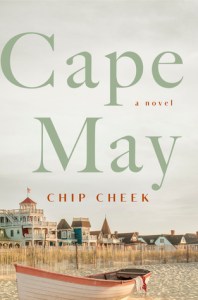
But the book I was most smug to have on my reading list for the trip was the recent novel Cape May by Chip Cheek. What could be more perfect for reading on location? I asked myself. Unfortunately, it stood out for the wrong reasons. In October 1957 a young pair of virgins, Effie and Henry, travel from Georgia to New Jersey for an off-season honeymoon in her uncle’s vacation home. They’re happy enough with each other but underwhelmed with the place (strangely, this matched my experience of Cape May), and even consider going home early until they fall in with Clara, a friend of Effie’s cousin; Clara’s lover, Max; and Max’s younger sister, Alma. Effie and Henry join the others for nightly drunken revelry.
[SPOILERS!] As the weeks pass Effie, ill and dejected, almost seems to disappear as Cheek delves into Henry’s besotted shenanigans, described in unnecessarily explicit sexual detail. When Effie makes a bid or two for her own sexual freedom late on, it only emphasizes the injustice of spending so much time foregrounding Henry’s perspective. Despite the strength of the period atmosphere and seaside location, this ends up being dull and dated. If you’re after a typically ‘trashy’ beach read and don’t mind lots of sex scenes, you may get on with it better than I did. 

Reading a few pages of Cape May over an ice-cold G&T at the wedding reception.
Bonus bookishness:
Vineland, New Jersey was on the way from our friends’ house to Cape May, so we stopped to take my proof copy of Barbara Kingsolver’s Unsheltered to its spiritual home. Alas, Vineland is an utterly boring small American town. However, Mary Treat at least appears on a painted mural on a building on the main street. The Historical Society, where Kingsolver did her research, was closed, but we photographed the outside.


What’s the last book you read ‘on location’? Did it work out well for you?
Painful but Necessary: Culling Books, Etc.
I’ve been somewhat cagey about the purpose for my trip back to the States. Yes, it was about helping my parents move, but the backstory to that is that they’re divorcing after 44 years of marriage and so their home of 13 years, one of three family homes I’ve known, is being sold. It was pretty overwhelming to see all the stacks of stuff in the garage. I was reminded of these jolting lines from Nausheen Eusuf’s lush poem about her late parents’ house, “Musée des Beaux Morts”: “Well, there you have it, folks, the crap / one collects over a lifetime.”


On the 7th I moved my mom into her new retirement community, and in my two brief spells back at the house I was busy dealing with the many, many boxes I’ve stored there for years. In the weeks leading up to my trip I’d looked into shipping everything back across the ocean, but the cost would have been in the thousands of dollars and just wasn’t worth it. Although my dad is renting a storage unit, so I’m able to leave a fair bit behind with him, I knew that a lot still had to go. Even (or maybe especially) books.
Had I had more time at my disposal, I might have looked into eBay and other ways to maximize profits, but with just a few weeks and limited time in the house itself, I had to go for the quickest and easiest options. I’m a pretty sentimental person, but I tried to approach the process rationally to minimize my emotional overload. I spent about 24 hours going through all of my boxes of books, plus the hundreds of books and DVDs my parents had set aside for sale, and figuring out the best way to dispose of everything. Maybe these steps will help you prepare for a future move.

The Great Book Sort-Out in progress.
When culling books, I asked myself:
- Do I have duplicate copies? This was often the case for works by Dickens, Eliot and Hardy. I kept the most readable copy and put the others aside for sale.
- Have I read it and rated it 3 stars or below? I don’t need to keep the Ayn Rand paperback just to prove to myself that I got through all 1000+ pages. If I’m not going to reread Jane Smiley’s A Thousand Acres, better to put it in the local Little Free Library so someone else can enjoy it for the first time.
- Can I see myself referring to this again? My college philosophy textbook had good explanations and examples, but I can access pithy statements of philosophers’ beliefs on the Internet instead. I’d like to keep up conversational French, sure, but I doubt I’ll ever open up a handbook of unusual verb conjugations.
- Am I really going to read this? I used to amass classics with the best intention of inhaling them and becoming some mythically well-read person, but many have hung around for up to two decades without making it onto my reading stack. So it was farewell to everything by Joseph Fielding and Sinclair Lewis; to obscure titles by D.H. Lawrence and Anthony Trollope; and to impossible dreams like Don Quixote. If I have a change of heart in the future, these are the kinds of books I can find in a university library or download from Project Gutenberg.
My first port of call for reselling books was Bookscouter.com (the closest equivalents in the UK are WeBuyBooks and Ziffit). This is an American site that compares buyback offers from 30 secondhand booksellers. There’s a minimum number of books / minimum value you have to meet before you can complete a trade-in. You print off a free shipping label and then drop off the box at your nearest UPS depot or arrange for a free USPS pickup. I ended up sending boxes to Powell’s Books, TextbookRush and Sellbackyourbook and making nearly a dollar per book. Powell’s bought about 18 of my paperback fiction titles, while the other two sites took a bizarre selection of around 30 books each.
Some books that were in rather poor condition or laughably outdated got shunted directly into piles for the Little Free Library or a Salvation Army donation. Many of my mom’s older Christian living books and my dad’s diet and fitness books I sorted into categories to be sold by the box in an online auction after the house sells.
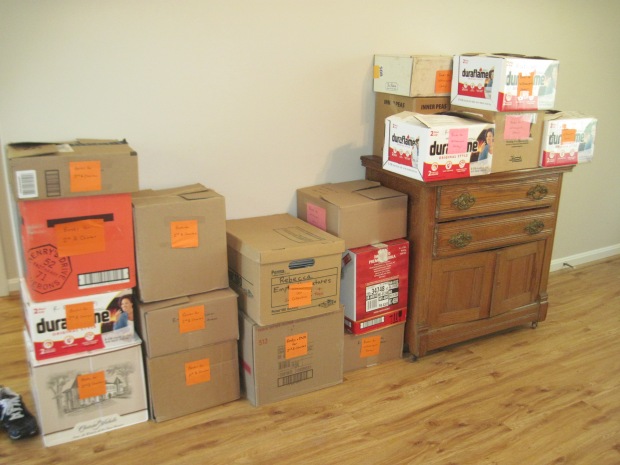
The final set of books awaiting sale.
All this still left about 18 boxes worth of rejects. For the non-antiquarian material I first tried 2nd & Charles, a new and secondhand bookstore chain that offers cash or store credit on select books. I planned to take the rest, including the antiquarian stuff, to an Abebooks seller in my mom’s new town, but I never managed to connect with him. So, the remaining boxes went to Wonder Book and Video, a multi-branch store I worked for during my final year of college. The great thing about them (though maybe not so great when you work there and have to sort through boxes full of dross) is that they accept absolutely everything when they make a cash offer. Although I felt silly selling back lots of literary titles I bought there over the years, at a massive loss, it was certainly an efficient way of offloading unwanted books.
As to everything else…
- I sent off 42.5 pounds (19.3 kilograms) of electronic waste to GreenDisk for recycling. That’s 75 VHS tapes, 63 CDs, 38 cassette tapes, 11 DVDs, five floppy disks, two dead cables, and one dead cell phone I saved from landfill, even if I did have to pay for the privilege.
- I donated all but a few of my jigsaw puzzles to my mom’s retirement community.
- I gave my mom my remaining framed artworks to display at her new place.
- I gave some children’s books, stuffed animals, games and craft supplies away to my nieces and nephews or friends’ kids.
- I let my step-nephew (if that’s a word) take whatever he wanted from my coin collection, and then sold that and most of my stamp collection back to a coin store.
- Most of my other collections – miniature tea sets, unicorn figurines, classic film memorabilia – all went onto the auction pile.
- My remaining furniture, a gorgeous rolltop desk plus a few bookcases, will also be part of the auction.
- You can tell I was in a mood to scale back: I finally agreed to throw out two pairs of worn-out shoes with holes in them, long after my mother had started nagging me about them.


Mementos and schoolwork have been the most difficult items for me to decide what to do with. Ultimately, I ran out of time and had to store most of the boxes as they were. But with the few that I did start to go through I tried to get in a habit of appreciating, photographing and then disposing. So I kept a handful of favorite essays and drawings, but threw out my retainers, recycled the science fair projects, and put the hand-knit baby clothes on the auction pile. (My mom kept the craziest things, like 12 inches of my hair from a major haircut I had in seventh grade – this I threw out at the edge of the woods for something to nest with.)


 All this work and somehow I was still left with 29 smallish boxes to store with my dad’s stuff. Fourteen of these are full of books, with another four boxes of books stored in my mom’s spare room closet to select reading material from on future visits. So to an extent I’ve just put off the really hard work of culling until some years down the road – unless we ever move to the States, of course, in which case the intense downsizing would start over here.
At any rate, in the end it’s all just stuff. What I’m really mourning, I know, is not what I had to get rid of, or even the house, but the end of our happy family life there. I didn’t know how to say goodbye to that, or to my hometown. I’ve got the photos and the memories, and those will have to suffice.
 Bookish Beck = Rebecca Foster. American transplant to England. Freelance proofreader and book reviewer.
 Bookish Beck