Book Serendipity, January to February 2024
I call it “Book Serendipity” when two or more books that I read at the same time or in quick succession have something in common – the more bizarre, the better. This is a regular feature of mine every couple of months. Because I usually have 20–30 books on the go at once, I suppose I’m more prone to such incidents. The following are in roughly chronological order.
- I finished two poetry collections by a man with the surname Barnett within four days in January: Murmur by Cameron Barnett and Birds Knit My Ribs Together by Phil Barnett.

- I came across the person or place name Courtland in The Optimist’s Daughter by Eudora Welty, then Cortland in a story from The Orange Fish by Carol Shields, then Cotland (but where? I couldn’t locate it again! Was it in Elizabeth Is Missing by Emma Healey?).
- The Manet painting Olympia is mentioned in Christmas Holiday by W. Somerset Maugham and The Paris Novel by Ruth Reichl (both of which are set in Paris).


- There’s an “Interlude” section in Babel by R.F. Kuang and The Vulnerables by Sigrid Nunez.
- The Morris (Minor) car is mentioned in Elizabeth Is Missing by Emma Healey and Various Miracles by Carol Shields.
- The “flour/flower” homophone is mentioned in Babel by R.F. Kuang and Various Miracles by Carol Shields.
- A chimney swift flies into the house in Cat and Bird by Kyoko Mori and The Optimist’s Daughter by Eudora Welty.
- A character named Cornelius in The Fruit Cure by Jacqueline Alnes and Wellness by Nathan Hill.
- Reading two year challenge books at the same time, A Year of Biblical Womanhood by Rachel Held Evans and Local by Alastair Humphreys, both of which are illustrated with frequent black-and-white photos by and of the author.
- A woman uses a bell to summon children in one story of Universally Adored and Other One Dollar Stories by Elizabeth Bruce and The Optimist’s Daughter by Eudora Welty.
- Apple turnovers get a mention in A Year of Biblical Womanhood by Rachel Held Evans and Wellness by Nathan Hill.
- A description of rolling out pie crust in A Year of Biblical Womanhood by Rachel Held Evans and Cat and Bird by Kyoko Mori.

- The idea of a house giving off good or bad vibrations in Wellness by Nathan Hill and a story from Various Miracles by Carol Shields.

- Emergency C-sections described or at least mentioned in Brother Do You Love Me by Manni Coe, The Unfamiliar by Kirsty Logan, Wellness by Nathan Hill, and lots more.
- Frustration with a toddler’s fussy eating habits, talk of “gentle parenting” methods, and mention of sea squirts in Wellness by Nathan Hill and Matrescence by Lucy Jones.
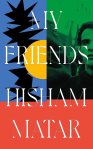
- The nickname “Poet” in The Tidal Year by Freya Bromley and My Friends by Hisham Matar.
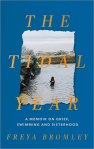
- A comment about seeing chicken bones on the streets of London in The Tidal Year by Freya Bromley and Went to London, Took the Dog by Nina Stibbe.
- Swans in poetry in The Tidal Year by Freya Bromley and Egg/Shell by Victoria Kennefick.
- A mention or image of Captcha technology in Egg/Shell by Victoria Kennefick and Went to London, Took the Dog by Nina Stibbe.
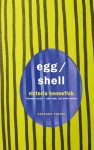

- An animal automaton in Loot by Tania James and Egg/Shell by Victoria Kennefick.
- A mention of Donna Tartt in The Tidal Year by Freya Bromley, Looking in the Distance by Richard Holloway, and Matrescence by Lucy Jones.
- Cathy Rentzenbrink appears in The Tidal Year by Freya Bromley and Went to London, Took the Dog by Nina Stibbe.
 Dialogue is given in italics in the memoirs The Tidal Year by Freya Bromley and The Unfamiliar by Kirsty Logan.
- An account of a man being forced to marry the sister of his beloved in A Year of Biblical Womanhood by Rachel Held Evans, Wellness by Nathan Hill, and The Tiger’s Wife by Téa Obreht.
- Saying that one doesn’t want to remember the loved one as ill (but really, not wanting to face death) so not saying goodbye (in Cat and Bird by Kyoko Mori) or having a closed coffin (Wellness by Nathan Hill).
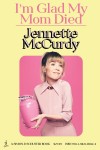
- An unhappy, religious mother who becomes a hoarder in Wellness by Nathan Hill and I’m Glad My Mom Died by Jennette McCurdy.
- Characters called Lidija and Jin in Exhibit by R. O. Kwon and Lydia and Jing in the first story of This Is Salvaged by Vauhini Vara.
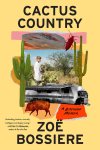
- Distress at developing breasts in Cactus Country by Zoë Bossiere and I’m Glad My Mom Died by Jennette McCurdy.
- I came across mentions of American sportscaster Howard Cosell in Heartburn by Nora Ephron and Stations of the Heart by Richard Lischer (two heart books I was planning on reviewing together) on the same evening. So random!
- Girls kissing and flirting with each other (but it’s clear one partner is serious about it whereas the other is only playing or considers it practice for being with boys) in Cactus Country by Zoë Bossiere and Winter’s Bone by Daniel Woodrell.
- A conversion to Catholicism in Places I’ve Taken My Body by Molly McCully Brown and Stations of the Heart by Richard Lischer.
- A zookeeper is attacked by a tiger when s/he goes into the enclosure (maybe not the greatest idea!!) in Tiger by Polly Clark and The Tiger’s Wife by Téa Obreht.

- The nickname Frodo appears in Tiger by Polly Clark and Brother Do You Love Me by Manni Coe.
- Opening scene of a parent in a coma, California setting, and striking pink and yellow cover to Death Valley by Melissa Broder and I’m Glad My Mom Died by Jennette McCurdy.

- An Englishman goes to Nigeria in Howards End by E.M. Forster and Immanuel by Matthew McNaught.
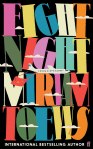 The Russian practice of whipping people with branches at a spa in Tiger by Polly Clark and Fight Night by Miriam Toews.
- A mother continues washing her daughter’s hair until she is a teenager old enough to leave home in Mrs. March by Virginia Feito and I’m Glad My Mom Died by Jennette McCurdy.
- Section 28 (a British law prohibiting the “promotion of homosexuality” in schools) is mentioned in A Bookshop of One’s Own by Jane Cholmeley, Some Kids I Taught and What They Taught Me by Kate Clanchy, and Brother Do You Love Me by Manni Coe.
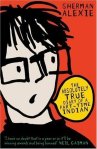
- Characters named Gord (in one story from Various Miracles by Carol Shields, and in Fight Night by Miriam Toews), Gordy (in The Absolutely True Diary of a Part-Time Indian by Sherman Alexie), and Gordo (in Blood Red by Gabriela Ponce).

- Montessori and Waldorf schools are mentioned in Cactus Country by Zoë Bossiere and When Fragments Make a Whole by Lory Widmer Hess.
- A trailer burns down in The Absolutely True Diary of a Part-Time Indian by Sherman Alexie and Cactus Country by Zoë Bossiere.
What’s the weirdest reading coincidence you’ve had lately?
Recent Releases by Nathan Hill, Hisham Matar, Sigrid Nunez and More
One key way in which 2024’s reading has already differed from previous years’ is that I no longer avoid doorstoppers. I now classify any book with over 400 pages as a doorstopper, and by that definition I have already gotten through three this year: The Tidal Year plus two of the below, with Wellness standing out as the true whopper at 597 small-print pages. January offered a set of releases full of variety: gritty yet funny flash fiction; a novel of big ideas and big empathy for its flawed characters; an exile’s elegant love letter to Libya from London; a coy pandemic-era reflection on connection and creation; and a tour of nature close to home.
Universally Adored and Other One Dollar Stories by Elizabeth Bruce
 This was a great collection of 33 stories, all of them beginning with the words “One Dollar” and most of flash fiction length. Bruce has a knack for quickly introducing a setup and protagonist. The voice and setting vary enough that no two stories sound the same. What is the worth of a dollar? In some cases, where there’s a more contemporary frame of reference, a dollar is a sign of desperation (for the man who’s lost house, job and wife in “Little Jimmy,” for the coupon-cutting penny-pincher whose unbroken monologue makes up the whole of “Grocery List”), or maybe just enough for a small treat for a child (as in “Mouse Socks” or “Boogie Board”). In the historical stories, a dollar can buy a lot more. It’s a tank of gas – and a lesson on the evils of segregation – in “Gas Station”; it’s a huckster’s exorbitant charge for a mocked-up relic in “The Grass Jesus Walked On.”
The tone ranges from black comedy (“Festus”) to high tragedy (“Votive Candle”), but the book mostly falls within the realm of dirty realism with the attention to working-class country folk, so I’d recommend the collection to fans of authors who perch on the lighter side of that subgenre, such as Barbara Kingsolver or Denis Johnson. A few of my favorite stories, in addition to the above, were “Ice-Cold Water,” which I appreciated for the Washington D.C. setting and the way that an assumption about who would be racist was overturned by a moment of simple compassion; “Dolores,” in which a slick humanitarian fundraiser meets a waitress who has his number; and “Boiling the Buggers,” a window onto Covid-exacerbated mental illness. (Read via BookSirens)
Wellness by Nathan Hill
Somehow nearly eight years have passed since Hill’s debut novel, The Nix, which I dubbed “a rich, multi-layered story about family curses and failure.” I admired it as much for its prose as for its ideas, and Wellness is just as effervescent and insightful. It’s a state-of-the-nation novel filtered through one Chicago family: experimental photographer and underperforming academic Jack; his wife Elizabeth, a placebo researcher at Wellness; and their YouTube-obsessed son Toby. They’ve recently invested their life savings in a new condo and are considering trendy features like open shelves and separate master bedrooms. It would be oversimplifying, but true, to say that this couple is experiencing midlife and marital crises. Their nineties college romance – and a time of life when everything felt open and possible – is so remote now. When Elizabeth suggests they join a friend at a swingers’ club and a patient of hers who’s also a parent at Toby’s school sees them outside, chaos ensues.
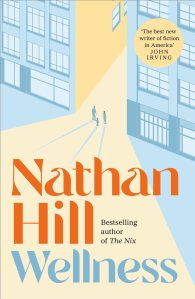
Some elements from The Nix carry over, such as campus politics, the American Midwest, and mother–son relationships, but also broader questions of authenticity, purpose and nurture. Is love itself a placebo? The novel spends time with Jack and Elizabeth at the dawn of their relationship and in the present day, but also looks back to their early careers and first years of parenthood. Hill is clearly fascinated with the sort of psychological experimentation Elizabeth engages in (there’s a whole bibliography of scientific papers consulted) but also turns it to humorous effect, as when Elizabeth subjects Toby to the marshmallow test. A lot of information is conveyed through dialogue, yet it never feels forced. A couple of long asides, on Elizabeth’s family history and the algorithms guiding Jack’s interactions with his conspiracy theorist father, tried my patience, but I loved a four-page chapter on a funeral supper where every sentence starts “There was.” Sooooo many quotable lines throughout.
The only fault in an addictive and spot-on novel (how did he know?! you’ll find yourself thinking about your own attitude to work/marriage/children) is that Hill is so committed to excavating these characters’ backstory of stunted emotion – Jack estranged from his religious Kansas farmer parents after a traumatic incident you feel right in the gut; Elizabeth glad to jettison her father’s wealth with his anger – that he hurries through the denouement. Still, this is sure to be a fiction highlight of my year. It’s one for readers of Jonathan Franzen, sure, but I also thought it reminiscent of Katherine Heiny’s Standard Deviation and Meg Wolitzer’s The Interestings.
With thanks to Picador for the proof copy for review.
My Friends by Hisham Matar
“Benghazi was the one place I longed for the most, it was also the place I most feared to return to.”
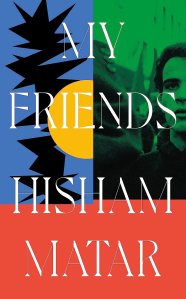 Taking a long walk through London one day, Khaled looks back from midlife on the choices he and his two best friends have made. He first came to the UK as an eighteen-year-old student at Edinburgh University. Everything that came after stemmed from one fateful day. Matar places Khaled and his university friend Mustafa at a real-life demonstration outside the Libyan embassy in London in 1984, which ended in a rain of bullets and the accidental death of a female police officer. Khaled’s physical wound is less crippling than the sense of being cut off from his homeland and his family. As he continues his literary studies and begins teaching, he decides to keep his injury a secret from them, as from nearly everyone else in his life. On a trip to Paris to support a female friend undergoing surgery, he happens to meet Hosam, a writer whose work enraptured him when he heard it on the radio back home long ago. Decades pass and the Arab Spring prompts his friends to take different paths.
I’d previously only read Matar’s short nonfiction work A Month in Siena. The slow, meditative style I enjoyed so much there didn’t translate well into doorstopper length; by the 300-page mark I found myself skimming to see if anything else might happen. Despite the title, we come to know Mustafa and Hosam much less well than we do Khaled. I would happily have had the book’s plot and sentiment concentrated into a taut 200 pages. However, I’m still interested in trying other books by Matar. In the Country of Men is significantly shorter and available from the backroom storage area of my library, and his Folio Prize-winning memoir The Return, too, is on shelf and I reckon will be right up my street.
With thanks to Viking (Penguin) for the proof copy for review.
The Vulnerables by Sigrid Nunez
I’m a huge Nunez fan after reading The Friend, What Are You Going Through, and especially A Feather on the Breath of God. Her last three books have been very much of a piece: autofiction voiced by an unnamed woman who has a duty of care towards a friend or a friend’s pet and ponders, in wry meta fashion, the nature of autobiographical writing and the meaning of life and death at a time of climate breakdown. Alas, The Vulnerables seems like no more than a rehashing of The Friend, with flanking main characters chosen at random from central casting: a parrot named Eureka and a mentally ill college drop-out called Vetch. This quirky trio is thrown together in a lavish New York City apartment during lockdown and nothing much happens but conversation brings them closer.
 A second problem: Covid-19 stories feel dated. For the first two years of the pandemic I read obsessively about it, mostly nonfiction accounts from healthcare workers or ordinary people looking for community or turning to nature in a time of collective crisis. But now when I come across it as a major element in a book, it feels like an out-of-place artefact; I’m almost embarrassed for the author: so sorry, but you missed your moment. My disappointment may primarily be because my expectations were so high. I’ve noted that two blogger friends new to Nunez were enthusiastic about this (but so was Susan, who’d enjoyed her before). That’s not to say this wasn’t a pleasantly fluid and incisive read, even if its message of essential human vulnerability is an obvious one. Anyway, I’ll take Nunez musing on familiar subjects over most other contemporary writers any day:
“Never write ‘I don’t remember,’ Editor says; it undermines your authority. But write as if you remember everything and Reader will smell a rat.”
“You can start with fiction or start with documentary, according to Jean-Luc Goddard. Either way, you will inevitably find the other.”
“I like this clarification by the narrator of a book by Stendhal: ‘It is not out of egotism that I say “I”; it is simply the quickest way to tell the story.’)”
(À propos of the doorstoppers above)
“Does that mean a long novel is easier to write than a short one? / Um, no. But, to borrow from a certain critic, in almost every long book I read I see a short one shirking its job.”
With thanks to Virago for the proof copy for review.
And a bonus work of nonfiction:
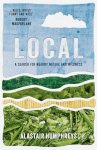
Local: A Search for Nearby Nature and Wildness by Alastair Humphreys
Lev Parikian alerted me to this amiable record of weekly discoveries of the nature on one’s home turf. Humphreys has been an international adventure traveller and written many books about his exploits. Here, by contrast, he zooms the lens in about as far as it will go, ordering a custom-made 20-km-square OS map that has his house at the centre and choosing one surrounding grid square per week (so 52 out of a total of 400) to cycle to and explore. He’s chosen to leave his town unnamed so this can function as an Everyman’s journey through edgelands. And his descriptions and black-and-white photographs really do present an accurate microcosm of modern England: fields, woods, waterways, suburban streets.
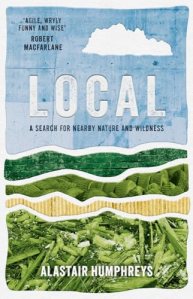 From one November to the next, he watches the seasons advance and finds many magical spaces with everyday wonders to appreciate. “This project was already beginning to challenge my assumptions of what was beautiful or natural in the landscape,” he writes in his second week. True, he also finds distressing amounts of litter, no-access signs and evidence of environmental degradation. But curiosity is his watchword: “The more I pay attention, the more I notice. The more I notice, the more I learn.”
Each week’s observations send him down a research rabbit hole, with topics including caves, land management, mudlarking, plant species, and much more. The nature of the short chapters means that there can only ever be a cursory look at huge issues like rewilding and veganism, but Humphreys is nimble in weaving in the brief, matter-of-fact discussions. His eagerness is irrepressible. “How you look, what you see, and the way all this makes you feel: a single map and the best of all possible worlds.” (See also: Paul’s review.)
With thanks to the author for the free copy for review.
 Bookish Beck = Rebecca Foster. American transplant to England. Freelance proofreader and book reviewer.
 Bookish Beck