Three Novels with (Tenuous) May Connections
Last year I read a May Sarton novel for the anniversary of her death; this year I thought I’d pick one up for her birth month. When I spotted mentions of May in the first line of two more novels from my shelves, I decided to make it a trio, however tenuous.
Hood by Emma Donoghue (1995)
First line: “Mayday in 1980, heat sealing my fingers together.”
Pen opens her story with a flashback of wandering Dublin with her girlfriend, Cara, when they were teenagers. “Why is it the most ordinary images that fall out, when I shuffle the memories? Two girls in a secondhand bookshop, hands sticky with sampled perfumes”. But in the novel’s present day, 13 years later, news has just come that Cara died in a crash on her way home by taxi after a Greek island holiday. They were only out to their lesbian friends; even Cara’s father, whose home they lived in together, was in the dark about their relationship, so Pen is in a curious position as the secret ‘widow’. “I felt such an amateur,” she confides. “About to embark on the biggest loss I could imagine, with no practice at mourning a mother or even a pop star”.
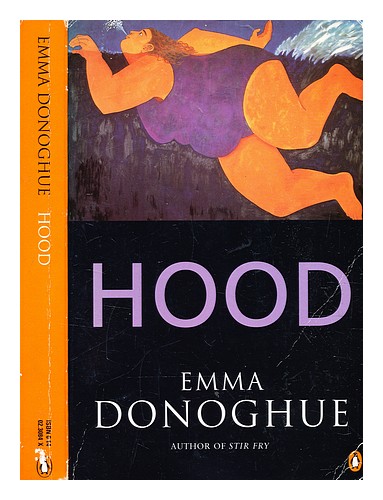 Pen requests compassionate leave for the death of her ‘housemate’ from the Catholic school where she teaches. She and Mr Wall have plenty of sadmin to do while also hosting his other daughter, Kate, who’s come back from America for the funeral. Pen keeps a lid on her emotions, seeing to household routines and attending formal and informal memorial services, but all the while she’s visited by memories from her life with Cara. (Not all happy; she wasn’t thrilled with Cara’s bisexuality and nonmonogamy.) Many are sensual: Pen is a woman with a strong appetite for food and sex, and matter-of-factly calls herself fat. The title is a riff on sisterhood but also connects to a reference to – ahem – the clitoral hood. Pen’s reliving of her lovemaking with Cara is often a little too anatomical in that way to be hot.
Last year I read Donoghue’s debut novel, Stir-fry; this was her second. Cara is more than a little reminiscent of Jael from the earlier book. I worried we would get an excruciating scene in which Pen attempts to act on her childhood crush on Kate, but luckily that’s not the case. The book is structured in seven long chapters, one per day for a week. It seemed far-fetched to me that Pen would already be clearing the house of Cara’s belongings within days of her death. While I appreciated the different angle on grief, Pen’s positive body image, and the way that liturgical and theological language permeates her thinking even though she no longer feels associated with the Catholic Church (“Grant me spiritual enlightenment through pain, sure, Lord, grand, you’re on, but not tonight”), this didn’t charm me like Stir-fry did. It felt a little too niche, like you’d need to be familiar with the 1990s lesbian scene to really feel welcome. (Secondhand – Awesomebooks.com)
Women and Children First by Alina Grabowski (2024)
 First line: “On the last Saturday in May, I drown in my sleep.”
This debut novel about a high school girl’s accidental death at a party is structured in two halves: five chapters headed “Pre” and another five under “Post.” Each one is narrated by a different girl or woman from a Boston-area community. They are dealing with chronic illness, loss, relationship difficulties, or career confusion. The prose is often lyrical, but the portraits don’t seem to add up to much and the character names are confusingly similar (Mona – Marina – Maureen; Layla – Lila – Lucy). I wondered if I would have preferred Grabowski’s writing in a short story collection. (Passed on by Susan, who reviewed it here – thank you!)
The Bridge of Years by May Sarton (1946)
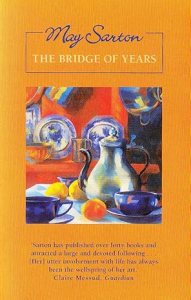 This is miniature saga of a Belgian family in the interwar years. Mélanie Duchesne is a furniture dealer and her husband, Paul, a philosopher who’s trying but failing to write a book. Their country home seems like an idyll, but even in this small community there are those whose lives have been irreparably damaged by wartime trauma. There are passages that feel just like a still life:
The room was full of sunlight warming the orange walls, making pools of ruddy light on the copper pots and the shining blue-and-white plates that stood on a shelf at the back, but not dissipating the melancholy face, in the portrait on the wall, of a thin, thoughtful little boy wrapped up in a blue scarf, who was Paul twenty years ago.
I made it through most of Part I, “Spring,” but put this back on the shelf to try another time when I have the patience for lovely prose and less attention to plot. (Secondhand – Awesomebooks.com)
 Bookish Beck = Rebecca Foster. American transplant to England. Freelance proofreader and book reviewer.
