Book Serendipity, November to December 2024
I call it “Book Serendipity” when two or more books that I read at the same time or in quick succession have something in common – the more bizarre, the better. This is a regular feature of mine every couple of months. Because I usually have 20–30 books on the go at once, I suppose I’m more prone to such incidents. People frequently ask how I remember all of these coincidences. The answer is: I jot them down on scraps of paper or input them immediately into a file on my PC desktop; otherwise, they would flit away! The following are in roughly chronological order.
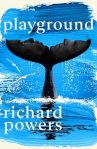
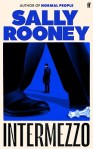
- Characters who were in a chess club and debating society in high school/college in Playground by Richard Powers and Intermezzo by Sally Rooney.
- Pondering the point of a memorial and a mention of hiring mourners in Immemorial by Lauren Markham and Basket of Deplorables by Tom Rachman.
- A mention of Rachel Carson, and her The Sea Around Us in particular, in Playground by Richard Powers, while I was also reading for review Rachel Carson and the Power of Queer Love by Lida Maxwell.
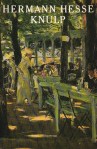
- A character pretends to be asleep when someone comes into the room to check on them in Knulp by Hermann Hesse and Rental House by Weike Wang.
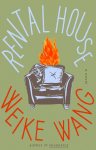
- A mention of where a partner puts his pistachio shells in After the Rites and Sandwiches by Kathy Pimlott and Rental House by Weike Wang.
 A character who startles very easily (in the last two cases because of PTSD) in Life before Man by Margaret Atwood, A History of Sound by Ben Shattuck, and Disconnected by Eleanor Vincent.
- The husband is named Nate in Life before Man by Margaret Atwood and Rental House by Weike Wang.
- In People Collide by Isle McElroy, there’s a mention of Elizabeth reading “a popular feminist book about how men explained things to women.” The day I finished reading the novel, I started reading the book in question: Men Explain Things to Me by Rebecca Solnit.
- I learned about the “he’s-at-home” (19th-century dildo) being used by whalers’ wives on Nantucket while the husbands are away at sea through historical fiction – Daughters of Nantucket by Julie Gerstenblatt, which I read last year – and encountered the practice again through an artefact found in the present day in The History of Sound by Ben Shattuck. Awfully specific!
- A week after I finished reading Station Eleven by Emily St. John Mandel, it turned up in a discussion of Vancouver Island in Island by Julian Hanna.
- A Cape Cod setting in Sandwich by Catherine Newman (earlier in the year) plus The History of Sound by Ben Shattuck and Rental House by Weike Wang.
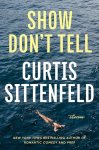
- A gay character references Mulder and Scully (of The X-Files) in the context of determining sexual preference, and there’s a female character named Kit, in The Old Haunts by Allan Radcliffe and one story of Show Don’t Tell by Curtis Sittenfeld.
- A mention of The Truman Show in the context of delusions in The Year of Living Biblically by A.J. Jacobs and You Don’t Have to Be Mad to Work Here by Benji Waterhouse.
- St. Lucia is mentioned in Beasts by Ingvild Bjerkeland, Brightly Shining by Ingvild Rishøi (two Norwegian authors named Ingvild there!), and Mudhouse Sabbath by Lauren Winner.
- A pet named Darwin: in Levels of Life by Julian Barnes it’s Sarah Bernhardt’s monkey; in Cold Kitchen by Caroline Eden it’s her beagle. Within days I met another pet beagle named Darwin in Island by Julian Hanna. (It took me a moment to realize why it’s a clever choice!)
- A character named Henrik in The Place of Tides by James Rebanks and one story of Show Don’t Tell by Curtis Sittenfeld, and a Hendrik in The Safekeep by Yael van der Wouden.
- A hat with a green ribbon in The Safekeep by Yael van der Wouden and one story of Show Don’t Tell by Curtis Sittenfeld (in which it’s an emoji).
- Romanian neighbours who speak very good English in Island by Julian Hanna and Rental House by Weike Wang.
- A scene of returning to a house one used to live in in Hyper by Agri Ismaïl, The Old Haunts by Allan Radcliffe, and one story of Show Don’t Tell by Curtis Sittenfeld.
- A woman has had three abortions in The House of Dolls by Barbara Comyns and Without Exception by Pam Houston.
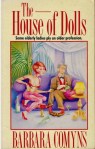
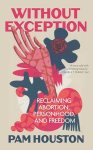
- Household items keep going missing and there’s broken china in The House of Dolls by Barbara Comyns and The Safekeep by Yael van der Wouden.
- Punctuated equilibrium (a term from evolutionary biology) is used as a metaphor in Hyper by Agri Ismaïl and Men Explain Things to Me by Rebecca Solnit.
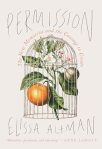 The author’s mother repeatedly asked her daughter a rhetorical question along the lines of “Do you know what I gave up to have you?” in Permission by Elissa Altman and Without Exception by Pam Houston.
- The author/character looks in the mirror at the end of a long day and hardly recognizes him/herself in The Place of Tides by James Rebanks, You Don’t Have to Be Mad to Work Here by Benji Waterhouse, and Amphibian by Tyler Wetherall.
- A man is afraid to hold his boyfriend’s hand in public in another country because he’s unsure about the cultural attitudes towards homosexuality in Clinical Intimacy by Ewan Gass and Small Rain by Garth Greenwell.
- The author’s mother is a therapist/psychologist and the author her/himself is undergoing some kind of mental health treatment in Unattached by Reannon Muth and You Don’t Have to Be Mad to Work Here by Benji Waterhouse.
- A man declares that dying in one’s mid-40s is nothing to complain about in A Beginner’s Guide to Dying by Simon Boas and Small Rain by Garth Greenwell.
- A woman ponders whether her ongoing anxiety is related to the stressful circumstances of her birth in Unattached by Reannon Muth and When the World Explodes by Amy Lee Scott.
What’s the weirdest reading coincidence you’ve had lately?
Autumn Reads: Don Freeman, Seamus Heaney, Jo Lindley, Alice Oseman
I keep a whole box full of future seasonal reads. Winter is the largest contingent because it includes Christmas, cold, snow and ice; followed by summer, which also covers heat, sun and so on. Every once in a while, I’ll come across a spring-related book. Autumn may be great for misty canal walks, vibrant leaves and variegated squashes, but it’s the hardest of the seasons to find books for. I’ve read all the obvious ones by now. Some of the below connections are more abstract but not too much of a stretch, I hope.


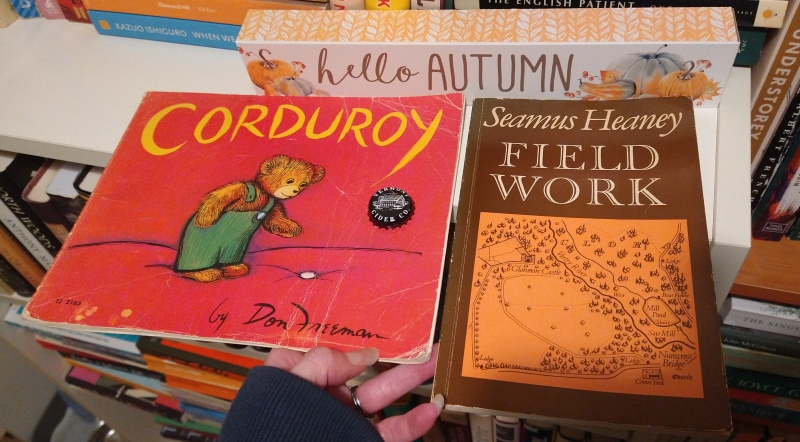
Corduroy by Don Freeman (1968)
Autumn is when I wear the most corduroy, sometimes (accidentally) head to toe.
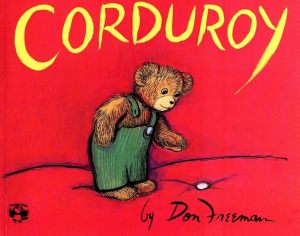
 I knew I’d read this as a child, but didn’t expect individual pages to feel so familiar. It must have been on frequent rotation in my house growing up. Corduroy the bear is among the toys on offer in a large department store. One morning Lisa, a little Black girl, picks him out, but her mother says no, they’ve spent too much already – and besides, the toy is damaged. He didn’t realize until her mother said: his green overall is missing a button. That night he rides the escalator to go look for the button, thinking he’ll never be loved until he’s complete. His adventure doesn’t turn out as planned, but Lisa hasn’t stopped thinking about him. Long before Toy Story, here was a sweet book about what toys get up to when we’re not around. And the repeated expressions of the bear’s meek wonderment – “This must be home,” “You must be a friend” – gave me the warm fuzzies. (Little Free Library)
Field Work by Seamus Heaney (1979)
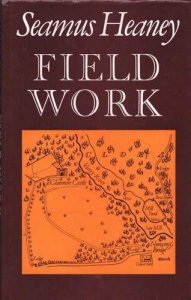 Harvest is a secondary theme in this poetry collection, which also has an overall melancholy tone that seems appropriate to the season of All Souls. Two poems are headed “In Memoriam” and another is titled “Elegy.” Even when they are not the stated topic, the Troubles rear up, as in the first section of “Triptych”: “Two young men with rifles on the hill, / Profane and bracing as their instruments. // Who’s sorry for our trouble?” The countryside can nevermore be an idyll when armoured cars and bombs could be anywhere. “The end of art is peace,” a late line from “The Harvest Bow,” may well be the poet’s motto (so long as “end” is interpreted as “goal”). There is a sequence of 10 sonnets and several poems devoted to animals. I experience Heaney’s poetry as linguistically fertile and formally rigorous; probably best heard out loud. (Secondhand – Oxfam, Marlborough)
Autumnal passages I marked:
“We toe the line / between the tree in leaf and the bare tree.” (from “September Song”)
“the sunflower, dreaming umber” (from “Field Work”)
“A rowan like a lipsticked girl” (from “Song”)
“the sunset blaze / of straw on blackened stubble, a thatch-deep, freshening barbarous crimson burn” (from “Leavings”)
But none of those stood out to me as much as “Oysters,” the opening poem, which I photographed here. I’ve read and savoured every line of it five times now. It’s gold.
Hello Autumn by Jo Lindley (2023)
 Depicted as elfin children, the seasons take turns wearing a single crown. Autumn is a timid soul worried about what might go wrong. But when one of the others is at risk, he rushes to help even if it might take him outside his comfort zone. By doing so, he realizes how much there is to enjoy in every season. This is part of a didactic series (Little Seasons/Best Friends with Big Feelings) about coping with anxiety. I’m surprised it wasn’t classified in the mostly-nonfiction “Family Matters” section of the children’s library, which includes books on feelings, illnesses, death, divorce, siblings, first experiences, etc. It was a little heavy-handed for me and I wasn’t sure why the characters had to be elves. (Public library)
Heartstopper: Volume 1 by Alice Oseman (2019)
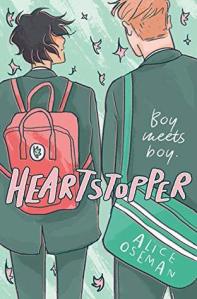 I’ve been rereading the series through the hardback reissue; I’m now on Volume 5 (and WHERE is Volume 6, huh?). I’ve included the first book because of the falling leaves motif on the cover, which fits the back-to-school vibe. (Public library)
What I thought this time: Just as cute the second time around. All the looks, all the blushes, all the angst! I’d forgotten the details of how Nick and Charlie met and got together. Single best page: when Tori appears out of nowhere and says to Charlie of Nick, “I don’t think he’s straight.”
Original review: It’s well known at Truham boys’ school that Charlie is gay. Luckily, the bullying has stopped and the others accept him. Nick, who sits next to Charlie in homeroom, even invites him to join the rugby team. Charlie is smitten right away, but it takes longer for Nick, who’s only ever liked girls before, to sort out his feelings. This black-and-white YA graphic novel is pure sweetness, taking me right back to the days of high school crushes.
Two Memoirs by Freaks and Geeks Alumni
 These days, I watch no television. At all. I haven’t owned a set in over eight years. But as a kid, teen and young adult, I loved TV. I devoured cartoons and reruns every day after school (Pinky and the Brain, I Love Lucy, Gilligan’s Island, The Brady Bunch, etc.); I was a devoted watcher of the TGIF line-up, and petitioned my parents to let me stay up late to watch Murphy Brown. We subscribed to the TV Guide magazine, and each September I would eagerly read through the pilot descriptions with a highlighter, planning which new shows I was going to try. It’s how I found ones like Alias, Felicity, Scrubs and 24 that I followed religiously. Starting in my freshman year of college, I was a mega-fan of American Idol for its first 12 seasons. And so on. Versus now I know nothing about what’s on telly and all the Netflix and box set hits have passed me by.
Ahem. On to the point.
Freaks and Geeks was my favourite show in high school (it aired in 1999–2000, when I was a junior) and the first DVD series I ever owned – a gift from my sister’s boyfriend, who became her first husband. It’s now considered a cult classic, but I can smugly say that I recognized its brilliance from the start. So did critics, but viewers? Not so much, or at least not enough; it was cancelled after just one season. I’ve vaguely followed the main actors’ careers since then, and though I normally don’t read celebrity autobiographies I’ve picked up two by former cast members in the last year. Both: 
Yearbook by Seth Rogen (2021)
 I have seen a few of Rogen’s (generally really dumb) movies. The fun thing about this autobiographical essay collection is that you can hear his deadpan voice in your head on every line. That there are three F-words within the first three paragraphs of the book tells you what to expect; if you have a problem with a potty mouth, you probably won’t get very far.
Rogen grew up Jewish in Vancouver in the 1980s and did his first stand-up performance at a lesbian bar at age 13. During his teens he developed an ardent fondness for drugs (mostly pot, but also mushrooms, pills or whatever was going), and a lot of these stories recreate the ridiculous escapades he and his friends went on in search of drugs or while high. My favourite single essay was about a trip to Amsterdam. He also writes about weird encounters with celebrities like George Lucas and Steve Wozniak. A disproportionately long section is devoted to the making of the North Korea farce The Interview, which I haven’t seen.
.jpg)
Seth Rogen speaking at the 2017 San Diego Comic Con International. Photo by Gage Skidmore, from Wikimedia Commons.
Individually, these are all pretty entertaining pieces. But by the end I felt that Rogen had told some funny stories with great dialogue but not actually given readers any insight into his own character; it’s all so much posturing. (Also, I wanted more of the how he got from A to B; like, how does a kid in Canada get cast in a new U.S. TV series?) True, I knew not to expect a sensitive baring of the soul, but when I read a memoir I like to feel I’ve been let in. Instead, the seasoned comedian through and through, Rogen keeps us laughing but at arm’s length.
This Will Only Hurt a Little by Busy Philipps (2018)
I hadn’t kept up with Philipps’s acting, but knew from her Instagram account that she’d gathered a cult following that she spun into modelling and paid promotions, and then a short-lived talk show hosting gig. Although she keeps up a flippant, sarcastic façade for much of the book, there is welcome introspection as she thinks about how women get treated differently in Hollywood. I also got what I wanted from the Rogen but didn’t get: insight into the how of her career, and behind-the-scenes gossip about F&G.
Philipps grew up first in the Chicago outskirts and then mostly in Arizona. She was a headstrong child and her struggle with anxiety started early. When she lost her virginity at age 14, it was actually rape, though she didn’t realize it at the time. At 15, she got pregnant and had an abortion. She developed a habit of seeking validation from men, even if it meant stringing along and cheating on nice guys.
 I enjoyed reading about her middle and high school years because she’s just a few years older than me, so the cultural references were familiar (each chapter is named after a different pop song) and I could imagine the scenes – like one at a junior high dance where she got trapped in a mosh pit and dislocated her knee, the first of three times that specific injury happens in the book – taking place in my own middle school auditorium and locker hallway.
She never quite made it to the performing arts summer camp she was supposed to attend in upstate New York, but did act in school productions and got an agent and headshots, so that when Mattel came to Scottsdale looking for actresses to play Barbie dolls in her junior year, she was perfectly placed to be cast as a live-action Cher from Clueless. She enrolled in college in Los Angeles (at LMU) but focused more on acting than on classes. After F&G, Dawson’s Creek was her biggest role. It involved moving to Wilmington, North Carolina and introduced her to her best friend, Michelle Williams, but she never felt she fit with the rest of the cast; her impression is that it was very much a star vehicle for Katie Holmes.

Busy Philipps at the Television Critics Association Awards in 2010. Photo by Greg Hernandez, from Wikimedia Commons.
Other projects that get a lot of discussion here are the Will Ferrell ice-skating movie Blades of Glory, which was her joint idea with her high school boyfriend Craig, and had a script written with him and his brother Jeff – there was big drama when they tried to take away her writing credit; and Cougar Town (with Courteney Cox), for which she won the inaugural Television Critics’ Choice Award. She auditioned a lot, including for TV pilots each year, but roles were few and far between, and she got rejected based on her size (when carrying baby weight after her daughters’ births, or once being cast as “the overweight friend”).
Anyway, I was here for the dish on Freaks and Geeks, and it’s juicy, especially about James Franco, who was her character Kim Kelly’s love interest on the show. Kim and Daniel had an on-again, off-again relationship, and the tension between them on camera reflected real life.
“Franco had come back from our few months off and was clearly set on being a VERY SERIOUS ACTOR … [he] had decided that the only way to be taken seriously was to be a fucking prick. Once we started shooting the series, he was not cool to me, at all. Everything was about him, always. His character’s motivation, his choices, his props, his hair, his wardrobe. Basically, he fucking bullied me. Which is what happens a lot on sets. Most of the time, the men who do this get away with it, and most of the time they’re rewarded.”
At one point, he pushed her over on the set; the directors slapped him on the wrist and made him apologize, but she knew nothing was going to come of it. Still, it was her big break:
what we were doing was totally different from the unrealistic teen shows every other network was putting out.
I didn’t know it then, but getting the call about was the first of many you-got-it calls I would get over the course of my career.
when [her daughter] Birdie turns thirteen, I’m going to watch the entire series with her.
And as a P.S., “Seth Rogen was cast as a guest star on [Dawson’s Creek] and he came out and did an episode with me, which was fun. He and Judd had brought me back to L.A. to do two episodes of Undeclared” & she was cast on one season of ER with Linda Cardellini.
The reason I don’t generally read celebrity autobiographies is that the writing simply isn’t strong enough. While Philipps conveys her voice and personality through her style (cursing, capital letters, cynical jokes), some of the storytelling is thin. I mean, there’s not really a chapter’s worth of material in an anecdote about her wandering off when she was two years old. And I think she overeggs it when she insists she’s always gone out and gotten what she wants; the number of rejections she’s racked up says otherwise. I did appreciate the #MeToo feminist perspective, though, looking back to her upbringing and the Harvey Weinsteins of the Hollywood world and forward to how she hopes things will be different for her daughters. I also admired her honesty about her mental health. But I wouldn’t really recommend this unless you are a devoted fan.

I loved these Freaks and Geeks-themed Valentines that a fan posted to Judd Apatow on Twitter this past February.


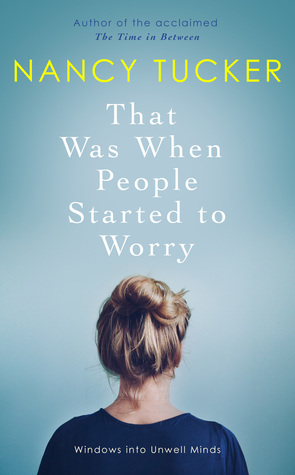
That Was When People Started to Worry by Nancy Tucker
Nancy Tucker’s first book, The Time in Between (2015), was a wrenching and utterly absorbing eating disorder memoir told in an original blend of forms: cinematic scenes of dialogue and stage directions, schedules, tongue-in-cheek dos and don’ts, imagined interrogations, and so on. She’s recreated that experimental/hybrid style here to capture the experiences of young women with mental health challenges.
At a time when she was still struggling with anorexia and suicidal thoughts, bouncing between her uni room and a psychiatric ward, Tucker felt the need to get beyond her own pain by engaging with others’ problems. She interviewed 70 women aged 16 to 25 for a total of more than 100 hours and chose to anonymize their stories by creating seven composite characters who represent various mental illnesses: depression, bipolar disorder, self-harm, anxiety, eating disorders, PTSD and borderline personality disorder.
Each chapter follows a similar format, focusing on a first-person narrative from the invented character but also interspersing other documents like e-mails, instant messages, conversations with a therapist, a video interview transcript or a self-interrogation. A different font then sets out a few-page section that, in a sardonic tone, suggests the problem really isn’t that serious and is easily solved with a handful of simple tips. After this point Tucker steps out of character to give statistics and commentary on the particular mental illness, as she heard it described by her interviewees. She returns to the character’s voice to close with a “What I wish I could tell you about my [depression, etc.]” section, a heartfelt plea for sympathy.
 These stories overlap with each other – anxiety and depression commonly co-occur with other mental illness, for instance. Yasmine’s bipolar means that sometimes she feels like she could run a marathon or write a novel in a few days, while other times she’s plunged into the depths of depression. Neither Abby (depression) nor Freya (anxiety) can face going to work; Maya (BPD, also known as emotionally unstable personality disorder) exhibits many of the symptoms from other chapters, including self-harm and feelings of emptiness.
Tucker is keen to emphasize how complex these disorders are: it’s never just a matter of being sad, having mood swings or seeking attention. She is sensitive to the way that certain ones might be belittled, such as binge eating disorder, which, because it isn’t as clinically recognized as anorexia or bulimia, can be equated with poor self-control. Also, mental health conditions exist on a continuum, so it’s hard to definitively announce a cure. In any case, “A binary perception of mental illness benefits no one,” Tucker explains: “the ‘insane’ may find themselves held at arms’ length, but the ‘sane’ may be denied rapid treatment, or accused of melodrama.”
The details of these narratives can be painful to read, like Georgia and friends browsing Tumblr for ideas of how to cut themselves with razors and take not-quite-overdoses of paracetamol, and Holly’s post-traumatic stress after not-quite-consensual sex with her boyfriend. But the voices are so intimately rendered, and the chapters so perfectly balanced between the general and the fictionalized particulars, that they illuminate mental health crises in a uniquely powerful way.
Reading this has helped me to understand friends’ and acquaintances’ behavior. I’ll keep it on the shelf as an invaluable reference book in the years to come. Based on what I’ve read thus far, this is my frontrunner for next year’s Wellcome Book Prize, which “aims to excite public interest and encourage debate around [medical] topics.” That Was When People Started to Worry seems to me to be just what the prize is looking for, as “Books that find stories in those brushes with medicine are ones that add new meaning to what it means to be human.”
My rating: 
That Was When People Started to Worry: Windows into Unwell Minds was published by Icon Books in May. My thanks to the publisher for a free copy for review.
 Bookish Beck = Rebecca Foster. American transplant to England. Freelance proofreader and book reviewer.
 Bookish Beck