Nonfiction November: Two Memoirs of Biblical Living by Evans and Jacobs
I love a good year-challenge narrative and couldn’t resist considering these together because of the shared theme. Sure, there’s something gimmicky about a rigorously documented attempt to obey the Bible’s literal commandments as closely as possible in the modern day. But these memoirs arise from sincere motives, take cultural and theological matters seriously, and are a lot of fun to read.

The Year of Living Biblically: One Man’s Humble Quest to Follow the Bible as Literally as Possible by A.J. Jacobs (2007)
Jacobs came up with the idea, so I’ll start with him. His first book, The Know-It-All, was about absorbing as much knowledge as possible by reading the encyclopaedia. This starts in similarly intellectual fashion with a giant stack of Bible translations and commentaries. From one September to the next, Jacobs vows, he’ll do his best to understand and implement commandments from both the Old and New Testaments. It’s not a completely random choice of project in that he’s a secular Jew (“I’m Jewish in the same way the Olive Garden is an Italian restaurant. Which is to say: not very.”). Firstly, and most obviously, he stops shaving and getting haircuts. “As I write this, I have a beard that makes me resemble Moses. Or Abe Lincoln. Or [Unabomber] Ted Kaczynski. I’ve been called all three.” When he also takes to wearing all white, he really stands out on the New York subway system. Loving one’s neighbour isn’t easy in such an antisocial city, but he decides to try his best.
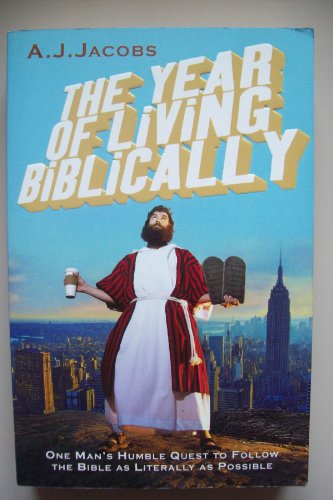 Jacobs is confused by the Bible’s combination of sensible moral guidelines and bizarre, arcane stuff. His conviction is that you can’t pick and choose – even if you don’t know why a law is important, you have to go with it. One of his “Top Five Most Perplexing Rules in the Bible” is a ban on clothing made of mixed fibers (shatnez). So he hires a shatnez tester, Mr. Berkowitz, who comes to investigate his entire wardrobe. To fulfil another obscure commandment, Berkowitz helps him ceremonially take an egg from a pigeon’s nest. Jacobs takes up prayer, hospitality, tithing, dietary restrictions, and avoiding women at the wrong time of the month. He gamely puts up a mezuzah, which displays a Bible passage above his doorframe. He even, I’m sorry to report, has a chicken sacrificed. Despite the proverb about not ‘sparing the rod’, he can’t truly bring himself to punish his son, so taps him gently with a Nerf bat; alas, Jasper thinks it’s a game. Stoning adulterers? Jacobs tosses pebbles at ankles.
The book is a near-daily journal, with a new rule or three grappled with each day. There are hundreds of strange and culturally specific guidelines, but the heart issues – covetousness, lust – pose more of a challenge. Alongside his work as a journalist for Esquire and this project, Jacobs has family stuff going on: IVF results in his wife’s pregnancy with twin boys. Before they become a family of five, he manages to meet some Amish people, visit the Creation Museum, take a trip to the Holy Land to see a long-lost uncle, and engage in conversation with Evangelicals across the political spectrum, from Jerry Falwell’s megachurch to Tony Campolo (who died just last week). Jacobs ends up a “reverent agnostic.” We needn’t go to such extremes to develop the gratitude he feels by the end, but it sure is a hoot to watch him. This has just the sort of amusing, breezy yet substantial writing that should engage readers of Bill Bryson, Dave Gorman and Jon Ronson. (Free mall bookshop) 
A Year of Biblical Womanhood: How a Liberated Woman Found Herself Sitting on Her Roof, Covering Her Head, and Calling Her Husband “Master” by Rachel Held Evans (2012)
 Evans’s book proposal must have referenced Jacobs’s project, but she comes at things from a different perspective as a progressive Christian, and likely had a separate audience in mind. Namely, the sort of people who worry about the concept of biblical womanhood and wrestle with Bible verses about women remaining silent in church and not holding positions of religious leadership over men. There are indeed factions of Christianity that take these passages literally. Given that she was a public speaker and popular theologian, Evans obviously didn’t. But in her native Alabama and her new home of Tennessee, many would. She decides to look more closely at some of the prescriptions for women in the scriptures, focusing on Proverbs 31, which describes the “woman of valor.” She looks at this idealized woman’s characteristics in turn and tries to adhere to them by dressing modestly, taking etiquette lessons, learning to cook and hosting dinners, and practicing for parenthood with a “Baby-Think-It-Over” doll. Like Jacobs, she stops cutting her hair and meets some Amish people. But she also sleeps outside in a tent while menstruating and undertakes silent meditation at an abbey and a mission trip to Bolivia. Each monthly chapter ends with a profile of a female character from the Bible and what might be learned from her story.
It’s a sweet, self-deprecating book. You can definitely tell that she was only 29 at the time she started her project. It’s okay with me that Evans turned all her literal intentions into more metaphorical applications by the end of the year. She concludes that the Church has misused Proverbs 31: “We abandoned the meaning of the poem by focusing on the specifics, and it became just another impossible standard by which to measure our failures. We turned an anthem into an assignment, a poem into a job description.” Her determination is not to obsess over rules but to continue with the habits that benefited her spiritual life, and to champion women whenever she can. I suspect this is a lesser entry from Evans’s oeuvre. She died too soon – suddenly in 2019, of brain swelling after a severe allergic reaction to an antibiotic – but remains a valued voice, and I’ll catch up on the rest of her books. Searching for Sunday, for instance, was great, and I’m keen to read Evolving in Monkey Town (about living in Dayton, Tennessee, where the famous Scopes Monkey Trial took place). (Birthday gift from my wish list, 2023) 
20 Books of Summer, #16–17, GREEN: Jon Dunn and W.H. Hudson
Today’s entries in my colour-themed summer reading are a travelogue tracking the world’s endangered hummingbirds and a bizarre classic novel that blends nature writing and fantasy. Though very different books, they have in common lush South American forest settings.
The Glitter in the Green: In Search of Hummingbirds by Jon Dunn (2021)
As a wildlife writer and photographer, Jon Dunn has come to focus on small and secretive but indelible wonders. His previous book, which I still need to catch up on, was all about orchids, and in this new one he travels the length of the Americas, from Alaska to Tierra del Fuego, to see as many hummingbirds as he can. He provides a thorough survey of the history, science and cultural relevance (from a mini handgun to an indie pop band) of this most jewel-like of bird families. The ruby-throated hummingbirds I grew up seeing in suburban Maryland are gorgeous enough, but from there the names and corresponding colourful markings just get more magnificent: Glittering-throated Emeralds, Tourmaline Sunangels, Violet-capped woodnymphs, and so on. I’ll have to get a look at the photos in a finished copy of the book!
 Dunn is equally good at describing birds and their habitats and at constructing a charming travelogue out of his sometimes fraught journeys. He has only a narrow weather of fog-free weather to get from Chile to Isla Robinson Crusoe and the plane has to turn back once before it successfully lands; a planned excursion in Bolivia is a non-starter after political protestors block some main routes. There are moments when the thrill of the chase is rewarded – as when he sees 24 hummingbird species in a day in Costa Rica – and many instances of lavish hospitality from locals who serve as guides or open their gardens to birdwatchers.
Like so many creatures, hummingbirds are in dire straits due to human activity: deforestation, invasive species, pesticide use and climate change are reducing the areas where they can live to pockets here and there; some species number in the hundreds and are considered critically endangered. Dunn juxtaposes the exploitative practices of (white, male) 19th- and 20th-century bird artists, collectors and hunters with indigenous birdwatching and environmental initiatives that are rising up to combat ecological damage in Latin America. Although society has moved past the use of hummingbird feathers in crafts and fashion, he learns that the troubling practice of dead hummingbirds being sold as love charms (chuparosas) persists in Mexico.
Whether you’re familiar with hummingbirds or not, if you have even a passing interest in nature and travel writing, I recommend The Glitter in the Green for how it invites readers into a personal passion, recreates an adventurous odyssey, and reinforces our collective responsibility for threatened wildlife. (Proof copy passed on by Paul of Halfman, Halfbook) 
A lovely folk tale I’ll quote in full:
A hummingbird as a symbol of hope, strength and endurance is a recurrent one in South American folklore. An Ecuadorian folk tale tells of a forest on fire – a hummingbird picks up single droplets of water in its beak and lets them fall on the fire. The other animals in the forest laugh, and ask the hummingbird what difference this can possibly make. They say, ‘Don’t bother, it is too much, you are too little, your wings will burn, your beak is too tiny, it’s only a drop, you can’t put out this fire. What do you think you are doing?’ To which the hummingbird is said to reply, ‘I’m just doing what I can.’
Links between the books: Hudson is quoted in Dunn’s introduction. In Chapter 7 of the below, Hudson describes a hummingbird as “a living prismatic gem that changes its colour with every change of position … it catches the sunshine on its burnished neck and gorget plumes—green and gold and flame-coloured, the beams changing to visible flakes as they fall”
Green Mansions: A Romance of the Tropical Forest by W.H. Hudson (1904)
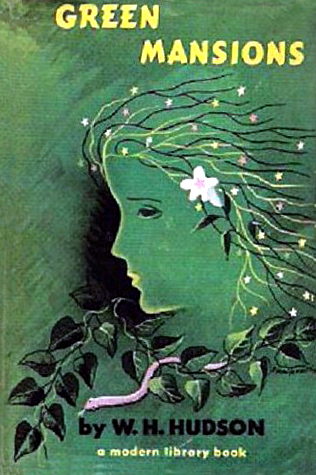 Like Heart of Darkness, this is a long recounted tale about a journey among ‘savages’. After a prologue, the narrator soon cedes storytelling duties to Mr. Abel, whom he met in Georgetown, Guyana in 1887. Searching for gold and fighting off illness, the 23-year-old Abel took up the habit of wandering the Venezuelan forest. The indigenous people were superstitious and refused to hunt in that forest. Abel began to hear strange noises – magical bird calls or laughter – that, siren-like, drew him deeper in. His native friend warned him it was the daughter of an evil spirit.
One day, after being bitten by a snake, Abel woke up in the dwelling of an old man and his 17-year-old granddaughter, Rima – the very wood sprite he’d sensed all these times in the forest; she saved his life. Recovering in their home and helping Rima investigate her origins, he romanticizes this tree spirit in a way that struck me as smarmy. It’s possible this could be appreciated as a fable of connection with nature, but I found it vague and old-fashioned. (Not to mention Abel’s condescending attitude to the indigenous people and to women.) I ended up skimming the last three-quarters.
My husband has read nonfiction by Hudson; I think I was under the impression that this was a memoir, in fact. Perhaps I’d enjoy Hudson’s writing in another genre. But I was surprised to read high praise from John Galsworthy in the foreword (“For of all living authors—now that Tolstoi has gone—I could least dispense with W. H. Hudson”) and to note how many of my Goodreads friends have read this; I don’t see it as a classic that stands the test of time.
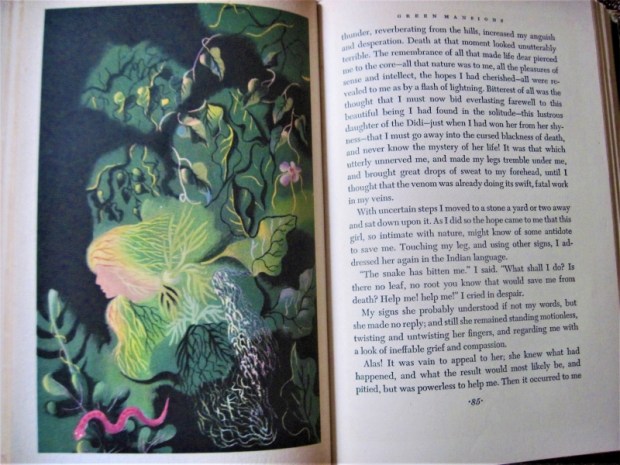
My 1944 hardback once belonged to one Mary Marcilliat of Louisville, Kentucky, and has strange abstract illustrations by E. McKnight Kauffer. (Free from the Book Thing of Baltimore) 
Coming up next: One black and one gold on Wednesday; a Green author and a rainbow bonus (probably on the very last day).
 Bookish Beck = Rebecca Foster. American transplant to England. Freelance proofreader and book reviewer.
 Bookish Beck